



-
Open Access
- View Open Access Papers
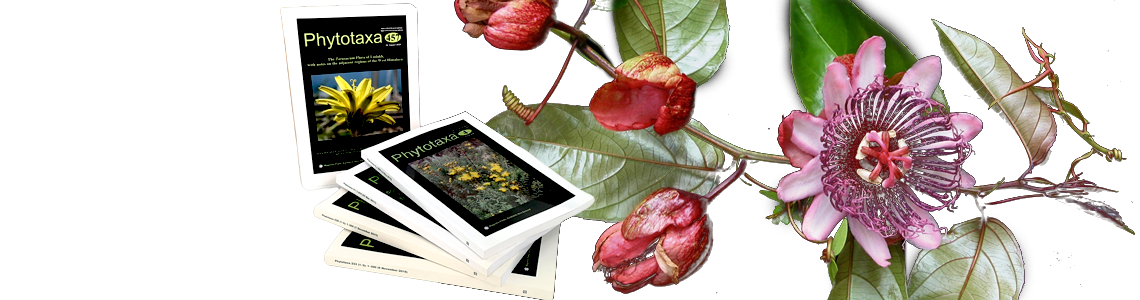
Phytotaxa is a hybrid journal and has published many open access papers:
We encourage the open access of papers as they are more widely read and cited. Our open access option has one of the lowest article processing fees.
Announcements
The 2025 journal impact factor for Phytotaxa is 1.2 (JCR 2026 June edition) 2026-06-18
The 2025 journal impact factor for Phytotaxa is 1.2 according to Clarivate's Journal Citation Reports—2026 June edition). This represents a significant increase (20%) over that of the previous year.
-
Resolving nomenclature of Abelmoschus rhodopetalus (Malvaceae) and its synonyms
Published : 2026-10-22 -
Resolving Herbarium Misidentifications and Confirming the Occurrence of Blyxa echinosperma (Hydrocharitaceae) in Sri Lanka: With Implications for Global Distribution Records
Published : 2026-10-22 -
A new holomycoheterotrophic orchid species of Silvorchis (Orchidinae, Orchideae, Orchidaceae) from the Xizang Autonomous Region
Published : 2026-10-22 -
A new taxonomic status for, and expansion of, Kalanchoe sect. Rhombopilosae, as K. ser. Rhombopilosae, in K. sect. Stellatopilosae, included in K. subg. Calophygia (Crassulaceae [subfam. Cotyledonoideae] tr. Kalanchoeae)
Published : 2026-10-22 -
Cymbella nanhuaensis sp. nov. (Bacillariophyceae, Cymbellales), a new, enigmatic cymbelloid diatom species from Hunan Province, China
Published : 2026-10-22 -
Kalanchoe ×annae-monroae (Crassulaceae [subfam. Cotyledonoideae] tr. Kalanchoeae), a new nothospecies derived from Malagasy parents [K. fedtschenkoi × K. scandens], with notes on the inheritance of characters that facilitate fitness for survival and invasiveness
Published : 2026-10-22
latest
-
Published : 2016-05-20The number of known plants species in the world and its annual increase
-
Polygala bamaensis (Polygalaceae), a replacement name for the later homonym Polygala spatulata
Published : 2025-09-09 -
An update of the taxonomic system of Dactylorhiza (Orchidaceae, Orchideae)
Published : 2025-03-07 -
Published : 2023-07-18A new and possibly carnivorous species of Crepidorhopalon (Linderniaceae) from Mozambique
-
Revision of the Mallomonas splendens species clade (Chrysophyceae, Synurales) based on morphological and molecular data
Published : 2025-07-08 -
A taxonomic revision of the lichen genus Lecanoropsis (Lecanoraceae)
Published : 2025-03-25