
Abstract
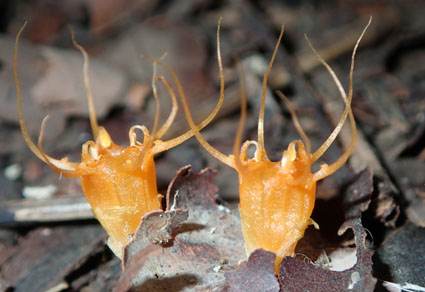
A new species of Oxygyne (Thismiaceae), O. myanmarensis Nob.Tanaka & Paing, is described from Myanmar. The genus Oxygyne was previously known only from southern Japan and central Africa, exhibiting a striking disjunct distribution. This discovery is also the first to demonstrate that the genus also occurs in Southeast Asia, bridging the gap between these two regions.References
- Abe, C. & Akasawa, Y. (1989) A new species of Oxygyne (Burmanniaceae) found in Shikoku, Japan. Journal of Japanese Botany 64: 161–164.
- Airy Shaw, H.K. (1952) A new genus and species of Burmanniaceae from south India. Kew Bulletin 2: 277–279. https://doi.org/10.2307/4109280
- Christenhusz, M.J.M., Fay, M.F. & Byng, J.W. (2018) GLOVAP nomenclature part 1. The Global Flora 4: 1–155. [Plant Gateway Ltd]
- Cheek, M., Tsukaya, H., Rudall, P.J. & Suetsugu, K. (2018) Taxonomic monograph of Oxygyne (Thismiaceae), rare achlorophyllous mycoheterotrophs with strongly disjunct distribution. PeerJ 6: e4828. https://doi.org/10.7717/peerj.4828
- Forster, J.R. & Forster, G. (1776) Characters generum plantarum. White, Cadell & Elmsly, London, 155 pp. https://doi.org/10.5962/bhl.title.4448
- Griffith, W. (1845) On the root parasites referred by authors to Rhizantheae and their allies. Proceedings of the Linnean Society of London 1: 216–221.
- Ohashi, H. (2015) Resurrection of Saionia (Thismiaceae). Journal of Japanese Botany 90: 115–118.
- POWO (2026) Plants of the World Online. Royal Botanic Gardens, Kew. Available from: http://www.plantsoftheworldonline.org/ (accessed 13 July 2026)
- Schlechter, F.R.R. (1906) Burmanniaceae africanae. Botanische Jahrbücher fur Systematik, Pflanzengeschichte und Pflanzengeographie 38: 137–143.
- Suetsugu, K., Nakamura, Y., Nakano, T. & Tagane, S. (2024) Relictithismia kimotsukiensis, a new genus and species of Thismiaceae from southern Japan with discussions on its phylogenetic relationship. Journal of Plant Research 137: 411–422. https://doi.org/10.1007/s10265-024-01532-5
- Thorogood, C.J. (2019) Oxygyne: an extraordinarily elusive flower. Plants, People, Planet 1: 67–70. https://doi.org/10.1002/ppp3.26
- Tsukaya, H. (2016) Burmanniaceae. In: Iwatsuki, K., Boufford, D.E. & Ohba, H. (Eds.) Flora of Japan, vol. IVb. Kodansha, Tokyo, pp. 194–197.
- Yahara, T. & Tsukaya, H. (2008) Oxygyne yamashitae, a new species of Thismiaceae from Yaku island, Japan. Acta Phytotaxonomica et Geobotanica 59: 97–104.