
Abstract
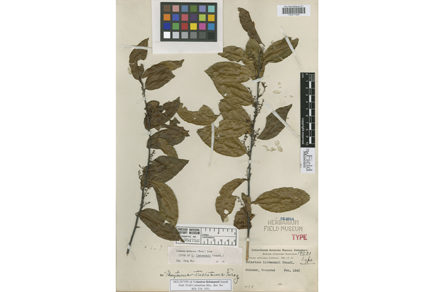
During a taxonomic investigation of species of Celastraceae from the Neotropics, it was revealed that Maytenus repanda Turczaninow (1858, published as ‘repandus’; non M. repanda Reissek, 1861, nom. illeg.), a long-overlooked name, does not belong to the genus Maytenus. Our examination of the protologue, the type specimens at KW (two syntypes, including the standing lectotype), and specimens / images from some other herbaria available online demonstrated that M. repanda is conspecific with the species currently known as Celastrus liebmannii Standley. Despite being the oldest available species-rank epithet for this taxon, the epithet of M. repanda cannot be transferred to the genus Celastrus because the name C. repandus Blume (1826) already exists. We provide a clarification of the name Maytenus repanda and formally propose it as a heterotypic synonym of C. liebmannii. The application of the name C. grenadensis Urban to that species is also discussed, and it is recommended to treat it as nomen dubium, a name of uncertain taxonomic application, because its original material has been lost or destroyed in the B herbarium during World War II. A proposal to reject the name C. grenadensis should be considered, similar to the case of the already rejected name Maytenus tovarensis Radlkofer.
References
- Acevedo-Rodríguez, P. & Strong, M.T. (2012) Catalogue of seed plants of West Indies. Smithsonian Contributions to Botany 98: 1–1192. https://doi.org/10.5479/si.0081024X.98.1
- Applequist, W.L. (2023) Report of the Nomenclature Committee for Vascular Plants: 73. Taxon 72 (1): 179–204. https://doi.org/10.1002/tax.12871
- BFG—The Brazil Flora Group (2015) Growing knowledge: an overview of seed plant diversity in Brazil. Rodriguesia 66: 1085–1113. [additional dataset: http://dx.doi.org/10.6084/m9.figshare.1538647] https://doi.org/10.1590/2175-7860201566411
- Biral, L. (2016) Sistemática e filogenia de Maytenus Molina para o Neotrópico. PhD Thesis. Universidade Estadual Paulista “Júlio de Mesquita Filho”, Rio Claro, 350 pp.
- Biral, L. (2020) Proposal to reject the name Maytenus tovarensis (Celastraceae). Taxon 69 (6): 1366–1367. https://doi.org/10.1002/tax.12398
- Biral, L., Simmons, M.P., Smidt, E., Tembrock, L.R., Bolson, M., Archer, R.H. & Lombardi, J.A. (2017) Systematics of the New World Maytenus (Celastraceae) and a new delimitation of the genus. Systematic Botany 42 (4): 680–693. https://doi.org/10.1600/036364417X696456
- Biral, L., Mosyakin, S.L. & Lombardi, J.A. (2019) Proposal to conserve the name Tontelea attenuata (Celastraceae) against Maytenus amygdalina. Taxon 68 (4): 863–864. https://doi.org/10.1002/tax.12105
- Biral, L. & Lombardi, J.A. (2025) Celastraceae. In: Acevedo-Rodríguez, P., Strong, M.T. & Pace, M.R. (Eds.) Families and genera of climbing plants of the Neotropics. Smithsonian Institution Scholarly Press, Washington DC., pp. 474–494.
- Biral, L. (2026) Celastraceae genera in São Paulo (Brazil): an update 20 years after the “Phanerogamic Flora”. Heringeriana 20: e918084. https://doi.org/10.70782/heringeriana.v20i1.918084
- Biral, L. & Lombardi, J.A. (2026) Celastraceae. Available from: https://floradobrasil.jbrj.gov.br/FB82 (accessed 29 March 2026)
- Bornstein, A.J. (1989) Celastraceae. In: Howard, R.A. (Ed.) Flora of the Lesser Antilles: Leeward and Windward Islands – Dicotyledoneae. Vol. 5, pt. 2. Harvard University, Jamaica Plain, Massachusetts, pp. 113–125. https://doi.org/10.5962/t.187734
- Breedlove, D.E. (1986) Flora de Chiapas. Instituto de Biologia, UNAM, México D.F., 246 pp.
- Blume, C.L. (1826–1827) Bijdragen tot de flora van Nederlandsch Indië, part 17. Ter Lands Drukkerij, Batavia, pp. 1067–1169. https://doi.org/10.5962/bhl.title.395
- Ding Hou (1955) A revision of the genus Celastrus. Annals of the Missouri Botanical Garden 42 (3): 215–302. [https://www.jstor.org/stable/2394657] https://doi.org/10.2307/2394657
- Dorr, L.J., Stergios, B., Smith, A.R. & Cuello A., N.L. (2000) Catalogue of the vascular plants of Guaramacal National Park, Portuguesa and Trujillo states. Contributions from the United States National Herbarium 40: 1–155. [https://www.jstor.org/stable/23493174]
- Groppo, M. (2008) Flora fanerogâmica do Parque Estadual do Brigadeiro: Celastraceae. Pabstia (Boletim do herbário Guido Pabst – GFJP) 19 (8): 1–8.
- Hiepko, P. (1987) The collections of the Botanical Museum Berlin-Dahlem (B) and their history. Englera 7: 219–252.
- Hokche, O., Berry, P.E. & Huber, O. (2008) Nuevo catálogo de la flora vascular de Venezuela. Fundación Instituto Botánico de Venezuela, Caracas, 859 pp.
- Liesner, R. (1999) Celastraceae. In: Jørgensen, P.M. & Leon-Yánez, S. (Eds.) Catalogue of the vascular plants of Ecuador / Catálogo de las plantas vasculares del Ecuador. Monographs in Systematic Botany from the Missouri Botanical Garden, 75: 392–393. [https://www.biodiversitylibrary.org/bibliography/202403]
- Liesner, R. (2014) Celastraceae. In: Jørgensen, P.M., Nee, M.H. & Beck, S.G. (Eds.) Catálogo de las plantas vasculares de Bolivia. Monographs in Systematic Botany from the Missouri Botanical Garden, 127: 497–502.
- Linnaeus, C. (1753) Species Plantarum, vols. 1–2. Laurentius Salvius, Holmiae [Stockholm], 1200 pp. https://doi.org/10.5962/bhl.title.669
- Loesener, T. (1897) Celastraceae. In: Engler, A. & Prantl, K. (eds.) Die naturlichen Pflanzenfamilien. Nachträge zum II.—IV. Teil. Wilhelm Engelmann, Leipzig, pp. 221–225.
- Lombardi, J.A. & Barrie, F.R. (2015) Celastraceae. In: Davidse, G.M., Sousa, M.S., Knapp, S., Chiang, F. & Ulloa Ulloa, C. (Eds.) Flora Mesoamericana, vol. 2, Part 3: Saururaceae a Zygophyllaceae. Universidad Autónoma de México, México D.F., Missouri Botanical Garden Press, St. Louis, and Natural History Museum, London, pp. 211–233.
- Lundell, C.L. (1939a) Studies of Mexican and Central American plants VII. Lloydia 2 (2): 73–108.
- Lundell, C.L. (1939b) Studies in American Celastraceae. II. Notes on genera and species from Mexico and South America. Lilloa 4: 377–387.
- Lundell, C.L. (1946) Plants of Mexico and Central America — I. Wrightia 1: 145–160.
- Molina, G.I. (1782) Saggio sulla Storia Naturale del Chili. Nella Stamperia di S. Tommaso d'Aquino, Bologna, 368 pp. https://doi.org/10.5962/bhl.title.62689
- Mosyakin, S.L. & McNeill, J. (2023) (315–316) Proposals to clarify the role of epitypes and to further nomenclatural stability with regard to epitypes and neotypes. Taxon 72 (4): 951–952. https://doi.org/10.1002/tax.13017
- Mosyakin, S.L., McNeill, J. & Boiko, G.V. (2019) Comments on proper type designation for names of taxa validated by Turczaninow in his Animadversiones, with case studies. Ukrainian Botanical Journal 76 (5): 379–389. https://doi.org/10.15407/ukrbotj76.05.379
- Nicolson, D.H., and others. (1991) Flora of Dominica, Part 2: Dicotyledoneae. Smithsonian Contributions to Botany 77: 274 pp. [https://www.biodiversitylibrary.org/item/215160] https://doi.org/10.5479/si.0081024x.77
- POWO (2026) Plants of the World Online. Kew Royal Botanical Gardens. Available from: https://powo.science.kew.org/about (accessed 29 March 2026)
- Radlkofer, L. (1878) Ueber Sapindus und damit in Zusammenhang stehende Pflanzen. Sitzungsberichte der mathematisch-physikalischen Classe der Königlichen Bayerischen Akademie der Wissenschaften zu München 8: 221–408.
- Reissek, S. (1861) Celastrineae, Ilicineae et Rhamneae. In: Martius, C.F.P. & Eichler, A.G. Flora Brasiliensis, enumeratio plantarum in Brasilia hactenus detectarum: quas suis aliorumque botanicorum studiis descriptas et methodo naturali digestas partim icone illustratas, Vol. 11 (1). Frid. Fleischer, Monachii et Lipsiae [Munich & Leipzig], pp. 1–124 + Tab. 1–41. https://doi.org/10.5962/bhl.title.454
- Richard, A. (1845) Celastrineae. In: Histoire physique, politique et naturelle de l'ile de Cuba. Botanique [pars 2] – plantes vasculaires. Arthus Bertrand, Paris, pp. 342–353.
- Savinov, I. (2005) Specimina typica taxorum e familia Celastraceae descriptorum N.S. Turczaninowio in Herbario Instituti Botanici nomine N.G. Kholodnii (KW) conservata. Novitates Systematicae Plantarum Vascularium [Novosti Sistematiki Vysshikh Rastenii] 37: 290–296. [In Russian: Савинов, И.А. (2005) Типовые образцы таксонов семейства Celastraceae, описанных Н.С. Турчаниновым, хранящиеся в Гербарии Института Ботаники им. Н.Г. Холодного (KW). Новости систематики высших растений 37: 290–296]
- Smith, G.F., Figueiredo, E. & Moore, G. (2016) Increasing nomenclatural stability by preventing the introduction of long-forgotten names that will compete with ones in use: A solution must be found, and soon. Taxon 65 (6): 1385–1390. https://doi.org/10.12705/656.11
- Stafleu, F.A. & Cowan, R.S. (1986) Taxonomic literature: A selective guide to botanical publications and collections with dates, commentaries and types, vol. 6: Sti–Vuy. Ed. 2. Bohn, Scheltema & Holkema, Utrecht & Antwerpen / dr. W. Junk b.v., Publishers, The Hague & Boston, 926 pp. https://doi.org/10.5962/t.206495
- Thiers, B.M. (2026–update continuously) Index Herbariorum. New York Botanical Garden. [https://sweetgum.nybg.org/science/ih/]
- Turczaninow, N.S. (1858) Animadversiones in secundam partem herbarii Turczaninowiani, nunc Universitatis Caesareae Charkowiensis [Animadversiones Part 2/2]. Bulletin de la Société Impériale des Naturalistes de Moscou 31 (Part 1, No. 2): 379–476.
- Turczaninow [as "Turczaninoff"], N.S. (1863) Animadversiones ad catalogum primum et secundum herbarii Universitatis Charkowiensis [Addenda to Animadversiones Parts 1 and 2]. Bulletin de la Société Impériale des Naturalistes de Moscou 36 (Part 1, No. 2): 545–615.
- Turland, N.J. & Wiersema, J.H. (2024) Synopsis of Proposals on Nomenclature — Madrid 2024: A review of the proposals to amend the International Code of Nomenclature for algae, fungi, and plants submitted to the XX International Botanical Congress. Taxon 73 (1): 325–404. https://doi.org/10.1002/tax.13114
- Turland, N.J., Wiersema, J.H., Barrie, F.R., Greuter, W., Hawksworth, D.L., Herendeen, P.S., Knapp, S., Kusber, W.-H., Li, D.-Z., Marhold, K., May, T.W., McNeill, J., Monro, A.M., Prado, J., Price, M.J. & Smith, G.F. (2018) International Code of Nomenclature for algae, fungi, and plants (Shenzhen Code), adopted by the Nineteenth International Botanical Congress Shenzhen, China, July 2017. Regnum Vegetabile 159. Koeltz Botanical Books, Glashütten, xxxviii + 254 pp. https://doi.org/10.12705/Code.2018
- Turland, N.J., Wiersema, J.H., Barrie, F.R., Ghandi, K., Gravendyck, J., Greuter, W., Hawksworth, D.L., Herendeen, P.S., Klopper, R.R., Knapp, S., Kusber, W.-H., Li, D.-Z., Marhold, K., May, T.W., Monro, A.M., Prado, J., Price, M.J., Smith, G.F. & Zamora Señoret, J.C. (2025) International Code of Nomenclature for algae, fungi, and plants (Madrid Code), accepted by the Twentieth International Botanical Congress, Madrid, Spain, July 2024. Regnum Vegetabile 162. University of Chicago Press, Chicago. [https://www.iaptglobal.org/_functions/code/madrid] https://doi.org/10.7208/chicago/9780226839479.001.0001
- Turland, N.J., Álvarez, I., Knapp, S., Monro, A.M. & Wiersema, J.H. (2024) XX International Botanical Congress, Madrid 2024: Report of Congress action on nomenclature proposals. Taxon 73 (5): 1308–1323. https://doi.org/10.1002/tax.13258
- Urban, I. (1904) Celastraceae. In: Urban, I. (Ed.) Symbolae Antillanae seu Fundamenta Florae Indiae Occidentalis, vol. 5. pp. 48–94. [https://www.biodiversitylibrary.org/page/688076#page/54/mode/1up]
- Villaseñor, J.L. (2016) Checklist of the native vascular plants of Mexico. Revista Mexicana de Biodiversidad 87: 559–902. https://doi.org/10.1016/j.rmb.2016.06.017
- Whitefoord, C. (1989) Recent plant collections from Dominica. Journal of the Arnold Arboretum 70 (1): 143–152. https://doi.org/10.5962/p.185949
- Wilson, K.L. (2023) Report of the General Committee: 26. Taxon 72 (4): 905–907. https://doi.org/10.1002/tax.12994