
Abstract
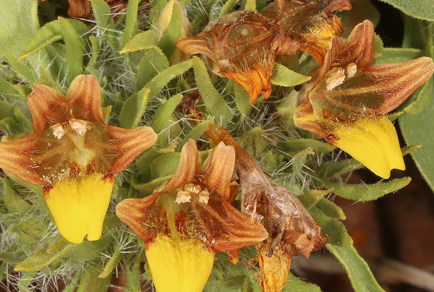
Petalidium saxatile, hitherto confused with P. canescens, and the widespread P. setosum, is here described as a new species. It is a range-restricted species, only known from the vicinity of Palmwag and southwards to the Bergsig area with an outlier population to the south of Khorixas in the Kaokoveld Centre of Endemism, northwestern Namibia. It grows mainly among basaltic rocks of the Etendeka Group on arid hillsides and along ephemeral riverbeds and drainage lines. Diagnostic characters for P. saxatile include the pale green appearance of the plants, vegetative parts with a dense white indumentum of relatively short dendritic trichomes appearing matted on young leaves, flowers borne in compact dichasia, and long simple eglandular trichomes on the bracts visible to the naked eye. The flowers of P. saxatile are distinctive in having the corolla lobes inside (adaxially) distinctly bicolorous: the upper and lateral lobes are pink or brown-pink, while the anterior lobe is yellow. Additionally, all lobes are discolorous in being much paler outside (abaxially). Furthermore, analyses of genetic data across many nuclear loci, generated using a ddRADseq approach, show the species to be genetically distinct from P. canescens. A comparison of key morphological features distinguishing P. saxatile from P. canescens and P. setosum, is provided. Based on IUCN Red List criteria, a provisional conservation assessment of Endangered (EN) is recommended for the new species. It is suggested that the Etendeka Tableland, to which P. saxatile is largely confined, may serve as a local subcentre of plant endemism within the larger Kaokoveld Centre of Endemism, at least for species in the genus Petalidium.
References
- Atlas of Namibia Team. (2022) Atlas of Namibia: its land, water and life. Namibia Nature Foundation, Windhoek, 390 pp.
- Bachman, S., Moat, J., Hill, A.W., De la Torre, J. & Scott, B. (2011) Supporting Red List threat assessments with GeoCAT: geospatial conservation assessment tool. ZooKeys 150: 117–126. https://doi.org/10.3897/zookeys.150.2109
- Beentje, H. (2016) The Kew plant glossary: an illustrated dictionary of plant terms, 2nd ed. Kew Publishing, Kew, 184 pp.
- Burke, A. (2003) How special are Etendeka mesas? Flora and elevation gradients in an arid landscape in north-west Namibia. Journal of Arid Environments 55 (4): 747–764. https://doi.org/10.1016/S0140-1963(02)00293-8
- Clarke, C.B. (1899) 24. Petalidium. In: Thiselton-Dyer, W.T. (ed.) Flora of Tropical Africa, 5 (1). L. Reeve & Co., London, pp. 87–93. [https://www.biodiversitylibrary.org/item/128#page/98/mode/1up]
- Craven, P. (2009) Phytogeographic study of the Kaokoveld Centre of Endemism. Ph.D. Thesis. University of Stellenbosch, Stellenbosch, 234 pp. [https://hdl.handle.net/10019.1/1325]
- Darbyshire, I., Kiel, C.A., Astroth, C.M., Dexter, K.G., Chase, F.M. & Tripp, E.A. (2020) Phylogenomic study of Monechma reveals two divergent plant lineages of ecological importance in the African savanna and succulent biomes. Diversity 12 (6): a237 [25 pp.]. https://doi.org/10.3390/d12060237
- Darriba, D., Taboada, G., Doallo, R. & Posada, D. (2012) jModelTest 2: more models, new heuristics and parallel computing. Nature Methods 9: a772. https://doi.org/10.1038/nmeth.2109
- De Queiroz, K. (1998) The general lineage concept of species, species criteria, and the process of speciation. In: Howard, D.J. & Berlocher, S.H. (Eds.) Endless forms: species and speciation. Oxford University Press, New York, pp. 57–75.
- Detay, A. & Detay, M. (2017) Geological wonders of Namibia. Struik Nature, Cape Town, 168 pp.
- Dexter, K.G., Swanepoel, W., Loiseau, O., Darbyshire, I., Nanyeni, L., Gonçalves, F.M., Chase, F. & Manzitto-Tripp, E.A. (2023) High endemism of the genus Petalidium (Acanthaceae) in the highlands and escarpments of Angola and Namibia. Namibian Journal of Environment 8: 135–147. [https://nje.org.na/index.php/nje/article/view/volume8-dexter]
- Doyle, J.J. & Doyle, J.L. (1987) A rapid DNA isolation procedure for small quantities of fresh leaf tissue. Phytochemical Bulletin 19: 11–15.
- Eaton, D.A. & Overcast, I. (2020) ipyrad: Interactive assembly and analysis of RADseq datasets. Bioinformatics 36 (8): 2592–2594. https://doi.org/10.1093/bioinformatics/btz966
- Edwards, D. & Leistner, O.A. (1971) A degree reference system for citing biological records in southern Africa. Mitteilungen der Botanischen Staatssammlung München 10: 501–509. [https://biostor.org/reference/185348]
- Figueiredo, E. & Smith, G.F. (2008) Plants of Angola/Plantas de Angola. Strelitzia 22. South African National Biodiversity Institute, Pretoria, 279 pp. [https://www.sanbi.org/documents/plants-of-angola-strelitzia-22/]
- Germishuizen, G. & Meyer, N.L. (Eds.) (2003) Plants of southern Africa: an annotated checklist. Strelitzia 14. National Botanical Institute, Pretoria, 1231 pp.
- Goudie, A. & Viles, H. (2015) Landscapes and land forms of Namibia. Springer, Dordrecht, 173 pp. https://doi.org/10.1007/978-94-017-8020-9
- Hewson, H.J. (2019) Plant indumentum: a handbook of terminology, revised ed. Australian Biological Resources Study, Commonwealth Department of the Environment and Energy, Australia, 47 pp.
- Huson, D.H. (1998) SplitsTree: analyzing and visualizing evolutionary data. Bioinformatics 14 (1): 68–73. https://doi.org/10.1093/bioinformatics/14.1.68
- IUCN. (2012) IUCN red list categories and criteria: Version 3.1. 2nd edn. Gland, Switzerland and Cambridge, U.K., iv + 32 pp.
- IUCN Standards and Petitions Committee. (2024) Guidelines for using the IUCN Red List Categories and Criteria. Version 16. Prepared by the Standards and Petitions Committee, IUCN Species Survival Commission, Gland, 122 pp. [https://www.iucnredlist.org/documents/RedListGuidelines.pdf]
- Linnaeus, C. (1753) Species Plantarum. Vol. 2. Impensis Laurentii Salvii, Stockholm, 640 pp. https://doi.org/10.5962/bhl.title.669
- Loiseau, O., Manzitto-Tripp, E.A., Swanepoel, W. & Dexter, K.G. (2023) Net diversification rates of the woody plant genus Petalidium (Acanthaceae) are highest in the ancient and arid Namib Desert. Frontiers in Ecology and Evolution 11: 1–10. https://doi.org/10.3389/fevo.2023.1193728
- Manktelow, M. (2000) The filament curtain: a structure important to systematics and pollination biology in the Acanthaceae. Botanical Journal of the Linnean Society 133 (2): 129–160. https://doi.org/10.1006/bojl.1999.0309
- Meyer, P.G. (1961) Beiträge zur kenntnis der Acanthaceen Südwestafrikas (III). Mitteilungen aus der Botanischen Staatssammlung, München 4: 59–72. [https://www.biodiversitylibrary.org/item/52384#page/747/mode/1up]
- Meyer, P.G. (1967) Beiträge zur Kenntnis der Acanthaceen Südwestafrikas. Mitteilungen aus der Botanischen Staatssammlung, München 6: 505–515. [https://biostor.org/reference/185247]
- Meeuse, A.D.J. (1960) Notes and new records of Africa flowering plants. Bothalia 7 (2): 407–425. https://doi.org/10.4102/abc.v7i2.1668
- Milner, S.C., Duncan, A.R., Ewart, A. & Marsh, J.S. (1994) Promotion of the Etendeka Formation to Group status: a new integrated stratigraphy. Communications of the Geological Survey of Namibia 9: 5–11.
- Moore, S. (1880) Enumeratio Acanthacearum Herbarii Welwitschiani Angolensis. Journal of Botany, British and Foreign 18: 225–233. [https://www.biodiversitylibrary.org/item/108761#page/236/mode/1up]
- Nees von Esenbeck, C.G. (1832) Acanthaceae India Orientalis. In: Wallich, N. (ed.) Plantae Asiaticae rariores: or descriptions and figures of a select number of unpublished East Indian plants, Vol. 3. Treuttel & Würtz, London, pp. 70–117. [https://www.biodiversitylibrary.org/item/9716#page/172/mode/1up]
- Obermeijer, A.A. (1936) The South African species of Petalidium. Annals of the Transvaal Museum 18: 151–162.
- Ronquist, F., Teslenko, M., Van der Mark, P., Ayres, D.L., Darling, A., Höhna, S., Larget, B, Liu, L, Suchard, M.A. & Huelsenbeck, J.P. (2012) MrBayes 3.2: efficient Bayesian phylogenetic inference and model choice across a large model space. Systematic Biology 61 (3): 539–542. https://doi.org/10.1093/sysbio/sys029
- Schinz, H. (1890) Beiträge zur Kenntnis der Flora von Deutsch-Südwest-Afrika und der angrenzenden Gebiete: IV. Verhandlungen des Botanischen Vereins für die Provinz Brandenburg 31: 179–230. [https://www.biodiversitylibrary.org/item/104936#page/269/mode/1up]
- Schinz, H. (1916) Mitteilungen aus dem botanischen Museum der Universität Zürich (LXXV). Vierteljahrsschrift der Naturforschenden Gesellschaft in Zürich 61: 406–631.
- Stamatakis, A. (2014) RAxML version 8: a tool for phylogenetic analysis and post-analysis of large phylogenies. Bioinformatics 30 (9): 1312–1313. https://doi.org/10.1093/bioinformatics/btu033
- Stearn, W.T. (2004) Botanical Latin, 4th ed. Timber Press Inc., Portland, Oregon, 546 pp.
- Swanepoel, W. (2020) Petalidium kaokoense (Acanthaceae), a new species from Namibia. Phytotaxa 468 (3): 236–242. https://doi.org/10.11646/phytotaxa.468.3.1
- Swanepoel, W., Dexter, K.G., Loiseau, O. & Van Wyk, A.E. (2023) Reinstatement of the name Petalidium ovatum (Acanthaceae), with an amplified description of the species. Phytotaxa 626 (3): 159–169. https://doi.org/10.11646/phytotaxa.626.3.2
- Swanepoel, W., Le Roux, M.M., Wojciechowski, M.F. & Van Wyk, A.E. (2015) Oberholzeria (Fabaceae subfam. Faboideae), a new monotypic legume genus from Namibia. PLoS ONE 10 (3): e0122080. https://doi.org/10.1371/journal.pone.0122080
- Swanepoel, W. & Manzitto-Tripp, E. (2022) Petalidium sesfonteinense (Acanthaceae), a new species from the Kaokoveld, Namibia. Phytotaxa 549 (2): 127–135. https://doi.org/10.11646/phytotaxa.549.2.1
- Swanepoel, W., Manzitto-Tripp, E.A., Dexter, K.G. & Van Wyk, A.E. (2024) Petalidium etendekaense (Acanthaceae), a new species from Namibia, with notes on the taxonomic identity of P. glutinosum. Phytotaxa 636 (1): 35–47. https://doi.org/10.11646/phytotaxa.636.1.3
- Swanepoel, W., Nanyeni, L. & Van Wyk, A.E. (2022) Petalidium mannheimerae (Acanthaceae), a new species from Namibia and South Africa, with notes on the taxonomic identity of P. parvifolium. Phytotaxa 561 (1): 1–13. https://doi.org/10.11646/phytotaxa.561.1.1
- Swanepoel, W. & Van Wyk, A.E. (2023a) Petalidium konkiepense (Acanthaceae), a new species from Namibia. Phytotaxa 585 (1): 29–38. https://doi.org/10.11646/phytotaxa.585.1.3
- Swanepoel, W. & Van Wyk, A.E. (2023b) Petalidium karasbergense (Acanthaceae), a new species from Namibia. Phytotaxa 609 (1): 1–9. https://doi.org/10.11646/phytotaxa.609.1.1
- Thiers, B. (2024) Index Herbariorum: A global directory of public herbaria and associated staff. New York Botanical Garden’s Virtual Herbarium. Available from: http://sweetgum.nybg.org/ih/ (accessed September 2024)
- Tripp, E.A. & Dexter, K.G. (2012) Taxonomic novelties in Namibian Ruellia (Acanthaceae). Systematic Botany 37 (4): 1023–1030. https://doi.org/10.1600/036364412X656509
- Tripp, E.A., Tsai, Y.E., Zhuang, Y. & Dexter, K.G. (2017) RADseq dataset with 90% missing data fully resolves recent radiation of Petalidium (Acanthaceae) in the ultra-arid deserts of Namibia. Ecology and Evolution 7 (19): 7920–7936. https://doi.org/10.1002/ece3.3274
- Van Wyk, A.E. & Smith, G.F. (2001) Regions of floristic endemism in southern Africa: a review with emphasis on succulents. Umdaus Press, Hatfield, Pretoria, 199 pp.