

Abstract
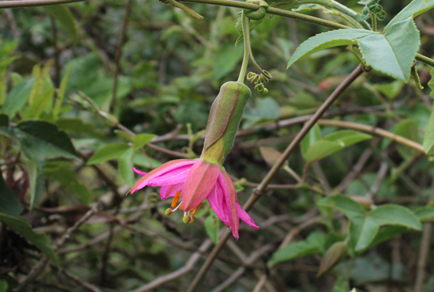
Two rare endemic species of genus Passiflora (Passifloraceae) from Ecuador have been studied and illustrated. This study has uncovered a new consistently unipetalous species closely related to the Ecuadorean P. unipetala. Field studies have shown maintainable vegetative and floral differences between the new species from Bolívar province proposed here as Passiflora nosferatu sp.nov. and P. unipetala found just west of Quito in Pichincha province. A comparison between P. unipetala and P. nosferatu has been provided, along with notes on the conservation, distribution, ecology and taxonomy of these two species. In addition, this study provides new and improved notes on P. brachyantha, a species of P. supersect. Tacsonia found only in southern Ecuador. This species is showing an alarming decline in population and distribution, where much of its original forest has been destroyed. Two new populations were observed, though recent road construction has already damaged both these localities leaving the future of the species uncertain.
References
- Aguirre, N., Eguiguren, P., Maita, J., Ojeda, T., Sanamiego, N., Furniss, M. & Aguirre, Z. (2017) Potential impacts to dry forest species distribution under two climate change scenarios in southern Ecuador. Neotropical Biodiversity 3 (1): 18–29. https://doi.org/10.1080/23766808.2016.1258867
- Avila Jr, R.S., Rocha, D.I., Nunes, C.E., Galetto, L., Dornelas, M.C. & Sazima, M. (2022) Divergent strategies of nectar secretion in two bat-pollinated Passiflora species. Flora 293: 1–8. https://doi.org/10.1016/j.flora.2022.152114
- Behnken, G. (2004) Passiflora brachyantha. Eine Naturhybride. Passiflorunde 12 (3): 1–2.
- Borchsenius, F. (1997) Patterns of plant species endemism in Ecuador. Biodiversity & Conservation 6: 379–399. https://doi.org/10.1023/A:1018312724137
- Cabrera, O., Benítez, Á., Cumbicus, N., Naranjo, C., Ramón, P., Tinitana, F. & Escudero, A. (2019) Geomorphology and altitude effects on the diversity and structure of the vanishing montane forest of southern Ecuador. Diversity 11 (3): 1–32. https://doi.org/10.3390/d11030032
- De Oliveira, A.A. & Daly, D.C. (1999) Geographic distribution of tree species occurring in the region of Manaus, Brazil: implications for regional diversity and conservation. Biodiversity & Conservation 8: 1245–1259. https://doi.org/10.1023/A:1008972901159
- Escobar, L.K. (1992) Passiflora brachyantha (Passifloraceae), a new species from the Andes of southern Ecuador. Novon 2 (3): 198–200. https://doi.org/10.2307/3391547
- Feuillet, C. & MacDougal, J.M. (2003) A new infrageneric classification of Passiflora L. (Passifloraceae). Passiflora 13: 34–38. https://doi.org/10.2307/3393379
- Gentry, A.H., Holm-Nielsen, L.B., Nielsen, I.C. & Balslev, H. (1989) Speciation in tropical forests. Tropical forests: Botanical dynamics, speciation and diversity, pp. 113–134. https://doi.org/10.1016/B978-0-12-353550-4.50017-4
- Gomes-da-Silva, J., Lanna, J. & Forzza, R.C. (2021) Distribution of endemic angiosperm species in Brazil on a municipality level. Biodiversity Data Journal 9: 1–19. https://doi.org/10.3897/BDJ.9.e66043
- Gray, J. (1838) A revision of the genera of bats (Vespertilionidae), and the description of some new genera and species. Magazine of Zoology and Botany 2: 483–505.
- Harms, H. (1894) Passiflora fur Ecuador. Botanische Jahrbücher für Systematik, Pflanzengeschichte und Pflanzengeographie 18 (1): 46.
- Hilgenhof, R. (2013) Passiflora subgenus Astrophea: Curiosities amongst the passionflowers. Sibbaldia: the International Journal of Botanic Garden Horticulture 11: 25–52. https://doi.org/10.24823/Sibbaldia.2013.49
- Holm-Nielsen, L.B. (1974) Notes on central Andean Passifloraceae. Botaniska notiser 127: 338–351.
- Holm-Nielsen, L.B., Jergensen, P.M. & Lawesson, J.E. (1988) Passifloraceae. In: Harling, G. & Sparre, B. (Eds.) Flora of Ecuador 31: pp. 1–130.
- IUCN (2022) Standards and Petitions Subcommittee. Guidelines for using the IUCN Red List Categories and Criteria. Version 13. Prepared by the Standards and Petitions Subcommittee. Available from: http://www.iucnredlist.org/documents/RedListGuidelines.pdf (accessed 20 January 2023)
- Jørgensen, P.M., Muchhala, N. & MacDougal, J.M. (2012) Passiflora unipetala, a new bat-pollinated species of Passiflora supersect Tacsonia (Passifloraceae). Novon: A Journal for Botanical Nomenclature 22 (2): 174–179. https://doi.org/10.3417/2011095
- Killip, E.P. (1938) The American species of Passifloraceae. Field Museum of Natural History, Washington, 408 pp. https://doi.org/10.5962/bhl.title.2269
- Krosnick, S.E., Ford, A.J. & Freudenstein, J.V. (2009) Taxonomic revision of Passiflora subgenus Tetrapathea including the monotypic genera Hollrungia and Tetrapathea (Passifloraceae), and a new species of Passiflora. Systematic Botany 34 (2): 375–385. https://doi.org/10.1600/036364409788606343
- Kuethe, J.R., Cornejo, X., Garzón-Suárez, H.X., Jiménez, M.M., Magdalena, C., Mejía-Pazos, N., Flores, J.C.E. & Decoux, J. (2025) Passionflower trees of Ecuador: revising the presence of Passiflora subg. Astrophea (Passifloraceae) and including resolution to the P. putumayensis and P. macrophylla taxonomic complexes. Phytotaxa 697 (2): 147–165. https://doi.org/10.11646/phytotaxa.697.2.1
- Kuethe, J.R., Montesinos, K., Garzón-Suárez, H.X. & Jost, L. (2023) A large new species of Passiflora supersect Laurifolia, ser Quadrangulares (Passifloraceae) from the sub-Amazonian forests of Ecuador, with notes on its taxonomic alliance and distribution. Phytotaxa 619: 277–284. https://doi.org/10.11646/phytotaxa.619.4.2
- Kuethe, J.R. (2020) Passiflora. List of recognized species – 2020. Published on ResearchGate, April 2020. Available from: https://doi.org/10.13140/RG.2.2.25502.48965 (accessed August 2024)
- Mezzonato-Pires, A.C., Milward-de-Azevedo, M.A., Mendonça, C.B.F. & Gonçalves-Esteves, V. (2018) Taxonomy, palynology and distribution notes of seven species of Passiflora L. (Passifloraceae ss) newly recorded from Brazil. PhytoKeys 95: 1–14. https://doi.org/10.3897/phytokeys.95.22342
- Moraes, A.M., Milward-de-Azevedo, M.A., Menini Neto, L. & de Faria, A.P.G. (2020) Distribution patterns of Passiflora L. (Passifloraceae ss) in the Serra da Mantiqueira, Southeast Brazil. Brazilian Journal of Botany 43: 999–1012. https://doi.org/10.1007/s40415-020-00665-w
- Muchhala, N. & Mena, P.V.L. (2005) A new species of Anoura (Chiroptera: Phyllostomidae) from the Ecuadorian Andes. Journal of Mammalogy 86: 457–461. https://doi.org/10.1644/1545-1542(2005)86[457:ANSOAC]2.0.CO;2
- Ocampo, J., d’Eeckenbrugge, G.C. & Jarvis, A. (2010) Distribution of the genus Passiflora L. diversity in Colombia and its potential as an indicator for biodiversity management in the coffee growing zone. Diversity 2: 1158–1180. https://doi.org/10.3390/d2111158
- SpeciesLink [continuously updated]. (2023) Available from: https://specieslink.net/ (accessed 10 January 2023)
- Tapia-Armijos, M.F., Homeier, J., Espinosa, C.I., Leuschner, C. & De La Cruz, M. (2015) Deforestation and forest fragmentation in South Ecuador since the 1970s–losing a hotspot of biodiversity. PloS one 10 (9): 13–31. https://doi.org/10.1371/journal.pone.0133701
- Thiers, B. (2025 [continuously updated]) Index herbariorum: a global directory of public herbaria and associated staff. New York Botanical Garden’s virtual herbarium.
- Tropicos. (2023 [continuously updated]) Missouri Botanical Garden. Available from: http://www.tropicos.org (accessed 9 January 2023)
- Ulmer, T. & MacDougal, J.M. (2004) Passiflora: Passionflowers of the world. Timber Press, Portland, Cambridge, 430 pp.
- Vanderplank, J. (1996) Passion flowers. MIT Press, 224 pp.
- Vanderplank, J., Edwards, S., Hilgenhof, R. & Rodriguez, C.M. (2017) 866. PASSIFLORA MACROPHYLLA. Curtis’s botanical magazine 34 (2): 123–132. https://www.jstor.org/stable/48505746
- Varassin, I.G., Trigo, J.R. & Sazima, M. (2001) The role of nectar production, flower pigments and odour in the pollination of four species of Passiflora (Passifloraceae) in south-eastern Brazil. Botanical journal of the Linnean Society 136 (2): 139–152. https://doi.org/10.1111/curt.12189
- Von Helversen, O., Winter, Y., Kunz, T.H. & Fenton, M.B. (2003) Glossophagine bats and their flowers: costs and benefits for plants and pollinators. Bat ecology, pp. 346–397.