

Abstract
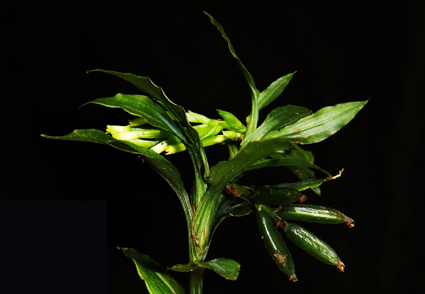
After examining morphological, molecular and genome-size evidence, we here describe a new orchid species, Apostasia fujianica, from Fujian, China. Morphological comparisons indicated that A. fujianica is similar to A. shenzhenica and A. nipponica, whereas the former displayed distinct differences in habit, roots, leaves, inflorescences and fruit shape and size. Apostasia fujianica (341 Mb) has a smaller genome size than A. shenzhenica (471 Mb), A. ramifera (366 Mb) and A. fogangica (931 Mb). Molecular analyses from combined nuclear (ITS, Xdh, naD1) and plastid (matK, rbcL, psbA-trnH, trnL-trnF and trnS-trnG) datasets indicated that A. fujianica is sister to A. shenzhenica. These results support the status of A. fujianica as a new species, distinguished in many aspects from A. shenzhenica, A. ramifera and A. nipponica.
References
Blume, C.L. (1834) De novis quibusdam plantarum familiis expositio et olim jam expositarum enumeratio. Tijdschrift voor Natuurlijke Geschiedenis en Physiologie 1: 140–142.
Brown, R. (1830) Apostasia Blume. In: Wallich, N. (Eds.) Plantae Asiaticae rariores 1. Treuttel and Würtz, London, pp. 74–76.
Chen, C.Q. & Lang, K.Y. (1986) A revision of the orchid subfamily Apostasioideae in China. Acta Phytotaxonomica Sinica 24: 346–352.
Chen, C.Q., Gale, S.W. & Cribb, P.J. (2009) Apostasioideae. In: Wu, Z.G., Raven, P.H. & Hong, D.Y. (Eds.), Flora of China 25. Science Press, Beijing, pp. 184–195.
Chen, L.J. & Liu, Z.J. (2011) Apostasia shenzhenica, a new species of Apostasioideae (Orchidaceae) from China. Plant Science Journal 29: 38–41. https://doi.org/10.3724/SP.J.1142.2011.10038
de Vogel, E.F. (1969) Monograph of the tribe Apostasieae (Orchidaceae). Blumea 17: 313–350.
IUCN (2012) IUCN Red List categories and criteria, version 3.1, second edition. Gland and Cambridge, 30 pp.
Jersáková, J., Trávní?ek, P., Kubatova, B., Krej?íková, J., Urfus, T., Liu, Z.J., Lamb, A., Ponert, J., Schulte, K., ?urn, V., Vrána, J., Leitch, I.J. & Suda, J. (2013) Genome size variation in Orchidaceae subfamily Apostasioideae: filling the phylogenetic gap. Botanical Journal of the Linnean Society 172: 95–105. https://doi.org/10.1111/boj.12027
Kocyan, A. & Endress, P.K. (2001) Floral structure and development of Apostasia and Neuwiedia (Apostasioideae) and their relationships to other Orchidaceae. International Journal of Plant Sciences 162: 847–867. https://doi.org/10.1086/320781
Kumar, P. & Gale, S. (2022) Taxonomic notes on Apostasia nipponica and Crepidium cordilabium (Orchidaceae), two species newly recorded from Hong Kong. Feddes Repertorium: 1–17. https://doi.org/10.1002/fedr.202200002
Li, M.H., Zhang, G.Q., Liu, Z.J. & Lan, S.R. (2014) Revision of Hygrochilus (Orchidaceae: Epidendroideae: Aeridinae) and a molecular phylogenetic analysis. Phytotaxa 159 (4): 256–268. https://doi.org/10.11646/phytotaxa.159.4.2
Li, M.H., Zhang, G.Q., Liu, Z.J. & Lan, S.R. (2016) Subtribal relationships in Cymbidieae (Epidendroideae, Orchidaceae) reveal a new subtribe, Dipodiinae, based on plastid and nuclear coding DNA. Phytotaxa 246 (1): 37–48. https://doi.org/10.11646/phytotaxa.246.1.3
Linnaeus, C. (1753) Species plantarum 2. Salvius, Stockholm, 951 pp.
Liu, Z.J., Chen, L.J., Chen, S.C., Cai, J., Tsai, W.C., Hsiao, Y.Y., Ma, X.Y. & Zhang, G.Q. (2011) Paraholcoglossum and Tsiorchis, two new orchid genera established by molecular and morphological analyses of the Holcoglossum alliance. PLoS ONE: e24864. https://doi.org/10.1371/journal.pone.0024864
Masamune, G. (1935) On the occurrence of Apostastia in Japan. Journal of Japanese Botany 11: 46–47.
Rao, V. (1974) The relationships of the Apostasiaceae on the basis of floral anatomy. Botanical Journal of the Linnean Society 68: 319–327. https://doi.org/10.1111/j.1095-8339.1974.tb01982.x
Rolfe, R.A. (1907) Miscellaneous notes (with figs.). Bulletin of Miscellaneous Information (Royal Botanic Gardens, Kew) 1907: 403–412. https://doi.org/10.2307/4111772
Yin, Y.Y., Zhong, P.S., Zhang, G.Q., Chen, L.J., Zeng, S.J., Li, M.H. & Liu, Z.J. (2016) Morphological, genome-size and molecular analyses of Apostasia fogangica (Apostasioideae, Orchidaceae), a new species from China. Phytotaxa 277 (1): 59–67. https://doi.org/10.11646/phytotaxa.277.1.5
Zhang, G.Q., Liu, K.W., Li, Z., Lohaus, R., Hsiao, Y.Y., Niu, S.C., Wang, J.Y., Lin, Y.C., Xu, Q., Chen, L.J., Yoshida, K., Fujiwara, S., Wang, Z.W., Zhang, Y.Q., Mitsuda, N., Wang, M., Liu, G.H., Pecoraro, L., Huang, H.X., Xiao, X.J., Lin, M., Wu, X.Y., Wu, W.L., Chen, Y.Y., Chang, S.B., Sakamoto, S., Ohme-Takagi, M., Yagi, M., Zeng, S.J., Shen, C.Y., Yeh, C.M., Luo, Y.B., Tsai, W.C., Peer, Y.V. de & Liu, Z.J. (2017) The Apostasia genome and the evolution of orchids. Nature 54: 379–383. https://doi.org/10.1038/nature23897
Zhang, G.Q., Liu, K.W., Chen, L.J., Xiao, X.J., Zhai, J.W., Li, L.Q., Cai, J., Hsiao, Y.Y., Rao, W.H. Huang, J., Ma, X.Y., Chung, S.W., Huang, L.Q., Tsai, W.C. & Liu, Z.J. (2013) A new molecular phylogeny and a new genus, Pendulorchis, of the Aerides-Vanda alliance (Orchidaceae: Epidendroideae). PLoS ONE: e60097. https://doi.org/10.1371/journal.pone.0060097
Zhang, W., Zhang, G., Zeng, P., Zhang, Y., Hu, H., Liu, Z. & Cai, J. (2021) Genome sequence of Apostasia ramifera provides insights into the adaptive evolution in orchids. BMC Genomics 22: 1–12. https://doi.org/10.1186/s12864-021-07852-3