

Abstract
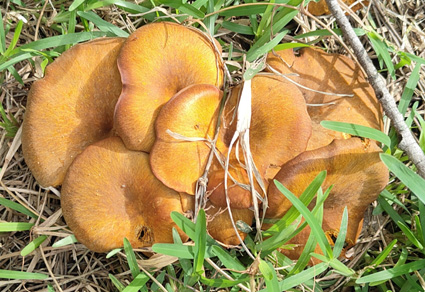
Gymnopilus sahyadricus is proposed as a new species belonging to the Hymenogastraceae. The species is described based on micromorphological features and phylogenetic study of the rDNA internal transcribed spacer (nrITS). Morphological observations and nrITS phylogenetic analysis support its recognition as a distinct species within Gymnopilus. The fruiting body is found on the soil surface and on decayed tree trunks and is characterised by medium-sized basidiomata with convex to plano-convex pilei that are bright golden-orange. The stipe is solid, fibrillose, and central to eccentric. Micromorphologically, the species has basidia, versiform cheilocystidia with long capitate necks and abundant pseudocystidia. Basidiospores are broadly ellipsoid to ellipsoid, dextrinoid, double-walled, faintly thick-walled, warty, tuberculate exosporium, granular, golden yellow to orange brown in colour. In the nrITS phylogeny, the two collections of G. sahyadricus formed a strongly supported monophyletic clade (ML bootstrap = 100%) distinct from the other sampled species. The new species formed a sister relationship with G. subearlei, providing strong molecular support for its recognition as a novel species within Gymnopilus.
References
- Altschul, S.F., Madden, T.L., Schäffer, A.A., Zhang, J., Zhang, Z., Miller, W. & Lipman, D.J. (1997) Gapped BLAST and PSI-BLAST: A new generation of protein database search programs. Nucleic Acids Research 25 (17): 3389–3402. https://doi.org/10.1093/nar/25.17.3389
- Bharath Kumar, S., Tejashwini, K. & Nagadesi, P.K. (2026) Molecular systematics of Hymenochaetales (Basidiomycota) of Western Ghats, Karnataka, India: New species and records. Journal of Sustainable Forestry: 1–39. https://doi.org/10.1080/10549811.2026.2646685
- Bharath Kumar, S., Muthu Kumar, A. & Nagadesi, P.K. (2025) New Host Record, Phenotypic, and Genotypic Identification: One New Species of Ganoderma from Western Ghats of Karnataka, India. Journal of Sustainable Forestry 44 (8): 764–794. https://doi.org/10.1080/10549811.2025.2525204
- Choudhary, S., Sharma, Y.P. & Uniyal, P. (2024) Tubaria armeniaca, a new species of Tubaria from the northwestern Himalayas of Uttarakhand, India. Indian Phytopathology 77 (1). https://doi.org/10.1007/s42360-024-00795-1
- Edler, D., Klein, J., Antonelli, A. & Silvestro, D. (2021) RAxMLGUI 2.0: A graphical interface and toolkit for phylogenetic analyses using RAxML. Methods in Ecology and Evolution 12 (2): 373–377. https://doi.org/10.1111/2041-210X.13512
- Government of Karnataka (2023) Karnataka Climate and Forest Report 2023. Department of Environment and Forestry, Bengaluru.
- Guzmán-Dávalos, L., Mueller, G.M., Cifuentes, J., Miller, A.N. & Santerre, A. (2003) Traditional infrageneric classification of Gymnopilus is not supported by ribosomal DNA sequence data. Mycologia 95 (6): 1204–1214. https://doi.org/10.1080/15572536.2004.11833028
- Hall, T.A. (1999) BioEdit: A user-friendly biological sequence alignment editor and analysis program for Windows 95/98/NT. Nucleic Acids Symposium Series 41: 95–98.
- He, M.-Q., Zhao, R.-L., Hyde, K.D., Begerow, D., Kemler, M., Yurkov, A., McKenzie, E.H.C., Raspé, O., Kakishima, M., Sánchez-Ramírez, S., Vellinga, E.C., Halling, R., Papp, V., Zmitrovich, I.V., Buyck, B., Ertz, D., Wijayawardene, N.N., Cui, B.-K., Schoutteten, N., Liu, X.-Z., Li, T.-H., Yao, Y.-J., Zhu, X.-Y., Liu, A.-Q., Li, G.-J., Zhang, M.-Z., Ling, Z.-L., Cao, B., Antonín, V., Boekhout, T., da Silva, B.D.B., De Crop, E., Decock, C., Dima, B., Dutta, A.K., Fell, J.W., Geml, J., Ghobad-Nejhad, M., Giachini, A.J., Gibertoni, T.B., Gorjón, S.P., Haelewaters, D., He, S.-H., Hodkinson, B.P., Horak, E., Hoshino, T., Justo, A., Lim, Y.W., Menolli, N. Jr., Mešić, A., Moncalvo, J.-M., Mueller, G.M., Nagy, L.G., Nilsson, R.H., Noordeloos, M., Nuytinck, J., Orihara, T., Ratchadawan, C., Rajchenberg, M., Silva-Filho, A.G.S., Sulzbacher, M.A., Tkalčec, Z., Valenzuela, R., Verbeken, A., Vizzini, A., Wartchow, F., Wei, T.-Z., Weiß, M., Zhao, C.-L. & Kirk, P.M. (2019) Notes, outline and divergence times of Basidiomycota. Fungal Diversity 99: 105–367. https://doi.org/10.1007/s13225-019-00435-4
- Hesler, L.R. (1969) North American species of Gymnopilus. Mycologia Memoir 3. Hafner Publishing Company, New York, 117 pp.
- Holec, J. & Kolařík, M. (2012) Taxonomy and phylogeny of Gymnopilus species with smooth spores from Europe. Persoonia 29: 38–62. https://doi.org/10.3767/003158512X661698
- Jayasiri, S.C., Hyde, K.D., Ariyawansa, H.A., Bhat, J., Buyck, B., Cai, L., Dai, Y.-C., Abd-Elsalam, K.A., Ertz, D., Hidayat, I., Jeewon, R., Jones, E.B.G., Bahkali, A.H., Karunarathna, S.C., Liu, J.-K., Luangsa-ard, J.J., Lumbsch, H.T., Maharachchikumbura, S.S.N., McKenzie, E.H.C., Moncalvo, J.-M., Ghobad-Nejhad, M., Nilsson, H., Pang, K.-L., Pereira, O.L., Phillips, A.J.L., Raspé, O., Rollins, A.W., Romero, A.I., Etayo, J., Selçuk, F., Stephenson, S.L., Suetrong, S., Taylor, J.E., Tsui, C.K.M., Vizzini, A., Abdel-Wahab, M.A., Wen, T.-C., Boonmee, S., Dai, D.Q., Daranagama, D.A., Dissanayake, A.J., Ekanayaka, A.H., Fryar, S.C., Hongsanan, S., Jayawardena, R.S., Li, W.-J., Perera, R.H., Phookamsak, R., de Silva, N.I., Thambugala, K.M., Tian, Q., Wijayawardene, N.N., Zhao, R.-L., Zhao, Q., Kang, J.-C. & Promputtha, I. (2015) The Faces of Fungi database: Fungal names linked with morphology, phylogeny and human impacts. Fungal Diversity 74: 3–18. https://doi.org/10.1007/s13225-015-0351-8
- Kalichman, J., Kirk, P.M. & Matheny, P.B. (2020) A compendium of generic names of agarics and Agaricales. Taxon 69 (3): 425–447. https://doi.org/10.1002/tax.12240
- Katoh, K. & Standley, D.M. (2013) MAFFT multiple sequence alignment software version 7: Improvements in performance and usability. Molecular Biology and Evolution 30 (4): 772–780. https://doi.org/10.1093/molbev/mst010
- Kaur, H., Kaur, M. & Rather, H. (2015) Species of Gymnopilus P. Karst.: New to India. Mycosphere 6 (2): 165–173. https://doi.org/10.5943/mycosphere/6/2/7
- Khan, J., Kiran, M., Jabeen, S., Sher, H. & Khalid, A.N. (2017) Gymnopilus penetrans and G. swaticus sp. nov. (Agaricomycota, Hymenogastraceae): A new record and a new species from northwest Pakistan. Phytotaxa 312 (1): 60–70. https://doi.org/10.11646/phytotaxa.312.1.4
- Kirk, P.M., Cannon, P.F., Minter, D.W. & Stalpers, J.A. (2008) Dictionary of the Fungi. 10th ed. CAB International, Wallingford.
- Kumar, S.B., Kumar, A.M. & Nagadesi, P.K. (2026) Diversity and first record of wood-rotting fungal pathogens from Western ghats patches in Malnad region, Karnataka, India. Indian Phytopathology 79: 437–456. https://doi.org/10.1007/s42360-026-00957-3
- Largent, D.L. (1986) How to Identify Mushrooms to Genus I: Macroscopic Features. 2nd ed. Mad River Press, Eureka, California.
- Liu, M. & Bau, T. (2019) Gymnopilus minisporus sp. nov., a new species and a new record of the European species G. hybridus from northeast China. Phytotaxa 397: 159–168. https://doi.org/10.11646/phytotaxa.397.2.3
- Manimohan, P., Joseph, A.V. & Leelavathy, K.M. (2006) The genus Gymnopilus (Agaricales) in Kerala State, India. Mycotaxon 96: 155–172.
- Matheny, P.B., Curtis, J.M., Hofstetter, V., Aime, M.C., Moncalvo, J.-M., Ge, Z.-W., Yang, Z.-L., Slot, J.C., Ammirati, J.F., Baroni, T.J., Bougher, N.L., Hughes, K.W., Lodge, D.J., Kerrigan, R.W., Seidl, M.T., Aanen, D.K., DeNitis, M., Daniele, G.M., Desjardin, D.E., Kropp, B.R., Norvell, L.L., Parker, A., Vellinga, E.C., Vilgalys, R. & Hibbett, D.S. (2006) Major clades of Agaricales: A multilocus phylogenetic overview. Mycologia 98: 982–995. https://doi.org/10.1080/15572536.2006.11832627
- Nagadesi, P.K. & Arya, A. (2014) Timber degrading fungi in sawmills of Gujarat. International Letters of Natural Sciences 2: 13–22. https://doi.org/10.56431/p-ybb088
- Patil, A.R. & Bornak, S.I. (2022) First report of Gymnopilus ochraceus Høil. (Agaricomycetes, Agaricales, Hymenogastraceae) from India and determination of bioactive components. Journal of Threatened Taxa 14: 22021–22025. https://doi.org/10.11609/jott.7881.14.10.22021-22025
- Prakash, P.Y. & Colney, Z. (2019) Macrofungal biodiversity in the western ghat foot hill semi-urban city of Manipal and forest terrains of Koodlu Theertha falls, Karnataka. Current Research in Environmental and Applied Mycology 9 (1): 321–326. https://doi.org/10.5943/cream/9/1/27
- Pushpa, H. & Purushothama, K.B. (2012) Biodiversity of mushrooms in and around Bangalore (Karnataka), India. Journal of Threatened Taxa 4: 2564–2574. https://doi.org/10.11609/JoTT.o2884.2564-2574
- Rees, B.J., Zuccarello, G.C. & Orlovich, D.A. (2002) Relationships between Australian and Northern Hemisphere Gymnopilus species II. A preliminary phylogeny of species of Gymnopilus and related genera based on internal transcribed spacer (ITS) region of ribosomal DNA. Mycotaxon 84: 93–110. https://doi.org/10.5962/p.418298
- Singer, R. (1986) The Agaricales in Modern Taxonomy. 4th ed. Koeltz Scientific Books, Koenigstein.
- Strauss, D., Ghosh, S., Murray, Z. & Gryzenhout, M. (2022) An overview of the taxonomy, phylogenetics and ecology of the psychedelic genera Psilocybe, Panaeolus, Pluteus and Gymnopilus. Frontiers in Forests and Global Change 5: 813998. https://doi.org/10.3389/ffgc.2022.813998
- Thomas, K.A., Guzmán-Dávalos, L. & Manimohan, P. (2003) A new species and new records of Gymnopilus from India. Mycotaxon 85: 297–305. https://doi.org/10.5962/p.414656
- Usha, N. & Janardhana, G.R. (2014) Diversity of macrofungi in the Western Ghats of Karnataka (India). Indian Forester 140 (5). https://doi.org/10.36808/if/2014/v140i5/49102
- Vellinga, E.C. (1988) Glossary. In: Bas, C., Kuyper, T.W., Noordeloos, M.E. & Vellinga, E.C. (Eds.) Flora Agaricina Neerlandica, Vol. 1. A.A. Balkema, Rotterdam, pp. 54–64.
- Wani, N.A., Kaur, M. & Malik, N.A. (2022) Genus Gymnopilus (Agaricales, Strophariaceae): Additions to the agarics of India. Journal of Threatened Taxa 14: 21091–21101. https://doi.org/10.11609/jott.6928.14.5.21091-21101
- White, T.J., Bruns, T., Lee, S. & Taylor, J. (1990) Amplification and direct sequencing of fungal ribosomal RNA genes for phylogenetics. In: Innis, M.A., Gelfand, D.H., Sninsky, J.J. & White, T.J. (Eds.) PCR Protocols: A Guide to Methods and Applications. Academic Press, San Diego, pp. 315–322. https://doi.org/10.1016/B978-0-12-372180-8.50042-1
- Yang, W.Q., Li, J.X., He, M.Q., Wang, S.H., Zhu, X.Y., Phurbu, D., Yun, J.M. & Zhao, R.L. (2024) Five new species of Gymnopilus from Xizang Autonomous Region of China and surrounding areas. Journal of Fungi 10: 220. https://doi.org/10.3390/jof10030220
- Zhang, Z., Schwartz, S., Wagner, L. & Miller, W. (2000) A greedy algorithm for aligning DNA sequences. Journal of Computational Biology 7: 203–214. https://doi.org/10.1089/10665270050081478