
Abstract
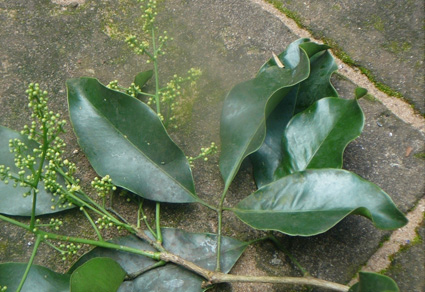
Here we describe Vepris wadigo based on new collections and observations of the informally published Diphasia sp. A of the Flora of Tropical East Africa. Vepris wadigo is known with certainty only from Kaya Kinondo and Kaya Timbwa forests in Kwale District of coastal Kenya where it is known as Mchikoma (Digo language).
Vepris is a genus of nearly 100 species, many of medicinal importance. They are evergreen, shrubs and trees, mainly of forest, confined to Africa and Madagascar with 1 species extending to Arabia and another endemic to India. Vepris wadigo is compared with the only other known diphasoid Vepris species of East Africa, Vepris morogoroensis of Tanzania. However, Vepris wadigo most closely resembles Vepris stolzii of Tanzania which differs in the 4-locular fruit.
The chemistry of Vepris wadigo is unique among the African species of Vepris which have been analysed, since acridones, quinolines and limonoids, which characterise the genus were not detected. The six compounds characterised included a benzamide newly described and named in this paper as wadigin (N-(2,6-dihydroxybenzoyl)-O-methyltyramine) and four lignans and neolignans not previously found or very unusual in Vepris. Lupeol, found in other African Vepris, was also recorded.
Vepris wadigo is here provisionally assessed as Endangered, EN B1ab(i,ii,iii)+2ab(i,ii,iii). Satellite imagery has shown that the area of the habitat has slowly decreased in recent decades.
References
- Appelhans, M.S. & Wen, J. (2020) Phylogenetic placement of Ivodea and biogeographic affinities of Malagasy Rutaceae. Plant Systematics and Evolution 306: 1–14. https://doi.org/10.1007/s00606-020-01633-3
- Atangana, A.F., Toze, F.A.A., Langat, M.K., Happi, E.N., Meva’a Mbaze, L.L., Mulholland, D.A., Kamdem Waffo, A.F., Sewald, N. & Wansi, J.D. (2017) Acridone alkaloids from Vepris verdoorniana (Exell & Mendonça) Mziray (Rutaceae). Phytochemistry Letters 19: 191–195. https://doi.org/10.1016/j.phytol.2017.01.001
- Bachman, S.P., Field, R., Reader, T., Raimondo, D., Donaldson, J., Schatz, G.E. & Nic Lughadha, E.M. (2019) Progress, challenges and opportunities for Red Listing. Biological Conservation 234: 45–55. https://doi.org/10.1016/j.biocon.2019.03.002
- Bachman, S.P., Nic Lughadha, E.M. & Rivers, M.C. (2018) Quantifying progress towards a conservation assessment for all plants. Conservation Biology. https://doi.org/10.1111/cobi.13071
- Badger, G.M., Christie, B.J. & Rodda, H.J. (1963) Isolation of NN-Dimethyl 4-Methoxyphenylethylamine from Teclea simplicifolia. Australian Journal of Chemistry 16: 734–735. https://doi.org/10.1071/ch9630734
- Badheka, L.P., Prabhu, B.R. & Mulchandani, N.B. (1987) Lignans of Piper cubeba. Phytochemistry 26: 2033–2036. https://doi.org/10.1016/S0031-9422(00)81752-5
- Barbosa-Filho, J.M., Yoshida, M., Gottlieb, O.R., Barbosa, R.de C.S.B.C., Giesbrecht, A.M. & Young, M.C.M. (1987) Benzoyl esters and amides, styrylpyrones and neolignans from the fruits of Aniba riparia. Phytochemistry 26: 2615–2617. [https://www.sciencedirect.com/science/article/abs/pii/S003194220083890X?via%3Dihub]
- Barthlott, W., Lauer, W. & Placke, A. (1996) Global distribution of species diversity in vascular plants: towards a world map of phytodiversity. Erdkunde 50: 317–327. https://doi.org/10.1007/s004250050096
- Beentje, H.J. & Cheek, M. (2003) Glossary. In: Beentje, H.J. (Ed.) Flora of Tropical East Africa. Balkema, Lisse, pp. 115. https://doi.org/10.1201/9781482283808
- Bridson, D.M. (1994) A new species of Keetia (Rubiaceae—Vanguerieae) and notes on the Kayas of the Kenya Coast. Kew Bulletin: 803–807. https://doi.org/10.2307/4118075
- Brown, M., Bachman, S. & Nic Lughadha, E.M. (2023) Three in four undescribed plant species are threatened with extinction. New Phytologist 240: 1340–1344. https://doi.org/10.1111/nph.19214
- Burkill, H.M. (1997) The Useful Plants of West Tropical Africa 4, families M–R. Royal Botanic Gardens, Kew, 969 pp.
- Capuron, R. (1961) Contribution à l’étude de la flore forestière de Madagascar. III. Sur quelques plantes ayant contribué au peuplement de Madagascar. A. Rutacées nouvelles. 4. Ivodea R. Capuron gen. nov. (Rutoideae—Xanthoxyleae—Evodiinae). Adansonia, n.s. 1: 73–82. https://doi.org/10.5962/p.296310
- Cheek, M. (2000) A synoptic revision of Ancistrocladus (Ancistrocladaceae) in Africa, with a new species from western Cameroon. Kew Bulletin 55: 871–882. https://doi.org/10.2307/4113632
- Cheek, M. (2004a) Kupeaeae, a new tribe of Triuridaceae from Africa. Kew Bulletin 58: 939–949. https://doi.org/10.2307/4111207
- Cheek, M. (2004b) A new species of Afrothismia (Burmanniaceae) from Kenya. Kew Bulletin 58: 951–955. https://doi.org/10.2307/4111208
- Cheek, M. & Cable, S. (1997) Plant Inventory for conservation management: the Kew-Earthwatch programme in Western Cameroon, 1993–96. In: Doolan, S. (Ed.) African Rainforests and the Conservation of Biodiversity. Earthwatch Europe, Oxford, pp. 29–38.
- Cheek, M. & Jannerup, P. (2006) A new species of Afrothismia (Burmanniaceae) from Tanzania. Kew Bulletin 60: 593–596.
- Cheek, M., Feika, A., Lebbie, A., Goyder, D., Tchiengue, B., Sene, O., Tchouto, P. & van der Burgt, X. (2017) A synoptic revision of Inversodicraea (Podostemaceae). Blumea 62: 125–156. https://doi.org/10.3767/blumea.2017.62.02.07
- Cheek, M., Frimodt-Moeller, C. & Hoerlyck, V. (2000) A new submontane species of Ancistrocladus from Tanzania. Kew Bulletin 55: 207–212. https://doi.org/10.2307/4117778
- Cheek, M., Gosline, G. & Onana, J.M. (2018) Vepris bali (Rutaceae), a new critically endangered (possibly extinct) cloud forest tree species from Bali Ngemba, Cameroon. Willdenowia 48: 285–292. https://doi.org/10.3372/wi.48.48207
- Cheek, M., Hatt, S. & Onana, J.M. (2022a) Vepris onanae (Rutaceae), a new Critically Endangered cloud-forest tree species, and the endemic plant species of Bali Ngemba Forest Reserve, Bamenda Highlands Cameroon. Kew Bulletin 77: 435–449. https://doi.org/10.1007/s12225-022-10020-9
- Cheek, M. & Luke, W.R.Q. (2023) A taxonomic synopsis of unifoliolate continental African Vepris (Rutaceae). Kew Bulletin 78: 469–497. https://doi.org/10.1007/s12225-023-10120-0
- Cheek, M., Luke, W.R.Q. & Gereau, R. (2025) Vepris viridis (Rutaceae), a new name for the most frequent and widespread unifoliolate African Vepris sp. Webbia. Journal of Plant Taxonomy and Geography 80: 85–86. https://doi.org/10.36253/jopt-17740
- Cheek, M., Luke, W.R.Q. & Gosline, G. (2022b) Lukea gen. nov. (Monodoreae-Annonaceae) with two new threatened species of shrub from the forests of the Udzungwas, Tanzania & Kaya Ribe, Kenya. Kew Bulletin 77: 647–664. https://doi.org/10.1007/s12225-022-10039-y
- Cheek, M., Mackinder, B., Gosline, G., Onana, J.M. & Achoundong, G. (2001) The phytogeography and flora of western Cameroon and the Cross River-Sanaga River interval. Systematics and Geography of Plants 71: 1097–1100. https://doi.org/10.2307/3668742
- Cheek, M., Molmou, D., Magassouba, S. & Ghogue, J.P. (2022c) Taxonomic revision of Saxicolella (Podostemaceae), African waterfall plants highly threatened by Hydro-Electric projects. Kew Bulletin 77: 403–433. https://doi.org/10.1007/s12225-022-10019-2
- Cheek, M., Nic Lughadha, E., Kirk, P., Lindon, H., Carretero, J., Looney, B., Douglas, B., Haelewaters, D., Gaya, E., Llewellyn, T., Ainsworth, M., Gafforov, Y., Hyde, K., Crous, P., Hughes, M., Walker, B.E., Forzza, R.C., Wong, K.M. & Niskanen, T. (2020) New scientific discoveries: plants and fungi. Plants, People Planet 2: 371–388. https://doi.org/10.1002/ppp3.10148
- Cheek, M., Oben, B. & Heller, T. (2009) The identity of the West-Central African Oricia lecomteana Pierre, with a new combination in Vepris (Rutaceae). Kew Bulletin 64: 509–512. https://doi.org/10.1007/s12225-009-9135-1
- Cheek, M. & Onana, J.-M. (2021) The endemic plant species of Mt Kupe, Cameroon with a new Critically Endangered cloud-forest tree species, Vepris zapfackii (Rutaceae). Kew Bulletin 76: 721–734. https://doi.org/10.1007/s12225-021-09984-x
- Cheek, M., Onana, J.-M., Yasuda, S., Lawrence, P., Ameka, G. & Buinovskaja, G. (2019) Addressing the Vepris verdoorniana complex (Rutaceae) in West Africa, with two new species. Kew Bulletin 74: 53. https://doi.org/10.1007/s12225-019-9837-y
- Cheek, M., Soto Gomez, M., Graham, S.W. & Rudall, P.J. (2024) Afrothismiaceae (Dioscoreales), a new fully mycoheterotrophic family endemic to tropical Africa. Kew Bulletin 79: 55–73. https://doi.org/10.1007/s12225-023-10124-w
- Cheek, M., Tchiengué, B. & van der Burgt, X. (2021) Taxonomic revision of the threatened African genus Pseudohydrosme Engl. (Araceae), with P. ebo, a new, critically endangered species from Ebo, Cameroon. PeerJ 9: e10689. https://doi.org/10.7717/peerj.10689
- Cheplogoi, P.K., Mulholland, D.A., Coombes, P.H. & Randrianarivelojosia, M. (2008) An azole, an amide and a limonoid from Vepris uguenensis (Rutaceae). Phytochemistry 69: 1384–1388. https://doi.org/10.1016/j.phytochem.2007.12.013
- Ciambrone, M., Langat, M.K. & Cheek, M. (2024) Vepris amaniensis: a morphological, biochemical, and molecular investigation of a species complex. PeerJ 12: e17881. https://doi.org/10.7717/peerj.17881
- Dagallier, L.-P., Mbago, F.M., Luke, W.R.Q. & Couvreur, T.L.P. (2021) Three new species of Uvariodendron (Annonaceae) from coastal East Africa in Kenya and Tanzania. PhytoKeys 174: 107–126. https://doi.org/10.3897/phytokeys.174.61630
- Darbyshire, I. (2006) Gesneriaceae. In: Beentje, H.J. (Ed.) Flora of Tropical East Africa. Royal Botanic Gardens, Kew, pp. 1–75.
- Darbyshire, I. (2009) Taxonomic notes and novelties in the genus Isoglossa (Acanthaceae) from east Africa. Kew Bulletin 64: 401–427. https://doi.org/10.1007/s12225-009-9123-5
- Darbyshire, I., Anderson, S., Asatryan, A., Byfield, A., Cheek, M., Clubbe, C., Ghrabi, Z., Harris, T., Heatubun, C.D., Kalema, J., Magassouba, S., McCarthy, B., Milliken, W., Montmollin, B.de, Nic Lughadha, E.M., Onana, J.-M., Saıdou, D., Sarbu, A., Shrestha, K. & Radford, E.A. (2017) Important Plant Areas: revised selection criteria for a global approach to plant conservation. Biodiversity & Conservation 26: 1767–1800. https://doi.org/10.1007/s10531-017-1336-6
- Darbyshire, I. & Kelbessa, E. (2007) Isoglossa asystasioides, a striking new species of Acanthaceae from Tanzania. Kew Bulletin 62: 617–621. [https://www.jstor.org/stable/20443394]
- Darbyshire, I., Vollesen, K. & Kelbessa, E. (2010) Acanthaceae (Part 2). In: Beentje, H.J. (Ed.) Flora of Tropical East Africa. Royal Botanic Gardens, Kew, pp. 287–756.
- da Rocha, M.A.N., Silva, E.P., Silva, R.N.M., de Sousa, G.R., Barbosa-Filho, J.M., Maia, M.D.S., Lima, A.S., de Souza-Ferrari, J. & de Oliveira Pereira, F. (2024) Riparin II-type benzamides as novel antibiofilm agents against dermatophytes: chemical synthesis, in vitro, ex vivo and in silico evaluation. The Journal of Antimicrobial Chemotherapy 79: 617–631. https://doi.org/10.1093/jac/dkae013
- Delile, A.R. (1843) Sur quelques plantes nouvelles d’Abyssinie. Annales des Sciences Naturelles, série 2 Botanique 20: 88–95.
- Engler, H.G.A. (1895) Die Pflanzenwelt Ost-Afrikas und der Nachbargebiete. Teil C: Verzeichniss der bis jetzt aus Ost-Afrika bekannt gewordenen Pflanzen. Reimer, Berlin, 478 pp., 45 pl. https://doi.org/10.5962/bhl.title.587
- Engler, H.G.A. (1896) Rutaceae. In: Engler, A. (Ed.) Die Natürlichen Pflanzenfamilien 3 (4). Engelmann, Leipzig, pp. 95–201.
- Engler, H.G.A. (1905) Rutaceae Africanae. Botanische Jahrbücher für Systematik 36: 241–246.
- Engler, H.G.A. (1917) Rutaceae africanae V. Beiträge zur Flora von Afrika. Botanische Jahrbücher für Systematik 54: 305–307.
- Engler, A. (1931) Rutaceae. In: Engler, A. & Prantl, K. (Eds.) Die Natürlichen Pflanzenfamilien ed. 2, 19a. Engelmann, Leipzig, pp. 304–314.
- Engler, A. & Diels, L. (1895) Diagnosen neuer afrikanischer Pflanzen. 4. Anonaceae. Notizblatt des Königlichen Botanischen Gartens und Museums zu Berlin 2: 292–302.
- Fries, R.E. (1930) Revision der Arten der Gattung Uvariodendron. Acta Horti Bergiani 10 (1): 51–52.
- Gereau, R.E. (2001) New names in African Celastraceae and Rutaceae. Novon 11: 43–44. https://doi.org/10.2307/3393205
- Gereau, R.E., Cumberlidge, N., Hemp, C., Hochkirch, A., Jones, T., Kariuki, M., Lange, C.N., Loader, S.P., Malonza, P.K., Menegon, M., Ndang’ang’a, P.K., Rovero, F. & Shirk, P. (2016) Globally threatened biodiversity of the Eastern Arc Mountains and coastal forests of Kenya and Tanzania. Journal of East African Natural History 105: 115–201. https://doi.org/10.2982/028.105.0104
- Gosline, G., Marshall, A.R. & Larridon, I. (2019) Revision and new species of the African genus Mischogyne (Annonaceae). Kew Bulletin 74: 28. https://doi.org/10.1007/s12225-019-9804-7
- Harris, D.J. (2000) Validation of the name Vepris glaberrima (Rutaceae). Kew Bulletin 55: 458–458. https://doi.org/10.2307/4115660
- Harvey, W.H. & Sonder, O.W. (1860) Flora Capensis 1. Reeve & Co., London, 605 pp.
- Hoffmann, F. (1889) Beiträge zur Kenntnis der Flora von Central-Ost-Afrika. Hermann Dabis, Jena, 39 pp. https://doi.org/10.1007/BF01672898
- Hooker, W.J. (1849) Niger flora; or, An enumeration of the plants of western tropical Africa. Bailliere, London, 587 pp., 50 pl. https://doi.org/10.5962/bhl.title.594
- Humphreys, A.M., Govaerts, R., Ficinski, S.Z., Nic Lughadha, E.M. & Vorontsova, M.S. (2019) Global dataset shows geography and life form predict modern plant extinction and rediscovery. Nature Ecology & Evolution 3.7: 1043–1047. https://doi.org/10.1038/s41559-019-0906-2
- Imbenzi, P.S., Osoro, E.K., Aboud, N.S., Ombito, J.O. & Cheplogoi, P.K. (2014) A review on chemistry of some species of genus Vepris (Rutaceae family). Journal of Scientific and Innovative Research 3: 357–362. https://doi.org/10.31254/jsir.2014.3314
- IPNI (continuously updated) The International Plant Names Index. Available from: http://ipni.org/ (accessed October 2025)
- IUCN (2012) IUCN Red List Categories and Criteria: Version 3.1. Second edition.–IUCN, Gland, Switzerland and Cambridge, UK. Available from: https://www.iucnredlist.org/resources/categories-and-criteria (accessed May 2025)
- IUCN Standards and Petitions Committee (2024) Guidelines for Using the IUCN Red List Categories and Criteria. Version 16. Prepared by the Standards and Petitions Committee. Available from: https://www.iucnredlist.org/documents/RedListGuidelines.pdf (accessed December 2025)
- Jussieu, A. (1825) Zanthoxyleae. Mémoires du Muséum d’Histoire Naturelle 12: 497–512.
- Kiplimo, J.J. & Koorbanally, N.A. (2012) Antibacterial activity of an epoxidised prenylated cinnamaldehdye derivative from Vepris glomerata. Phytochemistry Letters 5: 438–442. https://doi.org/10.1016/j.phytol.2012.03.017
- Kokwaro, J.O. (1978) New taxa and combinations in Rutaceae of E. and NE. Africa. Kew Bulletin 32: 785–798. https://doi.org/10.2307/4109775
- Kokwaro, J.O. (1982) Rutaceae. In: Polhill, R.M. (Ed.) Flora of Tropical East Africa. Royal Botanic Gardens Kew, Richmond, Surrey, 50 pp.
- Lachenaud, O. & Onana, J.-M. (2021) The West and Central African species of Vepris Comm. ex A.Juss. (Rutaceae) with simple or unifoliolate leaves, including two new combinations. Adansonia 43: 107–116. https://doi.org/10.5252/adansonia2021v43a10
- Langat, M.K. (2011) Flindersiamine, a Furoquinoline Alkaloid from Vepris uguenensis (Rutaceae) as a synergist to Pyrethrins for the control of the housefly, Musca domestica L. (Diptera: Muscidae). Journal of the Kenya Chemical Society 6: 9–15.
- Langat, M.K., Kami, T. & Cheek, M. (2022) Chemistry, taxonomy and ecology of the potentially chimpanzee-dispersed Vepris teva sp.nov. (Rutaceae) of coastal thicket in the Congo Republic. PeerJ 10: e13926. https://doi.org/10.7717/peerj.13926
- Langat, M.K., Mayowa, Y., Sadgrove, N., Danyaal, M., Prescott, T.A., Kami, T., Schwikkard, S., Barker, J. & Cheek, M. (2021) Multi-layered antimicrobial synergism of (E)-caryophyllene with minor compounds, tecleanatalensine B and normelicopine, from the leaves of Vepris gossweileri (I.Verd.) Mziray. Natural Product Research 36: 2447–2457. https://doi.org/10.1080/14786419.2021.1899176
- Léonard, J. (1984) Ancistrocladus robertsoniorum J.Léonard (Ancistrocladaceae), espèce nouvelle du Kenya. Bulletin du Jardin botanique National de Belgique 54: 465–470. https://doi.org/10.2307/3667853
- Letouzey, R. (1963) Rutaceae. In: Flore du Cameroun 1. Muséum Nationale D’Histoire Naturelle, Paris, pp. 31–154.
- Letouzey, R. (1966) Vepris heterophylla R. Let. stat. nov. pour le « Kinkéliba de Boubouli ». (Rutaceae Toddaliée d’Afrique occidentale et du Cameroun). Adansonia, sér. 2, 6: 243–246. https://doi.org/10.5962/p.296416
- Mendonça, F.A. (1961) Um novo género e novas espécies de Rutaceae. Memórias da Junta de Investigações Científicas do Ultramar ea flora de África: missões e Centro de Botânica. Ser. 2, 28: 81–85.
- Morton, C.M. (2017) Phylogenetic relationships of Vepris (Rutaceae) inferred from chloroplast, nuclear, and morphological data. PLoS ONE 12: e0172708. https://doi.org/10.1371/journal.pone.0172708
- Mucaleque, P., Langat, M.K., Mas-Claret, E., Cheek, M. & Darbyshire, I. (2024) New Acridone Alkaloids from Ugandan Vepris trichocarpa. Scientific African, e02168. https://doi.org/10.1016/j.sciaf.2024.e02168
- Mziray, W. (1992) Taxonomic studies in Toddalieae Hook.f. (Rutaceae) in Africa. Symbolae Botanicae Upsalienses 30: 1–95.
- Ndang’ang’a, K.P., Eshiamwata, G., Ngari, A., Pius, E., Arinaitwe, J. & Mbwana, S. (2007) Status report for the Eastern Arc Mountains and Coastal forests of Kenya and Tanzania Region. BirdLife International—Africa Partnership Secretariat, Nairobi, 69 pp.
- Ngumbau, V.M., Musili, P.M. & Hu, G.W. (2021) Premna mwadimei (Lamiaceae), a new species from Cha Simba, a remnant of coastal forests of Kenya, East Africa. Phytotaxa 510: 155–162. https://doi.org/10.11646/phytotaxa.510.2.4
- Ngumbau, V.M., Nyange, M., Wei, N., Van Ee, B.W., Berry, P.E., Malombe, I., Hu, G.W. & Wang, Q.F. (2020) A new species of Croton (Euphorbiaceae) from a Madagascan lineage discovered in Coastal Kenya. Systematic Botany 45: 242–248. https://doi.org/10.1600/036364420X15862837791294
- Nic Lughadha, E.M., Bachman, S.P., Leão, T.C., Forest, F., Halley, J.M., Moat, J., Acedo, C., Bacon, K.L., Brewer, R.F., Gâteblé, G., Gonçalves, S.C., Govaerts, R., Hollingsworth, P.M., Krisai-Greilhuber, I., de Lirio, E.J., Moore, P.G.P., Negrão, R., Onana, J.M., Rajaovelona, L.R., Razanajatovo, H., Reich, P.B., Richards, S.L., Rivers, M.C., Amanda Cooper, A., Iganci, J., Lewis, G.L., Smidt, E.C., Antonelli, A., Mueller, G.M. & Walker, B.E. (2020) Extinction risk and threats to plants and fungi. Plants, People, Planet 2: 389–408. https://doi.org/10.1098/rstb.2017.0402
- Olaranont, Y., Cheek, M., Mas-Claret, E., Prescott, T.A., Onana, J.-M. & Langat, M.K. (2023) Undescribed 2-quinolines, onanaenine A and B, from Cameroonian Vepris onanae (Rutaceae). Phytochemistry Letters 57: 1–4. https://doi.org/10.1016/j.phytol.2023.07.010
- Ombito, J.O., Chi, G.F. & Wansi, J.D. (2020) Ethnomedicinal uses, phytochemistry, and pharmacology of the genus Vepris (Rutaceae): A review. Journal of Ethnopharmacology 267: 113622. https://doi.org/10.1016/j.jep.2020.113622
- Onana, J.-M. & Chevillotte, H. (2015) Taxonomie des Rutaceae—Toddalieae du Cameroun revisitée: découverte de quatre espèces nouvelles, validation d’une combinaison nouvelle et véritable identité de deux autres espèces de Vepris Comm. ex A. Juss. Adansonia, sér. 3. 37: 103–129. https://doi.org/10.5252/a2015n1a7
- Onana, J.-M., Cheek, M. & Chevillotte, H. (2019) Additions au genre Vepris Comm. ex A. Juss. (Rutaceae-Toddalieae) au Cameroun. Adansonia 41: 41–52. https://doi.org/10.5252/adansonia2019v41a5
- Pierre, J.B.L. (1898) Sur les genres Oricia et Diphasia. Bulletin mensuel de La Société linnéenne de Paris, nouvelle série 8: 68–71.
- Plants of the World Online (continuously updated) Facilitated by the Royal Botanic Gardens, Kew. Available from: http://www.plantsoftheworldonline.org/?f=accepted_names&q=Vepris (accessed September 2025)
- Poitou, F., Masotti, V., Viano, J., Gaydou, E.M., Andriamahavo, N.R., Mamitiana, A., Rabemanantsoa, A., Razanamahefa, B.V. & Andriantsiferana, M. (1995) Chemical compositon of Vepris elliotii essential oil. Journal of Essential Oil Research 7: 447–449. https://doi.org/10.1080/10412905.1995.9698560
- Taubert, P.H.W. (1894) Nachträge und Verbesserungen. In: Engler, A. & Prantl, K. (Eds.) Die Natürlichen Pflanzenfamilien 3 (3). Engelmann, Leipzig, pp. 385–388.
- Thiers, B. (continuously updated) Index Herbariorum: A global directory of public herbaria and associated staff. New York Botanical Garden’s Virtual Herbarium. Available from: http://sweetgum.nybg.org/ih/ (accessed September 2025)
- Turland, N.J., Wiersema, J.H., Barrie, F.R., Gandhi, K.N., Gravendyck, J., Greuter, W., Hawksworth, D.L., Herendeen, P.S., Klopper, R.R., Knapp, S., Kusber, W.-H., Li, D.-Z., May, T.W., Monro, A.M., Prado, J., Price, M.J., Smith, G.F. & Zamora Señoret, J.C. (2025) International Code of Nomenclature for Algae, Fungi, and Plants (Madrid Code). Regnum Vegetabile 162. University of Chicago Press, Chicago. https://doi.org/10.7208/chicago/9780226839479.001.0001
- Verdcourt, B. (1996) A reappraisal of the Grevea (Montiniaceae) growing on the Kenya Coast. Kew Bulletin 51: 771–773. https://doi.org/10.2307/4119730
- Verdoorn, I.C. (1926) Revision of African Toddalieae. Bulletin of Miscellaneous Information, Royal Botanic Gardens, Kew 9: 389–416. https://doi.org/10.2307/4118639
- Wansi, J.D., Mesaik, M., Chiozem, D.D., Devkota, K.P., Gaboriaud-Kolar, N., Lallemand, M.-C., Wandji, J., Choudhary, M.I. & Sewald, N. (2008) Oxidative burst inhibitory and cytotoxic ndoloquinazoline and furoquinoline alkaloids from Oricia suaveolens. Journal of Natural Products 71: 1942–1945. https://doi.org/10.1021/np800276f
- Washburn, W.N., Sher, P.M. & Wu, G. (2001) Preparation of O-aryl glucosides as antidiabetic agents and SGLT2 inhibitors. Chemistry Abstracts 135: 273163A.
- Waterman, P.G., Meshal, I.A., Hall, J.B. & Swaine, M.D. (1978) Biochemical systematics and ecology of the Toddalioideae in the central part of the West African forest zone. Biochemical Systematics and Ecology 6: 239–245. https://doi.org/10.1016/0305-1978(78)90012-1
- Yamamura, S., Niwa, M., Nonoyama, M. & Terada, Y. (1978) Three novel neolignans from Heterotropa takaoi M. Tetrahedron Letters 19: 4891–4894. [https://linkinghub.elsevier.com/retrieve/pii/S0040403901857634] https://doi.org/10.1016/s0040-4039(01)85763-4