

Abstract
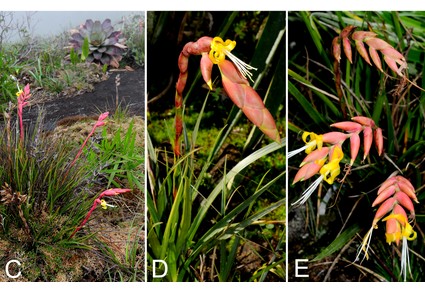
Based on botanical collections from unexplored Atlantic Forest inselbergs in the southern region of Espírito Santo state, southeastern Brazil, a new species of Stigmatodon and a rarely collected species of Alcantarea. Stigmatodon oleiferum D.R. Couto, Manhães & Leme is described and illustrated here on vertical rock walls, and its diagnostic characteristics and affinities are discussed. Furthermore, after nearly 30 years of being known only from the holotype collection, a new population of the endemic Alcantarea benzingii Leme was discovered from the slightly sloping parts of the rocky outcrops of the same inselberg. An amendment to its original description is provided, and its morphological characterization is improved. For both species, illustrations, photos of the species in their habitat, distribution map, data on habitat, ecology, geographic distribution, and assessments of conservation status are presented according to IUCN criteria.
Alcantarea benzingii Leme (1995: 19), emended. Leme & D.R. Couto
References
- Bachman, S., Moat, J., Hill, A.W., Torre, J. & Scott, B. (2011) Supporting Red List threat assessments with GeoCAT: geospatial conservation assessment tool. ZooKeys 150: 117–126. https://doi.org/10.3897/zookeys.150.2109.figure1
- Barfuss, M.H.J., Samuel, R., Till, W. & Stuessy, T.F. (2005) Phylogenetic relationships in subfamily Tillandsioideae (Bromeliaceae) based on DNA sequence data from seven plastid regions. American Journal of Botany 92: 337–351. https://doi.org/10.3732/ajb.92.2.337
- Barfuss, M.H.J., Till, W., Leme, E.M.C., Pizón, J.P., Manzanares, J.M., Halbritter, H., Samuel, R. & Brown, G.K. (2016) Taxonomic revision of Bromeliaceae subfam. Tillandsioideae based on a multi-locus DNA sequence phylogeny and morphology. Phytotaxa 279: 1–97. https://doi.org/10.11646/phytotaxa.279.1.1
- Benzing, D.H. (2000) Bromeliaceae: profile of an adaptive radiation. Cambridge University Press, Cambridge, 690 pp. https://doi.org/10.1017/CBO9780511565175
- Bridson, D. & Forman, L. (1998) The Herbarium Handbook. Royal Botanical Garden, Kew, 348 pp.
- Cabrera, A.L. (1957) El género Senecio (Compositae) en Brasil, Paraguay y Uruguay. Arquivos do Jardim Botânico do Rio de Janeiro 15: 163–264.
- Carvalho-Silva, M. & Guimarães, E.F. (2008) Peperomia ciliato-caespitosa M. Carvalho-Silva & E.F. Guim. (Piperaceae): uma nova espécie para o Brasil. Acta Botanica Brasilica 22: 559–561. https://doi.org/10.1590/S0102-33062008000200022
- Chautems, A., Peixoto, M. & Rossini, J. (2015) A new species of Sinningia Nees (Gesneriaceae) from Espírito Santo and Rio de Janeiro states, Brazil. Candollea 70: 231–235. https://doi.org/10.15553/c2015v702a8
- Coelho, M.A.N. & Valadares, R.T. (2019) Three new species of Anthurium (Araceae) from the Atlantic Forest of Rio de Janeiro, Minas Gerais, and Espírito Santo, Brazil. Novon 27: 22–32. https://doi.org/10.3417/2019267
- Couto, D.R., Manhães, V.C. & Costa, A.F. (2020) Stigmatodon attenuatoides (Tillandsioideae, Bromeliaceae): a new mat-forming species on inselbergs of southeastern Brazil. Phytotaxa 468: 143–149. https://doi.org/10.11646/phytotaxa.468.1.11
- Couto, D.R., Manhães, V.C. & Leme, E.M.C. (2021) Alcantarea alegrensis: a new endemic species from Espírito Santo State, Brazil, threatened by rock mining. Journal of the Bromeliad Society 71: 27–38.
- Couto, D.R., Kessous, I.M., Neves, B., Paixão-Souza, B., Gomes, C.F., Barfuss, M.H.J., Salgueiro, F., Sá-Haiad, B. & Costa, A.F. (2022) Molecular phylogenetics and trait evolution in Stigmatodon (Bromeliaceae, Tillandsioideae), an endemic genus to Brazilian Rocky Outcrops. Systematic Botany 47: 347–362. https://doi.org/10.1600/036364422X16512564801696
- Couto, D.R., Porembski, S., Barthlott, W. & de Paula, L.F.A. (2023) Hyperepilithics—an overlooked life form of vascular plants on tropical vertical rock walls. Austral Ecology 48: 1074–1082. https://doi.org/10.1111/aec.13352
- Couto, D.R., Manhães, V.C. & Leme, E.M.C. (2025) A diurnal new species of Stigmatodon (Bromeliaceae, Tillandsioideae) from vertical rock walls of the Atlantic Forest inselbergs, Espírito Santo state, Brazil. Phytotaxa 720: 149–156. https://doi.org/10.11646/phytotaxa.720.2.5
- de Paula, L.F.A., Azevedo, L.O., Mauad, L.P., Cardoso, L.J.T., Braga, J.M.A., Kollmann, L.J.C., Fraga, C.N., Menini Neto, L., Labiak, P.H., Mello-Silva, R., Porembski, S. & Forzza, R.C. (2020) Sugarloaf land in south-eastern Brazil: a tropical hotspot of lowland inselberg plant diversity. Biodiversity Data Journal 8: e53135. https://doi.org/10.3897/BDJ.8.e53135
- Fraga, C.N., Peixoto, A.L., Leite, Y.L.R., Santos, N.D., Oliveira, J.R.P.M., Sylvestre, L.S., Schwartsburd, P.B., Tuler, A.C., Freitas, J., Lírio, E.J., Couto, D.R., Dutra, V.F., Waichert, C., Sobrinho, T.G., Hostim-Silva, M., Ferreira, R.B., Bérnils, R.S., Costa, L.P., Chaves, F.G., Formigoni, M.H., Silva, J.P., Ribeiro, R.S., Reis, J.C.L., Capellão, R.T., Lima, R.O., Saiter, F.Z. & al. (2019) Lista da fauna e flora ameaçadas de extinção no estado do Espírito Santo. In: Fraga, C.N., Formigoni, M.H. & Chaves, F.G. (Orgs.) Fauna e flora ameaçadas de extinção no estado do Espírito Santo. Instituto Nacional da Mata Atlântica, Santa Teresa, pp. 342–419.
- Francisco, T.M., Couto, D.R., Moreira, M.M., Fontana, A.P. & Fraga, C.N. (2023) Inselbergs from Brazilian Atlantic Forest: high biodiversity refuges of vascular epiphytes from Espírito Santo. Biodiversity and Conservation 32: 2561–2584. https://doi.org/10.1007/s10531-023-02618-7
- Gonçalves, E.G. (2011) Philodendron bernardopazii and P. ricardoi spp. nov. (Araceae) from Espírito Santo State, Brazil. Nordic Journal of Botany 29: 385–390. https://doi.org/10.1111/j.1756-1051.2011.01103.x
- Gouda, E.J., Butcher, D. & Gouda, C.S. (2026 [cont. updated]) Encyclopaedia of Bromeliads, version 3. University Botanical Garden, Utrech. Available from: http://bromeliad.nl/encyclopedia (accessed 15 May 2026)
- Grant, J.R. (1995) The resurrection of Alcantarea and Werauhia, a new genus. Tropische und Subtropische Pflanzenwelt 91: 1–57.
- Harms, H. (1929) Bromeliaceae novae III. Notizblatt des Botanischen Gartens und Museums zu Berlin-Dahlem 10: 784–805. https://doi.org/10.2307/3994800
- Harms, H. (1930) Bromeliaceae. In: Engler, A. (Ed.) Die natürlichen Pflanzenfamilien nebst ihren Gattungen und wichtigeren Arten, insbesondere den Nutzpflanzen, Ed. 2, Vol. 15a. W. Engelmann, Leipzig, pp. 65–159. https://doi.org/10.3790/978-3-428-41140-5
- IUCN–International Union for Conservation of Nature (2024) Guidelines for Using the IUCN Red List Categories and Criteria, version 16. Prepared by the Standards and Petitions Committee. Available from: https://www.iucnredlist.org/resources/redlistguidelines (accessed 20 November 2024)
- Jussieu, A.L. de (1789) Genera plantarum: secundum ordines naturales disposita, juxta methodum in Horto regio parisiensi exaratam, anno M.DCC.LXXIV. Herissant, Paris, 498 pp. https://doi.org/10.5962/bhl.title.284
- Kollmann, L.J.C. & Peixoto, A.L. (2013) Begonia pachypoda L. Kollmann & Peixoto (Begoniaceae), a new species from Brazil currently known in cultivation as Begonia leathermaniae O’Reilly & Kareg. Candollea 68: 93–97. https://doi.org/10.15553/c2013v681a13
- Leme, E.M.C. (1995) Contribuição ao estudo do gênero Alcantarea I. Bromélia 2: 15–23.
- Leme, E.M.C., Fraga, C.N., Kollmann, L.J.C., Brown, G.K., Till, W., Ribeiro, O.B.C., Machado, M.C., Monteiro, F.J.S. & Fontana, A.P. (2010) Miscellaneous new species in the Brazilian Bromeliaceae. Rodriguésia 61: 21–67. https://doi.org/10.1590/2175-7860201061104
- Leme, E.M.C. & Kollmann, L.J.C. (2013) Miscellaneous new species of Brazilian Bromeliaceae. Phytotaxa 108: 1–40. https://doi.org/10.11646/phytotaxa.108.1.1
- Leme, E.M.C., Halbritter, H. & Barfuss, M.H.J. (2017) Waltillia, a new monotypic genus in Tillandsioideae (Bromeliaceae) arises from a rediscovered, allegedly extinct species from Brazil. Phytotaxa 299: 1–35. https://doi.org/10.11646/phytotaxa.299.1.1
- Leme, E.M.C., Couto, D.R., Kollmann, L.J.C. & Fraga, C.N. (2022) Novelties in Stigmatodon (Bromeliaceae, Tillandsioideae), a genus endemic to Brazil: three new species, one new combination, and two new stigma types. Phytotaxa 576: 233–249. https://doi.org/10.11646/phytotaxa.576.3.1
- Leme, E.M.C., Till, W., Halbritter, H. & Barfuss, M.H.J. (2025) Arachnandra, a new monotypic genus in Tillandsioideae (Bromeliaceae) from the Atlantic Forest in Brazil. Phytotaxa 693: 001–032. https://doi.org/10.11646/phytotaxa.693.1.1
- Lindley, J. (1843) Vriesea psittacina, Parrot-flowered Vriesea. Edward’s Botanical Register 29: 9–11.
- Martinelli, G. & Costa, A.F. (1990) Vriesea farneyi (subgenus Alcantarea), a new species from Brazil. Journal of Bromeliad Society 40: 151–153.
- Martinelli, G. & Forzza, R.C. (2006) Pitcairnia L’Hér. (Bromeliaceae): uma nova espécie, P. azouryi Martinelli & Forzza, e observações sobre P. encholirioides L.B. Sm. Revista Brasileira de Botânica 29: 603–607. https://doi.org/10.1590/s0100-84042006000400010
- Meerow, A.W., Scheepen, J.V. & Dutilh, J.H.A. (1997) Transfers from Amaryllis to Hippeastrum (Amaryllidaceae). Taxon 46: 15–19. https://doi.org/10.2307/1224287
- Mittermeier, R.A., Turner, W.R., Larsen, F.W., Brooks, T.M. & Gascon, C. (2011) Global biodiversity conservation: the critical role of hotspots. In: Zachos, F.E. & Habel, J.C. (Eds.) Biodiversity hotspots. Springer, Berlin & Heidelberg, pp. 3–22. https://doi.org/10.1007/978-3-642-20992-5_1
- Meyer, F.S., Couto, D.R., Kollmann, L.J.C. & Goldenberg, R. (2026) Three new species of Pleroma (Melastomataceae) from Atlantic Forest inselbergs, southeastern Brazil. Phytotaxa 778: 001–023. https://doi.org/10.11646/phytotaxa.778.1.1
- MMA. Ministério do Meio Ambiente. (2022) Portaria MMA nº 148, de 7 de junho de 2022.
- Morales-Armijo, F., Sobrevilla-Covarrubias, A., Estrada-Castillón, E., Escudero, A., Scheepens, J.F., Lorite, J. & March-Salas, M. (2024) Climbing route development affects cliff vascular plants more than subsequent climbing: A guide to evidence-based conservation management to regulate climbing. Journal of Applied Ecology 61: 2679–2689. https://doi.org/10.1111/1365-2664.14785
- Myers, N., Mittermeier, R.A., Mittermeier, C.G., Fonseca, G.A.B. & Kent, J. (2000) Biodiversity hotspots for conservation priorities. Nature 403: 853–858. https://doi.org/10.1038/35002501
- Pohl, J.E. (1828) Plantarum brasiliae icones et descriptiones hactenus ineditae: Iussu et auspiciis Francisci Primi, imperatoris et regis augustissimi. Vol. 1. Vindobonae, Wien. https://doi.org/10.5962/bhl.title.451
- Porembski, S., Silveira, F.A.O., Fiedler, P.L., Watve, A., Rabarimanarivo, M., Kouame, F. & Hopper, S.D. (2016) Worldwide destruction of inselbergs and related rock outcrops threatens a unique ecosystem. Biodiversity and Conservation 25: 2827–2830. https://doi.org/10.1007/s10531-016-1171-1
- QGIS Development Team. (2025) QGIS Geographic Information System: Versão 3.40.12 “Bratislava”. Open Source Geospatial Foundation Project. Available from: https://qgis.org (accessed 20 October 2025)
- Radford, A.E. (1986) Fundamentals of Plant Systematics. Harper & Row Publ. Inc., New York.
- Rusterholz, H.P., Müller, S.W. & Baur, B. (2004) Effects of rock climbing on plant communities on exposed limestone cliffs in the Swiss Jura mountains. Applied Vegetation Science 7: 35–40. https://doi.org/10.1658/1402-2001(2004)007[0035:EORCOP]2.0.CO;2
- Scharf, U. & Gouda, E.J. (2008) Bringing Bromeliaceae back to homeland botany. Journal of the Bromeliad Society 58: 123–129.
- Smith, L.B. & Downs, R.J. (1977) Tillandsioideae (Bromeliaceae). In: Rogerson, C.T. (Ed.) Flora Neotropica. Monograph no. 14. Part 2. Hafner Press, New York, pp. 661–1492.
- Stearn, W.T. (1973) Botanical Latin, ed. 2. David & Charles, Newton Abbot.
- Taubert, P.H.W. (1896) Beiträge zur Kenntnis der Flora des centralbrasilianischen Staates Goyaz. Botanische Jahrbücher für Systematik, Pflanzengeschichte und Pflanzengeographie 21: 402–457.
- Teles, A.M., Manhães, V.C. & Couto, D.R. (2024) Half a century later, a new species of Wunderlichia (Wunderlichieae, Asteraceae) from the Atlantic Forest inselbergs of Espírito Santo, Brazil. Phytotaxa 664: 172–180. https://doi.org/10.11646/phytotaxa.664.3.2
- Thiers, B. (2026 [continuously updated]) Index Herbariorum: A global directory of public herbaria and associated staff. New York Botanical Garden’s Virtual Herbarium. Available from: http://sweetgum.nybg.org/science/ih/ (accessed 1 March 2026)
- Uribbe, F.P., Neves, B., Jacques, S.S.A. & Costa, A.F. (2020) Morphological variation in the Vriesea procera complex (Bromeliaceae, Tillandsioideae) in the Brazilian Atlantic Rainforest, with recognition of new taxa. Systematic Botany 45: 53–68. https://doi.org/10.1600/036364420X15801369352306
- Valadares, R.T., Couto, D.R., Manhães, V.C., Silva, L.A. & Dutra, V.F. (2024) Anthurium capixaba (Araceae): a new species with cordate leaves from Brazil. Phytotaxa 664: 075–082. https://doi.org/10.11646/phytotaxa.664.1.7
- Versieux, L.M. & Wanderley, M.G.L. (2007) A new species of Alcantarea (É. Morren ex Mez) Harms, Bromeliaceae. Hoehnea 34 (3): 409–413. https://doi.org/10.1590/S2236-89062007000300009
- Versieux, L.M., Barbará, T., Wanderley, M.G.L., Calvente, A., Fay, M.F. & Lexer, C. (2012) Molecular phylogenetics of the Brazilian giant bromeliads (Alcantarea, Bromeliaceae): Implications for morphological evolution and biogeography. Molecular Phylogenetics and Evolution 64: 177–189. https://doi.org/10.1016/j.ympev.2012.03.015
- Versieux, L.M. & Wanderley, M.G.L. (2015) Bromélias-gigantes do Brasil. Offset Gráfia e Editora, Natal, 201 pp.
- Von Der Weid, J.P. (2006) Horizontes verticais. Editora Publit, Rio de Janeiro, 168 pp.