

Abstract
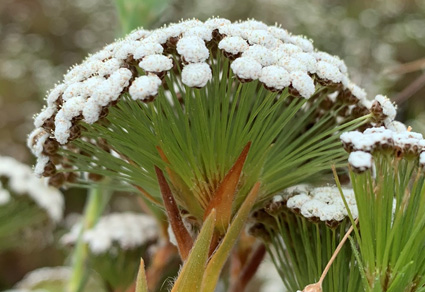
Actinocephalus concinnus (Eriocaulaceae) is here described and illustrated. The new species is morphologically similar to A. ithyphyllus but differs mainly in its slender habit, shorter elongate axes, bracts of the elongate axes pilose on both surfaces, and umbelliform arrangement of scapes. Actinocephalus encompasses now 55 species and one of these, A. bulbosus, has long remained taxonomically problematic due to its unusual morphology and by being known only from the holotypus. Therefore, the protologue was based on a single specimen, and the description did not reflect the morphological diversity of the species. Here, we provide an emended description of A. bulbosus and report new records collected nearly one hundred years after its original description. We also present a preliminary conservation assessment for both species and provide morphological and taxonomic notes.
References
- Andrino, C.O., Sano, P.T., Inglis, P.W., Hensold, N., Costa, F.N. & Simon, M.F. (2021) Phylogenetics of Paepalanthus (Eriocaulaceae), a diverse Neotropical monocot lineage. Botanical Journal of the Linnean Society 195: 34–52. https://doi.org/10.1093/botlinnean/boaa070
- Andrino, C.O., Sano, P.T. & Costa, F.N. (2021) Taxonomic re-evaluation of Actinocephalus (Eriocaulaceae) in light of new morphological and molecular evidence. Systematic Botany 46 (4): 929–934. https://doi.org/10.1600/036364421X16370109698641
- Andrino, C.O., Costa, F.N., Simon, M.F., Missagia, R.V. & Sano, P.T. (2023) Eriocaulaceae: a new classification system based on morphological evolution and molecular evidence. Taxon [published online]. https://doi.org/10.1002/tax.12915
- Bachman, S., Moat, J., Hill, A.W., Torre, J. de la & Scott, B. (2011) Supporting Red List threat assessments with GeoCAT: Geospatial conservation assessment tool. ZooKeys 150: 117–126. https://doi.org/10.3897/zookeys.150.2109
- Brasil (2000) Lei nº 9.985, de 18 de julho de 2000. Regulamenta o art. 225, §1º, incisos I, II, III e VII da Constituição Federal, institui o Sistema Nacional de Unidades de Conservação da Natureza e dá outras providências. Diário Oficial da União, Brasil.
- Bongard, A.G.H. von (1831) Essai monographique sur les espèces d’Eriocaulon du Brésil. Mem. Acad. Imp. Sci. St.-Pétersbourg, Sér. 6, Sci. Math. 1: 601–655.
- Colli-Silva, M., Vasconcelos, T.N. & Pirani, J.R. (2019) Outstanding plant endemism levels strongly support the recognition of campo rupestre provinces in mountaintops of eastern South America. Journal of Biogeography 46: 1723–1733. https://doi.org/10.1111/jbi.13585
- Costa, F.N., Andrino, C.O. & Negrão, R. (2023) Plantas raras, ameaçadas e endêmicas dos topos de serra do Espinhaço Meridional. Revista Espinhaço. https://doi.org/10.5281/zenodo.7868219
- Costa, F.N., Andrino, C.O., Sano, P.T., Trovó, M. & Echternacht, L. (2018) Paepalanthus (Eriocaulaceae) in the Central Espinhaço Range in Minas Gerais, Brazil: checklist, endemism, and nomenclatural changes. Phytotaxa 367 (2): 133–144. https://doi.org/10.11646/phytotaxa.367.2.3
- Costa, F.N. & Sano, P.T. (2013) New circumscription of the endemic Brazilian genus Actinocephalus (Eriocaulaceae). Novon 22 (3): 281–287. https://doi.org/10.3417/2011001
- Costa, F.N., Sano, P.T., Andrino, C.O. & Almeida, R.B.P. (2026) Actinocephalus. In: Flora e Funga do Brasil. Jardim Botânico do Rio de Janeiro. Available from: https://floradobrasil.jbrj.gov.br/FB7505 (accessed 12 March 2026)
- Harris, J.G. & Harris, M.W. (2001) Plant identification terminology: an illustrated glossary. 2nd edition. Spring Lake Publishing, Spring Lake, 206 pp.
- Hickey, L.J. (1973) Classification of the architecture of dicotyledonous leaves. American Journal of Botany 60 (1): 17–33. https://doi.org/10.1002/j.1537-2197.1973.tb10192.x
- IUCN (2012) IUCN Red List categories and criteria: Version 3.1. 2nd edition. IUCN, Gland and Cambridge, 33 pp.
- IUCN (1994) Guidelines for Protected Area Management Categories. IUCN, Gland and Cambridge.
- IUCN Standards and Petitions Subcommittee (2024) Guidelines for using the IUCN Red List categories and criteria. Version 16. Available from: http://www.iucnredlist.org/documents/RedListGuidelines.pdf (accessed 26 October 2026)
- Körnicke, F. (1863) Eriocaulaceae. In: Martius, K.F.P. & Eichler, A.W. (Eds.) Flora brasiliensis, vol. 3 (1). Typographia Regia, Munich, pp. 271–508.
- Martius, C.F.P. von (1841) Herbarium Florae Brasiliensis, vol. 24 (2). Typographia Regia, Monachii, Mtinch, 275 pp.
- Oriani, A., Scatena, V.L. & Sano, P.T. (2008) Morphological architecture of Actinocephalus (Koern.) Sano (Eriocaulaceae-Poales). Flora 203 (4): 341–349. https://doi.org/10.1016/j.flora.2007.04.008
- QGIS Development Team (2018) QGIS Geographic Information System. Open Source Geospatial Foundation Project. Available from: https://qgis.osgeo.org (accessed 12 March 2026)
- Rosa, M.M. & Scatena, V.L. (2007) Floral anatomy of Paepalanthoideae (Eriocaulaceae, Poales) and their nectariferous structures. Annals of Botany 99: 131–139. https://doi.org/10.1093/aob/mcl231
- Ruhland, W. (1903) Eriocaulaceae. In: Engler, A. (Ed.) Das Pflanzenreich, IV. 30 (Heft 13). Engelmann, Leipzig.
- Saint-Hilaire, A. (1833) Voyage dans le district des diamans et sur le littoral du Brésil, vol. 2. Libraire Gide.
- Sano, P.T. (1996) Fenologia de Paepalanthus hilairei Koern., P. polyanthus (Bong.) Kunth e P. robustus Silveira: Paepalanthus sect. Actinocephalus Koern. (Eriocaulaceae). Acta Botanica Brasilica 10: 317–328. https://doi.org/10.1590/S0102-33061996000200006
- Sano, P.T. (2004) Actinocephalus (Körn.) Sano (Paepalanthus sect. Actinocephalus), a new genus of Eriocaulaceae, and other taxonomic and nomenclatural changes involving Paepalanthus Mart. Taxon 53 (1): 99–107. https://doi.org/10.2307/4135493
- Silveira, A.A. (1928) Floralia Montium, vol. 1. Imprensa Official, Belo Horizonte.
- Thiers, B. (2026) [continuously updated]. Index Herbariorum: A global directory of public herbaria and associated staff. New York Botanical Garden’s Virtual Herbarium. Available from: http://sweetgum.nybg.org/ih/ (accessed 12 March 2026)
- Trovó, M., Andrade, M.J.G. de, Sano, P.T., Ribeiro, P.L. & Berg, C. van den (2013) Molecular phylogenetics and biogeography of Neotropical Paepalanthoideae with emphasis on Brazilian Paepalanthus (Eriocaulaceae). Botanical Journal of the Linnean Society 171 (1): 225–243. https://doi.org/10.1111/j.1095-8339.2012.01310.x
- Trovó, M. & Echternacht, L. (2022) The Paepalanthoideae (Eriocaulaceae) of the Chapada dos Veadeiros National Park, Brazil: taxonomic novelties, identification key, and illustrated list of species. European Journal of Taxonomy 834: 58–93. https://doi.org/10.5852/ejt.2022.834.1899
- Trovó, M. & Echternacht, L. (2023) Notes on Paepalanthus (Eriocaulaceae) from central Brazil and Paraguay. Phytotaxa 598 (2): 145–156. https://doi.org/10.11646/phytotaxa.598.2.4