

Abstract
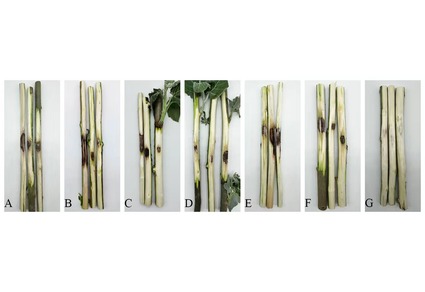
Poplar canker caused by Cytospora species is a widespread and destructive disease in China. However, the species diversity and pathogenicity of this genus associated with poplar (Populus spp.) remain inadequately studied. In this study, 17 representative Cytospora isolates were obtained from cankered stems of poplar collected in northern China. Based on morphological observations and phylogenetic analyses of ITS, act, rpb2, tef1-α, and tub2 loci, these isolates were identified as six species, including five known species, C. ailanthicola, C. eastringensis, C. hoffmannii, C. sophoriopsis, and C. translucens, and one novel species, C. euphraticae. Pathogenicity tests confirmed that these six species caused necrotic lesions of varying lengths on the stems of Populus × beijingensis. The inoculated fungi were successfully re-isolated from lesion margins, fulfilling Koch's postulates.
References
- Adams, G.C., Roux, J., Wingfield, M.J. & Common, R. (2005) Phylogenetic relationships and morphology of Cytospora species and related teleomorphs (Ascomycota, Diaporthales, Valsaceae) from Eucalyptus. Studies in Mycology 52: 1–144.
- Bhunjun, C.S., Phillips, A.J., Jayawardena, R.S., Promputtha, I. & Hyde, K.D. (2021) Importance of molecular data to identify fungal plant pathogens and guidelines for pathogenicity testing based on Koch’s postulates. Pathogens 10 (9): 1096. https://doi.org/10.3390/pathogens10091096
- Carbone, I. & Kohn, L.M. (1999) A method for designing primer sets for speciation studies in filamentous ascomycetes. Mycologia 3 (3): 553–556. https://doi.org/10.1080/00275514.1999.12061051
- Chen, M.M. (2003) Forest Fungi Phytogeography: Forest Fungi Phytogeography of China, North America, and Siberia and International Quarantine of Tree Pathogens. Pacific Mushroom Research and Education Center, Sacramento.
- Cronk, Q.C.B. (2005) Plant eco-devo: the potential of poplar as a model organism. New Phytologist 166 (1): 39–48. https://doi.org/10.1111/j.1469-8137.2005.01369.x
- Donk, M.A. (1964) Nomina conservanda proposita 1. Proposals in fungi. Deuteromycetes. Regnum Vegetabile 34: 7–15.
- Doyle, J.J. & Doyle, J.L. (1990) Isolation of plant DNA from fresh tissue. Focus (San Francisco, Calif.) 12: 13–15.
- Ehrenberg, C.G. (1818) Sylvae Mycologicae Berolinenses. Formis Theophili Bruschcke, Berlin.
- Fan, X.L., Bezerra, J.D.P., Tian, C.M. & Crous, P.W. (2020) Cytospora (Diaporthales) in China. Persoonia-Molecular Phylogeny and Evolution of Fungi 45 (1): 1–45. https://doi.org/10.3767/persoonia.2020.45.01
- Glass, N.L. & Donaldson, G.C. (1995) Development of primer sets designed for use with the PCR to amplify conserved genes from filamentous ascomycetes. Applied and Environmental Microbiology 61 (4): 1323–1330. https://doi.org/10.1128/aem.61.4.1323-1330.1995
- He, Z.Z., Abeywickrama, P.D., Wu, L.N., Zhou, Y.Y., Zhang, W., Yan, J.Y., Shang, Q.X., Zhou, Y. & Li, S.F. (2024) Diversity of Cytospora species associated with trunk diseases of Prunus persica (Peach) in Northern China. Journal of Fungi 10 (12): 843. https://doi.org/10.3390/jof10120843
- Hillis, D.M. & Bull, J.J. (1993) An empirical test of bootstrapping as a method for assessing confidence in phylogenetic analysis. Systematic Biology 42: 182–192. https://doi.org/10.1093/sysbio/42.2.182
- Ilyukhin, E., Nguyen, H.D.T., Castle, A.J. & Ellouze, W. (2023) Cytospora paraplurivora sp. nov. isolated from orchards with fruit tree decline syndrome in Ontario, Canada. PLoS ONE 18 (1): e0279490. https://doi.org/10.1371/journal.pone.0279490
- Jia, A.L., Chen, B.Y., Lu, H.Y., Xing, Y., Li, B. & Fan, X.L. (2024) Multigene phylogeny and morphology reveal three new species of Cytospora isolated from diseased plant branches in Fengtai District, Beijing, China. MycoKeys 101: 163–189. https://doi.org/10.3897/mycokeys.101.116272
- Jiang, N., Voglmayr, H., Li, J.R., Xue, H., Li, Y. & Crous, P.W. (2025) Species diversity of Cytospora associated with forest canker diseases in Xizang (Tibet), China. Persoonia-Molecular Phylogeny and Evolution of Fungi 55 (1): 361–438. https://doi.org/10.3114/persoonia.2025.55.10
- Komán, S., Németh, R. & Báder, M. (2023) An overview of the current situation of European poplar cultures with a main focus on Hungary. Applied Sciences 13 (23): 12922. https://doi.org/10.3390/app132312922
- Li, J.R., Li, Y., Wang, Y.L. & Jiang, N. (2026) Identification of Cytospora (Cytosporaceae, Diaporthales) species associated with poplar and willow canker diseases in Xizang, China. MycoKeys 132: 41–61. https://doi.org/10.3897/mycokeys.132.187445
- Lin, L., Fan, X.L., Groenewald, J.Z., Jami, F., Wingfield, M.J., Voglmayr, H., Jaklitsch, W., Castlebury, L.A., Tian, C.M. & Crous, P.W. (2024) Cytospora: an important genus of canker pathogens. Studies in Mycology 109: 323–401. https://doi.org/10.3114/sim.2024.109.05
- Lin, L., Pan, M., Bezerra, J.D., Tian, C.M. & Fan, X.L. (2023) Re-evaluation of the fungal diversity and pathogenicity of Cytospora species from Populus in China. Plant Disease 107 (1): 83–96. https://doi.org/10.1094/PDIS-02-22-0260-RE
- Liu, C.R., Dong, Y., Li, Y.B., Jiang, N., Zhu, T.S., Li, Z.J., Song, S.Q., Li, J.Q. & Luo, L.X. (2020) Identification of causal agent of apple, walnut and poplar Valsa canker disease in partial areas of Xinjiang. Acta Phytopathologica Sinica 50 (3): 267–275. https://doi.org/10.13926/j.cnki.apps.000461
- Liu, Y.J., Whelen, S. & Hall, B.D. (1999) Phylogenetic relationships among ascomycetes: evidence from an RNA polymerase II subunit. Molecular Biology and Evolution 16 (12): 1799–1808. https://doi.org/10.1093/oxfordjournals.molbev.a026092
- Luchi, N., Ioos, R. & Santini, A. (2020) Fast and reliable molecular methods to detect fungal pathogens in woody plants. Applied Microbiology and Biotechnology 104 (6): 2453–2468. https://doi.org/10.1007/s00253-020-10395-4
- Ma, Z.G., Zhu, J.L., Sun, Z.Q., Liang, J., Zhang, Z.X., Zhang, L.M., Sun, L.J. & Li, W.J. (2015) The influences of biotic and abiotic factors on the occurrence and severity of poplar canker disease in Qingfeng County, China and the management implications. Journal of Forestry Research 26 (4): 1025–1034. https://doi.org/10.1007/s11676-015-0122-0
- Pan, M. (2023) Identification of Cytospora species inhabiting wood in the Beijing area. MSc Thesis, Beijing Forestry University, Beijing.
- Posada, D. & Buckley, T.R. (2004) Model selection and model averaging in phylogenetics: advantages of Akaike information criterion and Bayesian approaches over likelihood ratio tests. Systematic Biology 53 (5): 793–808. https://doi.org/10.1080/10635150490522304
- Rambaut, A., Drummond, A.J., Xie, D., Baele, G. & Suchard, M.A. (2018) Posterior summarization in Bayesian phylogenetics using Tracer 1.7. Systematic Biology 67 (5): 901–904. https://doi.org/10.1093/sysbio/syy032
- Rehner, S.A. (2001) Primers for elongation factor 1-alpha (EF1-alpha). USDA ARS, Insect Biocontrol Laboratory, Beltsville, Maryland. [http://ocid.nacse.org/research/deephyphae/EF1primer.pdf]
- Ronquist, F., Teslenko, M., van der Mark, P., Ayres, D.L., Darling, A., Höhna, S., Larget, B., Liu, L., Suchard, M.A. & Huelsenbeck, J.P. (2012) MrBayes 3.2: Efficient Bayesian phylogenetic inference and model choice across a large model space. Systematic Biology 61: 539–542. https://doi.org/10.1093/sysbio/sys029
- Rossman, A.Y., Adams, G.C., Cannon, P.F., Castlebury, L.A., Crous, P.W., Gryzenhout, M., Jaklitsch, W.M., Mejia, L.C., Stoykov, D., Udayanga, D., Voglmayr, H. & Walker, D.M. (2015) Recommendations of generic names in Diaporthales competing for protection or use. IMA Fungus 6 (1): 145–154. https://doi.org/10.5598/imafungus.2015.06.01.09
- Senanayake, I.C., Crous, P.W., Groenewald, J.Z., Maharachchikumbura, S.S.N., Jeewon, R., Phillips, A.J.L., Bhat, J.D., Perera, R.H., Li, Q.R., Li, W.J., Tangthirasunun, N., Norphanphoun, C., Karunarathna, S.C., Camporesi, E., Manawasighe, I.S., Al-Sadi, A.M. & Hyde, K.D. (2017) Families of Diaporthales based on morphological and phylogenetic evidence. Studies in Mycology 86: 217–296. https://doi.org/10.1016/j.simyco.2017.07.003
- Spielman, L.J. (1985) A monograph of Valsa on hardwoods in North America. Canadian Journal of Botany 63: 1355–1378. https://doi.org/10.1139/b85-190
- Sreenivasaprasad, S. & Talhinhas, P. (2005) Genotypic and phenotypic diversity in Colletotrichum acutatum, a cosmopolitan pathogen causing anthracnose on a wide range of hosts. Molecular Plant Pathology 6 (4): 361–378. https://doi.org/10.1111/j.1364-3703.2005.00291.x
- Stamatakis, A. (2014) RAxML version 8: A tool for phylogenetic analysis and post analysis of large phylogenies. Bioinformatics (Oxford, England) 30: 1312–1313. https://doi.org/10.1093/bioinformatics/btu033
- Swofford, D.L. (2002) PAUP*: phylogenetic analysis using parsimony (*and other methods). Version 4.0b10. Sinauer Associates, Sunderland, Massachusetts.
- Tack, A.J.M., Thrall, P.H., Barrett, L.G., Burdon, J.J. & Laine, A.L. (2012) Variation in infectivity and aggressiveness in space and time in wild host–pathogen systems: causes and consequences. Journal of Evolutionary Biology 25 (10): 1918–1936. https://doi.org/10.1111/j.1420-9101.2012.02588.x
- Tai, F.L. (1979) Sylloge Fungorum Sinicorum. Science Press, Beijing.
- Tanner, F., Tonn, S., de Wit, J., van den Ackerveken, G., Berger, B. & Plett, D. (2022) Sensor-based phenotyping of above-ground plant-pathogen interactions. Plant Methods 18 (1): 35. https://doi.org/10.1186/s13007-022-00853-7
- Teng, S.C. (1963) Fungi of China. Science Press, Beijing.
- Wang, S. (2025) Study on the Species of Cytospora in forest trees in Some Regions of Xinjiang. MSc Thesis, Xinjiang Agricultural University, Urumqi.
- Wang, Y.L., Lu, Q., Decock, C., Li, Y.X. & Zhang, X.Y. (2015) Cytospora species from Populus and Salix in China with C. davidiana sp. nov. Fungal Biology 119 (5): 420–432. https://doi.org/10.1016/j.funbio.2015.01.005
- Wang, Y.L., Lu, Q., Jia, X.Z., Liang, J. & Zhang, X.Y. (2013) First report of branch canker caused by Cytospora atrocirrhata on Populus sp. and Salix sp. in China. Plant Disease 97 (3): 426. https://doi.org/10.1094/PDIS-09-12-0854-PDN
- Wehmeyer, L.E. (1975) The Pyrenomycetous fungi. Mycologia Memoirs 6: 1–250.
- Wei, J.C. (1979) Identification of Fungus Handbook. Science Press, Shanghai.
- White, T.J., Bruns, T., Lee, S. & Taylor, J. (1990) Amplification and direct sequencing of fungal ribosomal RNA genes for phylogenetics. In: Innis, M.A., Gelfand, D.H., Sninsky, J.J. & White, T.J. (Eds.) PCR Protocols: A Guide to Methods and Applications. Academic Press, San Diego, pp. 315–322. https://doi.org/10.1016/B978-0-12-372180-8.50042-1
- Wingfield, M.J., Beer, Z.W.D., Slippers, B., Wingfield, B.D., Groenewald, J.Z., Lombard, L. & Crous, P.W. (2012) One fungus, one name promotes progressive plant pathology. Molecular Plant Pathology 13: 604–613. https://doi.org/10.1111/j.1364-3703.2011.00768.x
- Zhang, J.X., Li, H., Ma, H.W. & Li, A.N. (2026) Integrated control of poplar canker in poplar shelterbelts in Wuwei, Gansu Province. Forests 17 (5): 574. https://doi.org/10.3390/f17050574
- Zhang, Q.T., He, M., Lu, Q., Liang, J. & Zhang, X.Y. (2013) Morphological and molecular identification of Cytospora germanica causing canker on Populus spp. in China. Plant Disease 97 (6): 846–846. https://doi.org/10.1094/PDIS-11-12-1065-PDN
- Zhang, Q.T., He, M., Zhang, X.Y., Lu, Q. & Liang, J. (2012) Canker on bark of Populus spp. caused by Cytospora tritici, a new disease in China. Plant Disease 96 (10): 1578–1578. https://doi.org/10.1094/PDIS-01-12-0040-PDN
- Zhuang, W.Y. (2005) Fungi of Northwestern China. Mycotaxon, Ithaca, NY.