
Abstract
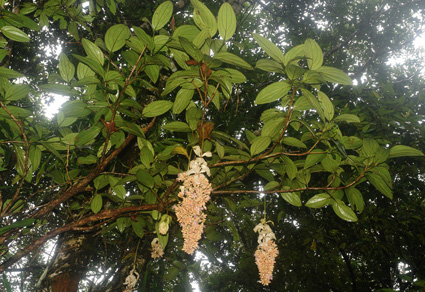
Medinilla bulutiorum, a new species from Apayao Province in northern Luzon, Philippines, is described herein, and updated distributions are provided for five allied species: M. banahaensis, M. magnifica, M. miniata, M. parvibractea, and M. vanoverberghii, the last of which is reinstated here as a species distinct from M. cumingii. Of these, M. bulutiorum is most similar to M. magnifica, characterized by generally long, pendulous inflorescences with large, showy bracts, but differs significantly in its terete branchlets, smaller petiolate, 5–7-plinerved leaves, inflorescences with rather crowded lateral branches, and a brown, furfuraceous-lepidote indumentum over whitish inflorescence axes and bracts. Despite its ubiquitous presence in the type locality, this taxon has gone unnoticed by botanists for more than a century—a testament to Apayao being only lately subjected to systematic botanical exploration. Such a discovery further reinforces the designation of the yApayaos Biosphere Reserve (yABR), a UNESCO-recognized site, as the last forest frontier of the Cordilleras. Medinilla bulutiorum is herein preliminarily assessed as Data Deficient under the IUCN Red List criteria.
References
- Adorador, J.T., Meneses-Adorador, Z.D. & Quakenbush, J.P. (2021) Medinilla malabrigoi (Melastomataceae), a new species from forests over limestone in Samar Island, Philippines. Phytotaxa 483: 95–105. https://doi.org/10.11646/phytotaxa.483.2.2
- Blume, C.L. (1831) Ueber einige Oostindische, und besonders Javanische Melastomaceen. Flora 14: 465–528.
- Brogniart, A.D. & Decaisne, J. (1851) Annales des Sciences Naturelles, Botanique, 3rd Series 15. Paris, 384 pp.
- Chen, L., Veranso-Libalah, C., Quakenbush, J.P., Liu, Y., Michelangeli, F.A., Morales-Briones, D.F. & Kadereit, G. (2026) Integrative utilization of genomic resources for improved phylogenetic resolution in Sonerileae (Melastomataceae). American Journal of Botany 113 (6): e70216. https://doi.org/10.1002/ajb2.70216
- Cronquist, A. (1978) Once again, what is a species? In: Knutson, L.V. (Ed.) Biosystematics in Agriculture. Allenheld Osmin, Montclair, New Jersey, pp. 3–20.
- De Candolle, A.P. (1828) Prodromus systematis naturalis regni vegetabilis. Volume 3. Treuttel & Würtz, Paris, 494 pp.
- Elmer, A.D.E. (1911) New Melastomataceae. In: Elmer, A.D.E. (Ed.) Leaflets of Philippine Botany. Vol. 4 (66). pp. 1191–1230.
- Fernando, E.S. & Balete, D.S. (2013) Medinilla dallciana (Melastomataceae: Dissochaeteae), a new species from Luzon Island, Philippines. Philippine Journal of Science 142: 89–93.
- Fernando, E.S., Quakenbush, J.P., Lillo, E.P. & Ong, P.S. (2018) Medinilla theresae (Melastomataceae), a new species from ultramafic soils in the Philippines. PhytoKeys 113: 145–155. https://doi.org/10.3897/phytokeys.113.30027
- Fernando, E.S., Suh, M.H., Lee, J. & Lee, D.K. (2008) Forest Formations of the Philippines. Korea: ASEAN-Korea Environmental Cooperation Unit, Seoul National University. Seoul: Geobook Publishing Co., 232 pp.
- Fernando, E.S., Quimado, M.O. & Quakenbush, J.P. (2025) Medinilla saxa (Melastomataceae: Sonerileae), a new, ultramafic rock-dwelling species from the Philippines. Phytotaxa 718: 144–152. https://doi.org/10.11646/phytotaxa.718.2.6
- IUCN (2012) IUCN Red List Categories and Criteria. Version 3.1, (2nd edn). Gland and Cambridge, 32 pp.
- IUCN Standards and Petitions Committee (2024) Guidelines for using the IUCN Red List Categories and Criteria. Version 16. Prepared by the Standards and Petitions Committee. Available from: https://www.iucnredlist.org/documents/RedListGuidelines.pdf (accessed 1 July 2026)
- Kartonegoro, A. (2022) Annotated checklist of the Medinilla (Melastomataceae) of Malesia. Rheedea 32 (4): 221–279. https://doi.org/10.22244/rheedea.2022.32.04.02
- Key Biodiversity Areas Partnership (2025) Key Biodiversity Areas factsheet: Apayao Lowland Forest. Extracted from the World Database of Key Biodiversity Areas. Developed by the Key Biodiversity Areas Partnership: BirdLife International, IUCN, American Bird Conservancy, Amphibian Survival Alliance, Conservation International, Critical Ecosystem Partnership Fund, Global Environment Facility, Re:wild, NatureServe, Rainforest Trust, Royal Society for the Protection of Birds, World Wildlife Fund and Wildlife Conservation Society. Available from: https://keybiodiversityareas.org/ (accessed 12 May 2025) https://doi.org/10.19121/2025.Report.51832
- Korthals, P.W. (1842) Verhandelingen over de Naturlijke Geschiedenis der Nederlandsche Overzeesche Bezittingen, Botanie. Leiden, 259 pp.
- Lin, C.W. & Rubite, R.R. (2020) Medinilla vexillifer (Melastomataceae: Dissochaeteae), an elegant new species from the Philippines. Taiwania 65 (2): 149–153. https://doi.org/10.6165/tai.2020.65.149
- Lindley, J. & Paxton, J. (1850) Paxton’s flower garden. Volume 1. Bradburry and Evans, London, 194 pp.
- Liu, Y., Veranso-Libalah, M.C., Kadereit, G., Zhou, R.C., Quakenbush, J.P., Lin, C.W. & Sae Wai, J. (2022) Systematics of the Tribe Sonerileae. In: Goldenberg, R., Michelangeli, F.A. & Almeda, F. (Eds.) Systematics, Evolution, and Ecology of Melastomataceae. Springer, Cham. pp. 321–343. https://doi.org/10.1007/978-3-030-99742-7_15
- Mayr, E. (2000) The biological species concept. In: Wheeler, Q.D. & Meier, E. (Eds.) Species concepts and phylogenetic theory: a debate. Columbia University Press, New York, pp. 17–29.
- Merrill, E.D. (1905) New or noteworthy Philippine plants III. Bureau of Government Laboratories Publications No. 29: 1–50. https://doi.org/10.5962/bhl.title.11045
- Merrill, E.D. (1912) Sertulum Bontocense. New or Interesting plants collected in Bontoc subprovince, Luzon, by Father Morice Vanoverbergh. Philippine Journal of Science, Botany 7 (2): 71–107.
- Merrill, E.D. (1913) Studies on Philippine Melastomataceae I. Philippine Journal of Science, Botany 8 (4): 207–250.
- Merrill, E.D. (1914) Plantae Wenzelianae II. Philippine Journal of Science, Botany 9 (4): 352–389.
- Merrill, E.D. (1917) New Philippine Melastomataceae. Philippine Journal of Science, Botany 12 (6): 336–360.
- Mueller, F. (1886) New Vacciniaceae from New Guinea. Journal of Botany 24: 289–291.
- Pelser, P.B., Barcelona, J.F. & Nickrent, D.L. (Eds.) (2011-onwards) Co’s Digital Flora of the Philippines. Available from: www.philippineplants.org (accessed 13 July 2026)
- Pelser, P.B., Dela Cruz, B., Suetos, K.J.E., Ibañez, J.C. & Barcelona, J.F. (2026) Medinilla calanasan (Melastomataceae), a new species from Apayao Province, Philippines. Phytotaxa 742: 99–104. https://doi.org/10.11646/phytotaxa.742.1.7
- Pelser, P.B., Dela Cruz, B., Legaspi, M.S.V., Ibañez, J.C. & Barcelona, J.F. (2025) Vaccinium kilangensis (Ericaceae), a new species from the border of Ilocos Norte and Apayao Provinces, northern Philippines. Phytotaxa 721: 75–80. https://doi.org/10.11646/phytotaxa.721.1.4
- Quakenbush, J.P. (2016) The Medinilla of Mount Makiling, Philippines. MSc Thesis, University of the Philippines, – Los Baños, Philippines, 266 pp.
- Quakenbush, J.P. (2024) Systematics, biogeography, and floral trait evolution of the plant genus, Medinilla (Melastomataceae). Western Michigan University.
- Quakenbush, J.P., Malabrigo, P.L., Umali, A.G.A., Tobias, A.B., Magarce-Camangeg, L., Ang, Y.P. & Bustamante, R.A.A. (2020) Notes on the Medinilla (Melastomataceae) of Palawan, Philippines, including two new species: M. simplicymosa and M. ultramaficola. Systematic Botany 45: 862–872. https://doi.org/10.1600/036364420X16033962925376
- Quakenbush, J.P., Chen, L., Penneys, D.S., Barkman, T.J., Liu, Y., Yakandawala, D., Veranso-Libalah, M.C. & Kadereit, G. (2025) Systematics of the fleshy-fruited Sonerileae (Melastomataceae). Taxon 74: 39–65. https://doi.org/10.1002/tax.13286
- Regalado, J.C. (1995) Revision of Philippine Medinilla (Melastomataceae). Blumea 40: 113–193.
- Roxbugh, W. (1820) In: Carey, W. & Wallich, N. (Eds.) Flora Indica. Volume 1. Mission Press, Serampore, 493 pp.
- UNESCO (2024) yApayaos—Man and the Biosphere Programme (MAB). Available from: https://www.unesco.org/en/mab/yapayaos (accessed 17 September 2026)
- Wallich, N. (1824) Tentamen Flora Napalensis Illustratae: consisting of botanical descriptions and figures of select Nipal plants. Calcutta, 64 pp. https://doi.org/10.5962/bhl.title.158810