
Abstract
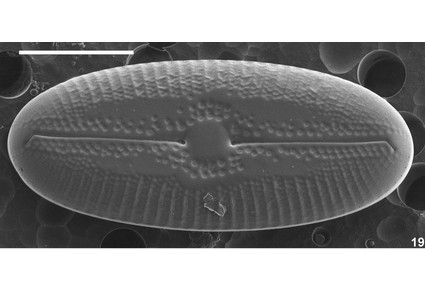
A new Diploneis species, D. langebertalotii sp. nov., is described from the sub-Antarctic islands in the southern Indian Ocean. The new species was previously identified as D. subovalis, a species described and only with certainty known from the North Island of New Zealand. The separation from D. subovalis is mainly based on differences in the length/width ratio, giving D. langebertalotii a more elongated, less elliptical outline. Diploneis langebertalotii, belonging to the subgenus Cribradiploneis, is characterised by rather large, linear-elliptic valves, biseriate striae, and typical small pores in the cribrate striae at the mantle edge. The latter feature is unusual in the genus Diploneis and only shared by only a small number of species. The new species was found under wet, terrestrial conditions such as wet mosses and moist soils.
References
- Bhatt, C. & Karthick, B. (2020) A new aerophilic species of the genus Diploneis (Bacillariophyta) from the Mawsmai cave of Meghalaya, Northeast India. Phytotaxa 443 (1): 67–78. https://doi.org/10.11646/phytotaxa.443.1.6
- Bourrelly, P. & Manguin, E. (1955 ‘1954’) Contribution à la flore algale d’eau douce des Iles Kerguelen. Mémoires de l’Institut Scientifique de Madagascar, Série B, Biologique Végétale 5: 5–58.
- Carlson, G.W.F. (1913) Süsswasser-Algen aus der Antarktis, Süd-Georgien und den Falkland Inseln. Wissenschaftliche Ergebnisse der Schwedischen Südpolar-Expedition 1901-1903, unter leitung von Dr. Otto Nordenskjöld. Stockholm, Lithographisches Institut des Generalstabs 4 (14): 1–94.
- Chattová, B., Lebouvier, M. & Van de Vijver, B. (2014) Freshwater diatom communities from Ile Amsterdam (TAAF, southern Indian Ocean). Fottea 14: 101–119. https://doi.org/10.5507/fot.2014.008
- Chattová, B., Lebouvier, M., Syrovátka, V. & Van de Vijver, B. (2021) Moss-inhabiting diatom communities from Ile Amsterdam (TAAF, southern Indian Ocean). Plant Ecology & Evolution 154 (1): 63–79. https://doi.org/10.5091/plecevo.2021.1767
- Cleve, P.T. (1891) The diatoms of Finland. Acta Societatia pro Fauna et Flora Fennica 8 (2): 1–68. https://doi.org/10.5962/bhl.title.64355
- Cleve, P.T. (1894) Synopsis of the naviculoid diatoms. Part I. Kongliga Svenska Vetenskapsakademiens Handlingar Series 4 26 (2): 1–194.
- Cox, E.J. & Ross, R. (1981) The striae of pennate diatoms. In: Ross, R. (Ed.) Proceedings of the Sixth Symposium on Recent and Fossil Diatoms. Budapest, September 1–5, 1980. Taxonomy · Morphology · Ecology · Biology. Otto Koeltz, Koenigstein, pp. 267–278.
- Ehrenberg, C.G. (1844) Mittheilung über 2 neue Lager von Gebirgsmassen aus Infusorien als Meeres-Absatz in Nord-Amerika und eine Vergleichung derselben mit den organischen Kreide-Gebilden in Europa und Afrika. Bericht über die zur Bekanntmachung Geeigneten Verhandlungen der Königl. Preuss. Akademie Der Wissenschaften zu Berlin 1844: 57–97.
- Ehrenberg, C.G. (1845) Vorläufige zweite Mittheilung über die weitere Erkenntnifs der Beziehungen des kleinsten organischen Lebens zu den vulkanischen Massen der Erde. I. Über die vulkanischen Infusorien-Tuffe (Pyrobiolithen) am Rhein. II. Über einen bedeutenden Infusiorien haltenden vulkanischen Aschen-Tuff (Pyrobiolith) auf der Insel Ascension. III. Über einen See-Infusioren haltenden weissen vulkanische Aschen-Tuff (Pyrobiolith) als sehr grosse Gebirgsmasse in Patagonien. Bericht über die zur Bekanntmachung geeigneten Verhandlungen der Königlich-Preussischen Akademie der Wissenschaften zu Berlin 1845: 133–157.
- Foged, N. (1979) Diatoms in New Zealand, the North Island. Bibliotheca Phycologica 47: 1–255.
- Gaertner, P., Meyer, B. & Scherbius, J. (1802) Oekonomisch-technische Flora der Wetterau. Band 3, Zweite Abtheilung. Heinrich Ludwig Brönner, Frankfurt am Main, 432 pp.
- Germain, H. (1937) Diatomées d’une tourbe de l’île Kerguelen. Bulletin de la Société Française de Microscopie 6: 11–16.
- Goeyers, C., Vitt, D.H. & Van de Vijver, B. (2022) Taxonomic and biogeographical analysis of diatom assemblages from historic bryophyte samples from Campbell Island (sub-Antarctic). Plant Ecology and Evolution 155 (1): 107–122. https://doi.org/10.5091/plecevo.84543
- Greville, R.K. (1855) Report on a collection of Diatomaceae made in the district of Braemar by Professor Balfour and Mr. George Lawson. Annals and Magazine of Natural History, 2nd series 15: 252–261. https://doi.org/10.1080/037454809495417
- Guiry, M.D. & Guiry, G.M. (2026) AlgaeBase. World-wide electronic publication, National University of Ireland, Galway. Available from: https://www.algaebase.org (accessed 14 April 2026)
- Hantzsch, C.A. (1860) Neue Bacillarien: Nitzschia vivax var. elongata, Cymatopleura nobilis. Hedwigia 2 (7): 1–40.
- Hirano, M. (1965) Freshwater algae in the Antarctic Regions. Monographiae Biologicae 15: 127–193. https://doi.org/10.1007/978-94-015-7204-0_4
- Jaeger, A. (1875) Genera et species muscorum systematice disposita seu adumbratio florae muscorum totius orbis terrarum similes hucusque cognitorum. Bericht über die Thätigkeit der St. Gallischen Naturwissenschaftlichen Gesellschaft 1873–74: 85–188.
- Jovanovska, E., Nakov, T. & Levkov, Z. (2013) Observations of the genus Diploneis from Lake Ohrid, Macedonia. Diatom Research 28 (3): 237–262. https://doi.org/10.1080/0269249X.2013.797219
- Jovanovska, E., Levkov, Z. & Edlund, M.B. (2015) The genus Diploneis Ehrenberg ex Cleve (Bacillariophyta) from Lake Hövsgöl, Mongolia. Phytotaxa 217 (3): 201–248. https://doi.org/10.11646/phytotaxa.217.3.1
- Jovanovska, E. & Levkov, Z. (2020) The genus Diploneis in the Republic of Northern Macedonia. Diatoms of Europe 9: 527–689, 691–699.
- Jovanovska, E., Wilson, M.C., Hamilton, P.B. & Stone, J. (2023) Morphological and molecular characterization of twenty-five new Diploneis species (Bacillariophyta) from Lake Tanganyika and its surrounding areas. Phytotaxa 593: 1–102. https://doi.org/10.11646/phytotaxa.593.1.1
- Kellogg, T.B. & Kellogg, D.E. (2002) Non-marine and littoral diatoms from Antarctic and sub-Antarctic regions. Distribution and updated taxonomy. Diatom Monographs 1: 1–795.
- Krammer, K. & Lange-Bertalot, H. (1986) Süßwasserflora von Mitteleuropa. Bacillariophyceae: Naviculaceae. Vol. 2/1. Gustav Fischer Verlag, Stuttgart & New York, pp. [i]–xvi, [1]–876.
- Krasske, G. (1949) Subfossile Diatomeen aus den Mooren Patagoniens und Feuerlands. Annales Academiae Scientiarum Fennicae, Sarja Series A IV, Biologica 14: 1–95.
- Lange-Bertalot, H. (1999) Neue Kombinationen von Taxa aus Achnanthes Bory (sensu lato). Iconographia Diatomologica 6: 270–283.
- Lange-Bertalot, H. & Krammer, K. (1987) Bacillariaceae, Epithemiaceae, Surirellaceae. Neue und wenig bekannte Taxa, neue Kombinationen und Synonyme sowie Bemerkungen und Ergänzungen zu den Naviculaceae. Bibliotheca Diatomologica 15: 1–289.
- Lange-Bertalot, H. & Fuhrmann, A. (2016) Contribution to the genus Diploneis (Bacillariophyta): twelve species from Holarctic freshwater habitats proposed as new to science. Fottea 16 (2): 157–183. https://doi.org/10.5507/fot.2015.027
- Lange-Bertalot, H. & Reichardt, E. (2000) Diploneis ovalis sensu stricto und Diploneis krammeri nov. spec. Revision des aktuellen Konzepts von Diploneis ovalis (Hilse) Cleve. Iconographia Diatomologica 9: 650–669.
- Lange-Bertalot, H., Fuhrmann, A. & Werum, M. (2020) Freshwater Diploneis: species diversity in the Holarctic and spot checks from elsewhere. Diatoms of Europe 9: 1–526, 691–699.
- Larson, D.D. (1974) Paleoecological investigations of diatoms in a core from Kerguelen islands, Southeast Indian Ocean. Institute of Polar Studies, Ohio State University, 61 pp., Report no. 50.
- Le Cohu, R. & Maillard, R. (1986) Diatomées d’eau douce des îles Kerguelen (à l’exclusion des Monoraphidées). Annales de Limnologie 22: 99–118. https://doi.org/10.1051/limn/1986018
- Le Cohu, R. & Van de Vijver, B. (2002) Le genre Diadesmis (Bacillariophyta) dans les archipels de Crozet et de Kerguelen avec la description de cinq espèces nouvelles. Annales de Limnologie 38: 119–132. https://doi.org/10.1051/limn/2002010
- Moser, G., Lange-Bertalot, H. & Metzeltin, D. (1998) Insel der Endemiten. Geobotanisches Phänomen Neukaledonien. Island of endemics New Caledonia - a geobotanical phenomenon. Bibliotheca Diatomologica 38: 1–464.
- Parikh, H., Stone, J.R. & Jovanovska, E. (2024) Evolution and morphological diversity of the genus Diploneis (Bacillariophyta) in lake Malawi, with description of six new species. Phycologia 63 (5): 462–479. https://doi.org/10.1080/00318884.2024.2390142
- Petersen, J.B. (1928) The aërial algae of Iceland. In: Rosenvinge, L.K. & Warming, E. (Eds.) The botany of Iceland. Vol. II. Part II. Wheldon and Wesley, Copenhagen & London, pp. 328–447.
- Pierre, J.-F. (1977) Les algues des eaux courantes de l’île de la Possession (Archipel Crozet, Terres Australes Française). Bulletin de la Société Phycologique de France 22: 79–86.
- Rodionova, E.V., Pomazkina, G.V. & Sherbakova, T.A. (2024) Бентосные диатомовые водоросли рода diploneis озера байкал [Benthic diatom algae of the genus Diploneis of Lake Baikal. Atlas and key]. Siberian Branch of RAS, Novosibirsk, pp. 1–202. https://doi.org/10.53954/9785604990162
- Ross, R., Cox, E.J., Karayeva, N.I., Mann, D.G., Paddock, T.B.B., Simonsen, R. & Sims, P.A. (1979) An amended terminology for the siliceous components of the diatom cell. Nova Hedwigia, Beiheft 64: 513–533.
- Round, F.E., Crawford, R.M. & Mann, D.G. (1990) The Diatoms. Biology and Morphology of the Genera. Cambridge University Press, Cambridge.
- Rumrich, U., Lange-Bertalot, H. & Rumrich, M. (2000) Diatomeen der Anden Von Venezuela bis Patagonien/Feuerland. Iconographia Diatomologica 9: 1–649.
- Smith, W. (1853) A synopsis of the British Diatomaceae; with remarks on their structure, function and distribution; and instructions for collecting and preserving specimens. The plates by Tuffen West. Vol. I. John van Voorst, Paternoster Row, London, pp. [i]–xxxiii, 1–89. https://doi.org/10.5962/bhl.title.10706
- Turland, N.J., Wiersema, J.H., Barrie, F.R., Gandhi, K.N., Gravendyck, J., Greuter, W., Hawksworth, D.L., Herendeen, P.S., Klopper, R.R., Knapp, S., Kusber, W.-H., Li, D.-Z., May, T.W., Monro, A.M., Prado, J., Price, M.J., Smith, G.F. & Señoret, C.Z. (2025) International Code of Nomenclature for algae, fungi, and plants (Madrid Code). The University of Chicago Press, Chicago, Regnum Vegetabile 162, pp. 1–288. https://doi.org/10.7208/chicago/9780226839479.001.0001
- Van de Vijver, B. & Beyens, L. (1996) Freshwater diatom communities of the Strømness Bay area, South Georgia. Antarctic Science 8: 359–368. https://doi.org/10.1017/S0954102096000533
- Van de Vijver, B. & Beyens, L. (1997) The epiphytic diatom flora from mosses of Strømness Bay area. Polar Biology 17: 492–501. https://doi.org/10.1007/s003000050148
- Van de Vijver, B. & Beyens, L. (1999a) Freshwater diatoms from Ile de la Possession (Crozet Archipelago, Subantarctica): an ecological assessment. Polar Biology 22: 178–188. https://doi.org/10.1007/s003000050408
- Van de Vijver, B. & Beyens, L. (1999b) Moss diatom communities from Ile de la Possession. Polar Biology 22: 219–231. https://doi.org/10.1007/s003000050414
- Van de Vijver, B., Ledeganck, P. & Beyens, L. (2001) Habitat preferences in freshwater diatom communities from sub-Antarctic Îles Kerguelen. Antarctic Science 13 (1): 28–36. https://doi.org/10.1017/S0954102001000050
- Van de Vijver, B., Frenot, Y. & Beyens, L. (2002) Freshwater diatoms from Ile de la Possession (Crozet Archipelago, Subantarctica). Bibliotheca Diatomologica 46: 1–412.
- Van de Vijver, B., Beyens, L., Vincke, S. & Gremmen, N.J.M. (2004a) Moss-inhabiting diatom communities from Heard Island, sub-Antarctic. Polar Biology 27: 532–543. https://doi.org/10.1007/s00300-004-0629-x
- Van de Vijver, B., Beyens, L. & Lange-Bertalot, H. (2004b) The genus Stauroneis in the Arctic and (Sub-)Antarctic Regions. Bibliotheca Diatomologica 51: 1–317.
- Van de Vijver, B., Gremmen, N.J.M. & Smith, V. (2008) Diatom communities from the sub-Antarctic Prince Edward Islands: diversity and distribution patterns. Polar Biology 31: 795–808. https://doi.org/10.1007/s00300-008-0418-z
- Van de Vijver, B., Scholberg, P. & Lebouvier, M. (2020) Pinnularia schoelynckiana, a new limnoterrestrial diatom species (Bacillariophyta) from the sub-Antarctic Iles Kerguelen (southern Indian Ocean). Botany Letters 167 (1): 42–49. https://doi.org/10.1080/23818107.2019.1675185
- van der Werff, A. (1955) A new method of concentrating and cleaning diatoms and other organisms. Internationalen Vereinigung für Theoretische und Angewandte Limnologie: Verhandlungen 12 (1): 276–277. https://doi.org/10.1080/03680770.1950.11895297
- Van Heurck, H. (1881) Synopsis des Diatomées de Belgique Atlas. Ducaju et Cie, Anvers, pp. pls XXXI–LXXVII [31–77].
- Villamor, G.B., Steer, B.S.C., Baluyot, A. & Meason, D.F. (2025) Understanding land‑use transitions in rural areas of the North Island, New Zealand from 1996 to 2018: an intensity analysis approach. GeoJournal 90 (76): 1–17. https://doi.org/10.1007/s10708-025-11324-6
- Witkowski, A., Kulikovskiy, M. & Riaux-Gobin, C. (2012) Achnanthidium sieminskae, a new diatom species from the Kerguelen Archipelago (Austral Islands). In: Wołowski, K., Kaczmarska, I., Ehrman, J.M. & Wojtal, A.Z. (Eds.) Current Advances in Algal Taxonomy and its Applications. pp. 61–68.