
Abstract
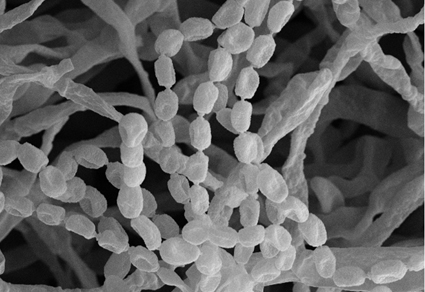
We describe Penicillium termitintestinicola sp. nov., isolated from the gut of an Odontotermes termite species collected from the Satara district of Maharashtra, India. Its taxonomic placement was assessed using an integrative approach combining morphology with multilocus phylogenetic analyses of the ribosomal internal transcribed spacer (ITS) region, partial beta-tubulin (BenA), calmodulin (CaM), and RNA polymerase II second-largest subunit (RPB2) genes. The new species formed a well-supported lineage sister to the series Thiersiorum within the section Aspergilloides, distinct from all currently recognised series. Consequently, we propose the series Termitintestinicolarum ser. nov. to accommodate this lineage. Penicillium termitintestinicola is characterised by non-vesiculate, monoverticillate conidiophores with short stipes, predominantly ellipsoidal, smooth conidia, greyish brown sclerotia on Malt Extract Agar (MEA) and Oatmeal Agar (OA), and colonies that produce a strong acid on Creatine Sucrose Agar (CREA). These findings highlight termite gut microhabitats as an underexplored niche for fungal discovery in India.
References
- Abreu, A.C., Gonçalves, M.F., Esteves, A.C. & Alves, A. (2025) Diversity and temporal succession of early-colonizing fungi in wood baits from an estuarine environment, with description of Penicillium alavariense sp. nov. Fungal Biology: 101645. https://doi.org/10.1016/j.funbio.2025.101645
- Ahmad, F., Yang, G., Zhu, Y., Poulsen, M., Li, W., Yu, T. & Mo, J. (2022) Tripartite symbiotic digestion of lignocellulose in the digestive system of a fungus-growing termite. Microbiology Spectrum 10 (6): e01234–22. https://doi.org/10.1128/spectrum.01234-22
- Aljanabi, S.M. & Martinez, I. (1997) Universal and rapid salt-extraction of high-quality genomic DNA for PCR-based techniques. Nucleic Acids Research 25 (22): 4692–4703. https://doi.org/10.1093/nar/25.22.4692
- Ashtekar, N., Anand, G., Thulasiram, H.V. & Rajeshkumar, K.C. (2021) Genus Penicillium: Advances and application in the modern era. In: Singh, J. & Gehlot, P. (Eds.) New and Future Developments in Microbial Biotechnology and Bioengineering: Recent Advances in Application of Fungi and Fungal Metabolites: Current Aspects. Elsevier, Amsterdam, pp. 201–213. https://doi.org/10.1016/B978-0-12-821005-5.00014-4
- Bianchini, G. & Sanchez-Baracaldo, P. (2024) TreeViewer: Flexible, modular software to visualise and manipulate phylogenetic trees. Ecology and Evolution 14: e10873. https://doi.org/10.1002/ece3.10873
- Carbonero-Pacheco, J., Aguilar, J., Raya, M.C., Trapero, A., Gaju-Ricart, M. & Agustí-Brisach, C. (2023) Diversity of cellulolytic microorganisms associated with the subterranean termite Reticulitermes grassei. Journal of Fungi 9 (3): 294. https://doi.org/10.3390/jof9030294
- Furnell, A., Benaud, N., Vázquez-Campos, X., Liew, E.C., Mertin, A., Vink, J.A., Montgomery, K., Wilkins, M.R., Summerell, B.A. & Ferrari, B.C. (2025) Penicillium psychrofluorescens sp. nov., a naturally autofluorescent Antarctic fungus. Mycology 16 (3): 1315–1338. https://doi.org/10.1080/21501203.2024.2421319
- Glass, N.L. & Donaldson, G.C. (1995) Development of primer sets designed for use with the PCR to amplify conserved genes from filamentous ascomycetes. Applied and Environmental Microbiology 61 (4): 1323–1330. https://doi.org/10.1128/aem.61.4.1323-1330.1995
- Hawksworth, D.L. (1974) Mycologist’s Handbook: An Introduction to the Principles of Taxonomy and Nomenclature in the Fungi and Lichens. Commonwealth Mycological Institute, Kew.
- Hawksworth, D.L. & Lücking, R. (2017) Fungal diversity revisited: 2.2 to 3.8 million species. Microbiology Spectrum 5 (4): 0.1128/microbiolspec.funk-0052-2016. https://doi.org/10.1128/microbiolspec.FUNK-0052-2016
- Hong, S.B., Cho, H.S., Shin, H.D., Frisvad, J.C. & Samson, R.A. (2006) Novel Neosartorya species isolated from soil in Korea. International Journal of Systematic and Evolutionary Microbiology 56 (2): 477–486. https://doi.org/10.1099/ijs.0.63980-0
- Houbraken, J., Visagie, C.M., Meijer, M., Frisvad, J.C., Busby, P.E., Pitt, J.I., Seifert, K.A., Louis-Seize, G., Demirel, R., Yilmaz, N. & Jacobs, K. (2014) A taxonomic and phylogenetic revision of Penicillium section Aspergilloides. Studies in Mycology 78: 373–451. https://doi.org/10.1016/j.simyco.2014.09.002
- Houbraken, J., Kocsubé, S., Visagie, C.M., Yilmaz, N., Wang, X.C., Meijer, M., Kraak, B., Hubka, V., Bensch, K., Samson, R.A. & Frisvad, J.C. (2020) Classification of Aspergillus, Penicillium, Talaromyces and related genera (Eurotiales): An overview of families, genera, subgenera, sections, series and species. Studies in Mycology 95: 51–69. https://doi.org/10.1016/j.simyco.2020.05.002
- Houbraken, J.A. & Samson, R.A. (2011) Phylogeny of Penicillium and the segregation of Trichocomaceae into three families. Studies in Mycology 70 (1): 1–51. https://doi.org/10.3114/sim.2011.70.01
- Jeewon, R. & Hyde, K.D. (2016) Establishing species boundaries and new taxa among fungi: recommendations to resolve taxonomic ambiguities. Mycosphere 7 (11): 1669–1677. https://doi.org/10.5943/mycosphere/7/11/4
- Jayasimha, P. & Henderson, G. (2007) Fungi isolated from integument and guts of Coptotermes formosanus and their antagonistic effect on Gloeophyllum trabeum. Annals of the Entomological Society of America 100 (5): 703–710. https://doi.org/10.1603/0013-8746(2007)100[703:FIFIAG]2.0.CO;2
- Kalyaanamoorthy, S., Minh, B.Q., Wong, T.K., von Haeseler, A. & Jermiin, L.S. (2017) ModelFinder: Fast model selection for accurate phylogenetic estimates. Nature Methods 14 (6): 587–589. https://doi.org/10.1038/nmeth.4285
- Katoh, K. & Standley, D.M. (2013) MAFFT multiple sequence alignment software version 7: Improvements in performance and usability. Molecular Biology and Evolution 30 (4): 772–780. https://doi.org/10.1093/molbev/mst010
- Kornerup, A. & Wanscher, J.H. (1978) Methuen Handbook of Colour. 3rd edn. Methuen, London.
- Liang, R.N., Lin, X.H., An, M.M. & Zhao, G.Z. (2025) Two new species of Penicillium (Eurotiales, Aspergillaceae) from China based on morphological and molecular analyses. MycoKeys 116: 255–274. https://doi.org/10.3897/mycokeys.116.149376
- Liu, Y.J., Whelen, S. & Hall, B.D. (1999) Phylogenetic relationships among ascomycetes: Evidence from an RNA polymerase II subunit. Molecular Biology and Evolution 16: 1799–1808. https://doi.org/10.1093/oxfordjournals.molbev.a026092
- Murthy, K.S. (2020) Molecular identity of subterranean termites. International Journal of Applied Sciences and Biotechnology 8 (4): 410–416. https://doi.org/10.3126/ijasbt.v8i4.32445
- Myers, N., Mittermeier, R.A., Mittermeier, C.G., da Fonseca, G.A.B. & Kent, J. (2000) Biodiversity hotspots for conservation priorities. Nature 403: 853–858. https://doi.org/10.1038/35002501
- Peterson, S.W., Bayer, E.M. & Wicklow, D.T. (2004) Penicillium thiersii, Penicillium angulare and Penicillium decaturense, new species isolated from wood-decay fungi in North America and their phylogenetic placement from multilocus DNA sequence analysis. Mycologia 96 (6): 1280–1293. https://doi.org/10.1080/15572536.2005.11832878
- Rajeshkumar, K.C. & Sruthi, O.P. (2024) Untangling the taxonomic conundrum: Systematizing the conidial Ascomycota of the Western Ghats, India. In: Proceedings of the International Mycological Congress XII (IMC 12), Poster 159. Maastricht.
- Ronquist, F., Teslenko, M., Van Der Mark, P., Ayres, D.L., Darling, A., Höhna, S., Larget, B., Liu, L., Suchard, M.A. & Huelsenbeck, J.P. (2012) MrBayes 3.2: Efficient Bayesian phylogenetic inference and model choice across a large model space. Systematic Biology 61 (3): 539–542. https://doi.org/10.1093/sysbio/sys029
- Rosa, V.S., da Silva, A.R., Ferrari, P., Trivella, D.B., de Souza, M.C., Sette, L.D., de Felício, R., Iamanaka, B.T., Taniwaki, M.H. & Silva, J.J. (2025) Newly discovered fungal species from black pepper marketed in Brazil: Penicillium pipericola sp. nov. and Syncephalastrum brasiliense sp. nov. Microorganisms 13 (12): 2691. https://doi.org/10.3390/microorganisms13122691
- Suh, S.-O., McHugh, J.V., Pollock, D.D. & Blackwell, M. (2005) The beetle gut: a hyperdiverse source of novel yeasts. Mycological Research 109(3): 261–265. https://doi.org/10.1017/S0953756205002388
- Tan, Y.P., Minns, S.A. & Lacey, A.E. (2025) Nomenclatural novelties. Index of Australian Fungi 60: 1–15. https://doi.org/10.5281/zenodo.16298231
- Tan, Y.P., Minns, S.A., Crombie, A., Vuong, D. & Lacey, E. (2026a) Nomenclatural novelties. Index of Australian Fungi 67: 1–30. https://doi.org/10.5281/zenodo.18502782
- Tan, Y.P., Sbaraini, N., Minns, S.A., Vuong, D., Kantvilas, G., Crombie, A., Chooi, Y.H. & Lacey, E. (2026b) Nomenclatural novelties. Index of Australian Fungi 69: 1–30. https://doi.org/10.5281/zenodo.19325562
- Visagie, C.M., Houbraken, J., Frisvad, J.C., Hong, S.B., Klaassen, C.H.W., Perrone, G., Seifert, K.A., Varga, J., Yaguchi, T. & Samson, R.A. (2014) Identification and nomenclature of the genus Penicillium. Studies in Mycology 78 (1): 343–371. https://doi.org/10.1016/j.simyco.2014.09.001
- Visagie, C.M., Yilmaz, N., Kocsubé, S., Frisvad, J.C., Hubka, V., Samson, R.A. & Houbraken, J. (2024) A review of recently introduced Aspergillus, Penicillium, Talaromyces and other Eurotiales species. Studies in Mycology 107: 1–66. https://doi.org/10.3114/sim.2024.107.01
- Visagie, C.M., Houbraken, J., Overy, D.P., Sklenař, F., Bensch, K., Frisvad, J.C., Mack, J., Perrone, G., Samson, R.A., van Vuuren, N.I. & Yilmaz, N. (2025) From chaos to tranquillity: A modern approach to the identification, nomenclature and phylogeny of Aspergillus, Penicillium and other Eurotiales updated accepted species list. Studies in Mycology 112 (1): 117–260. https://doi.org/10.3114/sim.2025.112.04
- White, T.J., Bruns, T., Lee, S. & Taylor, J. (1990) Amplification and direct sequencing of fungal ribosomal RNA genes for phylogenetics. In: Innis, M.A., Gelfand, D.H., Sninsky, J.J. & White, T.J. (Eds.) PCR Protocols: A Guide to Methods and Applications. Academic Press, New York, pp. 315–322. https://doi.org/10.1016/B978-0-12-372180-8.50042-1
- Wong, T.K., Ly-Trong, N., Ren, H., Baños, H., Roger, A.J., Susko, E., Bielow, C., De Maio, N., Goldman, N., Hahn, M.W. & Huttley, G. (2025) IQ-TREE 3: Phylogenomic inference software using complex evolutionary models. Preprint. https://doi.org/10.32942/X2P62N