
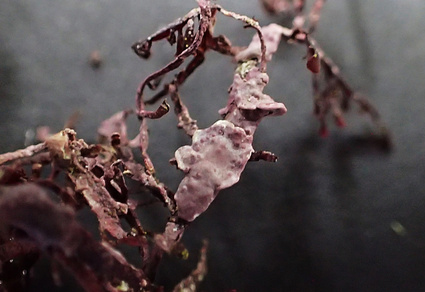

Abstract
The subfamily Lithophylloideae includes non-geniculate coralline algal genera for which taxonomic uncertainty persists due to pronounced morphological plasticity and the limited availability of type-anchored molecular data. Here, we report Pseudoderma sinicarum and Lithophyllum nagaokaense as new records from Korea, identified based on plastid DNA markers (psbA and rbcL) and morpho-anatomical observations. Phylogenetic analyses showed that sequences from Korean specimens were identical and nearly identical to the corresponding holotype sequences, providing strong molecular support for their taxonomic identities. Morpho-anatomical comparisons showed that Korean specimens of L. nagaokaense were consistent with the original description from Japan, whereas those of P. sinicarum exhibited previously undocumented variation in hypothallial cell type (palisade vs. non-palisade), cell dimensions, and the persistence of bistratose construction compared with the original description from China. These findings demonstrate that characters traditionally used for generic delimitation in Lithophylloideae can exhibit intraspecific variation. By integrating type-anchored molecular evidence with morpho-anatomical assessment, this study expands the known geographic distributions of both species and contributes to understanding taxonomic complexity within Lithophylloideae.
References
- Adey, W.H. & Adey, P.J. (1973) Studies on the biosystematics and ecology of the epilithic crustose Corallinaceae of the British Isles. British Phycological Journal 8: 343–407. https://doi.org/10.1080/00071617300650381
- Baba, M. & Kato, A. (2023) Taxonomic and distributional accounts on the non-geniculate coralline algae in Japan. Report of Marine Ecology Research Institute 28: 1–252.
- Basso, D., Caragnano, A. & Rodondi, G. (2014) Trichocytes in Lithophyllum kotschyanum and Lithophyllum spp. (Corallinales, Rhodophyta) from the NW Indian Ocean. Journal of Phycology 50: 711–717. https://doi.org/10.1111/jpy.12197
- Basso, D., Caragnano, A., Le Gall, L. & Rodondi, G. (2015) The genus Lithophyllum in the north-western Indian Ocean, with description of L. yemenense sp. nov., L. socotraense sp. nov., L. subplicatum comb. et stat. nov., and the resumed L. affine, L. kaiseri and L. subreduncum (Rhodophyta, Corallinales). Phytotaxa 208 (3): 183–200. https://doi.org/10.11646/phytotaxa.208.3.1
- Bittner, L., Payri, C.E., Maneveldt, G.W., Couloux, A., Cruaud, C., de Reviers, B. & Le Gall, L. (2011) Evolutionary history of the Corallinales (Corallinophycidae, Rhodophyta) inferred from nuclear, plastidial and mitochondrial genomes. Molecular Phylogenetics and Evolution 61: 697–713. https://doi.org/10.1016/j.ympev.2011.07.019
- Campbell, S.J. & Woelkerling, W.J. (1990) Are Titanoderma and Lithophyllum (Corallinaceae, Rhodophyta) distinct genera? Phycologia 29: 114–125. https://doi.org/10.2216/i0031-8884-29-1-114.1
- Caragnano, A., Foetisch, A., Maneveldt, G.W., Millet, L., Liu, L.-C., Lin, S.-M., Rodondi, G. & Payri, C.E. (2018) Revision of Corallinaceae (Corallinales, Rhodophyta): recognizing Dawsoniolithon gen. nov., Parvicellularium gen. nov. and Chamberlainoideae subfam. nov. containing Chamberlainium gen. nov. and Pneophyllum. Journal of Phycology 54: 391–409. https://doi.org/10.1111/jpy.12644
- Chamberlain, Y.M. (1991) Historical and taxonomic studies in the genus Titanoderma (Rhodophyta, Corallinales) in the British Isles. Bulletin of the British Museum (Natural History), Botany 21: 1–80.
- Chamberlain, Y.M. (1996) Lithophylloid Corallinaceae (Rhodophyta) of the genera Lithophyllum and Titanoderma from southern Africa. Phycologia 35: 204–221. https://doi.org/10.2216/i0031-8884-35-3-204.1
- Chamberlain, Y.M. & Irvine, L.M. (1994) Lithophylloideae Setchell. In: Irvine, L.M. & Chamberlain, Y.M. (Eds.) Seaweeds of the British Isles. Volume 1. Rhodophyta, Part 2B: Corallinales, Hildenbrandiales. HMSO, London, pp. 58–112. https://doi.org/10.1017/S0025315400090342
- Crouan, P.L. & Crouan, H.M. (1867) Florule du Finistère contenant les descriptions de 360 espèces nouvelles de sporogames, de nombreuses observations et une synonymie des plantes cellulaires et vasculaires qui croissent spontanément dans ce département, accompagnées de trente-deux planches où est représentée l’organographie, faite sur l’état vif, des fruits et des tissus de 198 genres d’algues avec la plante grandeur naturelle ou rédu plus une planche supplémentaire où sont figurés 24 champignons nouveaux. Friedrich Klincksieck, Paris & J.B. et A. Lefournier, Brest, 262 pp. https://doi.org/10.5962/bhl.title.11601
- Farr, T.J., Broom, J., Hart, D.R., Neill, K. & Nelson, W.A. (2009) Common coralline algae of northern New Zealand: An identification guide. NIWA.
- Fontana, S., Chang, W.R. & Liu, S.L. (2026) A multilocus Nanopore eDNA workflow for red algal diversity assessment in an algal reef system. Ecology and Evolution 16: e74209. https://doi.org/10.1002/ece3.74209
- Foslie, M. (1895) The Norwegian forms of Lithothamnion. Det Kongelige Norske Videnskabers Selskabs Skrifter 1894: 29–208. https://doi.org/10.18261/bs.dknvss
- Foslie, M. (1897) On some Lithothamnia. Det Kongelige Norske Videnskabers Selskabs Skrifter 1897 (1): 1–20. https://doi.org/10.18261/bs.dknvss
- Foslie, M. (1899) Some new or critical lithothamnia. Det Kongelige Norske Videnskabers Selskabs Skrifter 1898 (6): 1–19. https://doi.org/10.18261/bs.dknvss
- Foslie, M. (1900a) Five new calcareous algae. Det Kongelige Norske Videnskabers Selskabs Skrifter 1900 (3): 1–6. https://doi.org/10.18261/bs.dknvss
- Foslie, M. (1900b) New or critical calcareous algae. Det Kongelige Norske Videnskabers Selskabs Skrifter 1899 (5): 1–34. https://doi.org/10.18261/bs.dknvss
- Foslie, M. (1900c) Revised systematical survey of the Melobesieae. Det Kongelige Norske Videnskabers Selskabs Skrifter 1900 (5): 1–22. https://doi.org/10.18261/bs.dknvss
- Foslie, M. (1901) New forms of lithothamnia. Det Kongelige Norske Videnskabers Selskabs Skrifter 1901 (3): 1–6. https://doi.org/10.18261/bs.dknvss
- Foslie, M. (1905) New lithothamnia and systematical remarks. Det Kongelige Norske Videnskabers Selskabs Skrifter 1905 (5): 1–9. https://doi.org/10.18261/bs.dknvss
- Foslie, M. (1906) Den botaniske samling. Det Kongelige Norske Videnskabers Selskabs Aarsberetning 1905: 17–24.
- Foslie, M. (1907) Algologiske notiser IV. Det Kongelige Norske Videnskabers Selskabs Skrifter 1907 (6): 1–30. https://doi.org/10.18261/bs.dknvss
- Foslie, M. (1909) Algologiske notiser VI. Det Kongelige Norske Videnskabers Selskabs Skrifter 1909 (2): 1–63. https://doi.org/10.18261/bs.dknvss
- Freshwater, D.W. & Rueness, J. (1994) Phylogenetic relationships of some European Gelidium (Gelidiales, Rhodophyta) species, based on rbcL nucleotide sequence analysis. Phycologia 33: 187–194. https://doi.org/10.2216/i0031-8884-33-3-187.1
- Gabrielson, P.W., Miller, K.A. & Martone, P.T. (2011) Morphometric and molecular analyses confirm two distinct species of Calliarthron (Corallinales, Rhodophyta), a genus endemic to the northeast Pacific. Phycologia 50: 298–316. https://doi.org/10.2216/10-42.1
- Gomes, F.P., Lyra, M.B., Torrano-Silva, B.N., Vieira-Pinto, T., Jesionek, M.B., Coutinho, L.M., Henriques, M.C.M.O., Bahia, R.G., Salgado, L.T., Oliveira, M.C. & Barros-Barreto, M.B.B. (2024) Survey of non-geniculate coralline red algae from Brazil and the identification of four new species of Lithophyllum (Corallinales, Corallinophycidae). Phycologia 63: 339–359. https://doi.org/10.1080/00318884.2024.2376344
- Guiry, M.D. & Guiry, G.M. (2026) AlgaeBase. World-wide electronic publication, National University of Ireland, Galway. Available from: http://www.algaebase.org (accessed 19 October 2026)
- Hernández-Kantún, J.J., Rindi, F., Adey, W.H., Heesch, S., Peña, V., Le Gall, L. & Gabrielson, P.W. (2015) Sequencing type material resolves the identity and distribution of the generitype Lithophyllum incrustans, and related European species L. hibernicum and L. bathyporum (Corallinales, Rhodophyta). Journal of Phycology 51: 791–807. https://doi.org/10.1111/jpy.12319
- Hernández-Kantún, J.J., Gabrielson, P.W., Hughey, J.R., Pezzolesi, L., Rindi, F., Robinson, N.M., Peña, V., Riosmena-Rodríguez, R., Le Gall, L. & Adey, W.H. (2016) Reassessment of branched Lithophyllum spp. (Corallinales, Rhodophyta) in the Caribbean Sea with global implications. Phycologia 55: 619–639. https://doi.org/10.2216/16-7.1
- Heydrich, F. (1897a) Corallinaceae, insbesondere Melobesieae. Berichte der Deutschen Botanischen Gesellschaft 15: 34–70. https://doi.org/10.1111/j.1438-8677.1897.tb04781.x
- Heydrich, F. (1897b) Melobesiae. Berichte der Deutschen Botanischen Gesellschaft 15 (7): 403–420. https://doi.org/10.1111/j.1438-8677.1897.tb06141.x
- Huelsenbeck, J.P. & Ronquist, F. (2001) MRBAYES: Bayesian inference of phylogenetic trees. Bioinformatics 17: 754–755. https://doi.org/10.1093/bioinformatics/17.8.754
- Irvine, L.M. & Chamberlain, Y.M. (1994) Seaweeds of the British Isles, Volume 1: Rhodophyta, Part 2B: Corallinales, Hildenbrandiales. British Museum (Natural History), London, 276 pp. https://doi.org/10.1017/s0025315400090342
- Jesionek, M.B., Bahia, R.G., Hernández-Kantún, J.J., Adey, W.H., Yoneshigue-Valentin, Y., Longo, L.L. & Amado-Filho, G.M. (2016) A taxonomic account of non-geniculate coralline algae (Corallinophycidae, Rhodophyta) from shallow reefs of the Abrolhos Bank, Brazil. Algae 31: 317–340. https://doi.org/10.4490/algae.2016.31.11.16
- Jeong, S.Y., Nelson, W.A., Sutherland, J.E., Peña, V., Le Gall, L., Diaz-Pulido, G. & Cho, T.O. (2021) Corallinapetrales and Corallinapetraceae: A new order and family of coralline red algae including Corallinapetra gabrielii comb. nov. Journal of Phycology 57: 849–862. https://doi.org/10.1111/jpy.13115
- Kato, A. & Baba, M. (2019) Distribution of Lithophyllum kuroshioense sp. nov., Lithophyllum subtile and L. kaiseri (Corallinales, Rhodophyta), but not L. kotschyanum, in the northwestern Pacific Ocean. Phycologia 58: 648–660. https://doi.org/10.1080/00318884.2019.1643200
- Kato, A., Basso, D., Caragnano, A., Rodondi, G., Le Gall, L., Peña, V., Hall-Spencer, J.M. & Baba, M. (2022a) Morphological and molecular assessment of Lithophyllum okamurae with the description of L. neo-okamurae sp. nov. (Corallinales, Rhodophyta). Phycologia 61: 117–131. https://doi.org/10.1080/00318884.2021.2005330
- Kato, A., Muangmai, N. & Baba, M. (2022b) Confirmation of Lithophyllum trincomaliense comb. & stat. nov. and of L. validum (Corallinales, Rhodophyta) as distinct species based on genetic and morpho-anatomical analyses of type material. Phycologia 61 (6): 669–678. https://doi.org/10.1080/00318884.2022.2128572
- Katoh, K. & Standley, D.M. (2013) MAFFT multiple sequence alignment software version 7: Improvements in performance and usability. Molecular Biology and Evolution 30: 772–780. https://doi.org/10.1093/molbev/mst010
- Kim, G.W., Jeong, S.Y., Won, B.Y. & Cho, T.O. (2024) Distribution pattern of a new record crustose red alga, Lithophyllum neo-okamurae (Corallinales, Rhodophyta), in Korea. Korean Journal of Environmental Biology 42: 258–266. https://doi.org/10.11626/KJEB.2024.42.3.258
- Korshunova, T., Picton, B., Furfaro, G., Mariottini, P., Pontes, M., Prkić, J., Fletcher, K., Malmberg, K., Lundin, K. & Martynov, A. (2019) Multilevel fine-scale diversity challenges the ‘cryptic species’ concept. Scientific Reports 9: 6732. https://doi.org/10.1038/s41598-019-42297-5
- Lamarck, J.B. (1801) Système des animaux sans vertèbres, ou tableau général des classes, des ordres et des genres de ces animaux. Chez l’Auteur, Paris, 432 pp.
- Lee, K.T., Kim, T., Park, G.H., Oh, C., Park, H.S., Kang, D.H., Kang, H.S. & Yang, H.S. (2024) Assessment of sessile benthic communities in Jeju Island, Republic of Korea, using autonomous reef monitoring structures (ARMS). Diversity 16: 83. https://doi.org/10.3390/d16020083
- Lee, K.T., Vieira, C. & Kim, M.S. (2026a) A new crustose coralline alga, Lithophyllum jejuensis sp. nov. (Corallinales, Corallinophycidae, Rhodophyta), from Korea. Botanica Marina 69: 149–164. https://doi.org/10.1515/bot-2025-0069
- Lee, K.T., Yang, M.Y., Kang, J.C. & Kim, M.S. (2026b) Morpho-anatomical and genetic variation of Lithophyllum neo-okamurae and L. okamurae (Corallinales, Corallinophycidae, Rhodophyta) from Jeju Island, Korea. Phycological Research 74: 234–245. https://doi.org/10.1111/pre.70039
- Lee, Y.P. (2008) Marine algae of Jeju. Academy Publication, Seoul, Korea, 477 pp.
- Lee, Y.P. & Kang, S.Y. (2001) A catalogue of the seaweeds in Korea. Cheju National University Press, Cheju, Korea, 662 pp.
- Lemoine, M.P. (1913) Mélobésiées: révision des mélobésiées antarctiques. Masson et Cie, Paris, 64 pp.
- Lyra, M.B., Bahia, R.G., Jesionek, M.B., Carvalho, R.T., Moraes, F.C., Harvey, A.S., Pereira, R.C., Salgueiro, F. & Salgado, L.T. (2023) Hydrolithon farinosum and Lithophyllum epiphyticum sp. nov. (Corallinaceae, Corallinales, Rhodophyta), two epiphytic crustose coralline algae from the Abrolhos Archipelago, Brazil, Southwestern Atlantic. Diversity 15: 1013. https://doi.org/10.3390/d15091013
- Maneveldt, G.W., Gabrielson, P.W., Townsend, R.A. & Kangwe, J. (2019) Lithophyllum longense (Corallinales, Rhodophyta): A species with a widespread Indian Ocean distribution. Phytotaxa 419 (2): 149–168. https://doi.org/10.11646/phytotaxa.419.2.2
- Maneveldt, G.W., Brodie, J., Calderon, M.S., Diaz-Pulido, G., Gabrielson, P.W., Kato, A., Le Gall, L., Maridakis, C., Martone, P.T., Moro, I., Mrowicki, R.J., Nelson, W.A., Peña, V., Rindi, F., Rousseau, F., Schils, T., Schwoerbel, J., Tâmega, F.T.S. & Trentin, R. (2026) An updated classification of growth forms in non-geniculate coralline algae (Corallinophycidae, Rhodophyta). Journal of Phycology 62: 490–511. https://doi.org/10.1111/jpy.70144
- McCoy, S.J., Pueschel, C.M., Cornwall, C.E., Comeau, S., Kranz, S.A., Spindel, N.B. & Borowitzka, M.A. (2023) Calcification in the coralline red algae: A synthesis. Phycologia 62: 648–666. https://doi.org/10.1080/00318884.2023.2285673
- Min-Khant-Kyaw, K., Kato, A., Kurashima, A., Liao, L.M. & Baba, M. (2024) Lithophyllum nagaokaense sp. nov. (Corallinales, Corallinophycidae, Rhodophyta): A new rhodolith-forming non-geniculate coralline alga from Japan. Phycological Research 72: 167–179. https://doi.org/10.1111/pre.12549
- Min-Khant-Kyaw, K., Kato, A. & Baba, M. (2025) Magniporophytum gen. nov. and Orientalilithon gen. nov. (Hapalidiales, Corallinophycidae): Two new genera of coralline red algae from the Pacific Ocean, including the description of three new species. Journal of Phycology 61: 1718–1737. https://doi.org/10.1111/jpy.70098
- Min-Khant-Kyaw, K., Baba, M., Terada, R. & Kato, A. (2026) Unveiling coralline diversity of mesophotic rhodoliths in subtropical Japan, including new species of Sporolithon, emended genera Orientalilithon and Roseolithon (Corallinophycidae, Rhodophyta). Journal of Phycology 62: 1044–1070. https://doi.org/10.1111/jpy.70176
- Nägeli, C. (1858) Die Stärkekörner. In: Nägeli, C. & Cramer, C. (Eds.) Pflanzenphysiologisce Untersuchungen. Vol. 2, pp. i–x, 1–623.
- National Institute of Biological Resources (2026) National list of species of Korea. National Institute of Biological Resources, Incheon, Korea.
- Peña, V. & Torres, T.R.D.G. (2021) Lithophyllum artabricum V. Peña, sp. nov. (Corallinales, Rhodophyta): A cryptic species in the Atlantic Iberian Peninsula hitherto assigned to Lithophyllum stictiforme (Areschoug) Hauck. Cryptogamie, Algologie 42: 153–172. https://doi.org/10.5252/cryptogamie-algologie2021v42a11
- Peña, V., Vieira, C., Braga, J.C., Aguirre, J., Rösler, A., Baele, G. & Le Gall, L. (2020) Radiation of the coralline red algae (Corallinophycidae, Rhodophyta) crown group as inferred from a multilocus time-calibrated phylogeny. Molecular Phylogenetics and Evolution 150: 106845. https://doi.org/10.1016/j.ympev.2020.106845
- Pezzolesi, L., Falace, A., Kaleb, S., Hernández-Kantún, J.J., Cerrano, C. & Rindi, F. (2017) Genetic and morphological variation in an ecosystem engineer, Lithophyllum byssoides (Corallinales, Rhodophyta). Journal of Phycology 53: 146–160. https://doi.org/10.1111/jpy.12488
- Pezzolesi, L., Peña, V., Le Gall, L., Gabrielson, P.W., Kaleb, S., Hughey, J.R., Rodondi, G., Hernández-Kantún, J.J., Falace, A. & Rindi, F. (2019) Mediterranean Lithophyllum stictiforme (Corallinales, Rhodophyta) is a genetically diverse species complex: Implications for species circumscription, biogeography and conservation of coralligenous habitats. Journal of Phycology 55: 473–492. https://doi.org/10.1111/jpy.12837
- Philippi, R.A. (1837) Beweis, dass die Nulliporen Pflanzen sind. Archiv für Naturgeschichte 3: 387–393.
- Richards, J.L., Gabrielson, P.W. & Fredericq, S. (2014) New insights into the genus Lithophyllum (Lithophylloideae, Corallinaceae, Corallinales) from deepwater rhodolith beds offshore the NW Gulf of Mexico. Phytotaxa 190 (1): 162–175. https://doi.org/10.11646/phytotaxa.190.1.11
- Richards, J.L., Gabrielson, P.W., Hughey, J.R. & Freshwater, D.W. (2018) A re-evaluation of subtidal Lithophyllum species (Corallinales, Rhodophyta) from North Carolina, USA, and the proposal of L. searlesii sp. nov. Phycologia 57 (3): 318–330. https://doi.org/10.2216/17-110.1
- Rösler, A., Perfectti, F., Peña, V. & Braga, J.C. (2016) Phylogenetic relationships of Corallinaceae (Corallinales, Rhodophyta): Taxonomic implications for reef-building corallines. Journal of Phycology 52: 412–431. https://doi.org/10.1111/jpy.12404
- Setchell, W.A. (1943) Mastophora and the Mastophoreae: genus and subfamily of Corallinaceae. Proceedings of the National Academy of Science of the United States of America 29: 127–135. https://doi.org/10.1073/pnas.29.5.127
- Steneck, R.S. & Paine, R.T. (1986) Ecological and taxonomic studies of shallow-water encrusting Corallinaceae (Rhodophyta) of the boreal northeastern Pacific. Phycologia 25: 221–240. https://doi.org/10.2216/i0031-8884-25-2-221.1
- Tamura, K., Stecher, G. & Kumar, S. (2021) MEGA11: Molecular evolutionary genetics analysis version 11. Molecular Biology and Evolution 38: 3022–3027. https://doi.org/10.1093/molbev/msab120
- Thiers, B. (2026) Index herbariorum: A global directory of public herbaria and associated staff. New York Botanical Garden’s Virtual Herbarium. Available from: http://sweetgum.nybg.org/science/ih/ (accessed 2 March 2026)
- Torrano-Silva, B.N., Vieira, B.R., Riosmena-Rodríguez, R. & Oliveira, M.C. (2018) Guidelines for DNA barcoding of coralline algae, focusing on Lithophylloideae (Corallinales) from Brazil. Botanica Marina 61: 127–140. https://doi.org/10.1515/bot-2017-0040
- van der Reis, A.L., Sewell, M.A., Wade, R.M. & Nelson, W.A. (2026) Modular universal rbcL primers for (meta)barcoding: a systematic case study clarifying the identity of the marine macroalga Corallina armata (Rhodophyta, Corallinales). Metabarcoding and Metagenomics 10: 69–104. https://doi.org/10.3897/mbmg.10.173634
- van der Merwe, E., Miklasz, K., Channing, A., Maneveldt, G.W. & Gabrielson, P.W. (2015) DNA sequencing resolves species of Spongites (Corallinales, Rhodophyta) in the Northeast Pacific and South Africa, including S. agulhensis sp. nov. Phycologia 54 (5): 471–490. https://doi.org/10.2216/15-38.1
- Van der Merwe, E. & Maneveldt, G.W. (2016) A modern account of the South African non-geniculate Lithophylloideae (Corallinales, Corallinophycidae, Rhodophyta). South African Journal of Botany 103: 247–267. https://doi.org/10.1016/j.sajb.2015.07.013
- Vieira-Pinto, T., Oliveira, M.C., Bouzon, J., Sissini, M., Richards, J.L., Riosmena-Rodríguez, R. & Horta, P.A. (2014) Lithophyllum species from Brazilian coast: range extension of Lithophyllum margaritae and description of Lithophyllum atlanticum sp. nov. (Corallinales, Corallinophycidae, Rhodophyta). Phytotaxa 190 (1): 243–259. https://doi.org/10.11646/phytotaxa.190.1.21
- Wade, R.M., Gabrielson, P.W., Hind, K.R., Shivak, J., Hughey, J.R., Ohtsu, S., Baba, M., Kogame, K., Lindstrom, S.C., Miller, K.A. & Martone, P.T. (2023) Resolving some of the earliest names for Corallina species (Corallinales, Rhodophyta) in the North Pacific by sequencing type specimens and describing the cryptic C. hakodatensis sp. nov. and C. parva sp. nov. Journal of Phycology 59: 221–235. https://doi.org/10.1111/jpy.13299
- Woelkerling, W.J. (1988) The coralline red algae: An analysis of the genera and subfamilies of nongeniculate Corallinaceae. British Museum (Natural History) and Oxford University Press, Oxford, 268 pp.
- Woelkerling, W.J. & Campbell, S.J. (1992) An account of southern Australian species of Lithophyllum (Corallinales, Rhodophyta). Bulletin of the British Museum (Natural History), Botany 22: 1–107.
- Woelkerling, W.J., Irvine, L.M. & Harvey, A.S. (1993) Growth-forms in non-geniculate coralline red algae (Corallinales, Rhodophyta). Australian Systematic Botany 6: 277–293. https://doi.org/10.1071/SB9930277
- Yan, S.H., Wang, X.L., Xia, B.M. & Wang, G.C. (2024) A multiscale analysis of coralline algae Lithophylloideae (Corallinophycidae, Rhodophyta) shedding new light on understanding cryptic diversity. Molecular Phylogenetics and Evolution 199: 108140. https://doi.org/10.1016/j.ympev.2024.108140
- Yan, S.H., Wang, X.L., Sun, Z.M., Xia, B.M., Gu, W.H. & Wang, G.C. (2025) Study of epiphytic non-geniculate coralline algae reveals an evolutionarily significant genus, Pseudoderma gen. nov. (Lithophylloideae, Corallinophycidae). Molecular Phylogenetics and Evolution 206: 108313. https://doi.org/10.1016/j.ympev.2025.108313
- Yoon, H.S., Hackett, J.D. & Bhattacharya, D. (2002) A single origin of the peridinin- and fucoxanthin-containing plastids in dinoflagellates through tertiary endosymbiosis. Proceedings of the National Academy of Sciences 99: 11724–11729. https://doi.org/10.1073/pnas.172234799
- Supplementary file available from: https://doi.org/10.11646/phytotaxa.784.1.1