

Abstract
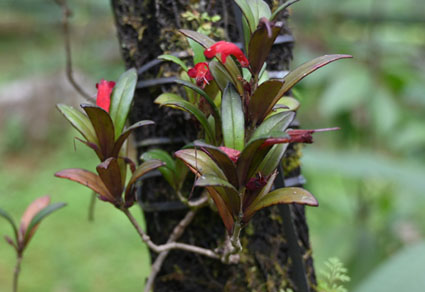
Aeschynanthus basarensis, from Arunachal Pradesh, India, is described and illustrated as a new species. It morphologically resembles Aeschynanthus micranthus in having sessile inflorescences, but differs due to the elliptic-lanceolate leaves, 3–4 cm long vs. narrowly ovate to elliptic, 5–10 cm long; calyx lobes linear-lanceolate vs. narrowly triangular to elliptic; corolla 2–2.2 vs. 2.5–3.5 cm long; style 4–4.2 vs. 0.5–1 cm long. It also appears to be morphologically similar to Aeschynanthus buxifolius, but differs in having leaves 3–4 vs. 0.7–2 cm long; bracts 1.5–2 vs. 3–4.5 mm; corolla lobes round, 2–2.5 mm vs. ovate to oblong, 3.2–3.5 mm; staminodes absent vs. present; style 4–4.2 vs. 0.65–1.5 cm long. This species is narrowly confined to the Lepa-Rada district of Arunachal Pradesh, in a small population comprising about 20–25 mature individuals in two localities Lep area of Soi Village. The threat status of this new species is provisionally assessed here as “Critically Endangered CRB2ab (III); D)” following the IUCN Red List Categories and Criteria version 16 (2024).
References
- Anthony, J. (1934) Diagnoses specierum novarum in herbario Horti Regii Botanici Edinburgensis cognitarum DLXX–DC. Notes from the Royal Botanic Garden, Edinburgh 18: 190–191. https://doi.org/10.24823/nrbge.1934.2388
- Bhattacharrya, U.C. (1997 [1993]) A new species of Aeschynanthus (Gesneriaceae) from Arunachal Pradesh, India. Bulletin of the Botanical Survey of India 35: 131–133. https://doi.org/10.20324/nelumbo/v35/1993/74420
- Bhattacharyya, U.C. & Goel, A.K. (2015 [‘2014’]) Systematic account of the genus Aeschynanthus Jack (Gesneriaceae) in India. Phytotaxonomy 14: 1–22.
- Bhattacharyya, U.C., Lakshminarasimhan, P. & Krishna, G. (2023) Gesneriaceae. In: Lakshminarasimhan, P., Arisdason, W., Karthigeyan, K., Krishna, G. & Mao, A.A. (Eds.) Flora of India 20. Botanical Survey of India, Kolkata, pp. 1–145.
- Candolle, A. de. (1845) Prodromus systematis naturalis regni vegetabilis Volume 9. Treuttel & Würtz, Paris, 573 pp. https://doi.org/10.5962/bhl.title.286
- Christie, F. & Mendum, M. (2002) The ontogeny of Aeschynanthus seeds–a comparative study using scanning electron microscopy. Botanical Journal of the Linnean Society 138: 197–207. https://doi.org/10.1046/j.1095-8339.2002.138002197.x
- Clarke, C.B. (1874) Commelynaceae et Cyrtandraceae Bengalenses. Thacker, Spink and Co., Calcutta, 133 pp. https://doi.org/10.5962/bhl.title.16058
- Clarke, C.B. (1883) Cyrtandreae. In: Candolle, A.L.L.P. de & Candolle, A.C.P. de (Eds.) Monographiae phanerogamarum prodromi nunc continuato, nunc revisi auctoribus Alphonso et Casimir de Candolle aliisque botanicis ultra memoratis, Vol. 5. G. Masson, Paris, pp. 304.
- Clarke, C.B. (1884) Gesneriaceae. In: Hooker, J.D. (Ed.) The Flora of British India 4. Reeve & Co., London, pp. 336–375.
- Debta, M.R., Shenoy, A., Akhil, M.K. & Nampy, S. (2024) Aeschynanthus maoi, a new species of Gesneriaceae from Arunachal Pradesh, India. Brittonia 76: 161–167. https://doi.org/10.1007/s12228-024-09790-2
- Dunn, S.T. (1903) Description of new Chinese plants, chiefly by S.T. Dunn, with an introductory notes by Charles Henry Wright, A.L.S. (Contributed by permission of Director of the Royal Botanic Garden Kew). The Journal of the Linnean Society, Botany 35: 483–518. https://doi.org/10.1111/j.1095-8339.1903.tb00699.x
- Dunn, S.T. (1920) Decades Kewenses: XCVI. Bulletin of Miscellaneous Information (Royal Botanic Gardens, Kew) 1920: 132–136. https://doi.org/10.2307/4120224
- Edwards, S. (1825–1826) Botanical Register Volume 11. James Ridgway, Piccadilly, London, t. 904.
- GBIF Secretariat (2023) GBIF Backbone Taxonomy. Aeschynanthus. Available from: https://doi.org/10.15468/39omei (accessed 17 September 2026) https://doi.org/10.15468/39omei
- GRC (2026, continuously updated) Gesneriaceae Resource Centre. Royal Botanic Garden Edinburgh U.K. Available from: https://padme.rbge.org.uk/GRC (accessed 17 September 2026)
- IUCN Standards & Petitions Committee (2024) Guidelines for using the IUCN Red List Categories and Criteria. Version 16. Prepared by the Standards and Petitions Committee. Available from: https://www.iucnredlist.org/documents/RedListGuidelines.pdf (accessed 17 September 2026)
- Jack (1823) On Cyrtandraceae, a new natural order of Plants. Transactions of the Linnean Society of London. London 14: 23–45. https://doi.org/10.1111/j.1095-8339.1823.tb00078.x
- Krishna, G., Lakshminarasimhan, P. & Bhattacharya, U.C. (2020) Gesneriaceae. In: Dash, S.S. & Mao, A.A. (Eds.) Flowering plants of India: an annotated checklist (Dicotyledons) 2. Botanical Survey of India, Kolkata, pp. 246–261.
- Lalhlupuii, M., Khomdram, S., Yumkham, S., Akhil, M.K. & Nampy, S. (2023) Aeschynanthus reiekensis, a new species of Gesneriaceae from Mizoram, Northeast India. Taiwania 68: 1–7. https://doi.org/10.6165/tai.2023.68.1
- Lamarck, J.B.A.P. de Monnet de & Poiret, J.L.M. (1789–1792) Encyclopédie méthodique. Botanique Par m. le chevalier de Lamarck Volume 3. Paris, Laporte, 759 pp. https://doi.org/10.5962/bhl.title.824
- Mendum, M., Lassnig, P., Weber, A. & Christie, F. (2001) Testa and seed appendage morphology in Aeschynanthus (Gesneriaceae): phytogeographical patterns and taxonomic implications. Botanical Journal of the Linnean Society 135: 195–213. https://doi.org/10.1111/j.1095-8339.2001.tb01091.x
- Middleton, D. (2007) A revision of Aeschynanthus (Gesneriaceae) in Thailand. Edinburgh Journal of Botany 64: 363–429. https://doi.org/10.1017/S0960428607004878
- Middleton, D. (2009) A revision of Aeschynanthus (Gesneriaceae) in Cambodia, Laos and Vietnam. Edinburgh Journal of Botany 66: 391–446. https://doi.org/10.1017/S0960428609990047
- Middleton, D. (2016) A revision of Aeschynanthus in Singapore and Peninsular Malaysia. Gardens’ Bulletin Singapore 68: 1–63. https://doi.org/10.3850/S2382581216000016
- Moaakum, S.D., Kri, S.K., Barbhuiya, H.A., Limthure & Krishna, G. (2025) A new species of Aeschynanthus Jack (Gesneriaceae) from North East India. Taiwania 70: 50–54. https://doi.org/10.6165/tai.2025.70.50
- Möller, M., Nampy, S., Janeesha, A.P. & Weber, A. (2017) The Gesneriaceae of India: consequences of updated generic concepts and new family classification. Rheedea 27: 23–41. https://doi.org/10.22244/rheedea.2017.27.1.5
- Roxburgh, W. (1820) Plants of the coast of Coromandel: selected from drawings and descriptions presented to the hon. court of directors of the East India Company, Volume 3. W. Bulmer and Co., London, 96 pp.
- Wallich, N. (1830) Plantae Asiaticae rariores Volume 1. Treuttel and Würtz, London, 84 pp. https://doi.org/10.5962/bhl.title.468
- Wang, W.T. (1975) Notulae de Gesneriaceis sinensibus. Acta Phytotaxonomica Sinica 13: 62–70.
- Wang, W.T., Pan, K.Y. & Li, Z.Y. (1998) Gesneriaceae. In: Wu, Z.Y. & Raven, P.H. (Eds.) Flora of China 18. Science Press, Beijing & Missouri Botanical Garden Press, St. Louis, pp. 349–358.
- Weber, A. (2004) Gesneriaceae. In: Kubitzki, K. & Kadereit, J.W. (Eds.) The families and genera of vascular plants 7. Springer-Verlag, Berlin, pp. 63–158. https://doi.org/10.1007/978-3-642-18617-2_8