

Abstract
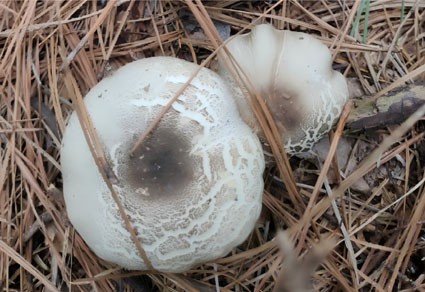
Smithiomyces Singer is a rare genus in the family Agaricaceae, previously known from the Neotropics and tropical Asia. Based on morphological observation and phylogenetic analyses of four nuclear loci (ITS, LSU, rpb2, and tef1-α), we describe Smithiomyces umbonatus sp. nov. from Anhui Province, China. The new species is characterized by a slightly prominent pileal umbo, conspicuous white rhizomorphs at the stipe base, and both 2- and 4-spored basidia. A full morphological description, field photographs, and line drawings of the microcharacters are provided.
References
- Anisimova, M., Gil, M., Dufayard, J.F., Dessimoz, C. & Gascuel, O. (2011) Survey of branch support methods demonstrates accuracy, power, and robustness of fast likelihood-based approximation schemes. Systematic Biology 60: 685–699. https://doi.org/10.1093/sysbio/syr041
- Chai, X.Y., Xu, X.F., Wang, M.Y. & Chai, Z.Y. (2013) Diversity of macrofungi in Langyashan Nature Reserve, Anhui Province, China. Acta Ecologica Sinica 33: 2074–2085. https://doi.org/10.5846/stxb201201040015
- Feng, B. & Yang, Z. (2018) Studies on diversity of higher fungi in Yunnan, southwestern China: a review. Plant Diversity 40: 165–171. https://doi.org/10.1016/j.pld.2018.07.001
- Gardes, M. & Bruns, T.D. (1993) ITS primers with enhanced specificity for basidiomycetes: application to the identification of mycorrhizae and rusts. Molecular Ecology 2: 113–118. https://doi.org/10.1111/j.1365-294X.1993.tb00005.x
- Ge, Z.W., Yang, Z.L., Qasim, T., Nawaz, R., Khalid, A.N. & Vellinga, E.C. (2015) Four new species in Leucoagaricus (Agaricaceae, Basidiomycota) from Asia. Mycologia 107: 1033–1044. https://doi.org/10.3852/14-351
- Ge, Z.W., Xu, T.X., Qu, H. & Ma, Y.R. (2021) Three new species of Smithiomyces from tropical Asia support an amphi-Pacific disjunct distribution in the genus. Mycologia 113: 1009–1021. https://doi.org/10.1080/00275514.2021.1936832
- Guo, T., Yang, R.H., Tang, M.X., Hou, D., Sun, X.L., Wang, L., Li, Y., Bao, D.P. & Zhou, X.W. (2022) Species diversity of macrofungi in the Mount Huangshan, East China. Mycosystema 41: 1398–1415. https://doi.org/10.13346/j.mycosystema.210499
- Hall, T.A. (1999) BioEdit: a user-friendly biological sequence alignment editor and analysis program for Windows 95/98/NT. Nucleic Acids Symposium Series 41: 95–98.
- Halling, R.E., Osmundson, T.W. & Neves, M.A. (2008) Pacific boletes: implications for biogeographic relationships. Mycological Research 112: 437–447. https://doi.org/10.1016/j.mycres.2007.11.021
- Hoang, D.T., Chernomor, O., von Haeseler, A., Minh, B.Q. & Vinh, L.S. (2018) UFBoot2: Improving the ultrafast bootstrap approximation. Molecular Biology and Evolution 35 (2): 518–522. https://doi.org/10.1093/molbev/msx281
- Horak, E. (1968) Synopsis generum Agaricalium. Beiträge zur Kryptogamenflora der Schweiz Band 13. Büchler, Wabern-Bern, 741 pp.
- Hou, Y.J. & Ge, Z.W. (2020) New species of Echinoderma and Lepiota (Agaricaceae) from China. Phytotaxa 447: 221–236. https://doi.org/10.11646/phytotaxa.447.4.1
- Justo, A., Angelini, C. & Bizzi, A. (2015) Smithiomyces dominicanus (Agaricales: Agaricaceae), a new species from the Dominican Republic. Phytotaxa 226: 92–98. https://doi.org/10.11646/phytotaxa.226.1.9
- Kalyaanamoorthy, S., Minh, B.Q., Wong, T.K., Von Haeseler, A. & Jermiin, L.S. (2017) ModelFinder: fast model selection for accurate phylogenetic estimates. Nature Methods 14: 587–589. https://doi.org/10.1038/nmeth.4285
- Katoh, K., Rozewicki, J. & Yamada, K.D. (2019) MAFFT online service: multiple sequence alignment, interactive sequence choice and visualization. Briefings in Bioinformatics 20: 1160–1166. https://doi.org/10.1093/bib/bbx108
- Kooij, P.W., Sulastri, M.P., Rodrigues, A. & Gaya, E. (2024) Disentangling the basidiomycete family Agaricaceae. Mycological Progress 23: 75. https://doi.org/10.1007/s11557-024-02011-w
- Kornerup, A. & Wanscher, J.H. (1978) Methuen Handbook of Colour, 3rd ed. Methuen, London, 252 pp.
- Largent, D. (1986) How to identify mushrooms to genus I: Macroscopic features, vol. 1. Mad River Press, Eureka, 425–431 pp.
- Largent, D., Johnson, D. & Watling, R. (1977) How to identify mushrooms to genus III: Microscopic features. Mad River Press, Eureka.
- Li, J.X., Cao, B., Phurbu, D., He, M.Q., Zhu, X.Y., Parra, L.A. & Zhao, R.L. (2024) The revision of the taxonomic system of Lycoperdaceae. Mycosphere 15: 4919–501. https://doi.org/10.5943/mycosphere/15/1/22
- Li, J.X., Zhao, R.L., Phurbu, D., Xing, R., Liu, D.M., He, M.Q., Ling, Z.L., Han, X.X., Feng, H.Y., Zhu, X.Y., Yang, W.Q., Wang, S.H. & Cao, B. (2025) Disentangling taxonomic chaos in Agaricaceae s.l.: an integrative phylogenomic framework with divergence dating reconstructs classification. Fungal Diversity 135: 745–881. https://doi.org/10.1007/s13225-025-00568-9
- Ma, Y.R., Liu, T.Z., Yu, X.D., Wei, T.Z. & Ge, Z.W. (2022) Six new species of Leucoagaricus (Agaricaceae) from northeastern China. Diversity 14: 31. https://doi.org/10.3390/d14050314
- Matheny, P.B. (2005) Improving phylogenetic inference of mushrooms with RPB1 and RPB2 nucleotide sequences (Inocybe; Agaricales). Molecular Phylogenetics and Evolution 35 (1): 1–20. https://doi.org/10.1016/j.ympev.2004.11.014
- Meng, J.Y., Gong, Y.P., Chen, M.L. & Luo, X. (2026) Macrofungal diversity in the mountainous regions of Anhui Province, East China. Mycosystema 45: 250236. https://doi.org/10.13346/j.mycosystema.250236
- Murrill, W.A. (1911) The Agaricaceae of tropical North America II. Mycologia 3: 79–91. https://doi.org/10.1080/00275514.1911.12017666
- Nguyen, L.T., Schmidt, H.A., Von Haeseler, A. & Minh, B.Q. (2015) IQ-TREE: a fast and effective stochastic algorithm for estimating maximum-likelihood phylogenies. Molecular Biology and Evolution 32: 268–274. https://doi.org/10.1093/molbev/msu300
- Qu, H., Damm, U., Hou, Y.J. & Ge, Z.W. (2023) Taxonomy and phylogeny of Cystolepiota (Agaricaceae, Agaricales): new species, new combinations and notes on the C. seminuda complex. Journal of Fungi 9: 537. https://doi.org/10.3390/jof9050537
- Raithelhuber, J. (1988) Typenstudien an Essikkaten aus Südamerikanischen Herbarien. Metrodiana 16: 5–29.
- Rambaut, A. & Drummond, A. (2008) FigTree: Tree figure drawing tool (Version 1.2.2). Institute of Evolutionary Biology, University of Edinburgh. [http://tree.bio.ed.ac.uk/software/figtree/]
- Rehner, S.A. & Buckley, E. (2005) A Beauveria phylogeny inferred from nuclear ITS and EF1-alpha sequences: evidence for cryptic diversification and links to Cordyceps teleomorphs. Mycologia 97: 84–98. https://doi.org/10.3852/mycologia.97.1.84
- Rick, J. (1937) Agarici riograndenses (Agaricales from Rio Grande). Lilloa 1: 307–346.
- Ronquist, F., Teslenko, M., Van Der Mark, P., Ayres, D.L., Darling, A., Höhna, S., Larget, B., Liu, L., Suchard, M.A. & Huelsenbeck, J.P. (2012) MrBayes 3.2: efficient Bayesian phylogenetic inference and model choice across a large model space. Systematic Biology 61: 539–542. https://doi.org/10.1093/sysbio/sys029
- Singer, R. (1944) New genera of fungi. I. Mycologia 36: 358–368. https://doi.org/10.1080/00275514.1944.12017559
- Singer, R. (1986) The Agaricales in modern taxonomy, 4th ed. Koeltz Scientific Books, Königstein im Taunus, 981 pp.
- Suh, H., Lupala, A.S., Cho, H.J., Jo, S., Choi, J. & Lim, Y.W. (2025) Exploring macrofungal biodiversity and distribution on Kyodong Island, Republic of Korea. Mycobiology 53: 466–479. https://doi.org/10.1080/12298093.2025.2510724
- Vellinga, E.C. (1988) Glossary. In: Bas, C., Kuyper, T.W., Noordeloos, M.E. & Vellinga, E.C. (Eds.) Flora Agaricina Neerlandica vol. 1. A.A. Balkema, Rotterdam, pp. 54–64.
- Vellinga, E.C. (1999) An American in a Belgian swimming pool. Mycologist 13: 50–53. https://doi.org/10.1016/S0269-915X(99)80002-0
- Vellinga, E.C. (2001) Macrolepiota, Chlorophyllum, Leucocoprinus, Leucoagaricus, Lepiota, Chamaemyces, Cystolepiota, Melanophyllum. In: Noordeloos, M.E., Kuyper, T.W. & Vellinga, E.C. (Eds.) Flora Agaricina Neerlandica vol. 5, pp. 62–162.
- Vellinga, E.C. (2004) Genera in the family Agaricaceae: evidence from nrITS and nrLSU sequences. Mycological Research 108: 354–377. https://doi.org/10.1017/S0953756204009700
- Vilgalys, R. & Hester, M. (1990) Rapid genetic identification and mapping of enzymatically amplified ribosomal DNA from several Cryptococcus species. Journal of Bacteriology 172: 4238–4246. https://doi.org/10.1128/jb.172.8.4238-4246.1990
- White, T.J., Bruns, T., Lee, S. & Taylor, J. (1990) Amplification and direct sequencing of fungal ribosomal RNA genes for phylogenetics. In: PCR Protocols: A Guide to Methods and Applications 18, pp. 315–322. https://doi.org/10.1016/B978-0-12-372180-8.50042-1
- Wilhelm, M. (2015) Smithiomyces mexicanus. Inventar des Pilzvorkommens in der Masoala-Halle des Zoo Zürich. Available from: https://www.pilze-basel.ch/tropenpilze-der-masoala-halle (accessed 3 October 2026)
- Xiang, C.Y., Gao, F. & Jakovlić, I. (2023) Using PhyloSuite for molecular phylogeny and tree-based analyses. iMeta 2: e87. https://doi.org/10.1002/imt2.87
- Zhang, D., Gao, F., Jakovlić, I., Zou, H., Zhang, J., Li, W.X. & Wang, G.T. (2020) PhyloSuite: an integrated and scalable desktop platform for streamlined molecular sequence data management and evolutionary phylogenetics studies. Molecular Ecology Resources 20: 348–355. https://doi.org/10.1111/1755-0998.13096