
Abstract
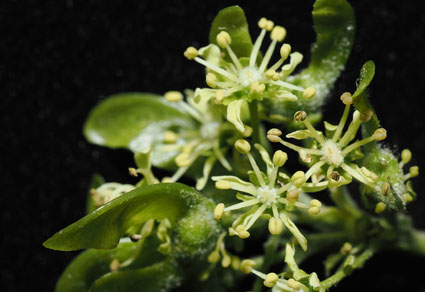
Acer wenshanense (Sapindaceae), a new species, is described and illustrated based on specimens from Wenshan City, Yunnan Province, China. Acer wenshanense is similar to A. sino-oblongum but differs in having sepals ca. 2.5 mm long (vs. ca. 4 mm long), petals narrowly oblong, ca. 3.5 mm long (vs. oblanceolate, ca. 4 mm long), ovary densely whitish hairy (vs. glabrous), young fruit green (vs. purplish red), and wings incurved and intercrossed (vs. spreading at an angle of 70–120°). It is also resembles A. fabri but differs in leaves abaxially whitish glaucous or pale green (vs. green),inflorescence corymbose (vs. paniculate), sepals yellowish green (vs. purplish red), petals yellowish green, narrowly oblong (vs. white, obovate), stamens yellowish green (vs. red), ovary densely whitish hairy (vs. glabrous), young fruit green (vs. purplish red), and wings incurved and intercrossed (vs. spreading at an angle of 60–130°). Acer wenshanense is currently known only from its type locality, represented by a single large tree. No seedlings, saplings, or other juvenile individuals were observed. We therefore recommend that this species be classified as a Plant Species with Extremely Small Populations (PSESP).
References
- Chen, Y.S. (2010) A new species of Acer (Aceraceae) from northern Thailand. Blumea 55: 242–245. https://doi.org/10.3767/000651910X540261
- Chen, Y.S., Yang, Q.E. & Zhu, G.H. (2003) Acer yangbiense (Aceraceae), a new species from Yunnan, China. Novon 13: 296–299. https://doi.org/10.2307/3393260
- Hance, H.F. (1884) A new Chinese maple. Journal of Botany, British and Foreign 22: 76.
- IUCN Standards and Petitions Committee (2024) Guidelines for Using the IUCN Red List Categories and Criteria, version 16. Prepared by the Standards and Petitions Committee. 112 pp.
- Metcalf, F.P. (1932) Acer [Section Integrifolia Pax] for southeastern China. Lingnan Science Journal 11 (2): 193–203.
- Xu, T.Z., Chen, Y.S., de Jong, P.C., Oterdoom, H.J. & Chang, C.S. (2008) Aceraceae. In: Wu, C.Y. & Raven, P.H. (Eds.) Flora of China, Volume 11. Science Press, Beijing; Missouri Botanic Garden, St. Louis, pp. 515–553.
- Yang, J., Cai, L., Liu, D.T., Chen, G., Gratzfeld, J. & Sun, W.B. (2020) China’s conservation program on Plant Species with Extremely Small Populations (PSESP): Progress and perspectives. Biological Conservation 244: 108535. https://doi.org/10.1016/j.biocon.2020.108535