

Abstract
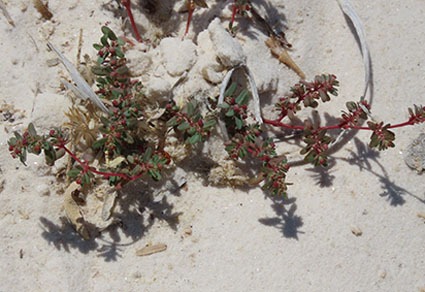
A new species of Euphorbia subg. Chamaesyce sect. Anisophyllum from harsh environments of Coahuila, Mexico, is described and illustrated with photos and a line drawing. This species was collected during a study in the Cuatro Ciénegas basin on gypsum and salty gypsum soils. Further research and collection studies revealed it as a new species, which is distinguished by the combination of an annual habit, glabrous herbage, entire leaves, entire-capitate styles, minute involucral appendages, and microscopically papillose white seeds. It is known only from three localities, and following IUCN Red List categories and criteria, we propose a preliminary assessment as Endangered (EN). Euphorbia villarrealii increases the known diversity of the section Anisophyllum within the Chihuahuan Desert, a primary center of diversity for the taxon. This species also increases the estimated endemicity in gypsum, salty and salty gypsum soils in the region.
References
- Aiton, W. (1789) Hortus Kewensis, or, A catalogue of the plantus cultivated in the royal Botanic Garden at Kew 2. Printed for George Nicol, Bookseller to his Majesty, London, 460 pp. https://doi.org/10.5962/bhl.title.116053
- Atwood, N.D. & Pinkava, D.J. (1977) A new gypsophilous species of Phacelia (Hydrophyllaceae) from Coahuila, Mexico. Madroño: 212–214.
- Bachman, S., Moat, J., Hill, A.W., de la Torre, J. & Scott, B. (2011) Supporting Red List threat assessments with GeoCAT: geospatial conservation assessment tool. ZooKeys 150: 117–126. https://doi.org/10.3897/zookeys.150.2109
- Boissier, P.E. (1862) Euphorbieae. In: de Candolle, A.P. (Ed.) Prodromus systematis naturalis regni vegetabilis 15 (2). Sumptibus Sociorum Treuttel et Würtz, Paris, pp. 3–188.
- Brandegee, T.S. (1891) Flora of the Cape Region of Baja California. Proceedings of the California Academy of Sciences Series 2 3: 108–182.
- Brandegee, T.S. (1911) Plantae Mexicanae Purpusianae. University of California Publications in Botany 4: 177–194.
- Cervantes Maldonado, A., Flores Olvera, H. & Valdés, J. (2001) Las Euphorbiaceae halófilas y gipsófilas de México, excepto Euphorbia. Anales del Instituto de Biología, Serie Botánica 72: 1–83.
- Collins, L.T., Velasco, C. & Schneider, A.C. (2023) Two new species of Aphyllon from northeastern Mexico. Systematic Botany 48: 587–594. https://doi.org/10.1600/036364423X17000842213560
- Czaja, A., Estrada-Rodríguez, J.L. & Flores-Olvera, H. (2014) The gypsum dunes of Cuatrociénegas Valley, Mexico: A secondary sabkha ecosystem with gypsophytes. In: Ajmal-Khan, M., Böer, B., Öztürk, M., Al-Abdessalaam, T.Z., Clüsener-Godt, M. & Gul, B. (Eds.) Sabkha Ecosystems Cash Crop Halophyte and Biodiversity Conservation Vol. IV, 1st ed. Springer, Berlin/Heidelberg, pp. 81–92. https://doi.org/10.1007/978-94-007-7411-7_6
- Coville, F.V. (1893) Botany of the Death Valley Expedition. Contributions from the United States National Herbarium 4: 1–363.
- De-Nova, J.A., Aguirre-Liguori, J.A. & Eguiarte, L.E. (2020) How Did Fouquieria Come to the Chihuahuan Desert? Phylogenetic and Phylogeographic Studies of Fouquieria shrevei and F. splendens and the Role of Vicariance, Selection, and Genetic Drift. In: Mandujano, M.C., Pisanty, I. & Eguiarte, L.E. (Eds.) Plant Diversity and Ecology in the Chihuahuan Desert. Emphasis on the Cuatro Ciénegas Basin. Chap. 6. Springer, Switzerland, pp. 95–108. https://doi.org/10.1007/978-3-030-44963-6_6
- Duby, J.E. (1828) Botanicon Gallicum 1. Desray, Paris, 544 pp.
- Engelmann, G. (1859) Euphorbia. In: Emory, W.H. (Ed.) Report on the United States and Mexican boundary survey 2 (1). Botany of the Boundary. Corneius Wendell, Washington, pp. 185–193.
- Engelmann, G. (1861) Enumeration of a Collection of Dried Plants made by L. J. Xantus, at Cape San Lucas, &c. in Lower California, between August, 1859, and February, 1860, and communicated to the Smithsonian Institution. Proceedings of the American Academy of Arts and Sciences 5: 153–173.
- Estrada-Castillón, E., Scott-Morales, L., Villarreal-Quintanilla, J.A., Jurado-Ybarra, E., Cotera-Correa, M., Cantú-Ayala, C. & García-Pérez, J. (2010) Clasificación de los pastizales halófilos del noreste de México asociados con perrito de las praderas (Cynomys mexicanus): diversidad y endemismo de especies. Revista Mexicana de Biodiversidad 81: 401–416. https://doi.org/10.22201/ib.20078706e.2010.002.231
- Featherman, A. (1871) Report of botanical survey of southern and central Louisiana made during the year 1870. Office of the Republican, New Orleans. https://doi.org/10.5962/bhl.title.62406
- Gmelin, J.F. (1776) Onomatologia botanica completa, oder Vollstandiges botanisches Worterbuch. Frankfurt, 8: 856 pp.
- Gray, A. (1853) Brief Characters of some New Genera and Species of Nyctaginaceae, principally collected in Texas and New Mexico, by Charles Wright, Esq., under the direction of Col. J. D. Graham, U. S. Topogr. Engineers, late Chief of the Scientific Corps of the Mexican Boundary Commission. The American Journal of Sciences and Arts, Series 2 15: 259–263.
- Gray, A. (1856) Manual of the botany of the Northern United States: including Virginia, Kentucky, and all east of the Mississippi, arranged according to the natural system, ed. 2. George P. Putnam, New York. https://doi.org/10.5962/bhl.title.56185
- Hemsley, W.B. (1882) Biologia Centrali-Americana. Botanica 2 (11): 576 pp.
- Johnston, I.M. (1939) New Phanerograms from Mexico. Journal of the Arnold Arboretum 20: 234–240. https://doi.org/10.5962/p.185412
- Johnston, I.M. (1941) New Phanerograms from Mexico, IV. Journal of the Arnold Arboretum 22: 110–124. https://doi.org/10.5962/p.185422
- Johnston, I.M. (1943) Noteworthy Species from Mexico and Adjacent United States, I. Journal of the Arnold Arboretum 24: 227–236. https://doi.org/10.5962/p.185476
- Johnston, M.C. (1975) Studies of the Euphorbia species of the Chihuahuan Desert Region and Adjacent Areas. Wrightia 5: 120–145.
- Johnston, M.C. & Warnock, B.H. (1960) Euphorbia jejuna, new species from western Texas. The Southwestern Naturalist 5: 97–99. https://doi.org/10.2307/3669462
- Kuntze, O. (1891) Revisio Generum Plantarum 2: 377–1011.
- Linnaeus, C. (1753) Species Plantarum. Laurentius Salvius, Stockholm, 1200 pp.
- Macbride, J.F. (1918) Various American Spermatophytes, new or transferred. Contributions from the Gray Herbarium of Harvard University 56: 50–61. https://doi.org/10.5962/p.336024
- Moore, M.J. & Jansen, R.K. (2007) Origins and biogeography of gypsophily in the Chihuahuan Desert plant group Tiquilia subg. Eddya (Boraginaceae). Systematic Botany 32: 392–414. https://doi.org/10.1600/036364407781179680
- Moore, M.J., Mota, J.F., Douglas, N.A., Flores Olvera, H. & Ochoterena, H. (2014) The ecology, assembly and evolution of gypsophile floras. In: Rajakaruna, N., Boyd, R.S. & Harris, T. (Eds.) Plant Ecology and Evolution in Harsh Environments. Chap. 5. Nova Publishers, New York, pp. 97–128.
- Morgan, D.R. & Hartman, R.L. (2003) A synopsis of Machaeranthera (Asteraceae: Astereae), with recognition of segregate genera. Sida 20 (4): 1387–1416.
- Ochoterena, H., Flores-Olvera, H., Gómez-Hinostrosa, C. & Moore, M.J. (2020) Gypsum and Plant Species: A Marvel of Cuatro Ciénegas and the Chihuahuan Desert. In: Mandujano, M.C., Pisanty, I. & Eguiarte, L.E. (Eds.) Plant Diversity and Ecology in the Chihuahuan Desert. Emphasis on the Cuatro Ciénegas Basin. Chap. 9. Springer, Switzerland, pp. 129–165. https://doi.org/10.1007/978-3-030-44963-6_9
- Ortiz-Brunel, J.P., Ochoterena, H., Moore, M.J., Aragón-Parada, J., Flores, J., Munguía-Lino, G., Rodríguez, A., Salinas-Rodríguez, M.M. & Flores-Olvera, H. (2023) Patterns of richness and endemism in the gypsicolous flora of Mexico. Diversity 15: 522. https://doi.org/10.3390/d15040522
- Pinkava, D.J. (1984) Vegetation and flora of the Bolson of Cuatro Ciénegas Region, Coahuila, Mexico: IV. Summary, endemism and corrected catalogue. Journal of the Arizona-Nevada Academy of Science 19: 23–47.
- Powell, A.M. & Worthington, R.D. (2018) Flowering Plants of Trans-Pecos Texas and Adjacent Areas. Sida, Botanical Miscellany 49: 1–1464.
- Rafinesque, C.S. (1817) Second decade of undescribed American plants. The American Monthly Magazine and Critical Reviews 2: 119–120.
- Rafinesque, C.S. (1838) Sylva Telluriana. Philadelphia, 184 pp.
- Rajakaruna, N., Boyd, R.S. & Harris, T.B. (Eds.) (2014) Plant Ecology and Evolution in Harsh Environments. Nova Science Publishers, Hauppauge, NY, 440 pp. https://doi.org/10.3120/0024-9637-62.2.136
- Rodríguez-Sánchez, M., Ochoterena, H., Pisanty, I., Ezcurra, E. & Flores-Olvera, H. (2022) Gypsum in the desert landscape: Floristic variations within the Cuatro Ciénegas basin in Coahuila, Mexico. Journal of Arid Environments 205: 104828. https://doi.org/10.1016/j.jaridenv.2022.104828
- Taylor, N.C. & Terry, M. (2016) Euphorbia cryptorubra (Euphorbiaceae), a new species in Euphorbia subgenus Chamaesyce section Anisophyllum from Texas, U.S.A., and Chihuahua, Mexico. Journal of the Botanical Research Institute of Texas 10: 1–9.
- Thiers, B. (2026 [continuously updated]) Index Herbariorum: a global directory of public herbaria and associated staff. New York Botanical Garden’s Virtual Herbarium. The New York Botanical Garden, Bronx. Available from: http://sweetgum.nybg.org/science/ih/ (accessed 22 June 2026)
- Turner, B.L. (1972) Two new gypsophilous species of Gaillardia (Compositae) from northcentral Mexico. Southwestern Naturalist 17 (2): 181–190. https://doi.org/10.2307/3670372
- Watson, S. (1882) Contributions to American Botany. Proceedings of the American Academy of Arts and Sciences 17: 316–382. https://doi.org/10.2307/25138655
- Wheeler, L.C. (1934) California Euphorbia Notes. Bulletin of the Southern California Academy of Sciences 33: 105–111.
- Wheeler, L.C. (1939) A miscellany of New World Euphorbiaceae—II. Contributions from the Gray Herbarium of Harvard University 127: 48–78. https://doi.org/10.5962/p.336232
- Yang, Y., Riina, R., Morawetz, J.J., Haevermans, T., Aubriot, X. & Berry, P.E. (2012) Molecular phylogenetics and classification of Euphorbia subgenus Chamaesyce (Euphorbiaceae). Taxon 61: 764–789. https://doi.org/10.1002/tax.614005