

Abstract
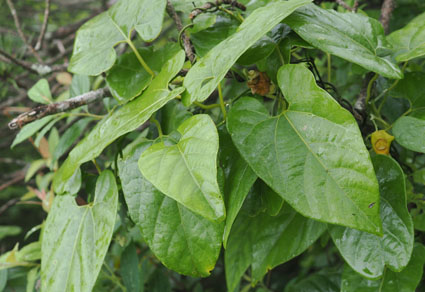
Aristolochia minjiangyuanensis, a new species of Aristolochia subgen. Siphisia from Jianning County, Fujian Province, China, is described and illustrated. Morphologically, it differs in having usually narrower, narrowly ovate-cordate leaves with a long-acuminate or acute apex, a subobovate perianth limb with the lower lobe significantly longer than the upper two lobes and an unspotted inner surface, a smaller throat, and an indumentum predominantly composed of grayish-white velvety hairs. Phylogenetic analyses, based on the nuclear ribosomal ITS region (5.8S + ITS2) and the plastid trnK region, support the placement of A. minjiangyuanensis within the A. kaempferi group, while the trnK analysis further strongly supports a sister relationship between the new species and A. vestita. The new species can be distinguished from A. vestita by its subobovate perianth limb with a revolute apex and an inner surface without spots or stripes, subcircular throat, and predominantly grayish-white velvety indumentum. It differs from A. kaempferi mainly in the morphology and markings of the perianth limb and in having a cylindrical, velvety capsule.
References
- Buchwalder, K., Samain, M.-S., Sankowsky, G., Neinhuis, C. & Wanke, S. (2014) Nomenclatural updates of Aristolochia subgenus Pararistolochia (Aristolochiaceae). Australian Systematic Botany 27 (1): 48–55. https://doi.org/10.1071/SB13042
- Do, T.V., Luu, T.H., Wanke, S. & Neinhuis, C. (2015) Three new species and three new records of Aristolochia subgenus Siphisia from Vietnam including a key to the Asian species. Systematic Botany 40 (3): 671–691. https://doi.org/10.1600/036364415X689140
- Duchartre, P. (1854) Tentamen methodicae divisionis generis Aristolochia, additis descriptionibus complurium novarum specierum novique generis Holostylis. Annales des Sciences Naturelles, 4a. Sér. 2: 29–76.
- Dunn, S.T. (1908) A botanical expedition to Central Fokien. Journal of the Linnean Society, Botany 38 (267): 350–373. https://doi.org/10.1111/j.1095-8339.1908.tb00858.x
- Edgar, R.C. (2004) MUSCLE: multiple sequence alignment with high accuracy and high throughput. Nucleic Acids Research 32 (5): 1792–1797. https://doi.org/10.1093/nar/gkh340
- Felsenstein, J. (1985) Confidence limits on phylogenies: an approach using the bootstrap. Evolution 39 (4): 783–791. https://doi.org/10.1111/j.1558-5646.1985.tb00420.x
- Franchet, A.R. (1888 [“1887”]) Plantae Davidianae ex Sinarum Imperio, deuxième partie (suite): Plantes du Thibet oriental, province de Moupine. Nouvelles Archives du Muséum d’Histoire Naturelle, sér. 2, 10: 33–198.
- González, F.A. (2012) Florística y sistemática filogenética innecesariamente disyuntas: El caso de Aristolochia, Euglypha y Holostylis (Aristolochiaceae). Revista de la Academia Colombiana de Ciencias Exactas, Físicas y Naturales 36 (139): 193–202.
- Hance, H.F. (1879) Novam Aristolochiae speciem. Journal of Botany, British and Foreign 17: 300.
- Harris, J.G. & Harris, M.W. (2001) Plant Identification Terminology: An Illustrated Glossary (2nd). Spring Lake Pub., Spring Lake, Utah, 216 pp.
- Hatusima, S. (1951) New and noteworthy plants from southern Japan and the adjacent districts (2). The Journal of Japanese Botany 26 (12): 371–376.
- Hayata, B. (1915) Icones Plantarum Formosanarum nec non et Contributiones ad Floram Formosanam, vol. 5. Bureau of Productive Industry, Government of Formosa, Taihoku.
- Hayata, B. (1916) Icones Plantarum Formosanarum nec non et Contributiones ad Floram Formosanam, vol. 6. Bureau of Productive Industry, Government of Formosa, Taihoku. https://doi.org/10.1038/097220a0
- Hoang, D.T., Vinh, L.S., Flouri, T., Stamatakis, A., von Haeseler, A. & Minh, B.Q. (2018) MPBoot: fast phylogenetic maximum parsimony tree inference and bootstrap approximation. BMC Evolutionary Biology 18: 11. https://doi.org/10.1186/s12862-018-1131-3
- Hu, Y., Wang, J., Liu, L., Yi, X., Wang, X., Wang, J., Hao, Y., Qin, L., Li, K., Feng, Y., Zhang, Z., Wu, H. & Jiao, Y. (2025) Evolutionary history of magnoliid genomes and benzylisoquinoline alkaloid biosynthesis. Nature Communications 16: 4039. https://doi.org/10.1038/s41467-025-59343-8
- Huber, H. (1993) Aristolochiaceae. In: Kubitzki, K., Rohwer, J.G. & Bittrich, V. (Eds.) The families and genera of vascular plants. Springer, Berlin, pp. 129–137. https://doi.org/10.1007/978-3-662-02899-5_10
- Hutchinson, J. & Dalziel, J.M. (1927) Aristolochiaceae. In: Hutchinson, J. & Dalziel, J.M. (Eds.) Flora of West Tropical Africa, vol. 1. Crown Agents for the Colonies, London, pp. 75–78.
- Hwang, S.-M. (1988) Aristolochia Linnaeus. In: Kiu, H.-S. & Ling, Y.-R. (Eds.) Flora Reipublicae Popularis Sinicae, vol. 24. Science Press, Beijing, pp. 199–245. [In Chinese]
- Hwang, S.M., Kelly, L.M. & Gilbert, M.G. (2003) Aristolochia Linnaeus. In: Wu, Z.Y., Raven, P.H. & Hong, D.Y. (Eds.) Flora of China, vol. 5. Science Press, Beijing & Missouri Botanical Garden Press, St. Louis, pp. 258–269.
- IUCN (2012) IUCN Red List Categories and Criteria: Version 3.1. Second edition. IUCN, Gland, Switzerland and Cambridge, UK, iv + 32 pp.
- IUCN Standards and Petitions Committee (2024) Guidelines for Using the IUCN Red List Categories and Criteria. Version 16. Prepared by the Standards and Petitions Committee.
- Jin, J.J., Yu, W.B., Yang, J.B., Song, Y., dePamphilis, C.W., Yi, T.S. & Li, D.Z. (2020) GetOrganelle: a fast and versatile toolkit for accurate de novo assembly of organelle genomes. Genome Biology 21: 241. https://doi.org/10.1186/s13059-020-02154-5
- Jost, M. & Wanke, S. (2024) A comparative analysis of plastome evolution in autotrophic Piperales. American Journal of Botany 111 (3): e16300. https://doi.org/10.1002/ajb2.16300
- Kalyaanamoorthy, S., Minh, B.Q., Wong, T.K.F., von Haeseler, A. & Jermiin, L.S. (2017) ModelFinder: fast model selection for accurate phylogenetic estimates. Nature Methods 14: 587–589. https://doi.org/10.1038/nmeth.4285
- Katoh, K. & Standley, D.M. (2013) MAFFT multiple sequence alignment software version 7: improvements in performance and usability. Molecular Biology and Evolution 30: 772–780. https://doi.org/10.1093/molbev/mst010
- Kodama, Y., Ara, T., Fukuda, A., Mashima, J., Kosuge, T., Mizusawa, H., Fujisawa, T., Kaminuma, E., Ogasawara, O. & Okubo, K. (2025) DDBJ update in 2024: the DDBJ Group Cloud service for sharing pre-publication data. Nucleic Acids Research 53: D45–D48. https://doi.org/10.1093/nar/gkae882
- Lemaire, C. (1865) Miscellanées: Aristolochia tricaudata. L’Illustration Horticole 12: Misc. 49.
- Linnaeus, C. von (1753) Species Plantarum, vol. 2. Impensis Laurentii Salvii, Holmiae, pp. 561–1200.
- Ohi-Toma, T., Sugawara, T., Murata, H., Wanke, S., Neinhuis, C. & Murata, J. (2006) Molecular phylogeny of Aristolochia sensu lato (Aristolochiaceae) based on sequences of rbcL, matK, and phyA genes, with special reference to differentiation of chromosome numbers. Systematic Botany 31 (3): 481–492. https://doi.org/10.1600/036364406778388656
- Ohi-Toma, T., Watanabe-Toma, K., Murata, H. & Murata, J. (2014) Morphological variations of Aristolochia kaempferi and A. tanzawana (Aristolochiaceae) in Japan. The Journal of Japanese Botany 89 (3): 152–163. https://doi.org/10.51033/jjapbot.89_3_10505
- Ohi-Toma, T. & Murata, J. (2016) Nomenclature of Isotrema, Siphisia, and Endodeca, and their related infrageneric taxa of Aristolochia (Aristolochiaceae). Taxon 65 (1): 152–157. https://doi.org/10.12705/651.11
- Ohi-Toma, T., Watanabe-Toma, K., Li, P., Sugawara, T. & Murata, J. (2021) Aristolochia vestita, a new species of subgenus Siphisia (Aristolochiaceae) from Zhejiang, China. The Journal of Japanese Botany 96 (5): 253–263.
- Phan, L.K., Wanke, S., Neinhuis, C. & Do, T.V. (2021) Aristolochia luudamcui (Aristolochiaceae), a new species from northern Vietnam. Phytotaxa 527 (1): 67–74. https://doi.org/10.11646/phytotaxa.527.1.7
- Quan, D.L., Ding, H.B., Li, J.W., Yang, B., Cai, Y.F., Su, H., Jiang, J.F., Aung, M.M. & Tan, Y.H. (2026) New species of Aristolochia (Aristolochiaceae) from China and Myanmar. Annales Botanici Fennici 63: 135–146. https://doi.org/10.5735/085.063.0120
- Rafinesque, C.S. (1819) Art. 3. The genera of North-American plants: and a catalogue of the species to the year 1817. By Thomas Nuttall, F.L.S. &c. &c. 2 vols. 12mo. Philadelphia 1818. American Monthly Magazine and Critical Review 4: 184–196.
- Ronquist, F., Teslenko, M., Mark, P.V.D., Ayres, D.L., Darling, A., Höhna, S., Larget, B., Liu, L., Suchard, M.A. & Huelsenbeck, J.P. (2012) MrBayes 3.2: efficient Bayesian phylogenetic inference and model choice across a large model space. Systematic Biology 61 (3): 539–542. https://doi.org/10.1093/sysbio/sys029
- Sayers, E.W., Cavanaugh, M., Frisse, L., Pruitt, K.D., Schneider, V.A., Underwood, B.A., Karsch-Mizrachi, I. & Ostell, J. (2025) GenBank 2025 update. Nucleic Acids Research 53: D56–D61. https://doi.org/10.1093/nar/gkae1114
- Schmidt, O.C. (1935) Aristolochiaceae. In: Engler, A. & Prantl, K. (Eds.) Die natürlichen Pflanzenfamilien, 2nd ed., vol. 16B. Wilhelm Engelmann, Leipzig, pp. 204–242.
- Tamura, K. (1992) Estimation of the number of nucleotide substitutions when there are strong transition-transversion and G+C-content biases. Molecular Biology and Evolution 9 (4): 678–687. https://doi.org/10.1093/oxfordjournals.molbev.a040752
- Tamura, K., Stecher, G. & Kumar, S. (2021) MEGA11: molecular evolutionary genetics analysis version 11. Molecular Biology and Evolution 38 (7): 3022–3027. https://doi.org/10.1093/molbev/msab120
- Wagner, S.T., Hesse, L., Isnard, S., Samain, M.-S., Bolin, J., Maass, E., Neinhuis, C., Rowe, N.P. & Wanke, S. (2014) Major trends in stem anatomy and growth forms in the perianth-bearing Piperales, with special focus on Aristolochia. Annals of Botany 113 (7): 1139–1154. https://doi.org/10.1093/aob/mcu044
- Wanke, S., González, F. & Neinhuis, C. (2006) Systematics of pipevines: Combining morphological and fast-evolving molecular characters to investigate the relationships within subfamily Aristolochioideae (Aristolochiaceae). International Journal of Plant Sciences 167: 1215–1227. https://doi.org/10.1086/508024
- Wanke, S., Granados Mendoza, C., Müller, S., Paizanni Guillén, A., Neinhuis, C., Lemmon, A.R., Lemmon, E.M. & Samain, M.-S. (2017) Recalcitrant deep and shallow nodes in Aristolochia (Aristolochiaceae) illuminated using anchored hybrid enrichment. Molecular Phylogenetics and Evolution 117: 111–123. https://doi.org/10.1016/j.ympev.2017.05.014
- Wang, Y., Liao, S., Landrein, S., Nguyen, K., Onyenedum, J. & Guo, Z. (2026) Aristolochia ferox, a new species of subg. Siphisia (Aristolochiaceae) from Guangxi, China. PhytoKeys 273: 171–183. https://doi.org/10.3897/phytokeys.273.169468
- Watanabe, K., Kajita, T. & Murata, J. (2006) Chloroplast DNA variation and geographical structure of the Aristolochia kaempferi group (Aristolochiaceae). American Journal of Botany 93 (3): 442–453. https://doi.org/10.3732/ajb.93.3.442
- Watanabe, K., Ohi-Toma, T. & Murata, J. (2008) Multiple hybridization in the Aristolochia kaempferi group (Aristolochiaceae): evidence from reproductive isolation and molecular phylogeny. American Journal of Botany 95 (7): 885–896. https://doi.org/10.3732/ajb.2007331
- Willdenow, C.L. (1805) Species Plantarum, ed. 4, vol. 4 (1). Impensis G.C. Nauk, Berolini, 629 pp.
- Wong, T.K.F., Ly-Trong, N., Ren, H., Demotte, P., Banos, H., Roger, A.J., Susko, E., Bielow, C., De Maio, N., Goldman, N., Hahn, M.W., dos Reis, M., Vinh, L.S., Huttley, G., Lanfear, R. & Minh, B.Q. (2026) IQ-TREE 3: phylogenomic inference software using complex evolutionary models. Molecular Biology and Evolution 43 (5): msag117. https://doi.org/10.1093/molbev/msag117
- Yu, W. & Cheng, C.Y. (1992) New taxa of the genus Aristolochia from Anhui Province. Bulletin of Botanical Research 12 (1): 109–111.
- Zhang, D., Gao, F., Jakovlić, I., Zou, H., Zhang, J., Li, W.X. & Wang, G.T. (2020) PhyloSuite: An integrated and scalable desktop platform for streamlined molecular sequence data management and evolutionary phylogenetics studies. Molecular Ecology Resources 20 (1): 348–355. https://doi.org/10.1111/1755-0998.13096
- Zhu, X.X., Liao, S., Sun, Z.P., Zhen, A.G. & Ma, J.S. (2017) The taxonomic revision of Asian Aristolochia (Aristolochiaceae) II: Identities of Aristolochia austroyunnanensis and A. dabieshanensis, and A. hyperxantha—a new species from Zhejiang, China. Phytotaxa 313 (1): 61–76. https://doi.org/10.11646/phytotaxa.313.1.4
- Zhu, X.X., Li, X.Q., Liao, S., Li, G.D. & Ma, J.S. (2019a) The taxonomic revision of Asian Aristolochia (Aristolochiaceae) V: Two new species from Yunnan, China. PhytoKeys 130: 93–106. https://doi.org/10.3897/phytokeys.130.33933
- Zhu, X.-X., Li, X.-Q., Liao, S., Du, C., Wang, Y., Wang, Z.-H., Yan, J., Zuo, Y.-J. & Ma, J.-S. (2019b) Reinstatement of Isotrema, a new generic delimitation of Aristolochia subgen. Siphisia (Aristolochiaceae). Phytotaxa 401 (1): 1–23. https://doi.org/10.11646/phytotaxa.401.1.1
- Zhu, X.X., Wang, J., Liao, S. & Ma, J.S. (2019c) Synopsis of Aristolochia L. and Isotrema Raf. (Aristolochiaceae) in China. Biodiversity Science 27 (10): 1143–1146. https://doi.org/10.17520/biods.2019183
- Zhu, X.X. & Ma, J.S. (2022) Aristolochia and Isotrema of Aristolochiaceae in China. In: Ma, J.S. (Ed.) China, Mother of Gardens, in the Twenty-First Century. China Forestry Publishing House, Beijing, pp. 190–303.