
Abstract
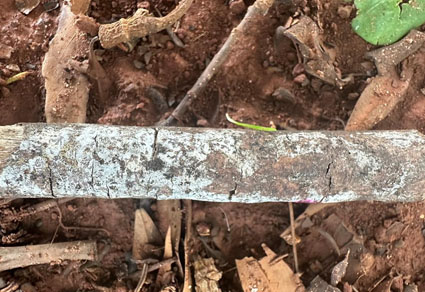
Wood-inhabiting fungi serve essential functions as decomposers within forest ecosystems. This study describes and illustrates a new wood-inhabiting fungus, Hyphoderma farinaceum, based on morphological characteristics and phylogenetic analyses. Hyphoderma farinaceum is distinguished by resupinate, membranaceous basidiomata with a farinaceous hymenial surface, a monomitic hyphal system with generative hyphae bearing clamp connections, and cylindrical basidiospores measuring 7.5–12 × 3.5–4.5 µm. Internal transcribed spacer (ITS) and nuclear large subunit (nLSU) sequences were obtained from the examined specimens, and phylogenetic analyses were conducted using Maximum Likelihood and Bayesian Inference methods. The results indicate that this species belongs to Hyphoderma and is closely related to H. fulgens. Detailed descriptions, illustrations, and phylogenetic analysis results are presented. This finding broadens the recognized diversity of Hyphoderma in subtropical China and enhances understanding of phylogenetic relationships within the genus.
References
- Baltazar, J.M., Silveira, R.M.B. & Rajchenberg, M. (2016) Type studies of J. Rick’s corticioid homobasidiomycetes (Agaricomycetes, Basidiomycota) housed in the Herbarium Anchieta (PACA). Phytotaxa 255 (2): 101–132. https://doi.org/10.11646/phytotaxa.255.2.1
- Bernicchia, A. & Gorjón, S.P. (2010) Fungi Europaei 12: Corticiaceae s.l. Edizioni Candusso, Alassio, 1008 pp.
- Boonmee, S., Wanasinghe, D.N., Calabon, M.S., Huanraluek, N., Chandrasiri, S.K.U., Jones, G.E.B., Rossi, W., Leonardi, M., Singh, S.K., Rana, S., Singh, P.N., Maurya, D.K., Lagashetti, A.C., Choudhary, D., Dai, Y.C., Zhao, C.L., Mu, Y.H., Yuan, H.S., He, S.H., Phookamsak, R., Jiang, H.B., Martín, M.P., Dueñas, M., Tellería, M.T., Kałucka, I.L., Jagodziński, A.M., Liimatainen, K., Pereira, D.S., Phillips, A.J.L., Suwannarach, N., Kumla, J., Khuna, S., Lumyong, S., Potter, T.B., Shivas, R.G., Sparks, A.H., Vaghefi, N., Abdel-Wahab, M.A., Abdel-Aziz, F.A., Li, G.J., Lin, W.F., Singh, U., Bhatt, R.P., Lee, H.B., Nguyen, T.T.T., Kirk, P.M., Dutta, A.K., Acharya, K., Sarma, V.V., Niranjan, M., Rajeshkumar, K.C., Ashtekar, N., Lad., S., Wijayawardene, N.N., Bhat, D.J., Xu, R.J., Wijesinghe, S.N., Shen, H.W., Luo, Z.L., Zhang, J.Y., Sysouphanthong, P., Thongklang, N., Bao, D.F., Aluthmuhandiram, J.V.S., Abdollahzadeh, J., Javadi, A., Dovana, F., Usman, M., Khalid, A.N., Dissanayake, A.J., Telagathoti, A., Probst, M., Peintner, U., Garrido-Benavent, I., Bóna, L., Merényi, Z., Boros, L., Zoltán, B., Stielow, J.B., Jiang, N., Tian, C.M., Shams, E., Dehghanizadeh, F., Pordel, A., Javan-Nikkhah, M., Denchev, T.T., Denchev, C.M., Kemler, M., Begerow, D., Deng, C.Y., Harrower, E., Bozorov, T., Kholmuradova, T., Gafforov, Y., Abdurazakov, A., Xu, J.C., Mortimer, P.E., Ren, G.C., Jeewon, R., Maharachchikumbura, S.S.N., Phukhamsakda, C., Mapook, A. & Hyde, K.D. (2021) Fungal diversity notes 1387–1511: Taxonomic and phylogenetic contributions on genera and species of fungal taxa. Fungal Diversity 111: 1–335. https://doi.org/10.1007/s13225-021-00489-3
- Case, N.T., Gurr, S.J., Fisher, M.C., Blehert, D.S., Boone, C., Casadevall, A., Chowdhary, A., Cuomo, C.A., Currie, C.R., Denning, D.W., Ene, I.V., Fritz-Laylin, L.K., Gerstein, A.C., Gow, N.A.R., Gusa, A., Iliev, I.D., James, T.Y., Jin, H.L., Kahmann, K., Klein, B.S., Kronstad, J.W., Ost, K.S., Peay, K.G., Shapiro, R.S., Sheppard, D.C., Shlezinger, N., Stajich, J.E., Stukenbrock, E.H., Taylor, J.W., Wright, G.D., Cowen, L.E., Heitman, J. & Segre, J.A. (2025) Fungal impacts on Earth’s ecosystems. Nature 638: 49–57. https://doi.org/10.1038/s41586-024-08419-4
- Cui, Y.J., Wu, Y.D., Jiang, Y.H., Zhu, A.H., Wu, F., Liu, H.G., Dai, Y.C. & Yuan, Y. (2025) Diversity of macrofungi in southeast Xizang 1. the wood-decay fungi. Mycology 16 (2): 635–669. https://doi.org/10.1080/21501203.2024.2379476
- Dai, Y.C., Yang, Z.L., Cui, B.K., Wu, G., Yuan, H.S., Zhou, L.W., He, S.H., Ge, Z.W., Wu, F., Wei, Y.L., Yuan, Y. & Si, J. (2021) Diversity and systematics of the important macrofungi in Chinese forests. Mycosystema 40: 770–805. https://doi.org/10.13346/j.mycosystema.210036
- Deng, Y.L., Chen, M., Zhang, S.C., Wang, K.S., Liu, W.T., Qiu, Y.H., Dou, Y.T., Liu, X.F., Wijesinghe, A.S.N., Zhou, H.M., Jabeen, S. & Zhao, C.L. (2026) Notes, taxonomy, and phylogeny of wood-inhabiting fungi in Russulales. Mycosphere 17: e003. https://doi.org/10.48130/mycosphere-0026-0003
- Dong, J.H., Chen, M.L., Chen, M., Li, Q., Zhu, Y.J., Zhang, X.C., Zhou, C.Q., Li, W., Muhammad, A., Zhou, H.M., Jabeen, S. & Zhao, C.L. (2025) Notes, outline, taxonomy and phylogeny of wood-inhabiting Agaricales. Mycosphere 16: 2599–2711. https://doi.org/10.5943/mycosphere/16/1/16
- Donk, M.A. (1957) Notes on resupinate Hymenomycetes IV. Fungus 27: 1–29.
- Duan, Z.Y., Guan, Q.X., Luo, K.Y. & Zhao, C.L. (2023) Morphological and molecular identification of three new resupinate species of Hyphoderma (Hyphodermataceae, Agaricomycetes) from East Asia. Phytotaxa 599: 1–19. https://doi.org/10.11646/phytotaxa.599.1.1
- Floudas, D. & Hibbett, D.S. (2015) Revisiting the taxonomy of Phanerochaete (Polyporales, Basidiomycota) using a four gene dataset and extensive ITS sampling. Fungal Biology 119 (8): 679–719. https://doi.org/10.1016/j.funbio.2015.04.003
- Guan, Q.X. & Zhao, C.L. (2021a) Taxonomy and phylogeny of the wood-inhabiting fungal genus Hyphoderma with descriptions of three new species from East Asia. Journal of Fungi 7: 308. https://doi.org/10.3390/jof7040308
- Guan, Q.X. & Zhao, C.L. (2021b) Two new corticioid species: Hyphoderma sinense and H. floccosum (Hyphodermataceae, Polyporales) from southern China. Mycosystema 40: 447–461. https://doi.org/10.13346/j.mycosystema.200382
- Guan, Q.X., Huang, J. & Zhao, C.L. (2023) Five new species of Schizoporaceae (Basidiomycota, Hymenochaetales) from East Asia. MycoKeys 96: 25–56. https://doi.org/10.3897/mycokeys.96.99327
- Guan, Q.X., Li, Y.F. & Zhao, C.L. (2021) Morphological and phylogenetic evidence for recognition of two new species of Hyphoderma (Basidiomycota) from southern China, with a key to all Chinese Hyphoderma. MycoKeys 83: 145–160. https://doi.org/10.3897/mycokeys.83.69909
- Guan, Q.X., Tohtirjap, A., Fan, L.F., Dai, Y.C., Li, W.Y., Zhao, H., Zhou, H.M., Alvarenga, R.L.M., Gibertoni, T.B., Gates, G., Liu, H.G., Tian, X.M., Li, Z.H., Deng, C.Y., Zeng, G.Y. & Wu, F. (2026) Diversity and phylogeny of jelly fungi with longitudinally septate basidia in Auriculariales and Tremellales. Fungal Diversity 136: 136014. https://doi.org/10.65390/fdiv.2026.136014
- Justo, A., Miettinen, O., Floudas, D., Ortiz-Santana, B., Sjökvist, E., Linder, D., Nakasone, K., Niemelä, T., Larsson, K., Ryvarden, L. & Hibbett, D.S. (2017) A revised family-level classification of the Polyporales (Basidiomycota). Fungal Biology 121 (9): 798–824. https://doi.org/10.1016/j.funbio.2017.05.010
- Kalyaanamoorthy, S., Minh, B.Q., Wong, T.K.F., Haeseler, A.V. & Jermiin, L.S. (2017) ModelFinder: Fast model selection for accurate phylogenetic estimates. Nature Methods 14: 587–589. https://doi.org/10.1038/nmeth.4285
- Katoh, K., Rozewicki, J. & Yamada, K.D. (2019) MAFFT online service: multiple sequence alignment, interactive sequence choice and visualization. Briefings in Bioinformatics 20: 1160–1166. https://doi.org/10.1093/bib/bbx108
- Larsson, A. (2014) AliView: a fast and lightweight alignment viewer and editor for large data sets. Bioinformatics 30: 3276–3278. https://doi.org/10.1093/bioinformatics/btu531
- Larsson, K.H. (2007) Re-thinking the classification of corticioid fungi. Mycological Research 111: 1040–1063. https://doi.org/10.1016/j.mycres.2007.08.001
- Li, W., Wang, H., Wang, X., Liao, X., Wang, K., Subodini Nuwanthika, W.A. & Zhao, C.L. (2026) Phylogeny, divergence time and historical biogeography of Hyphoderma (Hyphodermataceae, Polyporales): lntroducing five new species from China. MycoKeys 129: 43–80. https://doi.org/10.3897/mycokeys.129.183371
- Li, W., Wang, X.Y., Chen, D.X., Zhang, S.C., Li, Y.C., Zhao, C.L. & Zhan, Z.Y. (2025) Molecular phylogeny and morphology reveal a new wood-inhabiting fungus Hyphoderma cinereofuscum (Polyporales, Basidiomycota), from southwest China. Phytotaxa 683: 106–118. https://doi.org/10.11646/phytotaxa.683.2.2
- Luo, K.Y., Chen, Z.Y. & Zhao, C.L. (2022) Phylogenetic and taxonomic analyses of three new wood-inhabiting fungi of Xylodon (Basidiomycota) in a forest ecological system. Journal of Fungi 8: 405. https://doi.org/10.3390/jof8040405
- Ma, X., Huang, R.X., Zhang, Y. & Zhao, C.L. (2021) Hyphoderma fissuratum and H. mopanshanense spp. nov. (Polyporales) from southern China. Mycoscience 62: 36–41. https://doi.org/10.47371/mycosci.2020.08.004
- Martín, M.P., Zhang, L.F., Fernández-López, J., Dueñas, M., Rodríguez-Armas, J.L., Beltrán-Tejera, E. & Tellería, M.T. (2018) Hyphoderma paramacaronesicum sp. nov. (Meruliaceae, Polyporales, Basidiomycota), a cryptic lineage to H. macaronesicum. Fungal Systematics and Evolution 2: 57–68. https://doi.org/10.3114/fuse.2018.02.05
- Miller, M.A., Pfeiffer, W. & Schwartz, T. (2012) The CIPRES science gateway. Proceedings of the 1st Conference of the Extreme Science and Engineering Discovery Environment: Bridging from the Extreme to the Campus and Beyond 1–39. https://doi.org/10.1145/2335755.2335836
- Nilsson, R.H., Hallenberg, N., Nordén, B., Maekawa, N. & Wu, S.H. (2003) Phylogeography of Hyphoderma setigerum (Basidiomycota) in the northern hemisphere. Mycological Research 107: 645–652. https://doi.org/10.1017/S0953756203007925
- Petersen, J.H. (1996) Farvekort. In: Petersen, J.H. (Ed.) The Danish Mycological Society s’ Colour-Chart. Foreningentil Svampekundskabens Fremme, Greve, Germany, pp. 6.
- Ronquist, F., Teslenko, M., Mark, P.V.D., Ayres, D.L., Darling, A., Hohna, S., Larget, B., Liu, L., Suchard, M.A. & Huelsenbeck, J.P. (2012) Mrbayes 3.2: Efficient bayesian phylogenetic inference and model choice across a large model space. Systematic Biology 61 (3): 539–542. https://doi.org/10.1093/sysbio/sys029
- Rathnayaka, A.R., Tennakoon, D.S., Jones, G.E., Wanasinghe, D.N., Bhat, D.J., Priyashantha, A.H., Stephenson, S.L., Tibpromma, S. & Karunarathna, S.C. (2025) Significance of precise documentation of hosts and geospatial data of fungal collections, with an emphasis on plant associated fungi. New Zealand Journal of Botany 63 (2–3): 462–489. https://doi.org/10.1080/0028825x.2024.2381734
- Su, J.Q., Zhang, X.C., Zhao, C.L. & Zhou, H.M. (2024) Molecular phylogeny and morphology reveal a new wood-inhabiting fungal species, Hyphoderma guangdongense (Polyporales, Basidiomycota), from China. Phytotaxa 661: 075–086. https://doi.org/10.11646/phytotaxa.661.1.5
- Telleria, M.T., Dueñas, M., Beltrán-Tejera, E., Rodríguez-Armas, J.L. & Martín, M.P. (2012) A new species of Hyphoderma (Meruliaceae, Polyporales) and its discrimination from closely related taxa. Mycologia 104 (5): 1121–1132. https://doi.org/10.3852/11-344
- Vilgalys, R. & Hester, M. (1990) Rapid genetic identification and mapping of enzymatically amplified ribosomal DNA from several Cryptococcus species. Journal of Bacteriology 172 (8): 4238–4246. https://doi.org/10.1128/jb.172.8.4238-4246.1990
- Vu, D., Groenewald, M., De Vries, M., Gehrmann, T., Stielow, B., Eberhardt, U. & Verkley, G.J.M. (2019) Large-scale generation and analysis of filamentous fungal DNA barcodes boosts coverage for kingdom fungi and reveals thresholds for fungal species and higher taxon delimitation. Studies in Mycology 92: 135–154. https://doi.org/10.1016/j.simyco.2018.05.001
- Wallroth, C.F.W. (1833) Flora Cryptogamica Germaniae 2 Algas et fungos. Schragius [J.L. Schrag], Norimbergae [Nüremberg], 923 pp.
- Wang, C.G., Dai, Y.C., Kout, J., Gates, G.M., Liu, H.G., Yuan, Y. & Vlasák, J. (2024) Multi-gene phylogeny and taxonomy of Physisporinus (Polyporales, Basidiomycota). Mycosphere 15: 1455–1521. https://doi.org/10.5943/mycosphere/15/1/12
- Wang, C.G., Wu, Y.D., Zhang, X., Dai, Y.C., Li, Z.H. & Yuan, Y. (2025) Studies in phylogeny and divergence times of Irpicaceae and Meripilaceae (Polyporales, Basidiomycota), with an emphasis on Ceriporia and Meripilus including ten new species. IMA Fungus 16: e161336. https://doi.org/10.3897/imafungus.16.161336
- Wang, L., He, S.Y., Lambert, C., Zhu, Y.G., Zhang, J.L., Yang, Y., Li, W.L., Zhou, H.M. & Zhao, C.L. (2026) Comprehensive morphological and phylogenetic analyses of Hymenochaetales (Basidiomycota) unveil one new genus and twenty-six novel wood-inhabiting species from southwestern China. Persoonia 56: 328–380. https://doi.org/10.3114/persoonia.2026.56.05
- White, T.J., Bruns, T., Lee, S. & Taylor, J. (1990) Ampliffcation and direct sequencing of fungal ribosomal RNA genes for phylogenetics. In: Innis, M.A., Gelfand, D.H., Sninsky, J.J. & White, T.J. (Eds.) PCR protocols: A guide to methods and applications. Academic Press, San Diego, pp. 315–322. https://doi.org/10.1016/B978-0-12-372180-8.50042-1
- Wu, F., Zhou, L.W., Yang, Z.L., Bau, T., Li, T.H. & Dai, Y.C. (2019) Resource diversity of Chinese macrofungi: edible, medicinal and poisonous species. Fungal Diversity 98: 1–76. https://doi.org/10.1007/s13225-019-00432-7
- Wu, F., Liu, S.B., Wang, X.H., Zhang, M., Yang, Z.L. & Dai, Y.C. (2026) Species cataloging of edible and medicinal fungi in China. Mycosystema 45: 250237. https://doi.org/10.13346/j.mycosystema.250237
- Yang, Y., Jiang, Q.Q., Li, Q., Yang, J.W., Cha, L., Cheng, L.J., Yang, S.Q., Zhao, C.L. & Zhou, H.M. (2023) Molecular systematics and taxonomic analyses of three new wood-inhabiting fungi of Hyphoderma (Hyphodermataceae, Basidiomycota). Journal of Fungi 9: 1044. https://doi.org/10.3390/jof9111044
- Yang, Y., Li, R., Liu, C.M. & Zhao, C.L. (2023) Morphological and molecular identification for two new species of wood inhabiting macrofungi (Basidiomycota) from Yunnan-Guizhou Plateau, China. Phytotaxa 591 (1): 1–18. https://doi.org/10.11646/phytotaxa.591.1.1
- Yang, Y., Xu, Y., Wang, L., Jiang, Q.Q., Su, J.Q., Li, R., Zhou, H.M. & Zhao, C.L. (2025) Multigene phylogeny of seven wood-inhabiting fungal orders in Basidiomycota, and proposal of a new genus and thirteen new species. Mycosphere 16 (1): 245–295. https://doi.org/10.5943/mycosphere/16/1/4
- Yuan, Q., Chen, Q., You, S.C., Liu, X.F. & Zhao, C.L. (2026) Morphological and molecular identification of three new bamboo inhabiting species of Nigrochaete (Auriculariales, Basidiomycota) from China. MycoKeys 132: 191–214. https://doi.org/10.3897/mycokeys.132.184839
- Yurchenko, E. & Wu, S.H. (2014a) Hyphoderma pinicola sp. nov. of H. setigerum complex (Basidiomycota) from Yunnan, China. Botanical Studies 55: 1–8. https://doi.org/10.1186/s40529-014-0071-5
- Yurchenko, E. & Wu, S.H. (2014b) Hyphoderma formosanum sp. nov. (Meruliaceae, Basidiomycota) from Taiwan. Sydowia 66: 19–23.
- Yurchenko, E. & Wu, S.H. (2015) Hyphoderma moniliforme and H. nemorale (Basidiomycota) newly recorded from China. Mycosphere 6: 113–121. https://doi.org/10.5943/mycosphere/6/1/11
- Zeng, G.Y., Liu, S., Li, M.R., Zhao, Y.L., Hao, H.W., Cui, Y.J., Zhang, X., Yuan, Y., Gao, L., Sun, H.J., Zhao, H., Wu, F. & Dai, Y.C. (2026) A checklist of wood-decaying fungi in Guangxi Autonomous Region, South China. Mycosystema 45: 260018. https://doi.org/10.13346/j.mycosystema.260018
- Zhang, Q.Y., Liu, H.G., Papp, V., Zhou, M., Dai, Y.C. & Yuan, Y. (2023) New insights into the classification and evolution of Favolaschia (Agaricales, Basidiomycota) and its potential distribution, with descriptions of eight new species. Mycosphere 14: 777–814. https://doi.org/10.5943/mycosphere/14/1/10
- Zhou, M., Dai, Y.C., Vlasák, J., Liu, H.G. & Yuan, Y. (2023) Updated systematics of Trichaptum s.l. (Hymenochaetales, Basidiomycota). Mycosphere 14: 815–917. https://doi.org/10.5943/mycosphere/14/1/11