
Abstract
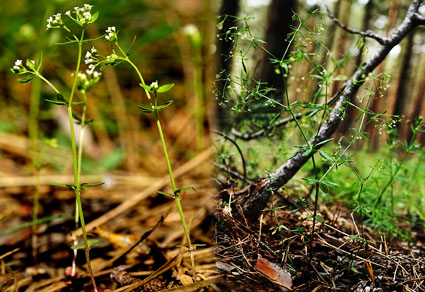
This study presents a comparative morphological, micromorphological, anatomical, and palynological investigation of two closely related species, Galium peplidifolium and G. penduliflorum (Rubiaceae), belonging to sect. Kolgyda in Türkiye. Although morphological features of these species have previously been reported, comprehensive comparative data, particularly on micromorphology and palynology, remain limited. The results revealed several potentially diagnostic characters useful for distinguishing the two species. Galium peplidifolium was characterized by curved or geniculate stems with a partially purplish lower portion, divaricate pedicels, and a cup-shaped corolla with acute to acuminate lobes lacking blackish points. In contrast, G. penduliflorum possessed nearly erect stems, usually nodding pedicels, and a subrotate corolla with long-aristate lobes and blackish points. The mericarp surface was folded and distinctly striate in G. peplidifolium, whereas it was partially collapsed with fissures and faintly granulate—striate ornamentation in G. penduliflorum. Both species possessed quadrangular stems and bifacial, amphistomatic leaves, but differed in several anatomical features, including cortical organization, pith structure, and supporting tissues associated with the leaf midrib, while sand crystals were observed only in G. peplidifolium. Pollen grains were predominantly heptacolpate in G. peplidifolium and exhibited both hexacolpate and octacolpate forms in G. penduliflorum, whereas both species showed prolate pollen and microechinate—perforate exine ornamentation. These findings demonstrate that the combined evaluation of morphological, micromorphological, anatomical, and palynological characters provides complementary evidence for distinguishing the two species and contributes to their taxonomic characterization within sect. Kolgyda.
References
- Abdel Khalik, K., Abd El-Ghani, M.M. & El Kordy, A. (2007) A palynological study of Galium L. (Rubiaceae) in Egypt and its systematic implication. Feddes Repertorium 118: 311–326. https://doi.org/10.1002/fedr.200711137
- Abdel Khalik, K., Abd El-Ghani, M.M. & El Kordy, A. (2008) Anatomical findings of the genus Galium L. (Rubiaceae) in Egypt and their systematic implications. Turkish Journal of Botany 32: 353–359.
- Abdel Khalik, K., Abd El-Twab, M. & Galal, R. (2014) Genetic diversity and relationships among Egyptian Galium (Rubiaceae) and related species using ISSR and RAPD markers. Biologia 69 (3): 300–310. https://doi.org/10.2478/s11756-013-0314-z
- Boissier, P.E. (1843) Diagnoses plantarum orientalium novarum. Series 1, no. 3. Typographia Ferd. Ramboz, Genevae, 60 pp.
- Daşkın, R., Bağçıvan, G. & Korkmaz, E. (2016) Morphological and anatomical features of Galium mite, G. angustissimum and G. galiopsis (Rubiaceae). Biyoloji Bilimleri Araştırma Dergisi 9 (2): 51–54.
- Daşkın, R. & Bağçıvan, G. (2017) A new species of Galium (Rubiaceae) from southwest Anatolia, Turkey. Phytotaxa 308: 267–274. https://doi.org/10.11646/phytotaxa.308.2.8
- Davis, A.P., Govaerts, R., Bridson, D.M., Ruhsam, M., Moat, J. & Brummitt, N.A. (2009) A global assessment of distribution, diversity, endemism, and taxonomic effort in the Rubiaceae. Annals of the Missouri Botanical Garden 96: 68–78. https://doi.org/10.3417/2006205
- Duman, H., Doğan-Güner, E. & Özbek, F. (2025) Galium polatliense sp. nov. (Rubiaceae) from central Anatolia, Türkiye. Nordic Journal of Botany 2025: e04747. https://doi.org/10.1002/njb.04747
- Dumortier, B.C.J. (1827) Flora Belgica. J. Casterman, Tournay [Tournai], 55 pp.
- Ehrendorfer, F. (1948) Rubiaceae. In: Rechinger, K.H. (Ed.) Ergebnisse einer botanischen Reise nach dem Iran. Annalen des Naturhistorischen Museums in Wien 56: 212–244.
- Ehrendorfer, F. (1958) Critical notes on Turkish Rubiaceae. Notes from the Royal Botanic Garden Edinburgh 22 (4): 323–401. https://doi.org/10.24823/nrbge.1958.2512
- Ehrendorfer, F. (1975) Infrageneric taxa in European Rubiaceae: Asperula and Galium. Botanical Journal of the Linnean Society 70 (1): 2–6.
- Ehrendorfer, F. & Schönbeck-Temesy, E. (1982) Galium L. In: Davis, P.H. (Ed.) Flora of Turkey and the East Aegean Islands, vol. 7. Edinburgh University Press, Edinburgh, pp. 767–849.
- Ehrendorfer, F., Barfuss, M.H.J., Manen, J.-F. & Schneeweiss, G.M. (2018) Phylogeny, character evolution and spatiotemporal diversification of the species-rich and world-wide distributed tribe Rubieae (Rubiaceae). PLOS ONE 13 (12): e0207615. https://doi.org/10.1371/journal.pone.0207615
- Garnier, G., Bézanger-Beauquesne, L. & Debraux, G. (1961) Ressources médicinales de la flore française, vol. 2. Vigot Frères, Paris, pp. 1282–1285.
- Huysmans, S., Dessein, S., Smets, E. & Robbrecht, E. (2003) Pollen morphology of NW European representatives confirms monophyly of Rubieae (Rubiaceae). Review of Palaeobotany and Palynology 127: 219–240. https://doi.org/10.1016/S0034-6667(03)00121-0
- Jussieu, A.L. de (1789) Genera plantarum secundum ordines naturales disposita, juxta methodum in Horto Regio Parisiensi exaratam. Viduam Herissant et Theophilum Barrois, Paris, 196 pp. https://doi.org/10.5962/bhl.title.284
- Kalas, M. & Kaya, A. (2026a) Comparative morphology and SEM-based micromorphology of 11 Galium L. taxa from Eskişehir, Türkiye. Feddes Repertorium 137: e70182. https://doi.org/10.1002/fedr.70182
- Kalas, M. & Kaya, A. (2026b) Comparative stem anatomy and its taxonomic significance in eleven Galium (Rubiaceae) taxa from Türkiye. Phytotaxa 776 (2): 147–165. https://doi.org/10.11646/phytotaxa.776.2.2
- Karamanoğlu, K. (1973) Genel Botanik. 1st ed. Çağlayan Kitabevi, İstanbul, Türkiye.
- Korkmaz, E. (2017) Bursa ilinde yayılışı olan Galium L. (Rubiaceae) taksonları üzerinde morfolojik ve anatomik araştırmalar. MSc thesis, Uludağ Üniversitesi, Fen Bilimleri Enstitüsü, Bursa, Türkiye.
- Metcalfe, C.R. & Chalk, L. (1950) Anatomy of the dicotyledons: leaves, stem, and wood in relation to taxonomy, with notes on economic uses, vol. 2. Clarendon Press, Oxford, pp. 759–776.
- Plants of the World Online (2025) Galium L. Royal Botanic Gardens, Kew, Richmond, UK. Available from: Plants of the World Online (accessed 1 December 2025)
- Punt, W., Hoen, P.P., Blackmore, S., Nilsson, S. & Le Thomas, A. (2007) Glossary of pollen and spore terminology. Review of Palaeobotany and Palynology 143: 1–81. https://doi.org/10.1016/j.revpalbo.2006.06.008
- Razafimandimbison, S.G. & Rydin, C. (2024) Phylogeny and classification of the coffee family (Rubiaceae, Gentianales): overview and outlook. Taxon 73: 673–717. https://doi.org/10.1002/tax.13167
- Robbrecht, E. (1988) Tropical woody Rubiaceae—characteristic features and progressions—contributions to a new subfamilial classification, vol. 1. Opera Botanica Belgica, Meise, 271 pp.
- Soza, V.L. & Olmstead, R.G. (2010) Evolution of breeding systems and fruits in New World Galium and relatives (Rubiaceae). American Journal of Botany 97 (10): 1630–1646. https://doi.org/10.3732/ajb.1000130
- Ullah, T., Khan, A., Khan, R., Sultan, A., Ali, S. & Kazi, M. (2025) Pollen morphology of the Galium L. (Rubieae–Rubiaceae) from Pakistan and evaluation of its systematic significance. Taiwania 70: 207–218. https://doi.org/10.6165/tai.2025.70.207
- Verstraete, B., De Block, P. & Robbrecht, E. (2025) A survey of generic names in Rubiaceae (Gentianales) with notes on context and patterns in naming. Taxon 74: 1153–1171. https://doi.org/10.1002/tax.13360
- Wikström, N., Bremer, B. & Rydin, C. (2020) Conflicting phylogenetic signals in genomic data of the coffee family (Rubiaceae). Journal of Systematics and Evolution 58: 440–460. https://doi.org/10.1111/jse.12566
- Yang, L.E., Meng, Y., Peng, D.L., Nie, Z.L. & Sun, H. (2018) Molecular phylogeny of Galium L. of the tribe Rubieae (Rubiaceae)—emphasis on Chinese species and recognition of a new genus Pseudogalium. Molecular Phylogenetics and Evolution 126: 221–232. https://doi.org/10.1016/j.ympev.2018.04.004