

Abstract
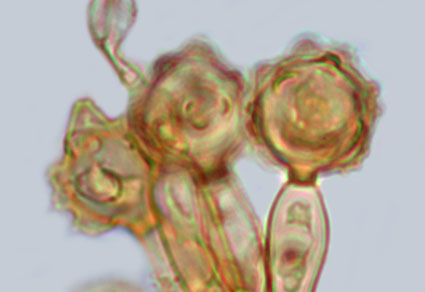
During a scientific visit to re-examine microfungi deposited in SP-Fungi, part of the Herbarium SP, a specimen previously identified as Leightoniomyces phillipsii and collected from decomposing roots was found to exhibit morphological features not reported in the original description. Detailed microscopic observations revealed consistent differences in conidial morphology, particularly the presence of digitate projections, and in reproductive structures, including connective cells forming short conidial chains. These characters support its recognition as a new species of the rare genus Leightoniomyces. Conidiogenesis is briefly discussed and a key to the known species are also provided. This study highlights the importance of herbarium collections as valuable repositories for detecting overlooked fungal diversity.
References
- Abbott, S.P. (2000) Holomorph studies of the Microascaceae. Ph.D. dissertation. Department of Biological Sciences, University of Alberta, Canada. https://doi.org/10.7939/r3-2n4b-nd88
- Alidadi, A., Vala, S.A. & Jouzani, G.S. (2020) Botryotrichum iranicum sp. nov. and Trematosphaeria magenta sp. nov. as two new species from Iran. Mycological Progress 19: 1575–1586. https://doi.org/10.1007/s11557-020-01648-7
- Bainier, G. (1907) Mycothèque de l’École de Pharmacie, XII-XVI. Bulletin de la Société Mycologique de France 23: 90–110.
- Berger, F. & Zimmermann, E. (2016) Ergänzungen zur Flechtenflora von Madeira mit besonderer Berücksichtigung lichenicoler Pilze. Hergozia 29: 235–276. https://doi.org/10.13158/heia.29.2.2016.235
- Berkeley, M.J. & Broome, C.E. (1875) Notices of British fungi (1402-1500). Annals and Magazine of Natural History 15: 28–41. https://doi.org/10.1080/00222937508681018
- Cole, C.T. & Kendrick, W.B. (1969) Conidium ontogeny in hyphomycetes. The annellosphores of Scopulariopsis brevicaulis. Canadian Journal of Botany 47: 925–929. https://doi.org/10.1139/b69-133
- Cole, G.T. & Aldrich, H.C. (1971) Ultrastructure of conidiogenesis in Scopulariopsis brevicaulis. Canadian Journal of Botany 49: 745–755. https://doi.org/10.1139/b71-113
- Corda, A.C.J. (1829) Deutschlands Flora, Abt. III. Die Pilze Deutschlands 2. pp. 37–70.
- Corda, A.C.J. (1837) Icones Fungorum hucusque Cognitorum 1. pp. 1–32.
- Diederich, P., Zimmermann, E., Etayo, J. & Braun, U. (2024) Leightoniomyces. In: Flora of Lichenicolous Fungi Vol. 2 Hyphomycetes. Luxembourg National Museum of Natural History, 544 pp.
- Ellis, M.B. (1971) Dematiaceous hyphomycetes. CABI, 608 pp.
- Grandi, R.A.P. (2012) First occurrence of Leightoniomyces phillipsii (Berk. & Leight.) D. Hawksw. & B. Sutton for South America. Brazilian Journal of Botany 35: 299–302. https://doi.org/10.1590/s1806-99592012000300009
- Gusmão, L.F.P., Monteiro, J.S. & Castañeda Ruiz, R.F. (2017) Tretoheliocephala compacta gen. & sp. nov. from the Brazilian semi-arid region. Mycotaxon 132: 453–458. https://doi.org/10.5248/132.453
- Hammill, T.M. (1971) Fine structure of annellophores. I. Scopulariopsis brevicaulis and S. koningii. American Journal of Botany 58: 88–97. https://doi.org/10.1002/j.1537-2197.1971.tb09950.x
- Hammill, T.M. (1972) Electron microscopy of phialoconidiogenesis in Metarrhizium anisopliae. American Journal of Botany 59: 317–326. https://doi.org/10.1002/j.1537-2197.1972.tb10099.x
- Hawksworth, D.L. (1977) Three new genera of lichenicolous fungi. Botanical Journal of the Linnean Society 75: 195–209. https://doi.org/10/1111/j.1095-8339.1977.tb01484.x
- Hawksworth, D.L. (1983) A key to the lichen-forming, parasitic, parasymbiotic and saprophytic fungi occurring on lichens in the British Isles. The Lichenologist 15: 1–44. https://doi.org/10.1017/S0024282983000031
- Hughes, S.J. (1958) Revisiones Hyphomycetum aliquot cum appendice de nominibus rejiciendis. Canadian Journal of Botany 36: 727–836. https://doi.org/10.1139/b58-067
- Kong, H.Z. (1998) Yunnania gen. nov. of Hyphomycetes. Mycotaxon 69: 319–326. https://doi.org/10.5962/p.415544
- Kuntze, O. (1898) Revisio generum plantarum. Revisio generum plantarum 3. pp. 1–576. https://doi.org/10.5962/bhl.title.327
- Mason, E.W. & Ellis, M.B. (1953) British species of Periconia. Mycological Papers 56: 1–127.
- McCune, B. & Stone, J. (2009) Leightoniomyces phillipsii, a synnematous soil-dwelling hyphomycete new to North America. Pacific Northwest Fungi 4: 1–4. https://doi.org/10.2509/naf2009.004.005
- Morton, F.J. & Smith, G. (1963) The genera Scopulariopsis Bainier, Microascus Zukal, and Doratomyces Corda. Mycological Papers 86: 1–96.
- Muntañola-Cvetkovic, M. & Gómez-Bolea, A. (1998) Arborillus llimonae nov. gen. et sp., a synnematous lichenicolous hyphomycete. Mycotaxon 68: 145–155.
- Pérez-Vargas, I., Etayo, J. & Hernández-Padrón, C. (2013) New species of lichenicolous fungi from the Canary Islands. Phytotaxa 99 (2): 58–64. https://doi.org/10.11646/phytotaxa.99.2.2
- Pound, R. & Clements, F.E. (1896) Report on Collections Made in 1894-95. Botanical Survey of Nebraska 4. pp. 1–48.
- Saccardo, P.A. (1886) Sylloge Hyphomycetum. Sylloge Fungorum 4. pp. 1–807.
- Sandoval-Denis, M., Guarro, J., Cano-Lira, J.F., Sutton, D.A., Wiederhold, N.P., De Hoog, G.S., Abbott, S.P., Decock, C., Singler, L. & Gené, J. (2016) Phylogeny and taxonomic revision of Microascaceae with emphasis on synnematous fungi. Studies in Mycology 83: 193–233. https://doi.org/10.1016/j.simyco.2016.07.002
- Seifert, K.A., Morgan-Jones, G. & Gams, W. (2011) The genera of Hyphomycetes. CBS-KNAW Fungal Biodiversity Centre, Utrecht, 2011.
- Wang, X.W., Yang, F.Y., Meijer, M., Kraak, B., Sun, B.D., Jiang, Y.L., Wu, Y.M., Bai, F.Y., Seifert, K.A., Crous, P.W., Samson, R.A. & Houbraken, J. (2018) Redefining Humicola sensu stricto and related genera in the Chaetomiaceae. Studies in Mycology 93: 65–153. https://doi.org/10.1016/j.simyco.2018.07.001
- Woudenberg, J.H.C., Meijer, M., Houbraken, J. & Samson, R.A. (2017) Scopulariopsis and scopulariopsis-like species from indoor environments. Studies in Mycology 88 (1): 1–35. https://doi.org/10.1016/j.simyco.2017.03.001
- Zukal, H. (1885) Ueber einige neue Pilze, Myxomyceten und Bakterien. Verhandlungen der Kaiserlich-Königlichen Zoologisch-Botanischen Gesellschaft in Wien 35: 333–342.