
Abstract
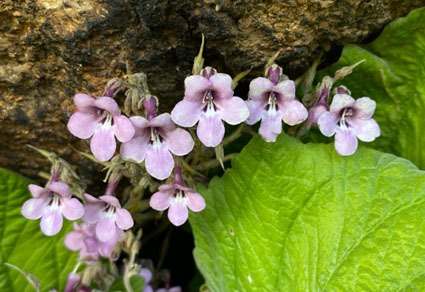
Streptocarpus petrodoxa is described from the granite whalebacks of Mpumalanga Province, South Africa. The species occurs in a highly restricted habitat beneath large granite boulders on inselbergs near White River, where it occupies shaded crevices in shallow, sandy lithosols derived from weathered granite. Comparisons with closely related taxa, S. pole-evansii and S. denticulatus, reveal distinct differences in leaf size, indumentum, corolla morphology and style orientation. All parts of the plant are covered with orange-red pigment granules, called dunnione, placing the species within a small group of Streptocarpus known to produce this chemical compound. Given its highly localised distribution, specialised habitat, and an estimated population of less than a thousand individuals, the species is assessed as Critically Endangered (CR B1ab(iii)+B2ab(iii)). A dichotomous key distinguishing S. petrodoxa, S. pole-evansii, S. denticulatus and S. dunnii is included.
References
- Baillon, H. (1874) Zantedeschia albomaculata. Bulletin Mensuel de la Société Linnéenne de Paris 1: 254.
- Bellstedt, D.U. & Edwards, T.J. (2004) A new species of Streptocarpus (Gesneriaceae) from the Pondoland coast, South Africa. Edinburgh Journal of Botany 60: 409–414. https://doi.org/10.1017/S0960428603000313
- Clarke, C.B. (1883) Cyrtandreae. In: Candolle, A. de & Candolle, C. de (Eds.) Monographiae Phanerogamarum 5. pp. 1–303.
- De Villiers, M.J., Pirie, M.D., Hughes, M., Möller, M., Edwards, T.J. & Bellstedt, D.U. (2013) An approach to identify putative hybrids in the ‘coalescent stochasticity zone’, as exemplified in the African plant genus Streptocarpus (Gesneriaceae). New Phytologist 198: 284–300. https://doi.org/10.1111/nph.12133
- Edwards, T.J., Hughes, M., Möller, M. & Bellstedt, D.U. (2008) New Streptocarpus species (Gesneriaceae) from South Africa. Botanical Journal of the Linnean Society 158: 743–748. https://doi.org/10.1111/j.1095-8339.2008.00934.x
- Fitzsimons, J.A. & Michael, D.R. (2017) Rocky outcrops: A hard road in the conservation of critical habitats. Biological Conservation 211: 36–44. https://doi.org/10.1016/j.biocon.2016.11.019
- Fourie, C.J., van Jaarsveld, E.J. & Hankey, A.J. (2026) Equilabium regale (Lamiaceae, Plectranthinae), a new species from Mpumalanga Province (South Africa) and an amended description for Equilabium dolomiticum. Phytotaxa 774 (2): 133–147. https://doi.org/10.11646/phytotaxa.774.2.3
- Gilly, C.L. (1943) An Afro-South American Cyperaceous complex. Brittonia 5: 1–20. https://doi.org/10.2307/2804870
- Hilliard, O.M. & Burtt, B.L. (1971) Streptocarpus: An African Plant Study. University of Natal Press, Pietermaritzburg.
- Hilliard, O.M. & Burtt, B.L. (1975) Studies in the Gesneriaceae of the Old World XXXVIII: A new species of Streptocarpus from East Africa. Notes from the Royal Botanic Garden Edinburgh 33: 467–469.
- Hilliard, O.M. & Burtt, B.L. (1986) Studies in the Gesneriaceae of the Old World XLIX: Additions and amendments to Streptocarpus. Notes from the Royal Botanic Garden Edinburgh 43: 229–232.
- Hilliard, O.M. & Burtt, B.L. (1988) Gesneriaceae. In: Launert, E. (Ed.) Flora Zambesiaca 8 (3). Flora Zambesiaca Managing Committee, London, pp. 43–60.
- Hilliard, O.M. & Burtt, B.L. (1990) Studies in the Gesneriaceae of the Old World LI: A new Streptocarpus from Mozambique. Notes from the Royal Botanic Garden Edinburgh 46: 321–322.
- Hilliard, O.M. (1992) Two new species of Streptocarpus from southern Africa. Edinburgh Journal of Botany 49: 75–81.
- Hooker, J.D. (1886) Streptocarpus dunnii. Curtis’s Botanical Magazine 112: t. 6903.
- Hooker, W.J. (1827) Didymocarpus rexii. Exotic Flora 3: t. 227.
- IUCN Standards and Petitions Subcommittee (2024) Guidelines for Using the IUCN Red List Categories and Criteria, version 16. Prepared by the Standards and Petitions Committee.
- IUCN (2012) IUCN Red List Categories and Criteria: Version 3.1, 2nd edition. IUCN, Gland.
- Karremans, A.P., Pupulin, F., Bogarín, D., Fernández, M., Rojas-Alvarado, G., Chinchilla, I.F., Salguero-Hernández, G., Oses, L. & Oconitrillo, N. (2024) Lankester Composite Digital Plate (LCDP). Centro de Investigación Jardín Botánico Lankester, Universidad de Costa Rica. Available from: https://www.researchgate.net/publication/380151671_Lankester_Composite_Digital_Plate_LCDP (accessed 2 September 2026)
- Lindley, J. (1828) Streptocarpus. Edwards’s Botanical Register 14: t. 1173.
- Linnaeus, C. (1753) Species plantarum, exhibentes plantas rite cognitas, ad genera relatas, cum differentiis specificis, nominibus trivialibus, synonymis selectis, locis natalibus, secundum systema sexuale digestas. Volumes 1 and 2. Salvius, Stockholm, 560 pp. [volume 1] and 1200 pp. [total]; indices not paginated. https://doi.org/10.5962/bhl.title.669
- Mucina, L. & Rutherford, M.C. (2006) The Vegetation of South Africa, Lesotho and Swaziland. South African National Biodiversity Institute, Pretoria.
- Nishii, K., Hughes, M., Briggs, M., Haston, E., Christie, F., De Villiers, M.J., Hanekom, T., Roos, W.G., Bellstedt, D.U. & Möller, M. (2015) Streptocarpus redefined to include all Afro‐Malagasy Gesneriaceae: Molecular phylogenies prove congruent with geographical distribution and basic chromosome numbers and uncover remarkable morphological homoplasies. Taxon 64 (6): 1243–1274. https://doi.org/10.12705/646.8
- Norman, N. & Whitfield, G. (2006) Geological Journeys: A Traveller’s Guide to South Africa’s Rocks and Landforms. Struik Nature, Cape Town.
- Paton, A.J., Mwanyambo, M., Govaerts, R.H.A., Smitha, K., Suddee, S., Phillipson, P.B., Wilson, T.C., Forster, P.I. & Culham, A. (2019) Nomenclatural changes in Coleus and Plectranthus (Lamiaceae). PhytoKeys 129: 1–158. https://doi.org/10.3897/phytokeys.129.34988
- Plants of the World Online (2026) Didymocarpus Wall. Facilitated by the Royal Botanic Gardens, Kew. Available from: https://powo.science.kew.org/results?q=Didymocarpus (accessed 16 March 2026)
- Price, J.R. & Robinson, R. (1938) A new natural colouring matter of the naphthalene group. Nature 141: 147.
- Thiers, B. (2026 [Continuously updated]) Index Herbariorum. Available from: https://sweetgum.nybg.org/science/ih/ (accessed 16 March 2026)
- Turrill, W.B. (1915) Streptocarpus denticulatus. Curtis’s Botanical Magazine 141: t. 8632.
- Verdoorn, I.C. (1937) Streptocarpus pole-evansii. Flowering Plants of South Africa 15: t. 678.
- Wallich, N. (1819) Didymocarpus. Edinburgh Philosophical Journal 1: 378.