

Abstract
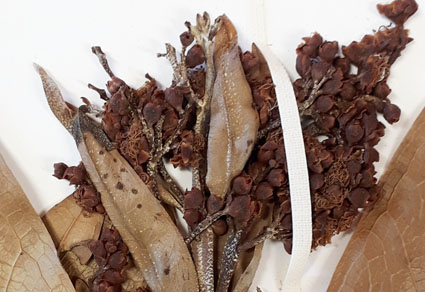
While studying the Myrcia (Myrtaceae) species from the Brazilian state of Rio de Janeiro, we found specimens displaying unusual combinations of morphological features for the genus. Based on evidence from herbaria and fieldwork, we propose that these specimens belong to four new species, which are described here as M. auriflora, M. brachypoda, M. confertiflora and M. palea. Among them, M. confertiflora is assigned to Myrcia sect. Aulomyrcia, while the other species are assigned to Myrcia sect. Calyptranthes. Two species were collected in Dense Ombrophilous Forests in southern and metropolitan Rio de Janeiro, while the other two occur in lowland seasonal forests in the northeastern region. Morphological descriptions, notes on taxonomy, distribution, habitat and phenology are provided for each species, along with illustrations, preliminary conservation assessments, and a map of occurrence records. Myrcia auriflora is categorized as Data Deficient (DD), M. confertiflora as Critically Endangered (CR) and the remaining species as Endangered (EN).
References
- Abreu, K.M.P., Braga, J.M.A. & Nascimento, M.T. (2014) Tree species diversity of coastal lowland semideciduous forest fragments in northern Rio de Janeiro State, Brazil. Bioscience Journal 30 (5): 1529–1550.
- Alves, J.G.S., Santos, L.L., Pereira-Silva, R.A. & Melo, A.L. (2024) Synopsis of Myrcia (Myrtaceae) in the State of Pernambuco, Brazil. Biota Neotropica 24 (3): e20231578. https://doi.org/10.1590/1676-0611-bn-2023-1578
- Amorim, B.S. (2017) Filogenia e taxonomia do clado Gomidesia (Myrcia s.l., Myrtaceae) na Floresta Atlântica do Brasil. Ph.D. Thesis. Universidade Federal de Pernambuco, Pernambuco, 190 pp.
- Amorim, B.S., Cabral, F.N., Albuquerque, P.M. & Fernandes, T. (2025) Myrcia fluminensis: a novelty of Myrcia sect. Gomidesia (Myrtaceae) from the montane Atlantic Forest of southeastern Brazil. Brittonia 77: 443–448. https://doi.org/10.1007/s12228-025-09852-z.
- Bachman, S., Moat, J., Hill, A., de la Torre, J. & Scott, B. (2011) Supporting Red List threat assessments with GeoCAT: Geospatial Conservation Assessment Tool. ZooKeys 150: 117–126. https://doi.org/10.3897/zookeys.150.2109
- Bebber, D.P., Carine, M.A., Wood, J.R.I., Wortley, A.H., Harris, D.J., Prance, G.T., Davidse, G., Paige, J., Pennington, T.D., Robson, N.K.B. & Scotland, R.W. (2010) Herbaria are a major frontier for species discovery. Proceedings of the National Academy of Sciences of the United States of America 107 (51): 22169–22171. https://doi.org/10.1073/pnas.1011841108
- Beentje, H. (2016) The Kew plant glossary—an illustrated dictionary of plant terms. Royal Botanic Gardens, Kew, 160 pp.
- Berg, O. (1855) Revisio Myrtacearum Americae. Linnaea 27 (1): 1–128.
- Berg, O. (1857) Myrtaceae I. In: Martius, C.P.F. von (Ed.) Flora brasiliensis, vol. 14, pt. 1. Frid. Fleischer in Comm., Lipsiae [Leipzig] & Monachii [Munich], pp. 1–468.
- Berg, O. (1859) Myrtographiae Brasiliensis Supplementum. In: Martius, C.P.F. von (Ed.) Flora brasiliensis, vol. 14, pt. 1. Frid. Fleischer in Comm., Lipsiae [Leipzig] & Monachii [Munich], pp. 530–636.
- CBI (Conservation Biology Institute) (2025) South America Country Boundaries (Data Basin Dataset). Available from: https://www.arcgis.com/home/item.html?id=0da030d7979c46088b1bcd1e8225cd90 (accessed 21 August 2025)
- Coelho, M.A., Baumgratz, J.F.A., Lobão, A.Q., Sylvestre, L.S., Trovó, M. & Silva, L.A.E. (2017) Flora do estado do Rio de Janeiro: avanços no conhecimento da diversidade. Rodriguésia 68 (1): 1–11. https://doi.org/10.1590/2175-7860201768101
- De Candolle, A.P. (1827) Myrtacées. In: Bory de Saint-Vincent, J.B.G.M. (Ed.) Dictionnaire classique d’histoire naturelle 11. Paris, pp. 399–407. https://doi.org/10.5962/bhl.title.33901
- De Candolle, A.P. (1828) Myrtacae. In: Candolle, A.P. (Ed.) Prodromus Systematis Naturalis Regni Vegetabilis Vol. 3. Treuttel & Würtz, Paris, pp. 207–296. https://doi.org/10.5962/bhl.title.286
- ESRI (2025) Satellite Map. Available from: https://www.esri.com/en-us/mapswe-love/gallery/satellite-map (accessed 21 August 2025)
- Fernandes, T., Sobral, M., Santos, M.F. & Braga, J.M.A. (2019) Myrcia auriculata (Myrtaceae), a new species from the Brazilian Atlantic Forest. Phytotaxa 399 (1): 77–82. https://doi.org/10.11646/phytotaxa.399.1.8
- Fernandes, T. (2020) Revisão taxonômica de Myrcia sect. Reticulosae (Myrtaceae). Master dissertation. Instituto de Pesquisas Jardim Botânico do Rio de Janeiro, Rio de Janeiro, 213 pp.
- Fernandes, T. (2024) Myrcia (Myrtaceae) do Rio de Janeiro. Ph.D. Thesis. Instituto de Pesquisas Jardim Botânico do Rio de Janeiro, Rio de Janeiro, 560 pp.
- Fernandes, T., Santos, M.F. & Lobão, A. (2020a) Flora do Rio de Janeiro: Myrcia sect. Eugeniopsis (Myrtaceae). Pesquisas, Botânica 74: 101–120.
- Fernandes, T., Lima, D.F. & Braga, J.M.A. (2020b) Myrcia adulterina (Myrtaeae), a new species from the Atlantic Forest of Rio de Janeiro, Brazil. Phytotaxa 452 (2): 165–172. https://doi.org/10.11646/phytotaxa.452.2.5
- Fernandes, T., Gaem, P.H., Vasconcelos, T.N.C., Bovini, M.G. & Braga, J.M.A. (2024) Myrcia cupreiflora (Myrtaceae), a new species from the Brazilian state of Rio de Janeiro. Phytotaxa 663 (2): 95–100. https://doi.org/10.11646/phytotaxa.663.2.5
- Fernandes, T., Lucas, E.J., Vasconcelos, T., Amorim, B. & Braga, J.M.A. (2025a) Taxonomic notes in Myrcia sect. Gomidesia (Myrtaceae) from Rio de Janeiro, Brazil: reestablishment of M. dolichopetala, and a new species, M. macrobracteosa. Nordic Journal of Botany 2025 (2): e04381. https://doi.org/10.1111/njb.04381
- Fernandes, T., Silva, D.M.N., Ferreira, C.D.M., Vasconcelos, T., Lucas, E.J. & Braga, J.M.A. (2025b) From the brink of extinction: rediscovery of two endemic tree species of Myrcia (Myrtaceae) in urban Brazilian Atlantic Forest. Oryx 59 (4): 440–444. https://doi.org/10.1017/S0030605325000110
- Gaem, P.H., Andrella, G.C., Maurin, O., Bittrich, V., Mazine, F.F., Lucas, E. & Amaral, M.C.E. (2025) Integrating datasets from herbarium specimens and images to treat a Neotropical myrtle species complex. Annals of Botany 135 (6): 1075–1092. https://doi.org/10.1093/aob/mcae183
- Gardner, G. (1842) Contributions towards a Flora of Brazil. London Journal of Botany 1: 528–548.
- Goodwin, Z.A., Harris, D.J., Filer, D., Wood, J.R.I. & Scotland, R.W. (2015) Widespread mistaken identity in tropical plant collections. Current Biology 25 (22): R1066–R1067. https://doi.org/10.1016/j.cub.2015.10.002
- Grisebach, A.H.R. (1860) Flora of the British West Indian Islands. Reeve, London, 805 pp.
- Habel, J.C., Assmann, T., Schmitt, T. & Avise, J.C. (2010) Relict Species: From Past to Future. In: Habel, J.C. & Assmann, T. (Eds.) Relict Species. Springer, Berlin, Heidelberg, pp. 1–5. https://doi.org/10.1007/978-3-540-92160-8_1
- Hickey, L.J. (1973) Classification of the architecture of dicotyledonous leaves. American Journal of Botany 60 (1): 17–33. https://doi.org/10.1002/j.1537-2197.1973.tb10192.x
- ICMBio (Instituto Chico Mendes de Conservação da Biodiversidade) (2018) Plano de Manejo da Área de Proteção Ambiental de Cairuçu. ICMBio, Paraty, 84 pp.
- INEA (Instituto Estadual do Ambiente) (2013) Plano de manejo do Parque Estadual da Pedra Branca. Secretaria do Meio Ambiente do Estado do Rio de Janeiro, Rio de Janeiro, 107 pp.
- IUCN (International Union for Conservation of Nature) (2012) IUCN Red List Categories and Criteria, Version 3.1. (2nd ed.) Prepared by the Species Survival Commission. International Union for Conservation of Nature, Gland and Cambridge, 32 pp.
- IUCN (International Union for Conservation of Nature) (2024) Guidelines for using the IUCN Red List Categories and Criteria. Version 16. Prepared by the Standards and Petitions Subcommittee. International Union for Conservation of Nature. Available from: http://www.iucnredlist.org/documents/RedListGuidelines.pdf (accessed 5 July 2026)
- Lannoy, L.C.D., Oliveira, A.I.D., Goldenberg, R. & Lima, D.F. (2021) Myrcia (Myrtaceae) in the state of Paraná, Brazil. Phytotaxa 486 (1): 1–105. https://doi.org/10.11646/phytotaxa.486.1.1
- Legrand, C.D. (1962) El genero Calyptranthes en el Brasil Austral. Lilloa 31: 183–206.
- Legrand, C.D. & Klein, R.M. (1967) Mirtáceas: Gomidesia. In: Reitz, P.R. (Ed.) Flora Ilustrada Catarinense. Herbário Barbosa Rodrigues, Itajaí, pp. 1–44.
- Legrand, C.D. & Klein, R.M. (1969) Mirtáceas: Myrcia. In: Reitz, R. (Ed.) Flora Ilustrada Catarinense. Herbário Barbosa Rodrigues, Itajaí, pp. 219–330.
- Legrand, C.D. & Klein, R.M. (1971a) Mirtáceas: Marlierea. In: Reitz, P.R. (Ed.) Flora Ilustrada Catarinense. Herbário Barbosa Rodrigues, Itajaí, pp. 457–487.
- Legrand, C.D. & Klein, R.M. (1971b) Mirtáceas: Calyptranthes. In: Reitz, P.R. (Ed.) Flora Ilustrada Catarinense. Herbário Barbosa Rodrigues, Itajaí, pp. 490–552.
- Lima, D.F., Mauad, A.V.S., Silva-Pereira, V. da, Smidt, E. de C. & Goldenberg, R. (2015) Species boundaries inferred from ISSR markers in the Myrcia laruotteana complex (Myrtaceae). Plant Systematics and Evolution 301: 353–363. https://doi.org/10.1007/s00606-014-1078-9
- Lima, D.F. (2017) Estudos filogenéticos e taxonômicos em Myrcia DC. sensu lato (Myrtaceae), com ênfase no clado Guianensis. Ph.D. Thesis. Universidade Estadual de Campinas, Campinas, 334 pp.
- Linnaeus, C. (1753) Species plantarum. v. 1. Impensis Laurentii Salvii, Holmiae [Stockholm], 560 pp.
- Lourenço, A.R.L., Burton, G.P., Alves, M. & Lucas, E. (2020) Myrcia sect. Calyptranthes (Myrtaceae) from the Atlantic Forest, Brazil. Phytotaxa 460 (1): 12–58. https://doi.org/10.11646/phytotaxa.460.1.2
- Lourenço, A.R.L., Parra-O., C., Sánchez-Chávez, E. & Lucas, E. (2018) New combinations and names for continental Calyptranthes (Myrtaceae: Myrcia s.l.). Phytotaxa 373 (1): 71–85. https://doi.org/10.11646/phytotaxa.373.1.3
- Lucas, E.J., Matsumoto, K., Harris, S.A., Nic Lughadha, E.M., Bernardini, B. & Chase, M.W. (2011) Phylogenetics, morphology and evolution of the large genus Myrcia s.l. (Myrtaceae). International Journal of Plant Sciences 172 (7): 915–934. https://doi.org/10.1086/660913
- Lucas, E.J., Wilson, C.E., Lima, D.F., Sobral, M. & Matsumoto, K. (2016) A conspectus of Myrcia sect. Aulomyrcia (Myrtaceae). Annals of the Missouri Botanical Garden 101 (4): 648–698. https://doi.org/10.3417/2014015
- Lucas, E.J., Amorim, B.S., Lima, D.F., Lima-Lourenço, A.R., Nic Lughadha, E.M., Proença, C.E.B., Rosa, P.O., Rosário, A.S., Santos, L.L., Santos, M.F., Souza, M.C., Staggemeier, V.G., Vasconcelos, T.N.C. & Sobral, M. (2018) A new infra-generic classification of the species-rich Neotropical genus Myrcia s.l. Kew Bulletin 73: 9. https://doi.org/10.1007/s12225-017-9730-5
- Marsico, T.D., Krimmel, E.R., Carter, J.R., Gillespie, E.L., Lowe, P.D., McCauley, R., Morris, A.B., Nelson, G., Smith, M., Soteropoulos, M. & Monfils, A.K. (2020) Small herbaria contribute unique biogeographic records to county, locality, and temporal scales. American Journal of Botany 107: 1577–1587. https://doi.org/10.1002/ajb2.1563
- Mazine, F.F., Valdemarin, K.S., Bünger, M.O., Faria, J.E.Q., Fernandes, T., Giaretta, A., Santana, K.C., Sobral, M. & Souza, M.A.D. (2026) Eugenia in Flora e Funga do Brasil. Jardim Botânico do Rio de Janeiro. Available from: https://floradobrasil.jbrj.gov.br/FB10338 (accessed 5 June 2026)
- McDade, L.A. (1995) Species concepts and problems in practice: insight from botanical monographs. Systematic Botany 20 (4): 606–622. https://doi.org/10.2307/2419813
- MMA (Ministério do Meio Ambiente) (2025) Download de dados geográficos. Available from: http://mapas.mma.gov.br/i3geo/datadownload.htm (accessed 21 August 2025)
- POWO (2026) Plants of the World Online. Facilitated by the Royal Botanic Gardens, Kew. Available from: https://powo.science.kew.org/ (accessed 5 July 2026)
- QGIS Development Team (2025) QGIS Geographic Information System. Open-Source Geospatial Foundation Project. Available from: http://qgis.osgeo.org (accessed 21 August 2025)
- Radford, A.E., Dickison, W.C., Massey, J.R. & Bell, C.R. (1974) Vascular plant systematics. Harper and Row, New York, 891 pp.
- Rodrigues, A.V. & Duarte, L. (2024) Mapping species richness and evolutionary regions of the genus Myrcia. Journal of Biogeography 51 (5): 827–839. https://doi.org/10.1111/jbi.14791
- Santos, L.L. dos (2017) Taxonomia e filogenia de Myrcia sect. Myrcia (Myrcia s.l., Myrtaceae). Ph.D. Thesis. Universidade Federal Rural de Pernambuco, Pernambuco, 319 pp. https://doi.org/10.11606/t.41.2014.tde-10032015-085549
- Santos, L.L. dos, Forest, F., Lima, D.F., Sales, M.F., Vasconcelos, T.N., Staggemeier, V.G. & Lucas, E. (2021) Phylogenetic and biogeographic analysis in Myrcia sect. Myrcia (Myrcia s.l., Myrtaceae) with focus on highly polyphyletic Myrcia splendens. International Journal of Plant Sciences 182 (9): 778–792. https://doi.org/10.1086/715639
- Santos, M.F. (2025) Taxonomic monograph of Myrcia sect. Eugeniopsis (Myrciinae, Myrteae, Myrtaceae), an endemic clade of Eastern South America. Phytotaxa 703 (1): 1–100. https://doi.org/10.11646/phytotaxa.703.1.1
- Santos, M.F., Amorim, B.S., Burton, G.P., Fernandes, T., Gaem, P.H., Lourenço, A.R.L., Lima, D.F., Rosa, P.O., Santos, L.L.D., Staggemeier, V.G., Vasconcelos, T.N.C. & Lucas, E.J. (2026) Myrcia in Flora do Brasil 2020. Jardim Botânico do Rio de Janeiro. Available from: https://floradobrasil2020.jbrj.gov.br/FB10660 (accessed 5 July 2026)
- Santos, M.F., Lucas, E. & Sano, P.T. (2018) A taxonomic monograph of Myrcia sect. Sympodiomyrcia (Myrteae, Myrtaceae). Phytotaxa 380 (1): 1–114. https://doi.org/10.11646/phytotaxa.380.1.1
- Santos, M.F., Amorim, B.S., Burton, G.P., Faria, J.E.Q., Fernandes, T., Flickinger, J.A., Gaem, P.H., Landrum, L.R., Lima, D.F., Proença, C.E.B., Rosa, P.O., Santos, L.L. dos, Setubal, R.B., Stadnik, A.M.S., Staggemeier, V.G., Vasconcelos, T.N.C. & Lucas, E.J. (2024) A taxonomic account of Myrciinae (Myrteae, Myrtaceae): generic and sectional placement of forgotten species and a list of all accepted species. Phytotaxa 674 (2): 129–170. https://doi.org/10.11646/phytotaxa.674.2.1
- Scaravelli, F.S., Gaem, P.H., Valdemarin, K.S., Lucas, E. & Mazine, F.F. (2022) Myrcia (Myrtaceae) in the Vale Natural Reserve, Linhares, Espírito Santo, Brazil. Rodriguésia 73: e02352020. https://doi.org/10.1590/2175-7860202273024
- SEA (Secretaria de Estado do Ambiente) & INEA (Instituto Estadual do Ambiente) (2013) Plano de Manejo (Fase 2)-Parque Estadual da Ilha Grande (PEIG). Angra dos Reis, Rio de Janeiro, 98 pp.
- Silveira, N.J.E. (1985) Notas sobre o gênero Myrcia DC. (Myrtaceae)—II. Roessléria 7 (1): 65–68.
- Sobral, M. (2003) A família Myrtaceae no Rio Grande do Sul. Unisinos, São Leopoldo, 215 pp.
- Sobral, M. (2007) A evolução do conhecimento taxonômico das Angiospermas no Brasil (1990–2006) e um estudo de caso: a família Myrtaceae no município de Santa Teresa, Espírito Santo. Ph.D. Thesis. Universidade Federal de Minas Gerais, Belo Horizonte, 374 pp.
- Sobral, M. (2010) Ten new Myrtaceae from eastern and northeastern Brazil. Journal of the Botanical Research Institute of Texas 4 (1): 133–158.
- Souza, M.C., Morim, M.P., Conde, M.M.S. & Menezes, L.F.T. (2007) Subtribo Myrciinae O.Berg (Myrtaceae) na Restinga da Marambaia, RJ, Brasil. Acta Botanica Brasilica 21 (1): 49–63. https://doi.org/10.1590/S0102-33062007000100006
- Swartz, O.P. (1788) Nova Genera & Species Plantarum seu Prodromus descriptionum vegetabilium. Bibliopoliis Acad. M. Swederi, Holmiae [Stockholm], Upsaliæ [Uppsala] & Aboæ [Turku], 158 pp. https://doi.org/10.5962/bhl.title.4400
- Thiers, B. (2026) [continuously updated] Index Herbariorum: A global directory of public herbaria and associated staff. New York Botanical Garden’s Virtual Herbarium. Available from: http://sweetgum.nybg.org/ih/ (accessed 6 July 2026)
- Werneck, M.S., Sobral, M.E.G., Rocha, C.T.V., Landau, E.C. & Stehmann, J.R. (2011) Distribution and Endemism of Angiosperms in the Atlantic Forest. Natureza & Conservação 9: 188–193. https://doi.org/10.4322/natcon.2011.024