

Abstract
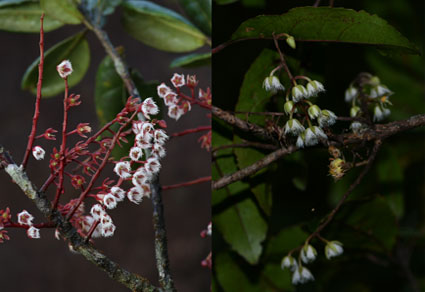
A recent taxonomic revision of Sri Lankan species of the genus Elaeocarpus has resolved previously reported cryptic species diversity and described two new species: Elaeocarpus sripadensis, confined to the Peak Wilderness Sanctuary in the Ratnapura District, and Elaeocarpus rubrovenosus from Haputale in the Badulla District and Mandaramnuwara in the Nuwara Eliya District. With these additions, the number of Elaeocarpus species recorded in Sri Lanka increases from 10 to 12. Both new species are described and illustrated, and their conservation status is assessed following the IUCN Red List Categories and Criteria. Elaeocarpus sripadensis and E. rubrovenosus are evaluated as Critically Endangered (CR), under Criteria B1ab(i, ii, iii, iv) + D and B1ab(iii)+2ab(iii) +D., respectively.
References
- Arnott, W.G.A. (1836) Pugillus plantarum Indiae orientalis. Nova acta physico-medica 18: 321–356.
- Antonelli, A., Govaerts, R., Nic Lughadha, E., Onstein, R., Smith, R.J. & Zizka, A. (2023) Why plant diversity and distribution matter. New Phytologist 240 (4): 1331–1336. https://doi.org/10.1111/nph.19282
- Baba, Y. & Crayn, D. (2012) Elaeocarpus hylobroma (Elaeocarpaceae): a new species endemic to mountain tops in north-east Queensland, Australia. Kew Bulletin 67: 743–750. https://doi.org/10.1007/s12225-012-9398-9
- Christenhusz, M.J. & Byng, J.W. (2016) The number of known plant species in the world and its annual increase. Phytotaxa 261 (3): 201–217. https://doi.org/10.11646/phytotaxa.261.3.1
- Guruge, D.P.G.S.K., Yakandawala, D. & Yakandawala, K. (2016) Confirming the identity of newly recorded Nymphaea rubra Roxb. ex Andrews discerning from Nymphaea pubescens Willd. using morphometrics and molecular sequence analyses. Bangladesh Journal of Plant Taxonomy 23 (2): 107 pp. https://doi.org/10.3329/bjpt.v23i2.30819
- Hapuarachchi, S.I., Silva, G.G.N.D., Yakandawala, D.M.D. & Yakandawala, K. (2025) Intraspecific diversity in the Elaeocarpus montanus Thwaites (Elaeocarpaceae) species complex in Sri Lanka: Insights from an integrative morphological and molecular approach. Ceylon Journal of Science 54 (3): 865–879. https://doi.org/10.4038/cjs.v54i3.8922
- Hooker, W. (1837) Icones Plantarum, vol. 2. Longman, London, 154 pp.
- Hooker, J.D. (1874) Flora of British India, vol. 1. L. Reeve & Co., London, 406 pp. https://doi.org/10.5962/bhl.title.678
- IUCN Standards and Petitions Committee (2024) Guidelines for Using the IUCN Red List Categories and Criteria. Version 15.1 Prepared by the Standards and petitions committee. Available from: https://www.iucnredlist.org/resources/redlistguidelines (accessed 30 April 2026)
- Kim, K.C. & Byrne, L.B. (2006) Biodiversity loss and the taxonomic bottleneck: emerging biodiversity science. Ecological Research 21 (6): 794–810. https://doi.org/10.1007/s11284-006-0035-7
- Linnaeus, C. (1753) Species plantarum. Laurent Salvii, Stockholm, 515 pp.
- Meijer, W. (1995) Elaeocarpaceae. In: Dassanayake, M.D., Fossberg, F.R. & Clayton, W.D. (Eds.) Revised Handbook to The Flora of Ceylon, vol. 9. Amerind Publication Co. Pvt. Ltd., New Delhi, pp. 80–90.
- Ministry of Environment (2020) The National Red List 2020 of Sri Lanka; Conservation Status of the Fauna and Flora. Ministry of Environment, Colombo, 59 pp.
- POWO (2026) Plants of the World Online. Facilitated by the Royal Botanic Gardens, Kew. Available from: http://www.plantsoftheworldonline.org/ (accessed 4 August 2026)
- Roxburgh, W. (1832) Flora Indica, or Descriptions of Indian Plants, vol. 2. W. Thacker & Co., Calcutta, 597 pp. https://doi.org/10.5962/bhl.title.590
- Schlechter, R. (1916) 40. Die Elaeocarpaceen Papuasiens. Botanische Jahrbücher für Systematik, Pflanzengeschichte und Pflanzengeographie 54 (3): 92–155.
- Silva, N., Dasanayaka, S., Yakandawala, D. & Yakandawala, K. (2025) Taxonomic resolution of the Elaeocarpus hedyosmus Zmarzty (Elaeocarpaceae) species complex in Sri Lanka using an integrative approach. Phytotaxa 706 (2): 101–128. https://doi.org/10.11646/phytotaxa.706.2.1
- Silva, G.G.N.D., Yakandawala, D.M.D. & Yakandawala, K. (2021) Morphometric analysis of genus Elaeocarpus L. (Elaeocarpaceae) in Sri Lanka. Proceedings of The Peradeniya University International Research Sessions 22: 134.
- Silva, N., Yakandawala, D. & Yakandawala, K. (2023) A Elaeocarpus mahamayensis (Elaeocarpaceae), a new endemic species from the Knuckles Mountain Range in Sri Lanka. Phytotaxa 616 (1): 1–26. https://doi.org/10.11646/phytotaxa.616.1.1
- Thwaites, G.H.K. & Hooker, J.D. (1858) Enumeratio plantarum Zeylaniae. Dulau and Co., London, 32 pp.
- Weibel, R. (1972) Deux especes nouvelles du genere Elaeocarpus provenant des montagnes du sed del’ Inde. Candollea 27 (1): 17–19.
- Wight, R. (1840) Illustrations of Indian Botany: Or, Figures Illustrative of Each of the Natural Orders of Indian Plants Described in the Author’s Prodromus Florae Peninsulae Indiae Orientalis, vol. 1. J.B. Pharoah, Madras, 84 pp. https://doi.org/10.5962/bhl.title.9603
- Zmarzty, S. (2001) Revision of Elaeocarpus (Elaeocarpaceae) section Elaeocarpus in Southern India and Sri Lanka. Kew Bulletin: 405–447. https://doi.org/10.2307/4110964