
Abstract
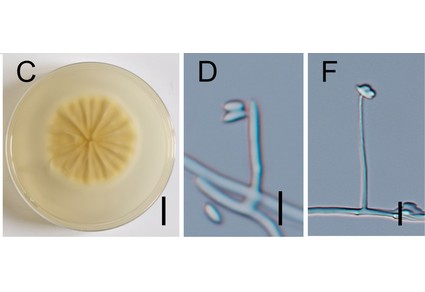
Simplicillium is a diverse genus of fungi in Cordycipitaceae that occurs in a wide range of ecological niches, including soil, insects, plants, and other fungi. During a survey of fungal diversity in maize rhizosphere soil from Guizhou Province, China, three isolates representing an undescribed species of Simplicillium were obtained. Phylogenetic analyses based on a combined dataset of six loci (ITS, nrSSU, nrLSU, tef-1α, rpb1, and rpb2) revealed that the three isolates formed a distinct and highly supported monophyletic lineage within Simplicillium. The new lineage was recovered as sister to a clade comprising S. zunyiense, S. cantharise, and S. araneicola. Morphologically, the new species is characterized by moderately growing colonies on PDA, abundant white fluffy to cottony aerial mycelium, solitary slender phialides, ellipsoidal to cylindrical conidia, the absence of spherical slimy heads, and the absence of octahedral crystals. Based on phylogenetic evidence and morphological characteristics, the fungus is described herein as Simplicillium sansuiense sp. nov. This study expands the known diversity of Simplicillium and provides a taxonomic basis for future studies on the species diversity, ecology, and biological functions of the genus.
References
- Berendsen, R.L., Pieterse, C.M.J. & Bakker, P.A.H.M. (2012) The rhizosphere microbiome and plant health. Trends in Plant Science 17 (8): 478–486. https://doi.org/10.1016/j.tplants.2012.04.001
- Bischoff, J.F., Rehner, S.A. & Humber, R.A. (2006) Metarhizium frigidum sp. nov.: A cryptic species of M. anisopliae and a member of the M. flavoviride complex. Mycologia 98: 737–745. https://doi.org/10.1080/15572536.2006.11832645
- Chen, W., Liang, J., Ren, X., Zhao, J., Han, Y. & Liang, Z. (2022) Multigene phylogeny, phylogenetic network, and morphological characterizations reveal four new arthropod-associated Simplicillium species and their evolutional relationship. Frontiers in Microbiology 13: 950773. https://doi.org/10.3389/fmicb.2022.950773
- Chen, W.H., Han, Y.F., Liang, J.D. & Liang, Z.Q. (2021) Taxonomic and phylogenetic characterizations reveal four new species of Simplicillium (Cordycipitaceae, Hypocreales) from Guizhou, China. Scientific Reports 11 (1): 15300. https://doi.org/10.1038/s41598-021-94893-z
- Chen, W.H., Liang, J.D., Ren, X.X., Zhao, J.H., Han, Y.F. & Liang, Z.Q. (2022) Phylogenetic, ecological and morphological characteristics reveal two new spider-associated genera in Clavicipitaceae. MycoKeys 91: 49–66. https://doi.org/10.3897/mycokeys.91.86812
- Chen, W.H., Liu, C., Han, Y.F., Liang, J.D., Tian, W.Y. & Liang, Z.Q. (2019) Three novel insect-associated species of Simplicillium (Cordycipitaceae, Hypocreales) from Southwest China. MycoKeys 58: 83–102. https://doi.org/10.3897/mycokeys.58.37176
- Chen, W.H., Shu, H.L., Li, D., Liang, J.D., Sun, C.L., Zhao, J.H., Wijayawardene, N.N., Han, Y.F. & Tian, W.Y. (2025) Shedding light on the darkness: cryptic diversity of cordyceps-like fungi in karst regions of Guizhou Province, China. Mycosphere 16 (1): 2887–2974. https://doi.org/10.5943/mycosphere/16/1/20
- Custódio, F.A. & Pereira, O.L. (2025) New treasures in Cordycipitaceae: Fungicolous fungi associated with Pseudocercospora fijiensis and P. musae in Brazil, including Matutinistella gen. nov. Fungal Systematics and Evolution 15: 133–152. https://doi.org/10.3114/fuse.2025.15.06
- Darriba, D., Taboada, G.L., Doallo, R. & Posada, D. (2012) jModelTest 2: more models, new heuristics and parallel computing. Nature Methods 9 (8): 772. https://doi.org/10.1038/nmeth.2109
- Gao, S., Meng, W., Zhang, L., Yue, Q., Zheng, X. & Xu, L. (2021) Parametarhizium (Clavicipitaceae) gen. nov. with two new species as a potential biocontrol agent isolated from forest litters in Northeast China. Frontiers in Microbiology 12: e627744. https://doi.org/10.3389/fmicb.2021.627744
- Hoang, D.T., Chernomor, O., von Haeseler, A., Minh, B.Q. & Vinh, L.S. (2017) UFBoot2: improving the ultrafast bootstrap approximation. Molecular Biology and Evolution 35 (2): 518–522. https://doi.org/10.1093/molbev/msx281
- Hopple, J.S. (1994) Phylogenetic investigations in the genus Coprinus based on morphological and molecular characters. Ph.D. Dissertation, Duke University, Durham, NC, USA.
- Hou, L.W., Giraldo, A., Groenewald, J.Z., Rämä, T., Summerbell, R.C., Huang, G.Z., Cai, L. & Crous, P.W. (2023) Redisposition of acremonium-like fungi in Hypocreales. Studies in Mycology 105 (1): 23–203. https://doi.org/10.3114/sim.2023.105.02
- Jones, J.T., Haegeman, A., Danchin, E.G.J., Gaur, H.S., Helder, J., Jones, M.G.K., Kikuchi, T., Manzanilla-López, R., Palomares-Rius, J.E., Wesemael, W.M.L. & Perry, R.N. (2013) Top 10 plant-parasitic nematodes in molecular plant pathology. Molecular Plant Pathology 14 (9): 946–961. https://doi.org/10.1111/mpp.12057
- Kalyaanamoorthy, S., Minh, B.Q., Wong, T.K.F., von Haeseler, A. & Jermiin, L.S. (2017) ModelFinder: fast model selection for accurate phylogenetic estimates. Nature Methods 14 (6): 587–589. https://doi.org/10.1038/nmeth.4285
- Kerry, B.R. (2000) Rhizosphere interactions and the exploitation of microbial agents for the biological control of plant-parasitic nematodes. Annual Review of Phytopathology 38: 423–441. https://doi.org/10.1146/annurev.phyto.38.1.423
- Kondo, N., Iwasaki, H., Tokiwa, T., Mura, S. & Nonaka, K. (2020) Simplicillium spumae (Cordycipitaceae, Hypocreales), a new hyphomycetes from aquarium foam in Japan. Mycoscience 61 (3): 116–121. https://doi.org/10.1016/j.myc.2020.02.002
- Leplat, J., Francois, A. & Bousta, F. (2022) Leptobacillium cavernicola, a newly discovered fungal species isolated from several Paleolithic-decorated caves in France. Phytotaxa 571 (2): 186–196. https://doi.org/10.11646/phytotaxa.571.2.5
- Li, W., Luo, T., Li, J., Zhang, J., Wu, M., Yang, L. & Li, G. (2023) Antifungal activity and biocontrol potential of Simplicillium lamellicola JC-1 against multiple fungal pathogens of oilseed rape. Journal of Fungi 9: 57. https://doi.org/10.3390/jof9010057
- Liu, F. & Cai, L. (2012) Morphological and molecular characterization of a novel species of Simplicillium from China. Cryptogamie Mycologie 33 (2): 137–144. https://doi.org/10.7872/crym.v33.iss2.2012.137
- Liu, Y.J., Whelen, S. & Hall, B.D. (1999) Phylogenetic relationships among ascomycetes: Evidence from an RNA polymerse II subunit. Molecular Biology and Evolution 16 (12): 1799–1808. https://doi.org/10.1093/oxfordjournals.molbev.a026092
- Lu, Y., Li, S., Liu, Z., Zhao, J., Yu, Z., Liang, Z., He, H., Li, J., Huang, Y., Li, X. & Yu, H. (2025) Morphology and phylogeny of two new species within Cordycipitaceae (Hypocreales) from China. MycoKeys 115: 187–208. https://doi.org/10.3897/mycokeys.115.140683
- Minh, B.Q., Schmidt, H.A., Chernomor, O., Schrempf, D., Woodhams, M.D., von Haeseler, A. & Lanfear, R. (2020) IQ-TREE 2: New models and efficient methods for phylogenetic inference in the genomicera. Molecular Biology and Evolution 37 (5): 1530–1534. https://doi.org/10.1093/molbev/msaa015
- Mongkolsamrit, S., Khonsanit, A., Thanakitpipattana, D., Tasanathai, K., Noisripoom, W., Lamlertthon, S., Himaman, W., Houbraken, J., Samson, R.A. & Luangsa-ard, J.J. (2020) Revisiting Metarhizium and the description of new species from Thailand. Studies in Mycology 95: 171–251. https://doi.org/10.1016/j.simyco.2020.04.001
- Mongkolsamrit, S., Noisripoom, W., Thanakitpipattana, D., Khonsanit, A., Lamlertthon, S. & Luangsa-ard, J.J. (2021) New species in Aciculosporium, Shimizuomyces and a new genus Morakotia associated with plants in Clavicipitaceae from Thailand. Fungal Systematics and Evolution 8: 27–37. https://doi.org/10.3114/fuse.2021.08.03
- Nonaka, K., Kaifuchi, S., Ōmura, S. & Masuma, R. (2013) Five new Simplicillium species (Cordycipitaceae) from soils in Tokyo, Japan. Mycoscience 54 (1): 42–53. https://doi.org/10.1016/j.myc.2012.07.002
- Okane, I., Nonaka, K., Kurihara, Y., Abe, J.P. & Yamaoka, Y. (2020) A new species of Leptobacillium, L. symbioticum, isolated from mites and sori of soybean rust. Mycoscience 61 (4): 165–171. https://doi.org/10.1016/j.myc.2020.04.006
- Preedanon, S., Suetrong, S., Srihom, C., Somrithipol, S., Kobmoo, N., Saengkaewsuk, S., Srikitikulchai, P., Klaysuban, A., Nuankaew, S., Chuaseeharonnachai, C., Chainuwong, B., Muangsong, C., Zhang, Z.F., Cai, L. & Boonyuen, N. (2023) Eight novel cave fungi in Thailand’s Satun Geopark. Fungal Systematics and Evolution 12 (1): 1–30. https://doi.org/10.3114/fuse.2023.12.01
- Rehner, S.A. & Buckley, E.A. (2005) Beauveria phylogeny inferred from nuclear ITS and EF1-α sequences: evidence for cryptic diversification and links to Cordyceps teleomorphs. Mycologia 97 (1): 84–98. https://doi.org/10.3852/mycologia.97.1.84
- Ronquist, F., Teslenko, M., van der Mark, P., Ayres, D.L., Darling, A., Höhna, S., Larget, B., Liu, L., Suchard, M.A. & Huelsenbeck, J.P. (2012) MrBayes 3.2: efficient Bayesian phylogenetic inference and model choice across a large model space. Systematic Biology 61 (3): 539–542. https://doi.org/10.1093/sysbio/sys029
- Smalla, K., Wieland, G., Buchner, A., Zock, A., Parzy, J., Kaiser, S., Roskot, N., Heuer, H. & Berg, G. (2001) Bulk and rhizosphere soil bacterial communities studied by denaturing gradient gel electrophoresis: Plant-dependent enrichment and seasonal shifts revealed. Applied and Environmental Microbiology 67 (10): 4742–4751. https://doi.org/10.1128/AEM.67.10.4742-4751.2001
- Soares, F.E.F., Aguilar-Marcelino, L. & Braga, F.R. (2024) Editorial: Nematophagous fungi as nematode control agents. Frontiers in Fungal Biology 4: 1353132. https://doi.org/10.3389/ffunb.2023.1353132
- Soares, F.E.F., Ferreira, J.M., Genier, H.L.A., Al-Ani, L. & Aguilar-Marcelino, L. (2023) Biological control 2.0: Use of nematophagous fungi enzymes for nematode control. Journal of Natural Pesticide Research 4: 100025.
- Stamatakis, A., Hoover, P. & Rougemont, J. (2008) A rapid bootstrap algorithm for the RAxML Web servers. Systematic Biology 57: 758–771. https://doi.org/10.1080/10635150802429642
- Sun, J.Z., Ge, Q.Y., Zhu, Z.B., Zhang, X.L. & Liu, X.Z. (2019) Three dominating hypocrealean fungi of the ‘white mold spots’ on acrylic varnish coatings of the murals in a Koguryo tomb in China. Phytotaxa 397 (3): 225–236. https://doi.org/10.11646/phytotaxa.397.3.2
- Sung, G.H., Hywel-Jones, N.L., Sung, J.M., Luangsa-ard, J.J., Shrestha, B. & Spatafora, J.W. (2007) Phylogenetic classification of Cordyceps and the clavicipitaceous fungi. Studies in Mycology 57: 5–59. https://doi.org/10.3114/sim.2007.57.01
- Vilgalys, R. & Hester, M. (1990) Rapid genetic identification and mapping of enzymatically amplified ribosomal DNA from several Cryptococcus species. Journal of Bacteriology 172: 4238–4246. https://doi.org/10.1128/jb.172.8.4238-4246.1990
- Wang, D., Ma, N., Rao, W. & Zhang, Y. (2023) Recent advances in life history transition with nematode-trapping fungus Arthrobotrys oligospora and its application in sustainable agriculture. Pathogens 12: 367. https://doi.org/10.3390/pathogens12030367
- Wang, Y., Tang, D.X., Chen, H., Li, Q.R., Loinheuang, C. & Shen, X.C. (2025) Phylogenetic evidence re-veal a close relationship between Amphichorda and Ovicillium in Bionectriaceae (Hypocreales). MycoKeys 117: 337–352. https://doi.org/10.3897/mycokeys.117.151366
- Wang, Y., Wang, Z.Q., Thanarut, C., Dao, V.M., Wang, Y.B. & Yu, H. (2023) Phylogeny and species delimitations in the economically, medically, and ecologically important genus Samsoniella (Cordycipitaceae, Hypocreales). MycoKeys 99: 227–250. https://doi.org/10.3897/mycokeys.99.106474
- Wang, Y.B., Wang, Y., Fan, Q., Duan, D.E., Zhang, G.D., Dai, R.Q., Dai, Y.D., Zeng, W.B., Chen, Z.H., Li, D.D., Tang, D.X., Xu, Z.H., Sun, T., Nguyen, T., Tran, N., Dao, V., Zhang, C.M., Huang, L.D., Liu, Y.J., Zhang, X.M., Yang, D.R., Sanjuan, T., Liu, X.Z., Yang, Z.L. & Yu, H. (2020) Multigene phylogeny of the family Cordycipitaceae (Hypocreales): New taxa and the new systematic position of the Chinese cordycipitoid fungus Paecilomyces hepiali. Fungal Diversity 103: 1–46. https://doi.org/10.1007/s13225-020-00457-3
- Ward, N.A., Robertson, C.L., Chanda, A.K. & Schneider, R.W. (2012) Effects of Simplicillium lanosoniveum on Phakopsora pachyrhizi, the soybean rust pathogen, and its use as a biological control agent. Phytopathology 102 (8): 749–760. https://doi.org/10.1094/PHYTO-01-11-0031
- Wei, D.P., Wanasinghe, D.N., Hyde, K.D., Mortimer, P.E., Xu, J., Xiao, Y.P., Bhunjun, C.S. & To-Anun, C. (2019) The genus Simplicillium. MycoKeys 60: 69–92. https://doi.org/10.3897/mycokeys.60.38040.figure4
- White, T.J., Bruns, T.D., Lee, S.B. & Taylor, J.W. (1990) Amplifcation and direct sequencing of fungal ribosomal RNA genes for phylogenetics. In: Innis, M.A., Gelfand, D.H., Sninsky, J.J. & White, T.J. (Eds.) PCR Protocols: A Guide to Methods and Applications. Academic, pp. 315–322. https://doi.org/10.1016/b978-0-12-372180-8.50042-1
- Yan, Q.H., Ni, Q.R., Gu, W.J., Liu, H.W., Yuan, X.Y. & Sun, J.Z. (2023) Simplicillium sinense sp. nov., a novel potential pathogen of tinea faciei. Frontiers in Microbiology 14: 1156027. https://doi.org/10.3389/fmicb.2023.1156027
- Zare, R. & Gams, W. (2001) A revision of Verticillium section Prostrata. IV. The genera Lecanicillium and Simplicillium gen. nov. Nova Hedwigia 73 (1–2): 1–50. https://doi.org/10.1127/nova.hedwigia/73/2001/1
- Zare, R. & Gams, W. (2016) More white verticillium-like anamorphs with erect conidiophores. Mycological Progress 15 (10–11): 993–1030. https://doi.org/10.1007/s11557-016-1214-8
- Zhang, Z.F., Liu, F., Zhou, X., Liu, X.Z., Liu, S.J. & Cai, L. (2017) Culturable mycobiota from Karst caves in China, with descriptions of 20 new species. Persoonia 39 (1): 1–31. https://doi.org/10.3767/persoonia.2017.39.01
- Zhang, Z.F., Zhou, S.Y., Eurwilaichitr, L., Ingsriswang, S., Raza, M., Chen, Q., Zhao, P., Liu, F. & Cai, L. (2021) Culturable mycobiota from Karst caves in China II, with descriptions of 33 new species. Fungal Diversity 106 (1): 29–136. https://doi.org/10.1007/s13225-020-00453-7
- Zhang, Z.Y., Feng, Y., Tong, S.Q., Ding, C.Y., Tao, G. & Han, Y.F. (2023) Morphological and phylogenetic characterisation of two new soil-borne fungal taxa belonging to Clavicipitaceae (Hypocreales, Ascomycota). MycoKeys 98: 113–132. https://doi.org/10.3897/mycokeys.98.106240
- Zhao, D., Liu, B., Li, L.Y., Zhu, X.F., Wang, Y., Duan, Y.X. & Chen, L.J. (2013) Simplicillium chinense: a biological control agent against plant parasitic nematodes. Biocontrol Science and Technology 23 (8): 980–986. https://doi.org/10.1080/09583157.2013.809514
- Zhao, D., Liu, B., Li, L.Y., Zhu, X.F., Wang, Y.Y., Wang, J.Q., Duan, Y.X. & Chen, L.J. (2013) Simplicillium chinense: a biological control agent against plant parasitic nematodes. Biocontrol Science and Technology 23 (8): 980–986. https://doi.org/10.1080/09583157.2013.809514
- Zhao, D., Liu, B., Li, L.Y., Zhu, X.F., Wang, Y.Y., Wang, J.Q., Duan, Y.X. & Chen, L.J. (2013) Simplicillium chinense: a biological control agent against plant parasitic nematodes. Biocontrol Science and Technology 23 (8): 980–986. https://doi.org/10.1080/09583157.2013.809514