
Abstract
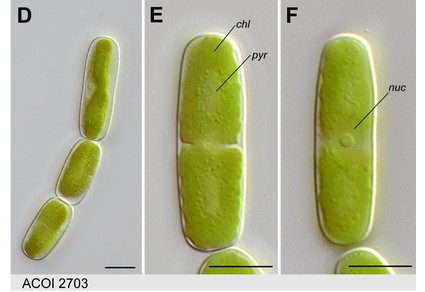
Since the emergence of molecular phylogenetics, several genera within the Zygnematophyceae have been shown to be polyphyletic. Polyphyly is particularly apparent among taxa with a plain morphology such as the genus Mesotaenium Nägeli. Currently, this genus name is applied to zygnematophyte species of several distinct evolutionary lineages, which require a taxonomic revision. For this, the type species, M. endlicherianum Nägeli, needs to be clearly assigned to one of these lineages. We studied three closely related Mesotaenium-like strains of lineage Meso-2 with an integrative approach combining morphology, cell cycle characterisation, and molecular phylogenetics based on the rbcL gene. Our results reveal clear genetic and morphological differences among the strains, supporting their recognition as three distinct species. To establish a stable taxonomic framework, we epitypify M. endlicherianum based on strain SAG 12.97 and thus formally assign the genus Mesotaenium to lineage Meso-2. Additionally, we describe two new species for this clade and establish the common cellular details of the latter. The defined phylogenetic placement of Mesotaenium established in this work now paves the way for additional taxonomic revisions of provisionally described lineages.
References
- An, S.S., Friedl, T. & Hegewald, E. (1999) Phylogenetic Relationships of Scenedesmus and Scenedesmus- like Coccoid Green Algae as Inferred from ITS-2 rDNA Sequence Comparisons. Plant Biology 1: 418–428. https://doi.org/10.1111/j.1438-8677.1999.tb00724.x
- Barcytė, D., Pilátová, J., Mojzeš, P. & Nedbalová, L. (2020) The arctic Cylindrocystis (Zygnematophyceae, Streptophyta) green algae are genetically and morphologically diverse and exhibit effective accumulation of polyphosphate. Journal of Phycology 56: 217–232. https://doi.org/10.1111/jpy.12931
- de Bary, A. (1858) Untersuchungen über die Familie der Conjugaten (Zygnemeen und Desmidieen): Ein Beitrag zur physiologischen und beschreibenden Botanik. Förstnersche Buchhandlung, Leipzig, 82 pp., pl. I–VIII. https://doi.org/10.5962/bhl.title.63789
- Berggren, S. (1871) Bidrag till kännedom om fanerogamfloran vid Diskobugten och Auleitsivik-fjorden på Grönlands vestkust. Öfversigt af Förhandlingar Kongl. Vetenskaps-akademiens: 853–897.
- Bridel-Brideri, S.E. (1827) Bryologia Universa seu Systematica ad Novam Methodum Dispositio, Historia et Descriptio omnium Muscorum Frondosorum Hucusque Cognitorum cum Synonymia ex Auctoribus Probatissimis. II. Sumtibus Joan. Ambros. Barth, Lepzig, 848 pp., pl. I–X, Suppl. I–Suppl. III. https://doi.org/10.5962/bhl.title.60260
- Buech, G. (1967) Zur Taxonomie und Cytologie der Gattung Mesotaenium Nägeli. Dissertation. Universität des Saarlandes.
- Busch, A. & Hess, S. (2022a) A diverse group of underappreciated zygnematophytes deserves in-depth exploration. Applied Phycology: 1–18. https://doi.org/10.1080/26388081.2022.2081819
- Busch, A. & Hess, S. (2022b) Sunscreen mucilage: a photoprotective adaptation found in terrestrial green algae (Zygnematophyceae). European Journal of Phycology 57: 107–124. https://doi.org/10.1080/09670262.2021.1898677
- Busch, A., Slominski, E., Remias, D., Procházková, L. & Hess, S. (2024) A mesophilic relative of common glacier algae, Ancylonema palustre sp. nov., provides insights into the induction of vacuolar pigments in zygnematophytes. Environmental Microbiology 26: e16680. https://doi.org/10.1111/1462-2920.16680
- Carrillo-Carrasco, V.P., Hernández-García, J. & Weijers, D. (2023) Electroporation-based delivery of proteins in Penium margaritaceum and other zygnematophycean algae. Physiologia Plantarum 175: e14121. https://doi.org/10.1111/ppl.14121
- Chase, M.W., Salamin, N., Wilkinson, M., Dunwell, J.M., Kesanakurthi, R.P., Haidar, N. & Savolainen, V. (2005) Land plants and DNA barcodes: short-term and long-term goals. Philosophical Transactions of the Royal Society B: Biological Sciences 360: 1889–1895. https://doi.org/10.1098/rstb.2005.1720
- Cheng, S., Xian, W., Fu, Y., Marin, B., Keller, J., Wu, T., Sun, W., Li, X., Xu, Y. & Zhang, Y. (2019) Genomes of subaerial Zygnematophyceae provide insights into land plant evolution. Cell 179: 1057–1067. https://doi.org/10.1016/j.cell.2019.10.019
- Civáň, P., Foster, P.G., Embley, M.T., Séneca, A. & Cox, C.J. (2014) Analyses of Charophyte Chloroplast Genomes Help Characterize the Ancestral Chloroplast Genome of Land Plants. Genome Biology and Evolution 6: 897–911. https://doi.org/10.1093/gbe/evu061
- Cushman, J.A. (1906) New England Desmids of the Sub-Family Saccodermae. Bulletin of the Torrey Botanical Club 33: 343. https://doi.org/10.2307/2478911
- Dadras, A., Fürst-Jansen, J.M.R., Darienko, T., Krone, D., Scholz, P., Sun, S., Herrfurth, C., Rieseberg, T.P., Irisarri, I., Steinkamp, R., Hansen, M., Buschmann, H., Valerius, O., Braus, G.H., Hoecker, U., Feussner, I., Mutwil, M., Ischebeck, T., de Vries, S., Lorenz, M. & de Vries, J. (2023a) Environmental gradients reveal stress hubs pre-dating plant terrestrialization. Nature Plants 9: 1419–1438. https://doi.org/10.1038/s41477-023-01491-0
- Dadras, A., Rieseberg, T.P., Zegers, J.M.S., Fürst-Jansen, J.M.R., Irisarri, I., de Vries, J. & de Vries, S. (2023b) Accessible versatility underpins the deep evolution of plant specialized metabolism. Phytochemistry Reviews. https://doi.org/10.1007/s11101-023-09863-2
- De Araújo, C.B., De Mattos Bicudo, C.E., Da Silva, T.G., Šťastný, J., Trumhová, K. & Škaloud, P. (2022) Hidden generic diversity in desmids: description of Pseudomicrasterias gen. nov. (Desmidiaceae, Zygnematophyceae). Phycologia 61: 227–240. https://doi.org/10.1080/00318884.2022.2031781
- Domozych, D.S., Sørensen, I., Popper, Z.A., Ochs, J., Andreas, A., Fangel, J.U., Pielach, A., Sacks, C., Brechka, H. & Ruisi-Besares, P. (2014) Pectin metabolism and assembly in the cell wall of the charophyte green alga Penium margaritaceum. Plant Physiology 165: 105–118. https://doi.org/10.1104/pp.114.236257
- Fujimoto, M., Shimizu, Y., Ito, Y., Ebine, K., Minamino, N., Kanazawa, T., Fukao, Y., Nakano, A., Uemura, T. & Ueda, T. (2025) Neofunctionalization of VAMP7 opened up a plant-unique vacuolar transport pathway. Current Biology 35: 2630–2641.e10. https://doi.org/10.1016/j.cub.2025.04.062
- Galtier, N., Gouy, M. & Gautier, C. (1996) SEAVIEW and PHYLO_WIN: two graphic tools for sequence alignment and molecular phylogeny. Bioinformatics 12: 543–548. https://doi.org/10.1093/bioinformatics/12.6.543
- Gontcharov, A.A. (2008) Phylogeny and classification of Zygnematophyceae (Streptophyta): current state of affairs. Fottea 8: 87–104. https://doi.org/10.5507/fot.2008.004
- Gontcharov, A.A., Marin, B. & Melkonian, M. (2003) Molecular phylogeny of conjugating green algae (Zygnemophyceae, Streptophyta) inferred from SSU rDNA sequence comparisons. Journal of Molecular Evolution 56: 89–104. https://doi.org/10.1007/s00239-002-2383-4
- Gontcharov, A.A., Marin, B. & Melkonian, M. (2004) Are combined analyses better than single gene phylogenies? A case study using SSU rDNA and rbc L sequence comparisons in the Zygnematophyceae (Streptophyta). Molecular Biology and Evolution 21: 612–624. https://doi.org/10.1093/molbev/msh052
- Gontcharov, A.A. & Melkonian, M. (2010) Molecular Phylogeny and Revision of the Genus Netrium (Zygnematophyceae, Streptophyta): Nucleotaenium gen. nov. Journal of Phycology 46: 346–362. https://doi.org/10.1111/j.1529-8817.2010.00814.x
- Gouy, M., Guindon, S. & Gascuel, O. (2010) SeaView version 4: a multiplatform graphical user interface for sequence alignment and phylogenetic tree building. Molecular Biology and Evolution 27: 221–224. https://doi.org/10.1093/molbev/msp259
- Guiry, M.D. & Guiry, G.M. (2026) AlgaeBase. World-wide electronic publication. Available from: https://www.algaebase.org (accessed 30 July 2026)
- Hall, J.D., Fučíková, K., Lewis, L.A. & Karol, K.G. (2010) An assessment of proposed DNA barcodes in freshwater green algae. Cryptogam Algol 31: 529–55.
- Hall, J.D., Karol, K.G., McCourt, R.M. & Delwiche, C.F. (2008) Phylogeny of the Conjugating Green Algae Based on Chloroplast and Mitochondrial Nucleotide Sequence Data. Journal of Phycology 44: 467–477. https://doi.org/10.1111/j.1529-8817.2008.00485.x
- Hall, J.D. & McCourt, R. (2016) Zygnematophyta. In: Handbook of the protists. pp. 135–163. https://doi.org/10.1007/978-3-319-32669-6_41-1
- Hansgirg, A. (1886) Prodromus der Algenflora von Böhmen Erster Theil. Enthaltend die Rhodophyceen, Phaeophyceen und einen Teil der Chlorophyceen. Řivnáč, Prag, 286 pp.
- Hayden, H.S., Blomster, J., Maggs, C.A., Silva, P.C., Stanhope, M.J. & Waaland, J.R. (2003) Linnaeus was right all along: Ulva and Enteromorpha are not distinct genera. European Journal of Phycology 38: 277–294. https://doi.org/10.1080/1364253031000136321
- Hegewald, E., Wolf, M., Keller, A., Friedl, T. & Krienitz, L. (2010) ITS2 sequence-structure phylogeny in the Scenedesmaceae with special reference to Coelastrum (Chlorophyta, Chlorophyceae), including the new genera Comasiella and Pectinodesmus. Phycologia 49: 325–335. https://doi.org/10.2216/09-61.1
- Hess, S., Williams, S.K., Busch, A., Irisarri, I., Delwiche, C.F., De Vries, S., Darienko, T., Roger, A.J., Archibald, J.M., Buschmann, H., Von Schwartzenberg, K. & De Vries, J. (2022) A phylogenomically informed five-order system for the closest relatives of land plants. Current Biology 32: 4473–4482.e7. https://doi.org/10.1016/j.cub.2022.08.022
- Kiemle, S.N., Domozych, D.S. & Gretz, M.R. (2007) The extracellular polymeric substances of desmids (Conjugatophyceae, Streptophyta): chemistry, structural analyses and implications in wetland biofilms. Phycologia 46: 617–627. https://doi.org/10.2216/06-97.1
- Kumar, S., Stecher, G., Li, M., Knyaz, C. & Tamura, K. (2018) MEGA X: molecular evolutionary genetics analysis across computing platforms. Molecular Biology and Evolution 35: 1547–1549. https://doi.org/10.1093/molbev/msy096
- Lagerheim, G. (1886) Algologiska Bidrag. I. Contributions algologique à la flore de la Suède. Botaniska Notiser: 44–50.
- Link, H.F. (1820) Epistola Ad Virum Celeberrimum Nees Ab Esenbeck De Algis Aquaticis In Genera Disponendis. Sumtibus Adolphi Marcus, Bonn, 8 pp., pl. I.
- Linnaeus (1753) Species Plantarum: Exhibentes Plantas Rite Cognitas, Ad Genera Relatas, Cum Differentiis Specificis, Nominibus Trivialibus, Synonymis Selectis, Locis Natalibus, Secundum Systema Sexuale Digestas. II. Impensis Laurentii Salvii, Stockholm, 640 pp. https://doi.org/10.5962/bhl.title.59734
- Luo, J. & Hall, B.D. (2007) A Multistep Process Gave Rise to RNA Polymerase IV of Land Plants. Journal of Molecular Evolution 64: 101–112. https://doi.org/10.1007/s00239-006-0093-z
- Marks, J. & Petersen, M. (2026) Early occurrence of caffeoylshikimic acid esterase (CSE) activity in the hornwort Anthoceros agrestis. Planta 263: 49. https://doi.org/10.1007/s00425-025-04915-7
- Matasci, N., Hung, L.-H., Yan, Z., Carpenter, E.J., Wickett, N.J., Mirarab, S., Nguyen, N., Warnow, T., Ayyampalayam, S. & Barker, M. (2014) Data access for the 1,000 Plants (1KP) project. Gigascience 3: 2047–217X. https://doi.org/10.1186/2047-217x-3-17
- McFadden, G.I. & Melkonian, M. (1986) Use of Hepes buffer for microalgal culture media and fixation for electron microscopy. Phycologia 25: 551–557. https://doi.org/10.2216/i0031-8884-25-4-551.1
- Medina, R., Johnson, M.G., Liu, Y., Wickett, N.J., Shaw, A.J. & Goffinet, B. (2019) Phylogenomic delineation of Physcomitrium (Bryophyta: Funariaceae) based on targeted sequencing of nuclear exons and their flanking regions rejects the retention of Physcomitrella, Physcomitridium and Aphanorrhegma. Journal of Systematics and Evolution 57: 404–417. https://doi.org/10.1111/jse.12516
- Meyen, F.J.F. (1829) Beobachtungen über einige niedere Algenformen. Nova Acta Physico-Medica 14: 768–778.
- Nägeli, C. (1849) Gattungen einzelliger Algen: physiologisch und systematisch bearbeitet. Friedrich Schulthess, Zürich, 138 pp., pl. I–VIII. https://doi.org/10.5962/bhl.title.6805
- Newmaster, S.G., Fazekas, A.J. & Ragupathy, S. (2006) DNA barcoding in land plants: evaluation of rbcL in a multigene tiered approach. Botany 84: 335–341. https://doi.org/10.1139/b06-047
- Procházková, L., Řezanka, T., Nedbalová, L. & Remias, D. (2021) Unicellular versus Filamentous: The Glacial Alga Ancylonema alaskana comb. et stat. nov. and Its Ecophysiological Relatedness to Ancylonema nordenskioeldii (Zygnematophyceae, Streptophyta). Microorganisms 9: 1103. https://doi.org/10.3390/microorganisms9051103
- Ralfs, J. (1848) The British Desmidieae: The Drawings by Edw. Jenner. Reeve, London, 226 pp., pl. I–XXXV.
- Rieseberg, T.P., Dadras, A., Bergschmidt, L.I.N., Bierenbroodspot, M.J., Fürst-Jansen, J.M.R., Irisarri, I., de Vries, S., Darienko, T. & de Vries, J. (2023) Divergent responses in desiccation experiments in two ecophysiologically different Zygnematophyceae. Physiologia Plantarum 175: e14056. https://doi.org/10.1111/ppl.14056
- Rieseberg, T.P., Dadras, A., Darienko, T., Post, S., Herrfurth, C., Fürst-Jansen, J.M.R., Hohnhorst, N., Petroll, R., Rensing, S.A., Pröschold, T., De Vries, S., Irisarri, I., Feussner, I. & De Vries, J. (2025) Time-resolved oxidative signal convergence across the algae–embryophyte divide. Nature Communications 16: 1780. https://doi.org/10.1038/s41467-025-56939-y
- de Roij, M., Hernández García, J., Das, S., Borst, J.W. & Weijers, D. (2025) ARF degradation defines a deeply conserved step in auxin response. Nature Plants 11: 717–724. https://doi.org/10.1038/s41477-025-01975-1
- Schimper, W.-P., Bruch, P., Gümbel, T. & Schimper, W.-P. (1836) Bryologia Europae, seu Genera Muscorum Europaeorum Monographice Illustrata. III. Sumptibus Librariae E. Schweizerbart, Stuttgart, 305 pp., pl. 1–305. https://doi.org/10.5962/bhl.title.50508
- Schindelin, J., Arganda-Carreras, I., Frise, E., Kaynig, V., Longair, M., Pietzsch, T., Preibisch, S., Rueden, C., Saalfeld, S. & Schmid, B. (2012) Fiji: an open-source platform for biological-image analysis. Nature Methods 9: 676–682. https://doi.org/10.1038/nmeth.2019
- Stamatakis, A. (2014) RAxML version 8: a tool for phylogenetic analysis and post-analysis of large phylogenies. Bioinformatics 30: 1312–1313. https://doi.org/10.1093/bioinformatics/btu033
- Tamura, K., Stecher, G. & Kumar, S. (2021) MEGA11: Molecular Evolutionary Genetics Analysis Version 11. Molecular Biology and Evolution 38: 3022–3027. https://doi.org/10.1093/molbev/msab120
- Teiling, E. (1954) Actinotaenium, genus Desmidiacearum resuscitatum. Botanisk Notiser 4: 376–426.
- West, W. & West, G.S. (1904) A monograph of the British Desmidiaceae. I. The Ray Society, London, 224 pp., pl. 1–32. https://doi.org/10.5962/bhl.title.1619