
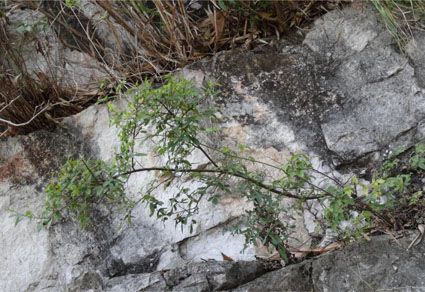

Abstract
Campylotropis guizhouensis, a new species from Guizhou Province, Southwest China, is described and illustrated. It is morphologically similar to C. sulcata and molecularly closely related to C. trigonoclada, but can be distinguished from both species by its terete appressed-pubescent branchlets with minute angles and obscure sulci, linear-lanceolate stipules, subdensely appressed-pubescent leaf abaxial surfaces, axillary and terminal single raceme, smaller lanceolate bracts, and obliquely ovate to near-semicircular legumes. Molecular phylogenetic analysis also indicates that the new species forms an independent lineage, clearly separate from the morphologically similar C. sulcata. Additional information of this new species, including its phenology, distribution, habitat and etymology, is also provided.
References
- Bentham, G. (1865) Lespedeza. In: Bentham, G. & Hooker, J.D. (Eds.) Genera Plantarum. Vol. 1. Reeve and Co., Kent, pp. 524.
- Bunge, A.A. (1835) Plantarum mongholico-chinensium, decas prima. Uchenya zapiski Imperatorskogo Kazanskogo Universiteta 4: 154–180.
- Feng, Y., Gao, X.F., Zhang, J.Y., Jiang, L.S., Li, X., Deng, H.N., Liao, M. & Xu, B. (2022) Complete chloroplast genomes provide insights into evolution and phylogeny of Campylotropis (Fabaceae). Frontiers in Plant Science 13: 895543. https://doi.org/10.3389/fpls.2022.895543
- Fu, P.Y. (1987) A study of the genus Campylotropis Bunge in China. Bulletin of Botanical Research 7: 11–55.
- Huang, P.H., Ohashi, H. & Iokawa, Y. (2010) Campylotropis. In: Wu, Z.Y., Raven, P.H. & Hong, D.Y. (Eds.) Flora of China. Vol. 10. Science Press, Beijing & Missouri Botanical Garden Press, St. Louis, pp. 292–302.
- Iokawa, Y. & Ohashi, H. (2002a) A taxonomic study of Campylotropis (Leguminosae) I. Journal of Japanese Botany 77: 179–222. https://doi.org/10.51033/jjapbot.77_4_9591
- Iokawa, Y. & Ohashi, H. (2002b) A taxonomic study of Campylotropis (Leguminosae) II. Journal of Japanese Botany 77: 251–283. https://doi.org/10.51033/jjapbot.77_5_9602
- Iokawa, Y. & Ohashi, H. (2002c) A taxonomic study of Campylotropis (Leguminosae) III. Journal of Japanese Botany 77: 315–350. https://doi.org/10.51033/jjapbot.77_6_9615
- IUCN Standards and Petitions Committee (2024) Guidelines for Using the IUCN Red List Categories and Criteria. Version 16. Prepared by the Standards and Petitions Committee. Available from: https://www.iucnredlist.org/documents/RedListGuidelines.pdf (accessed 3 July 2026)
- Jiang, L.S. & Xu, B. (2021) Campylotropis luquanensis (Fabaceae: Papilionoideae), a new species from Southwest China. Phytotaxa 524: 114–118. https://doi.org/10.1002/ece3.11410
- Jiang, L.S., Li, X.H., Li, X. & Xu, B. (2024) Campylotropis xinfeniae (Fabaceae, Papilionoideae), a new species from Yunnan, China, based on morphological and molecular evidence. Ecology and Evolution 14: e11410. https://doi.org/10.11646/phytotaxa.524.2.6
- Jiang, L.S., Feng, Y., Zhang, J.Y., Li, X., Liao, M., Deng, H.N., Yu, Q. & Xu, B. (2025) Phylogenomic framework, biogeography and character evolution of the genus Campylotropis (Fabaceae, Papilionoideae). Molecular Phylogenetics and Evolution: 108484. https://doi.org/10.1016/j.ympev.2025.108484
- Maximowicz, C.J. (1873) Synopsis generis Lespedezae, Michaux. Acta Horti Petropolitani 2: 327–388.
- Michaux, A. (1803) Flora Boreali-Americana. Vol. 2. Levrault, Paris, 340 pp.
- Ohashi, H. (1971) A taxonomic study of the tribe Coronilleae (Leguminosae) with a special reference to pollen morphology. Journal of the Faculty of Science 11: 25–92.
- Ohashi, H., Polhill, R.M. & Shubert, B.G. (1981) Desmodieae. In: Polhill, R.M. & Raven, P.H. (Eds.) Advances in Legume Systematics. Vol. 1. Royal Botanic Gardens, Kew, pp. 292–300.
- Ohashi, H. (1982) Lespedeza. In: Satake, Y., Ohwi, J., Kitamura, S., Watari, S. & Tominari, T. (Eds.) Wild Flowers in Japan, Herbaceous Plants (Including Dwarf Subshrubs). Vol. 2. Heibonsha Ltd., Tokyo, pp. 204–206.
- Schindler, A.K. (1912a) Kummerowia. Repertorium Specierum Novarum Regni Vegetabilis 10: 403. https://doi.org/10.1002/fedr.4870102410
- Schindler, A.K. (1912b) Campylotropis trigonoclada. Repertorium Specierum Novarum Regni Vegetabilis 11: 430. https://doi.org/10.1002/fedr.19120112603
- Schindler, A.K. (1912c) Das genus Campylotropis. Repertorium Specierum Novarum Regni Vegetabilis 11: 338–347. https://doi.org/10.1002/fedr.19120112603
- Schindler, A.K. (1916) Campylotropis sulcata. Botanische Jahrbücher für Systematik, Pflanzengeschichte und Pflanzengeographie 54: 65.
- Schindler, A.K. (1926) Desmodii generumque affinium species et combinationes novae. II. Repertorium Specierum Novarum Regni Vegetabilis 22: 250–288. https://doi.org/10.1002/fedr.19260221306
- Schindler, A.K. (1928) Die Desmodiinen in der botanischen Literatur nach Linné. Repertorium Specierum Novarum Regni Vegetabilis, Beihefte 49: 1–371.
- Thiers, B.M. (2026) Index Herbariorum: A global directory of public herbaria and associated staff. New York Botanical Garden's Virtual Herbarium. Available from: https://sweetgum.nybg.org/science/ih/ (accessed 30 September 2026)
- Xu, B., Wu, N., Gao, X.F. & Zhang, L.B. (2012) Analysis of DNA sequences of six chloroplast and nuclear genes suggests incongruence, introgression, and incomplete lineage sorting in the evolution of Lespedeza (Fabaceae). Molecular Phylogenetics and Evolution 62: 346–358. https://doi.org/10.1016/j.ympev.2011.10.007