
Abstract
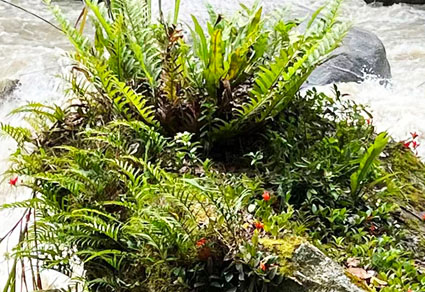
Drynaria lineatisora, a new fern species from China, Myanmar, and Vietnam, is described and illustrated here. This species is morphologically similar to D. coronans but can be clearly distinguished by its elongate-linear sori, dark brown scales with shortly spinulose-denticulate margins, and spiny spore ornamentation. In contrast, D. coronans has orbicular to short-linear sori, yellowish scales with long-ciliate margins, and smooth spore surfaces. Moreover, D. coronans is widely distributed across tropical and subtropical regions of Southeast Asia, whereas D. lineatisora shows a disjunct distribution limited to mountainous areas of Medog (Xizang, China), northern Myanmar, and northern Vietnam. Molecular phylogenetic evidence based on chloroplast genome further confirms significant divergence between the two species.
References
- Alderwerelt van Rosenburgh, C.R.W.K. van (1909) Pleopeltidis specierum Malaiarum enumeratio. Bulletin du Département de l’Agriculture aux Indes Néerlandaises 27: 1–46.
- Bory, J. (1824) Dictionnaire classique d'histoire naturelle. Rey et Gravier, Paris, 6: 1–593.
- Bory, J. (1825) Sur un sous-genre a former parmis les polypodes, sous le nom de drynaire, Drynaria. Annales des Sciences Naturelles (Paris) 5: 462–470.
- Capella-Gutiérrez, S., Silla-Martinez, J.M. & Gabaldon, T. (2009) trimAl: A tool for automated alignment trimming in large-scale phylogenetic analyses. Bioinformatics 25: 1972–1973. https://doi.org/10.1093/bioinformatics/btp348
- Chan, P.-P. & Lowe, T.M. (2019) tRNAscan-SE: Searching for tRNA genes in genomic sequences. Methods in Molecular Biology 1962: 1–14. https://doi.org/10.1007/978-1-4939-9173-0_1
- Chen, S., Zhou, Y., Chen, Y. & Gu, J. (2018) Fastp: An ultra-fast all-in-one FASTQ preprocessor. Bioinformatics 34: i884–i890. https://doi.org/10.1093/bioinformatics/bty560
- Chen, X.-H., Shu, J.-P., Li, J., Yan, Y.-H., Zheng, X.-L. & Gu, Y.-F. (2026) Comparative plastome analyses and evolutionary relationships of Drynaria. Frontiers in Plant Science 16: 1688693. https://doi.org/10.3389/fpls.2025.1688693
- Ching, R.-C. (1940) On natural classification of the family “Polypodiacaeae”. Sunyatsenia 4: 201–268.
- Ching, R.-C. (1941) A new genus of ferns from Hainan. Sunyatsenia 6: 10–11.
- Christenhusz, M.J. & Schneider, H. (2012) (2054) Proposal to conserve the name Drynaria against Aglaomorpha (Polypodiaceae). Taxon 61: 465–466. https://doi.org/10.1002/tax.612019
- Christensen, C. (1934) Index Filicum: Supplementum tertium pro annis 1917–1933. H. Hagerup, Copenhagen.
- Copeland, E.B. (1917) The genus Christiopteris. Philippine Journal of Science, Section C, Botany 12: 331–336.
- Copeland, E.B. (1929) The oriental genera of Polypodiaceae. University of California Publications in Botany 16: 45–128.
- Du, X.-Y., Lu, J.-M., Zhang, L.-B., Wen, J., Kuo, L.-Y., Mynssen, C.M., Schneider, H. & Li, D.-Z. (2021) Simultaneous diversification of Polypodiales and angiosperms in the Mesozoic. Cladistics 37: 518–539. https://doi.org/10.1111/cla.12457
- Hoang, D.T., Chernomor, O., Haeseler, A.V., Minh, B.Q. & Vinh, L.S. (2018) UFBoot2: Improving the ultrafast bootstrap approximation. Molecular Biology and Evolution 35: 518–522. https://doi.org/10.1093/molbev/msx281
- Hoshizaki, B.J. (1991) An “Intergeneric” hybrid: Aglaomorpha × Drynaria. American Fern Journal 81: 37–43. https://doi.org/10.2307/1547518
- Janssen, T. & Schneider, H. (2005) Exploring the evolution of humus collecting leaves in drynarioid ferns (Polypodiaceae, Polypodiidae) based on phylogenetic evidence. Plant Systematics and Evolution 252: 175–197. https://doi.org/10.1007/s00606-004-0264-6
- Jin, J.-J., Yu, W.-B., Yang, J.-B., Song, Y., de Pamphilis, C.W., Yi, T.-S. & Li, D.-Z. (2020) GetOrganelle: A fast and versatile toolkit for accurate de novo assembly of organelle genomes. Genome Biology 21: 241. https://doi.org/10.1186/s13059-020-02154-5
- Kalyaanamoorthy, S., Minh, B.Q., Wong, T.K.F., von Haeseler, A. & Jermiin, L.S. (2017) ModelFinder: Fast model selection for accurate phylogenetic estimates. Nature Methods 14: 587–589. https://doi.org/10.1038/nmeth.4285
- Katoh, K. & Standley, D.M. (2013) MAFFT multiple sequence alignment software version 7: Improvements in performance and usability. Molecular Biology and Evolution 30: 772–780. https://doi.org/10.1093/molbev/mst010
- Kreier, H.P., Schneider, H. & Smith, A.R. (2008) Phylogeny and biogeography of Drynaria (Polypodiaceae) inferred from chloroplast rbcL and atpB sequences. Taxon 57: 712–723. https://doi.org/10.1002/tax.573007
- Mettenius, G. (1856) Über einige Farngattungen einige Farngattungen. I. Polypodium. Abhandlungen der Senckenbergischen Naturforschenden Gesellschaft 2: 1–138.
- Moore, T. (1857–1862) Index filicum: a synopsis, with characters, of the genera, and an enumeration of the species of ferns, with synonyms, references. W. Pamplin, London. https://doi.org/10.5962/bhl.title.55301
- Nguyen, L.T., Schmidt, H.A., von Haeseler, A. & Minh, B.Q. (2015) IQ-TREE: A fast and effective stochastic algorithm for estimating maximum likelihood phylogenies. Molecular Biology and Evolution 32: 268–274. https://doi.org/10.1093/molbev/msu300
- POWO (2026) Plants of the World Online. Facilitated by the Royal Botanic Gardens, Kew. Available from: https://powo.science.kew.org/ (accessed 24 April 2026)
- Presl, C.B. (1836) Tentamen pteridographiae, seu, Genera filicacearum praesertim juxta venarum decursum et distributionem exposita. Typis Filiorum Theophili Haase, Pragae, 290 pp. https://doi.org/10.5962/bhl.title.630
- Qu, X.-J., Moore, M.J., Li, D.-Z. & Yi, T.-S. (2019) PGA: A software package for rapid, accurate, and flexible batch annotation of plastomes. Plant Methods 15: 50. https://doi.org/10.1186/s13007-019-0435-7
- Rambaut, A. (2017) FigTree-version 1.4.3, a graphical viewer of phylogenetic trees.
- Ronquist, F., Teslenko, M., van der Mark, P., Ayres, D.L., Darling, A., Höhna, S., Larget, B., Liu, L., Suchard, M.A. & Huelsenbeck, J.P. (2012) MrBayes 3.2: Efficient Bayesian phylogenetic inference and model choice across a large model space. Systematic Biology 61: 539–542. https://doi.org/10.1093/sysbio/sys029
- Schneider, H., Kreier, H.-P., Hovenkamp, P. & Janssen, T. (2008) Phylogenetic relationships of the fern genus Christiopteris shed new light onto the classification and biogeography of drynarioid ferns. Botanical Journal of the Linnean Society 157: 645–656. https://doi.org/10.1111/j.1095-8339.2008.00825.x
- Schott, H. (1836) Genera filicum. Wallishauser, Vienna, 84 pp.
- Shao, W., Kuo, L.-Y., Chen, C.-W., Shang, H. & Mustapeng, A.M.A. (2026) Phylogenetics and systematics of selligueoid ferns based on comprehensive taxon sampling and a phyloplastomic backbone. Taxon 75: e70030. https://doi.org/10.1002/tax.70030
- Shen, Z.-F., Liu, T.-Q., Zhang, Z.-R., Cai, C.-T., Yang, J.-B. & Tian, B. (2019) Authentication of traditional Chinese medicinal herb “Gusuibu” by DNA-based molecular methods. Industrial Crops and Products 141: 111756–111756. https://doi.org/10.1016/j.indcrop.2019.111756
- Smith, J. (1841) An arrangement and definition of the genera of ferns, with observations on the affinities of each genus. Journal of Botany 3: 392–422.
- Smith, J. (1842) An arrangement and definition of the genera of ferns, with observations on the affinities of each genus. Journal of Botany 4: 37–70.
- Sun, M., Li, J., Li, D. & Shi, L. (2017) Complete chloroplast genome sequence of the medical fern Drynaria roosii and its phylogenetic analysis. Mitochondrial DNA. Part B, Resources 2: 7–8. https://doi.org/10.1080/23802359.2016.1275835
- Tropicos (2026) Tropicos. Missouri Botanical Garden. Available from: https://www.tropicos.org/ (accessed 20 May 2026)
- Vongthavone, T., Tagane, S., Souladeth, P., Souvannakhoummane, K., Phonepaseuth, P. & Xayyasith, S. (2025) Two new species and five new distribution records of Pteridophytes from Phou Pha Marn limestone karst in central Laos. Kew Bulletin 80: 185–196. https://doi.org/10.1007/s12225-024-10213-4
- Wallich, N. (1828) Numerical list of dried specimens of plants in the East India Company's Museum. London, 306 pp. https://doi.org/10.5962/bhl.title.1917
- Wei, R., Yang, J., He, L.-J., Liu, H.-M., Hu, J.-Y., Liang, S.-Q., Wei, X.-P., Zhao, C.-F. & Zhang, X.-C. (2021) Plastid phylogenomics provides novel insights into the infrafamilial relationship of Polypodiaceae. Cladistics 37: 717–727. https://doi.org/10.1111/cla.12461
- Wick, R.R., Schultz, M.B., Zobel, J. & Holt, K.E. (2015) Bandage: Interactive visualization of de novo genome assemblies. Bioinformatics 31: 3350–3352. https://doi.org/10.1093/bioinformatics/btv383
- Willdenow, C.L. von (1810) Species Plantarum, vol. 5 (1). G.C. Nauk, Berlin, 542 pp.
- Zhang, X.-C., Lu, S.-G., Lin, Y.-X., Qi, X.-P., Moore, S., Xing, F.-W., Wang, F.-G., Hovenkamp, P., Gilbert, M.G., Nooteboom, H.P., Parris, B.S., Haufler, C., Kato, M. & Smith, A.R. (2013) Polypodiaceae. In: Wu, Z.-Y., Raven, P.H. & Hong, D.-Y. (Eds.) Flora of China, vol. 2–3 (Pteridophytes). Science Press, Beijing & Missouri Botanical Garden Press, St. Louis, pp. 758–850.
- Zhao, J., Liang, Z.-L., Fang, S.-L., Li, R.-J., Huang, C.-J., Zhang, L.-B., Robison, T., Zhu, Z.-M., Cai, W.-J., Yu, H., He, Z.-R. & Zhou, X.-M. (2025) Phylogenomics of Paragymnopteris (Cheilanthoideae, Pteridaceae): insights from plastome, mitochondrial, and nuclear datasets. Molecular Phylogenetics and Evolution 204: 108253. https://doi.org/10.1016/j.ympev.2024.108253
- Zhao, J., Wang, J.-G., Niu, H.-B., Pan, W.-H., Huang, C.-J., Liang, Z.-L., He, Z.-R., Jiang, L.-J. & Zhou, X.-M. (2026) Phylogeny and evolutionary history of subfamily Microsoroideae (Polypodiaceae): new insights from plastome and nuclear gene data. Cladistics 42: 236–263. https://doi.org/10.1111/cla.70024