

Abstract
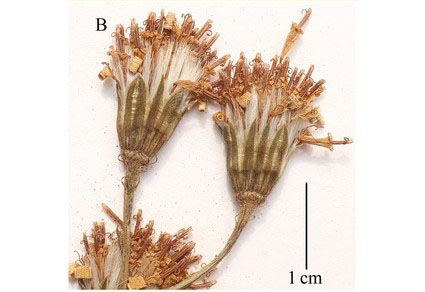
Synotis hieraciifolia was rediscovered near its type locality in Luodian County, Guizhou Province, China. The species is distinguished within the genus Synotis by its evergreen habit, subleathery leaf blade, and sweet-smelling flowers. Initially collected by Joseph Henri Esquirol in 1912, the species remained a mystery, with not only its distribution locality unclear but also its morphological characteristics and variation patterns poorly understood due to the scarcity of collections. In this study, fieldwork was conducted, and the collection history and collection routes of Joseph Henri Esquirol in Guizhou were verified after 13 years of dedicated effort, with the aim of solving the above-mentioned basic taxonomic problems. The results show that S. hieraciifolia occurs widely in Guizhou and Guangxi provinces, with its morphological characteristics, such as the leaf shape and number of phyllaries, as well as its blooming time varying. We also discovered that the precise locality of the type is actually in Luodian County rather than Guanling County, Guizhou Province. An amended taxonomic description of S. hieraciifolia is provided, accompanied by color photographs from different populations of this species.
References
- Chen, Y.L. (1999) Senecioneae Cass. In: Chen, Y.L. (Ed.) Flora Reipublicae Popularis Sinicae, vol. 77 (1). Science Press, Beijing, pp. 1–326.
- Chen, Y.L., Nordenstam, B. & Jeffrey, C. (2011) Synotis (C. B. Clarke) C. Jeffrey & Y.L. Chen. In: Wu, Z.Y. & Raven, P.H. (Eds.) Flora of China, vols. 20–21. Science Press, Beijing & Missouri Botanical Garden Press, St. Louis, pp. 489–505.
- Fan, Y., Wang, L.Y., Zhang, R. & Tang, M. (2022a) Notes on the specific identity of Synotis damiaoshanica (Compositae, Senecioneae), with clarification of the confusing identities of S. guizhouensis and S. sinica. Phytotaxa 543 (2): 150–160. https://doi.org/10.11646/phytotaxa.543.2.5
- Fan, Y., Zhang, R., Guo, C.L. & Tang, M. (2022b) On the identity of Synotis ionodasys (Asteraceae: Senecioneae) from Yunnan, China. Phytotaxa 545 (2): 207–216. https://doi.org/10.11646/phytotaxa.545.2.9
- IUCN Standards and Petitions Committee (2022) Guidelines for using the IUCN Red List Categories and Criteria, version 15. Prepared by the Standards and Petitions Committee. Available from: https://www.iucnredlist.org/documents/RedListGuidelines.pdf (accessed 28 Oct. 2026)
- Jeffrey, C. & Chen, Y.L. (1984) Taxonomic studies on the tribe Senecioneae (Compositae) of Eastern Asia. Kew Bulletin 39 (2): 205–446. https://doi.org/10.2307/4110124
- Jin, Z.C., Song, Z.Q., Guo, Y.J. & Chen, Y.S. (2024) Synotis carnosifolia (Asteraceae, Senecioneae), a new species from Yunnan, China. Phytotaxa 660 (2): 171–180. https://doi.org/10.11646/phytotaxa.660.2.7
- Li, H.M., Lazkov, G.A., Illarionova, I.D., Tong, T.J., Shao, Y.Y. & Ren, C. (2018) Transfer of Senecio karelinioides (Asteraceae-Senecioneae) to Synotis based on evidence from morphology, karyology and ITS/ETS sequence data. Nordic Journal of Botany 32: 1–12. https://doi.org/10.1111/njb.01838
- Li, Z., Zheng, H.L. & Tang, M. (2020) Synotis panzhouensis (Asteraceae, Senecioneae), a distinct new species with red-purple pappus from southwestern Guizhou, China. PhytoKeys 166: 79–86. https://doi.org/10.3897/phytokeys.166.58654
- Liu, Y.L., Zhang, R., Ren, C., Liu, B., Zhang, Y. & Tang, M. (2020) On the specific identity of Chinese endemic species Synotis longipes (Compositae-Senecioneae). Phytotaxa 472 (3): 269–276. https://doi.org/10.11646/phytotaxa.472.3.5
- Liu, Y.L., Zhu, X.X., Peng, Y.L. & Tang, M. (2021) Synotis jinshajiangensis (Asteraceae: Senecioneae), a new species from northwestern Yunnan, China. Phytotaxa 478 (1): 162–170. https://doi.org/10.11646/phytotaxa.478.1.12
- Tang, M. (2014) A Systematic Study of the Genus Synotis (Compositae-Senecioneae). University of Chinese Academy of Sciences, Beijing.
- Tang, M., Wang, L.Y. & Yang, Q.E. (2013a) Synotis xinningensis (Asteraceae), a new species from Hunan, China. Botanical Studies 54: e16. https://doi.org/10.1186/1999-3110-54-16
- Tang, M., Hong, Y. & Yang, Q.E. (2013b) Synotis baoshanensis (Asteraceae), a new species from Yunnan, China. Botanical Studies 54 (1): e17. https://doi.org/10.1186/1999-3110-54-17
- Tang, M., Wang, L.Y. & Yang, Q.E. (2013c) The identity of Synotis cordifolia (Asteraceae—Senecioneae). Journal of Tropical and Subtropical Botany 21: 101–108.
- Tang, M., Ren, C. & Yang, Q.E. (2014) Parasenecio chenopodiifolius (Compositae–Senecioneae) is a Synotis and conspecific with S. otophylla based on evidence from morphology, cytology and ITS/ETS sequence data. Nordic Journal of Botany 32: 824–835. https://doi.org/10.1111/njb.00574
- Tang, M., Ren, C. & Yang, Q.E. (2017) Reinstatement of the Sino-Himalayan species Senecio pentanthus (Asteraceae, Senecioneae). Phytotaxa 292: 253–261. https://doi.org/10.11646/phytotaxa.292.3.5
- Tang, M., Ren, C., Chen, Y.S. & Yang, Q.E. (2022) Synotis nyalamensis (Asteraceae, Senecioneae), a new species from southern Xizang (Tibet), China. Phytotaxa 554 (3): 278–284. https://doi.org/10.11646/phytotaxa.554.3.6
- Zhao, L.C., Ren, C., Yu, Z.Y., Tang, M. & Yang, Q.E. (2023) Synotis jinpingensis (Asteraceae, Senecioneae), a new species with white ray florets from southeastern Yunnan, China. PhytoKeys 235: 199–210. https://doi.org/10.3897/phytokeys.235.112230