

Abstract
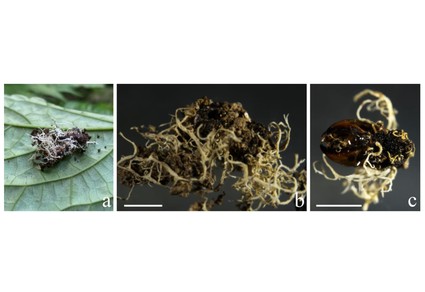
A new Polycephalomyces species collected on lepidopteran larvae in the karst region of Guizhou Province, China, is introduced here as Pol. xianhepingensis sp. nov., based on morphology and phylogenetic analyses. Polycephalomyces xianhepingensis is characterized by entangled and branched synnemata, without a fertile head, and cylindrical to obovoid conidia. Phylogenetic analyses of the new species were performed based on six loci (ITS, SSU, LSU, TEF-1α, RPB1, and RPB2). The multilocus phylogenetic analyses indicated that the new species belongs to the genus Polycephalomyces. The new species was introduced coupled with a description, illustration, and phylogenetic analysis.
References
- Alzohairy, A. (2011) BioEdit: An important software for molecular biology. GERF Bulletin of Biosciences 2 (1): 60–61.
- Ban, S. (2016) Re-classification of family Ophiocordycipitaceae, the entomopathogenic fungi. Microbes and Resources 32 (2): 105–113.
- Ban, S., Sakane, T. & Nakagiri, A. (2015) Three new species of Ophiocordyceps and overview of anamorph types in the genus and the family Ophiocordycipitaceae. Mycological Progress 14: 1017. https://doi.org/10.1007/s11557-014-1017-8
- Ban, S., Sakane, T., Toyama, K. & Nakagiri, A. (2009) Teleomorph-anamorph relationships and reclassification of Cordyceps cuboidea and its allied species. Mycoscience 50 (4): 261–272. https://doi.org/10.1007/s10267-008-0480-y
- Bischoff, J.F., Sullivan, R.F., Hywel-Jones, N.L. & White, J.F. (2003) Resurrection of Blistum tomentosum and its exclusion from Polycephalomyces (Hyphomycetes, Deuteromycota) based on 28S rDNA sequence data. Mycotaxon 86: 433–444. https://doi.org/10.5962/p.418368
- Cao, B., Phurbu, D., Ralaiveloarisoa, A., Liimatainen, K., Niskanen, T., Ramírez-Cruz, V., Bradshaw, A.J., Dentinger, B.T.M., Ramírez-Guillén, F., Cortés-Pérez, A., Guzmán-Dávalos, L., Villalobos-Arámbula, A.R., Castro-Jauregui, O., Santos da Silva, P., Day, R., Davoodian, N., Lebel, T., Castellano, M., May, T.W., Toome, M., Vasey, J., Hofer, K., Thangavel, R., Braithwaite, M., Braithwaite, L., Dutta, A.K., Chattopadhyay, P., Roy, N., Tanti, B., Biswas, P.R., Arumugam, E., Kezo, K., Kaliyaperumal, M., Murugadoss, R., Ji, J.X., Kakishima, M., Cooper, J., Nuytinck, J., Luo, Z.L., Wang, W.P., Zhang, X., Wen, T.C., Jia, A.L., Fan, X.L., Jiang, N., Jiao, N., Zhang, Y., Manawasinghe, I.S., Li, H., Xiong, Y.R., Zhou, T., Tan, Q.L., Hoshino, T., Lagaet, P., De Lange, R., Verbeken, A., Tondeleir, L., Manz, C., Hampe, F., Zhao, C.L., Yang, Y., Zhang, G.Q., Dai, D.Q., Tomšovský, M., Denchev, T.T., Denchev, C.M., Léveillé-Bourret, Ét., Kemler, M., Chen, Y.P., Maharachchikumbura, S.S.N., Feng, Z.X., Wang, L., Wang, Q.M., Wan, S.P., Yu, F.Q., Liu, J.K., Du, H.Z., Wu, N., Hu, H.L., Su, J.Y., Wang, Z.H., Hu, Y.P., Yu, H., Wang, J., Yang, Y.H., Dong, W., Shu, Y.X., Zhao, H.J., Wang, C.Q., Xia, W.X., Liao, C.F., Doilom, M., Li, G.J., Suwannarach, N., Senwanna, C., Gafforov, Y., Flakus, A., Suchan, T., Plata, O., Rodriguez-Flakus, P., Tamang, J., Acharya, K., Yang, H.D., Jayawardena, R.S., Tiendrebeogo, A., Decock, C., Somda, I., Legrève, A., Yang, Y., Xiao, Y.P., Zhou, X.Z., Li, J.X., Thongklang, N., Han, X.X., Yang, W.Q., Wang, S.H., He, M.Q., Hyde, K.D. & Zhao, R.L. (2025) Fungal diversity notes 1919–2016: Taxonomic and phylogenetic contributions to fungal taxa. Fungal Diversity 132: 425–651. https://doi.org/10.1007/s13225-025-00556-z
- Capella-Gutiérrez, S., Silla-Martínez, J.M. & Gabaldón, T. (2009) TrimAl: A tool for automated alignment trimming in large-scale phylogenetic analyses. Bioinformatics 25 (15): 1972–1973. https://doi.org/10.1093/bioinformatics/btp348
- Castlebury, L.A., Rossman, A.Y., Sung, G.H., Hyten, A.S. & Spatafora, J.W. (2004) Multigene phylogeny reveals new lineage for Stachybotrys chartarum, the indoor air fungus. Mycological Research 108 (8): 864–872. https://doi.org/10.1017/S0953756204000607
- Chaverri, P., Bischoff, J.F., Evans, H.C. & Hodge, K.T. (2005) Regiocrella, a new entomopathogenic genus with a pycnidial anamorph and its phylogenetic placement in the Clavicipitaceae. Mycologia 97 (6): 1225–1237. https://doi.org/10.1080/15572536.2006.11832732
- Chen, W.H., Li, D., Liang, J.D., Ren, X.X., Zhao, J.H. & Han, Y.F. (2024) Two new Cordyceps-like species, Perennicordyceps zongqii sp. nov. (Polycephalomycetaceae) and Purpureocillium zongqii sp. nov. (Ophiocordycipitaceae), in Hypocreales from karst region of China. MycoKeys 110: 141–158. https://doi.org/10.3897/mycokeys.110.135724
- Crous, P.W., Wingfield, M.J., Burgess, T.I., Carnegie, A.J., Hardy, G.E. St. J., Smith, D., Summerell, B.A., Cano-Lira, J.F., Guarro, J., Houbraken, J., Lombard, L., Martín, M.P., Sandoval-Denis, M., Alexandrova, A.V., Barnes, C.W., Baseia, I.G., Bezerra, J.D.P., Guarnaccia, V., May, T.W., Hernández-Restrepo, M., Stchigel, A.M., Miller, A.N., Ordoñez, M.E., Abreu, V.P., Accioly, T., Agnello, A., Colmán, A.A., Albuquerque, C.C., Alfredo, D.S., Alvarado, P., Araújo-Magalhães, G.R., Arauzo, S., Atkinson, T., Barili, A., Barreto, R.W., Bezerra, J.L., Cabral, T.S., Camello-Rodríguez, F., Cruz, R.H.S.F., Daniëls, P.P., da Silva, B.D.B., de Almeida, D.A.C., de Carvalho Júnior, A.A., Decock, C.A., Delgat, L., Denman, S., Dimitrov, R.A., Edwards, J., Fedosova, A.G., Ferreira, R.J., Firmino, A.L., Flores, J.A., García, D., Gené, J., Giraldo, A., Góis, J.S., Gomes, A.A.M., Gonçalves, C.M., Gouliamova, D.E., Groenewald, M., Guéorguiev, B.V., Guevara-Suarez, M., Gusmão, L.F.P., Hosaka, K., Hubka, V., Huhndorf, S.M., Jadan, M., Jurjević, Ž., Kraak, B., Kučera, V., Kumar, T.K.A., Kušan, I., Lacerda, S.R., Lamlertthon, S., Lisboa, W.S., Loizides, M., Luangsa-ard, J.J., Lysková, P., Mac Cormack, W.P., Macedo, D.M., Machado, A.R., Malysheva, E.F., Marinho, P., Matočec, N., Meijer, M., Mešić, A., Mongkolsamrit, S., Moreira, K.A., Morozova, O.V., Nair, K.U., Nakamura, N., Noisripoom, W., Olariaga, I., Oliveira, R.J.V., Paiva, L.M., Pawar, P., Pereira, O.L., Peterson, S.W., Prieto, M., Rodríguez-Andrade, E., De Blas, C.R., Roy, M., Santos, E.S., Sharma, R., Silva, G.A., Souza-Motta, C.M., Takeuchi-Kaneko, Y., Tanaka, C., Thakur, A., Smith, M.Th., Tkalčec, Z., Valenzuela-Lopez, N., van der Kleij, P., Verbeken, A., Viana, M.G., Wang, X.W. & Groenewald, J.Z. (2017) Fungal planet description sheets: 625–715. Persoonia 39: 270–467. https://doi.org/10.3767/persoonia.2017.39.11
- Dong, Q.Y., Zeng, N.K., Zhou, J.N., Gao, S.Y., Xu, C.D. & Wang, Z.J. (2026) Molecular phylogeny and morphology reveal two novel entomopathogenic species of Hypocreales (Polycephalomycetaceae and Cordycipitaceae), from China. MycoKeys 127: 109–133. https://doi.org/10.3897/mycokeys.127.176090
- Johnston, P.R. & Park, D. (2023) Dingleyomyces lloydii (Hypocreales, Polycephalomycetaceae), gen. nov., comb. nov. New Zealand Journal of Botany 63 (4): 851–858. https://doi.org/10.1080/0028825X.2023.2291453
- Katoh, K., Rozewicki, J. & Yamada, K.D. (2019) MAFFT online service: Multiple sequence alignment, interactive sequence choice and visualization. Briefings in Bioinformatics 20 (4): 1160–1166. https://doi.org/10.1093/bib/bbx108
- Kepler, R.M., Ban, S., Nakagiri, A., Bischoff, J., Hywel-Jones, N., Owensby, C.A. & Spatafora, J.W. (2013) The phylogenetic placement of hypocrealean insect pathogens in the genus Polycephalomyces: An application of One Fungus One Name. Fungal Biology 117 (9): 611–622. https://doi.org/10.1016/j.funbio.2013.06.002
- Kepler, R.M., Ban, S., Luangsa-ard, J.J., Hywel-Jones, N., Quandt, C.A., Sung, G.H., Rehner, S.A., Aime, M.C., Henkel, T.W., Sanjuan, T., Zare, R., Chen, M., Li, Z., Rossman, A.Y., Spatafora, J.W. & Shrestha, B. (2017) A phylogenetically-based nomenclature for Cordycipitaceae (Hypocreales). IMA Fungus 8: 315–329. https://doi.org/10.5598/imafungus.2017.08.02.08
- Kobayasi, Y. (1941) The genus Cordyceps and its allies. Science Reports of the Tokyo Bunrika Daigaku 5: 53–260.
- Kobayasi, Y. & Shimizu, D. (1982) Cordyceps species from Japan. 4. Bulletin of the National Science Museum Tokyo 8 (3): 79–91.
- Liang, Z.Q., Chen, W.H., Liang, J.D., Han, Y.F. & Zhou, X. (2016) Phenotypic polymorphism of the synnematous entomogenous fungi in an ant nest of Ponera. Mycosystema 35 (8): 906–917. https://doi.org/10.13346/j.mycosystema.150069
- Liu, Z., Wang, H., Liu, X., Han, P., Pan, W. & Yu, H. (2026) Molecular phylogeny and morphology reveal two new species of Pleurocordyceps luopingensis sp. nov. (Polycephalomycetaceae) and Pseudometarhizium cangyuanense sp. nov. (Clavicipitaceae) from Yunnan, southwestern China. MycoKeys 132: 147–172. https://doi.org/10.3897/mycokeys.132.185759
- Liu, Y.L., Whelen, S. & Hall, B.D. (1999) Phylogenetic relationships among ascomycetes: evidence from an RNA polymerase II subunit. Molecular Biology and Evolution 16 (12): 1799–1808. https://doi.org/10.1093/oxfordjournals.molbev.a026092
- Liu, Z., Lu, Y., Tang, D., Zhu, J., Luo, L., Chen, Y. & Yu, H. (2024a) Molecular phylogenetic and comparative genomic analysis of Pleurocordyceps fusiformispora sp. nov. and Perennicordyceps elaphomyceticola in the family Polycephalomycetaceae. Journal of Fungi 10 (4): 297. https://doi.org/10.3390/jof10040297
- Liu, Z., Tang, D., Lu, Y., Zhu, J., Luo, L., Sun, T. & Yu, H. (2024b) Morphology and phylogeny of four new species within Polycephalomycetaceae (Hypocreales) parasitising Ophiocordyceps species. MycoKeys 105: 179–202. https://doi.org/10.3897/mycokeys.105.119893
- Mains EB (1948) Entomogenous fungi. Mycologia 40: 402–416
- Matočec, N., Kušan, I. & Ozimec, R. (2014) The genus Polycephalomyces (Hypocreales) in the frame of monitoring Veternica cave (Croatia) with a new segregate genus Perennicordyceps. Ascomycete.Org 6 (5): 125–133.
- Miller, M.A., Pfeiffer, W. & Schwartz, T. (2010) Creating the CIPRES Science Gateway for inference of large phylogenetic trees. In: Proceedings of the Gateway Computing Environments Workshop (GCE). New Orleans, LA, USA, 14 November 2010, pp. 1–8. https://doi.org/10.1109/GCE.2010.5676129
- Nikoh, N. & Fukatsu, T. (2000) Interkingdom host jumping underground: phylogenetic analysis of entomoparasitic fungi of the genus Cordyceps. Molecular Biology and Evolution 17: 629–638. https://doi.org/10.1093/oxfordjournals.molbev.a026341
- Nylander, J.A.A. (2004) MrModeltest v2. Program distributed by the author. Evolutionary Biology Centre, Uppsala University. [https://github.com/nylander/MrModeltest2]
- Poinar, G. & Vega, F.E. (2020) Entomopathogenic fungi (Hypocreales: Ophiocordycipitaceae) infecting bark lice (Psocoptera) in Dominican and Baltic amber. Mycology 11 (1): 71–77. https://doi.org/10.1080/21501203.2019.1706657
- Quandt, C.A., Kepler, R.M., Gams, W., Araújo, J.P.M., Ban, S., Evans, H.C., Hughes, D., Humber, R., Hywel-Jones, N., Li, Z.Z., Luangsa-ard, J.J., Rehner, S.A., Sanjuan, T., Sato, H., Shrestha, B., Sung, G.H., Yao, Y.J., Zare, R. & Spatafora, J.W. (2014) Phylogenetic-based nomenclatural proposals for Ophiocordycipitaceae (Hypocreales) with new combinations in Tolypocladium. IMA Fungus 5 (1): 121–134. https://doi.org/10.5598/imafungus.2014.05.01.12
- Rambaut, A. (2012) FigTree tree figure drawing tool version 1.4.0. [http://tree.bio.ed.ac.uk/software/figtree/]
- Rathnayaka, A.R., Tennakoon, D.S., Jones, G.E., Wanasinghe, D.N., Bhat, D.J., Priyashantha, A.H., Stephenson, S.L., Tibpromma, S. & Karunarathna, S.C. (2024) Significance of precise documentation of hosts and geospatial data of fungal collections, with an emphasis on plant-associated fungi. New Zealand Journal of Botany 63: 462–489. https://doi.org/10.1080/0028825X.2024.2381734
- Sangdee, A., Sangdee, K., Seepho, P., Jaihan, P. & Kanyaphum, T. (2017) Colony characteristics, nucleoside analog profiles, and genetic variations of medicinal fungus Polycephalomyces nipponicus (Ascomycetes) isolates from northeast Thailand. International Journal of Medicinal Mushrooms 19 (5): 445–455. https://doi.org/10.1615/IntJMedMushrooms.v19.i5.60
- Sanjuan, T.I., Franco-Molano, A.E., Kepler, R.M., Spatafora, J.W., Tabima, J. & Vasco-Palacios, A.M. (2015) Five new species of entomopathogenic fungi from the Amazon and evolution of Neotropical Ophiocordyceps. Fungal Biology 119: 901–916. https://doi.org/10.1016/j.funbio.2015.06.010
- Schoch, C.L., Seifert, K.A., Huhndorf, S., Robert, V., Spouge, J.L., Levesque, C.A., Chen, W. & Fungal Barcoding Consortium (2012) Nuclear ribosomal internal transcribed spacer (ITS) region as a universal DNA barcode marker for Fungi. Proceedings of the National Academy of Sciences of the United States of America 109 (16): 6241–6246. https://doi.org/10.1073/pnas.1117018109
- Seifert, K.A. (1985) A monograph of Stilbella and some allied Hyphomycetes. Studies in Mycology 27: 1–235.
- Somsila, P., Sakee, U., Srifa, A. & Kanchanarach, W. (2018) Antioxidant and antimicrobial activities of Polycephalomyces nipponicus. Journal of Pure and Applied Microbiology 12: 567–576. https://doi.org/10.22207/JPAM.12.2.15
- Stamatakis, A. (2014) RAxML version 8: a tool for phylogenetic analysis and post-analysis of large phylogenies. Bioinformatics 30: 1312–1313. https://doi.org/10.1093/bioinformatics/btu033
- Sun, Y.B. (2017) FasParser: A package for manipulating sequence data. Zoological Research 38 (2): 110–112. https://doi.org/10.24272/j.issn.2095-8137.2017.017
- Tang, J.Y., Liu, J.W., Yu, H. & Yang, Z.L. (2025) Linking historical types with the current taxonomy: DNA sequence generation and molecular phylogenetic inferences for thirteen macrofungal species. Mycological Progress 24: 36. https://doi.org/10.1007/s11557-025-02051-w
- Van Vooren, N. & Audibert, C. (2005) Révision du complexe Cordyceps sphecocephala 1re partie: les guêpes végétales. Bulletin Mensuel de la Société Linnéenne de Lyon 74: 221–254. https://doi.org/10.3406/linly.2005.13604
- Vilgalys, R. & Hester, M. (1990) Rapid genetic identification and mapping of enzymatically amplified ribosomal DNA from several Cryptococcus species. Journal of Bacteriology 172: 4238–4246. https://doi.org/10.1128/jb.172.8.4238-4246.1990
- Wang, L., Li, H.H., Chen, Y.Q., Zhang, W.M. & Qu, L.H. (2014) Polycephalomyces lianzhouensis sp. nov., a new species, co-occurs with Ophiocordyceps crinalis. Mycological Progress 13: 996. https://doi.org/10.1007/s11557-014-0996-9
- Wang, Y., Wei, D.P., Peng, X.C., Kang, J.C., Li, Z.Z., Li, C.R., Zhang, X., Wang, G.Y., Zhou, Y., He, X.S., Chomnunti, P. & Wen, T.C. (2024) Interesting mycoparasites and Paradingleyomyces lepidopterorum gen. et sp. nov. (Hypocreales, Polycephalomycetaceae) from Yunnan Province, China. MycoKeys 110: 185–210. https://doi.org/10.3897/mycokeys.110.134132
- Wang, Y.B., Yu, H., Dai, Y.D., Wu, C.K., Zeng, W.B., Yuan, F. & Liang, Z.Q. (2015a) Polycephalomyces agaricus, a new hyperparasite of Ophiocordyceps sp. infecting melolonthid larvae in southwestern China. Mycological Progress 14: 70. https://doi.org/10.1007/s11557-015-1090-7
- Wang, Y.B., Yu, H., Dai, Y.D., Chen, Z.H., Zeng, W.B., Yuan, F. & Liang, Z.Q. (2015b) Polycephalomyces yunnanensis (Hypocreales), a new species of Polycephalomyces parasitizing Ophiocordyceps nutans and stink bugs (hemipteran adults). Phytotaxa 208 (1): 34–44. https://doi.org/10.11646/phytotaxa.208.1.3
- Wang, Y.H., Bhattarai, S., Wang, W.J., Li, Y., Wang, K., Kirk, P.M., Bushley, K.E., Dong, C.H., Hawksworth, D.L. & Yao, Y.J. (2021) Pleurocordyceps gen. nov. for a clade of fungi previously included in Polycephalomyces based on molecular phylogeny and morphology. Journal of Systematics and Evolution 59 (5): 1065–1080. https://doi.org/10.1111/jse.12705
- Wang, W.J., Wang, X.L., Li, Y., Xiao, S.R., Kepler, R.M. & Yao, Y.J. (2012) Molecular and morphological studies of Paecilomyces sinensis revealing a new clade in the clavicipitaceous fungi and a new combination in Polycephalomyces. Systematics and Biodiversity 10: 221–232. https://doi.org/10.1080/14772000.2012.690784
- Wei, D.P., Gentekaki, E., Wanasinghe, D.N., Tang, S.M. & Hyde, K.D. (2022) Diversity, molecular dating and ancestral characters state reconstruction of entomopathogenic fungi in Hypocreales. Mycosphere 13: 281–351. https://doi.org/10.5943/mycosphere/si/1f/8
- Wei, D.P., Gentekaki, E., Luangsa-ard, J.J., Wijayawardene, N.N., Wanasinghe, D.N., Liu, Z.L., Huang, Q.F., Liu, N.Y., Xie, S.W., Kang, J.C. & Wen, T.C. (2026) Taxonomy, phylogeny and diversity of hyperparasites and their allied entomopathogens in Hypocreales. Studies in Mycology 114: 370–436. https://doi.org/10.3114/sim.2026.114.02
- Wei, D.P., Wanasinghe, D.N., Xu, J.C., To-Anun, C., Mortimer, P.E., Hyde, K.D., Elgorban, A.M., Madawala, S., Suwannarach, N., Karunarathna, S.C., Tibpromma, S. & Lumyong, S. (2021) Three novel entomopathogenic fungi from China and Thailand. Frontiers in Microbiology 11: 608991. https://doi.org/10.3389/fmicb.2020.608991
- White, T.J., Bruns, T., Lee, S. & Taylor, J.W. (1990) Amplification and direct sequencing of fungal ribosomal RNA genes for phylogenetics. PCR Protocols: A Guide to Methods and Applications 18: 315–322. https://doi.org/10.1016/B978-0-12-372180-8.50042-1
- Xiao, Y.P., Wang, Y.B., Hyde, K.D., Gentekaki, E., Sun, J.Z., Yang, Y., Meng, J., Yu, H. & Wen, T.C. (2023) Polycephalomycetaceae, a new family of clavicipitoid fungi segregates from Ophiocordycipitaceae. Fungal Diversity 120 (1): 1–76. https://doi.org/10.1007/s13225-023-00517-4
- Xiao, Y.P., Wen, T.C., Hongsanan, S., Jeewon, R., Luangsa-ard, J.J., Brooks, S., Wanasinghe, D.N., Long, F.Y. & Hyde, K.D. (2018) Multigene phylogenetics of Polycephalomyces (Ophiocordycipitaceae, Hypocreales), with two new species from Thailand. Scientific Reports 8 (1): 18087. https://doi.org/10.1038/s41598-018-36792-4
- Xiao, Y.P., Yang, Y., Jayawardena, R.S., Gentekaki, E., Peng, X.C., Luo, Z.L. & Lu, Y.Z. (2024) Four novel Pleurocordyceps (Polycephalomycetaceae) species from China. Frontiers in Microbiology 14: 1256967. https://doi.org/10.3389/fmicb.2023.1256967
- Yang, J.I., Stadler, M., Chuang, W.Y., Wu, S. & Ariyawansa, H.A. (2020) In vitro inferred interactions of selected entomopathogenic fungi from Taiwan and eggs of Meloidogyne graminicola. Mycological Progress 19 (1): 97–109. https://doi.org/10.1007/s11557-019-01546-7
- Zeng, X.Y., Tan, T.J., Tian, F.H., Wang, Y. & Wen, T.C. (2023) OFPT: A one-stop software for fungal phylogeny. Mycosphere 14 (1): 1730–1741. https://doi.org/10.5943/mycosphere/14/1/20
- Zhang, X., Peng, X.C., Wei, D.P., Wang, Y., Norphanphoun, C., Hongsanan, S., Xie, N., Liu, Z.L., Mapook, A., Kang, J.C., Saichana, N., Hyde, K.D. & Wen, T.C. (2026) Reappraisal of the phylogenetic relationships of hirsutella-like fungi across Ophiocordycipitaceae and Polycephalomycetaceae (Hypocreales, Sordariomycetes), and the description of seven new species. IMA Fungus 17: e171084. https://doi.org/10.3897/imafungus.17.171084
- Zhong, X., Li, S.S., Peng, Q.Y., Zhang, J.S., Kan, X.T., Zhang, G.R. & Liu, X. (2016) A polycephalomyces hyperparasite of Ophiocordyceps sinensis leads to shortened duration of production and reduced numbers of host ascospores. Fungal Ecology 21: 24–31. https://doi.org/10.1016/j.funeco.2016.03.002