

Abstract
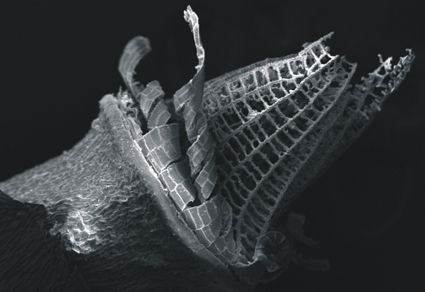
The taxonomy of the Fontinalis antipyretica complex has long been a subject of debate, with recent molecular studies often suggesting a broad, polymorphic species concept. This study challenges the current consensus by a multidimensional morphometric analysis of the gametophytic and sporophytic micromorphology, supported by the examination of 44 type specimens, and allows a revision of the Fontinalis antipyretica complex. Hierarchical Cluster Analysis (HCA) and Principal Component Analysis (PCA) demonstrated full congruence, distinguishing nine groups that differ in the range of variation across all analyzed traits: leaf dimensions and leaf cell parameters of their gametophyte. The dendrogram structure revealed a division of specimens into two main groups: those with longer and wider leaves and cells, and specimens with shorter and narrower leaves and leaf cells. Consequently, considering the obtained results and the marked distinctiveness of each analyzed group, the research beyond Fontinalis antipyretica sensu stricto, allowed for the reinstatement to species rank of F. androgyna R.Ruthe, F. bryhnii Limpr., F. cavifolia Warnst. & M. Fleisch., F. gracilis Lindb., F. kindbergii Renauld & Cardot, and F. minor Brid. Furthermore, it enabled the proposal of new combinations—F. cymbifolia (W.E.Nicholson) Wolski comb. nov., and the description of F. larssonii Wolski sp. nov. A crucial complement to the morphometrics proved to be the micromorphology of the sporophytic exostome of the studied specimens. Substantial differences were demonstrated in the ornamentation of the tooth surfaces—ranging from nearly smooth in F. larssonii, through baculate papillae in F. antipyretica, to angular tubercles in F. cymbifolia. The results prove that within the analyzed taxa, cellular parameters combined with peristome ultrastructure provide a stable basis for the discrimination of the studied specimens. Thus, the conducted research not only systematizes our knowledge of the Fontinalis antipyretica complex and enriches it with previously unpublished micromorphological data but also provides an intelligible identification key for the described taxa, offering a practical tool for analyzing the intraspecific variation of Fontinalis antipyretica sensu lato.
References
- 
- 
- 
- 
- 
- 
- 
- 
- 
- 
- 
- 
- 
- 
- 
- 
- 
- 
- 
- 
- 
- 
- Allen, B.H. (1983) On the costa of Fontinalis (Musci). Lindbergia 9: 37–40.
- Allen, B.H. (1988) Studies on the genus Fontinalis (Musci: Fontinalaceae). Brittonia 40: 180–187. https://doi.org/10.2307/2807002
- Allen, B.H. (1991) A review of the Fontinalis sullivantii complex (Musci: Fontinalaceae). The Bryologist 94: 430–434. https://doi.org/10.2307/3243839
- Allen, B.H. (2014) Fontinalis. In: Flora of North America Editorial Committee (Eds.) Flora of North America North of Mexico, Vol. 28. Oxford University Press, New York and Oxford, pp. 489–501.
- Atwood, J.J. (2015) A taxonomic revision of the moss genus Lepidopilidium (Pilotrichaceae). Annals of the Missouri Botanical Garden 100: 263–338. https://doi.org/10.3417/2014021
- Brinda, J.C. & Atwood, J.J. (2025) A Synopsis of the Fontinalaceae. The Bryophyte Nomenclator, 29 Oct 2025.
- Brotherus, V.F. (1923) Die Laubmoose Fennoskandias. Georg & Co., Helsingfors, 558 pp.
- Buck, W.R. (1980) A generic revision of the Entodontaceae. Journal of the Hattori Botanical Laboratory 48: 71–159. https://doi.org/10.18968/jhbl.48.0_71
- Buck, W.R. (1990) A monograph of Entodon (Entodontaceae) in Australia, eastern Melanesia and southern Oceania. Australian Systematic Botany 3: 701–709. https://doi.org/10.1071/SB9900701
- Buck, W.R. & Goffinet, B. (2024) A new checklist of the mosses of the continental United States and Canada. The Bryologist 127: 484–549. https://doi.org/10.1639/0007-2745-127.4.484
- Buck, W.R., Cox, C.J., Shaw, A.J. & Goffinet, B. (2005) Ordinal relationships of pleurocarpous mosses, with special emphasis on the Hookeriales. Systematics and Biodiversity 2: 121–145. https://doi.org/10.1017/S1477200004001410
- Cardot, J. (1892) Monographie des Fontinalacées. Mémoires de la Société Nationale des Sciences Naturelles et Mathématiques de Cherbourg 28: 1–152.
- Fedosov, V.E., Fedorova, A.V. & Ignatova, E.A. (2022) Integrative taxonomic revision of the genus Campylopus (Leucobryaceae, Bryophyta) in Russia. Arctoa 31: 205–222. https://doi.org/10.15298/arctoa.31.22
- Gardiner, A., Ignatov, M.S., Huttunen, S. & Troitsky, A.V. (2005) On the resurrection of the families Pseudoleskeaceae Schimp. and Pylaisiaceae Schimp. (Musci, Hypnales). Taxon 54: 651–663. https://doi.org/10.2307/25065422
- Glime, J.M. (1984) Physio-ecological factors relating to reproduction and phenology in Fontinalis dalecarlica. The Bryologist 87: 17–23. https://doi.org/10.2307/3242877
- Glime, J.M. (2015) Adventures with stream mosses—A Fontinalis point of view. Part III: Surviving the flow. Evansia 32: 1–9. https://doi.org/10.1639/079.032.0103
- Hedenäs, L. (2018) Cryptic speciation, habitat differences, and geography interact in a widespread moss species complex. Plant Systematics and Evolution 304: 1131–1143.
- Hedenäs, L. & Geissler, P. (1999) Lectotypification of Hedwigian names of mosses. Candollea 54: 517–532.
- Hedwig, J. (1801) Species muscorum frondosorum descriptae et tabulis aeneis LXXVII illustratae. Joannis Ambrosii Barthii, Lipsiae, 352 pp. https://doi.org/10.5962/bhl.title.26
- Hodgetts, N.G., Söderström, L., Blockeel, T.L., Caspari, S., Ignatov, M.S., Konstantinova, N.A., Lockhart, N., Papp, B., Schnyder, N., Schröck, C., Sergio, C., Garcia, C., Porley, R.D., Vieira, C., Areshimashvili, N., Afonina, O.M., Bednarek-Ochyra, H., Bouman, A., Bruggeman-Nannenga, M.A., Brugués, M., Enroth, J., Erzberger, P., Frahm, J.-P., Gabriel, R., Garilleti, R., Gallego, M.T., Górski, P., Hallingbäck, T., Hedenäs, L., Holyoak, D.T., Hugonnot, V., Ignatova, E.A., Kiebacher, T., Kučera, J., Lara, F., Mazimpaka, V., McCarthy, J., Muñoz, J., Sabovljević, M.B., Schmidt, C., Shevock, J.R., Sotiaux, A., Szurdoki, E., Vanderpoorten, A., Van Rooy, J. & Yakupov, G. (2020) An annotated checklist of bryophytes of Europe, Macaronesia and Cyprus. Journal of Bryology 42: 1–116. https://doi.org/10.1080/03736687.2019.1694329
- Ignatov, M.S., Ignatova, E.A., Maksimov, A.I. & Chernyadjeva, I.V. (2020) Fontinalis. In: Ignatov, M.S. (Ed.) Flora of Mosses of Russia, Vol. 5. KMK Scientific Press, Moscow, pp. 141–160.
- Ignatov, M.S., Maksimov, A.I., Fedorova, A.V. & Ignatova, E.A. (2020a) On the taxonomy of Fontinalis gracilis (Fontinalaceae, Bryophyta) and superficially similar species. Nova Hedwigia Beiheft 150: 243–264. https://doi.org/10.1127/nova-suppl/2020/243
- Ignatova, E.A., Fedorova, A.V., Kuznetsova, O.I. & Ignatov, M.S. (2019) Taxonomy of the Plagiothecium laetum complex (Plagiotheciaceae, Bryophyta) in Russia. Arctoa 28: 28–45. https://doi.org/10.15298/arctoa.28.05
- Kiebacher, T. & Szövényi, P. (2024) Morphological, genetic and ecological divergence in near-cryptic bryophyte species widespread in the Holarctic: the Dicranum acutifolium complex (Dicranales) revisited in the Alps. Journal of Plant Research 137: 561–574. https://doi.org/10.1007/s10265-024-01534-3
- Latoszewski, M. (2025) Analysis of type materials of the section Lepidophyllae Cardot genus Fontinalis Hedw. BSc thesis, conducted under the supervision of Grzegorz J. Wolski, Faculty of Biology and Environmental Protection, University of Łódź, Łódź, 45 pp.
- Magill, R.E. & van Rooy, J. (1998) Flora of Southern Africa. Bryophyta: Part 1 Musci, Fascicle 3: Erpodiaceae—Hookeriaceae. National Botanical Institute, Pretoria, 628 pp.
- Milde, J. (1869) Bryologia Silesiaca. Laubmoos-Flora von Nord- und Mittel-Deutschland. Arthur Felix, Leipzig, 410 pp. https://doi.org/10.5962/bhl.title.32328
- Nyholm, E. (1954) Illustrated moss flora of Fennoscandia. II. Musci, Fascicle 1. CWK Gleerup, Lund, 87 pp.
- Ruthe, R. (1872) Bryologische Mittheilungen aus Pommern. Hedwigia 11: 166–171.
- Shaw, A.J. (2001) Biogeographic patterns and cryptic speciation in bryophytes. Journal of Biogeography 28: 253–261. https://doi.org/10.1046/j.1365-2699.2001.00530.x
- Smith, A.J.E. (2004) The Moss Flora of Britain and Ireland, 2nd edn. Cambridge University Press, Cambridge, 1012 pp. https://doi.org/10.1017/CBO9780511541858
- Suzuki, T. (2016) A revised new catalog of the mosses of Japan. Hattoria 7: 9–223. https://doi.org/10.18968/hattoria.7.0_9
- Turland, N.J., Wiersema, J.H., Barrie, F.R., Greuter, W., Hawksworth, D.L., Herendeen, P.S., Knapp, S., Kusber, W.-H., Li, D.-Z., Marhold, K., May, T.W., McNeill, J., Monro, A.M., Prado, J., Price, M.J. & Smith, G.F. (Eds.) (2025) International Code of Nomenclature for algae, fungi, and plants (Madrid Code) adopted by the Twentieth International Botanical Congress Madrid, Spain, July 2024. Koeltz Botanical Books, Glashütten.
- Welch, W.H. (1960) A Monograph of the Fontinalaceae. Springer-Science+Business Media, B.V., The Hague, 357 pp. https://doi.org/10.1007/978-94-017-6339-4
- Wolski, G.J. (2017) Morphological and anatomical variability of Plagiothecium nemorale in Central Poland. Herzogia 30: 36–50. https://doi.org/10.13158/heia.30.1.2017.36
- Wolski, G.J. (2025) The genus Plagiothecium (Plagiotheciaceae) in Europe—current state of knowledge, checklist and key to taxa. PhytoKeys 253: 67–102. https://doi.org/10.3897/phytokeys.253.142268
- Wolski, G.J. & Nowicka-Krawczyk, P. (2020) Resurrection of the Plagiothecium longisetum Lindb. and proposal of the new species—P. angusticellum. PLoS ONE 15: e0230237. https://doi.org/10.1371/journal.pone.0230237
- Wolski, G.J. & Polus, K. (2024) Is the endemic species Fontinalis dichelymoides Lindb. not as rare as previously thought in Europe? Herzogia 37: 169–175. https://doi.org/10.13109/herz.2024.37.2.169
- Zhu, Y.-Q., Buck, W.R. & Wang, Y.-F. (2010) A revision of Entodon (Entodontaceae) in East Asia. The Bryologist 113: 516–589. https://doi.org/10.1639/0007-2745-113.3.516