
Abstract
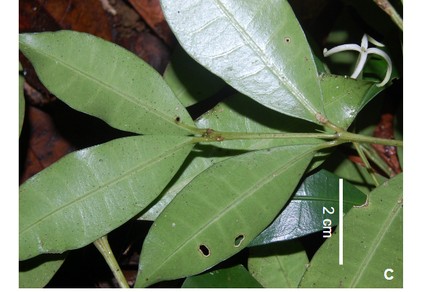
Faramea spiralis is here described and illustrated, and its conservation status was assessed. The new species differs from others by the combination of a white corolla with reflexed, tardily spiraled lobes and a calyx with filiform lobes that are two or more times longer than the tube. The conservation status is provisionally assessed as Vulnerable (VU). It is known only from Atlantic Forest, in Bahia, northeastern Brazil.
References
- Aublet, J.B.C.F. (1775) Histoire des plantes de la Guiane Françoise 1: 102, t. 40. https://doi.org/10.5962/bhl.title.674
- Bachman, S., Moat, J., Hill, A.W., de la Torre, J. & Scott, B. (2011) Supporting Red List threat assessments with GeoCAT: geospatial conservation assessment tool. In: Smith, V. & Penev, L. (Eds.) e-Infrastructures for Data Publishing in Biodiversity Science. ZooKeys 150: 117–126. (Version BETA). https://doi.org/10.3897/zookeys.150.2109
- Candolle, A.P. de (1830) Prodromus systematis naturalis regni vegetabilis. Vol. 4. Treuttel et Würtz, Paris, 683 pp. https://doi.org/10.5962/bhl.title.286
- Flora e Funga do Brasil (2025) Rubiaceae. Jardim Botânico do Rio de Janeiro. Available from: https://floradobrasil.jbrj.gov.br/FB13941 (accessed 12 December 2025)
- IUCN (2012) IUCN Red list Categories and Criteria: Version 3.1, 2nd Edition. IUCN, Gland, Switzerland and Cambridge, UK. [https://portals.iucn.org/library/node/10315]
- IUCN Standards and Petitions Committee (2022) Guidelines for Using the IUCN Red List Categories and Criteria. Version 14. Available from: http://www.iucnredlist.org/documents/RedListGuidelines.pdf (accessed 10 July 2023)
- Martius, C.F.P. von (1824) Tetramerium coeruleum. Novorum Actorum Academiae Caesareae Leopoldino-Carolinae Germanicae Naturae Curiosorum 12: 12–13.
- Müller, J. (1875) Rubiaceae brasilienses novae. Flora 58 (20): 465–480.
- Taylor, C.M. & Jardim, J.G. (2020) Rubiacearum Americanarum Magna Hama Pars XLVI: New Species and Taxonomic Changes in Faramea of Central and South America (Rubiaceae, Coussareeae). Novon 20: 108–142. https://doi.org/10.3417/2019552
- Thiers, B. (2026) (continuously updated) Index Herbariorum: A global directory of public herbaria and associated staff. New York Botanical Garden's Virtual Herbarium. [sweetgum.nybg.org/ih/]