

Abstract
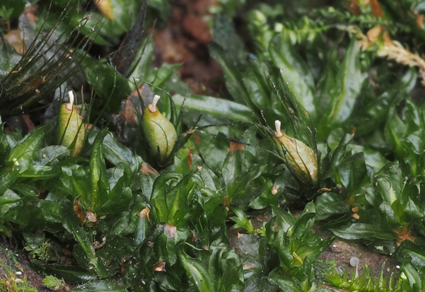
Diphyscium suzukii and D. tamasii are reported as new to China. Diphyscium suzukii, previously known only from Japan and categorized as Endangered (CR+EN), is distinguished by smooth leaf cells, relatively small oblong-lanceolate to lingulate leaves, and fimbriate inner perichaetial leaves. Diphyscium tamasii, a Vietnamese endemic with no record since its original description, is characterized by its small stature, strongly reduced vegetative leaves, and apically bifurcate inner perichaetial leaves. Mature sporophytes of D. tamasii are reported here for the first time. An updated key to the Chinese species of Diphyscium is also presented.
References
- Bizot, M. (1980) Enumeratio muscorum novorum. III. Cryptogamie: Bryologie, Lichénologie 1: 423–430.
- Brinda, J.C. & Atwood, J.J. (Eds.) (2026) A Synopsis of Diphyscium. Available from: https://www.bryonames.org/nomenclator?group=Diphyscium (accessed 24 February 2026)
- Cardot, J. (1904) Première contribution à la flore bryologique de la Corée. Beihefte zum Botanischen Centralblatt 17: 1–44.
- Chiang, T.Y. & Lin, S.H. (2001) Taxonomic revision and cladistic analysis of Diphyscium (Family Diphysciaceae) of Taiwan. Botanical Bulletin of Academia Sinica 42 (3): 215–222. [https://www.researchgate.net/publication/251186585]
- Deguchi, H. (1984) Diphyscium unipapillosum, sp. nov. (Diphysciaceae, Musci) from Japan. Journal of Japanese Botany 59 (4): 97–103. https://doi.org/10.51033/jjapbot.59_4_7599
- Dozy, F. & Molkenboer, J.H. (1854 [1854–1861]) Bryologia Javanica 1, fasc. 5. A.W. Sythoff, Leiden, pp. 33–36.
- Fleischer, M. (1919) Natürliches System der Bryales. In: Engler, A. & Gilg, E. (Eds.) Syllabus der Pflanzenfamilien, ed. 8. Verlag von Gebrüder Borntraeger, Berlin, pp. 89–90.
- GBIF.org (2026) GBIF Occurrence Search: Diphyscium D.Mohr. Available from: https://www.gbif.org/species/2672969 (accessed 24 February 2026)
- Griffith, W. (1842) Muscologia itineris Assamici [I]. W. Ridsdale, Bishop's College Press, Calcutta, pp. 465–514.
- Hedwig, J. (1801) Species Muscorum Frondosorum. Joannis Ambrosii Barthii, Lipsiae, vi + 352 pp.
- Iwatsuki, Z. (1976) Bryological miscellanies. XXI–XXII. Journal of the Hattori Botanical Laboratory 40: 139–143. https://doi.org/10.18968/jhbl.40.0_139
- Jia, Y. & He, S. (2024) A Catalogue of Asian Mosses. Science Press, Beijing, pp. 34–37.
- Kobayashi, R. (2010) Two threatened mosses newly found in Yakushima Island, southern Kyushu, Japan. Bryological Research 10 (2): 56. https://doi.org/10.24474/bryologicalresearch.10.2_56
- Li, Y.F., Luo, L., Liu, Y., He, Q., Yu, N.N., Gaowa, N., Yi, Z.Q., Wang, J.J., Han, W., Peng, T., Ho, B.C., He, X., Zhang, L., Chen, Z.D., Jia, Y. & Wang, Q.H. (2024) The Bryophyte Phylogeny Group: A revised familial classification system based on plastid phylogenomic data. Journal of Systematics and Evolution 62: 577–588. https://doi.org/10.1111/jse.13063
- Magombo, Z.L.K. (2002) New combinations and synonyms in the moss family Diphysciaceae. Novon 12 (4): 501–503. https://doi.org/10.2307/3393130
- Magombo, Z.L.K. (2003) Taxonomic revision of the moss family Diphysciaceae M.Fleisch. (Musci). The Journal of the Hattori Botanical Laboratory 94: 1–86. https://doi.org/10.18968/jhbl.94.0_1
- Milne, J. & Klazenga, N. (2012) Australian Mosses Online 16. Diphysciaceae, Version 7 May 2012. Australian Biological Resources Study, Canberra. Available from: http://www.anbg.gov.au/abrs/Mosses_Online/Diphysciaceae.pdf (accessed 24 February 2026)
- Mitten, W. (1859) Musci Indiae Orientalis: an enumeration of the mosses of the East Indies. Journal of the Proceedings of the Linnean Society, Botany, Supplement 1. Longman, Brown, Green, Longmans & Roberts and Williams and Norgate, London, 171 pp. https://doi.org/10.1111/j.1095-8339.1859.tb02466.x
- Mitten, W. (1891) On the species of Musci and Hepaticae recorded from Japan. Transactions of the Linnean Society of London, 2nd Series: Botany 3: 153–206. https://doi.org/10.1111/j.1095-8339.1891.tb00626.x
- Mohr, D.M.H. (1803) Observationes Botanicae. Kiliae, 45 pp. + 2.
- Nakai, T. (1937) Iconographia Plantarum Asiae Orientalis 2 (1). Shunyodo Shoten, Tokyo, pp. 83–114.
- Noguchi, A. (1987) Diphysciaceae. In: Noguchi, A. (Ed.) Illustrated moss flora of Japan part 1. Hattori Botanical Laboratory, Nichinan, pp. 10–18.
- Robinson, H.E. (1965) A small collection of bryophytes from Kashmir. The Bryologist 68: 313–320. [https://www.researchgate.net/publication/250064886] https://doi.org/10.1639/0007-2745(1965)68[313:ASCOBF]2.0.CO;2
- Runfola, D., Anderson, A., Baier, H., Crittenden, M., Dowker, E., Fuhrig, S., Goodman, S., Grimsley, G., Layko, R., Melville, G., Mulder, M., Oberman, R., Panganiban, J., Peck, A., Seitz, L., Shea, S., Slevin, H., Youngerman, R. & Hobbs, L. (2020) geoBoundaries: A global database of political administrative boundaries. PLoS ONE 15 (4): e0231866. https://doi.org/10.1371/journal.pone.0231866
- Suzuki, T., Inoue, Y. & Tsubota, H. (2015) Diphyscium (Diphysciaceae, Bryopsida) species newly found in Japan. Hattoria 6: 63–73. https://doi.org/10.18968/hattoria.6.0_63
- Takaki, N. (1950) Notes on Japanese moss flora (3). Journal of Japanese Botany 25 (8): 185–192. https://doi.org/10.51033/jjapbot.25_8_3207
- Tan, B.C. & Ninh, T. (2003) Vu Quang and other Vietnam mosses collected by Tran Ninh, B.C. Tan and T. Pócs in 2002. Acta Academiae Paedagogicae Agriensis, Sectio Biologiae, Nova Series 24: 85–101.
- Tang, Q.M., Ho, B.C. & Wei, Y.M. (2019) An IUCN threatened moss species, Hypnodontopsis apiculata (Rhachitheciaceae, Bryophyta), new to China. Herzogia 32: 369–374. https://doi.org/10.13158/heia.32.2.2019.369
- Tang, Q.M., Ho, B.C. & Wei, Y.M. (2020) New national records and range extensions of the moss genus Fissidens (Fissidentaceae) from Guangxi, China. Hattoria 11: 41–60. https://doi.org/10.18968/hattoria.11.0_41
- Wang, M.Z. (2013) Diphysciaceae. In: Wu, D. & Zhang, L. (Eds.) Bryophyte Flora of Guangdong. Guangdong Science and Technology Press, Guangzhou, pp. 509–510. [in Chinese]
- Wang, M.Z., Wu, P.C., He, S. & Magombo, Z.L.K. (2005) Diphysciaceae. In: Wu, P.C., Crosby, M.R. & He, S. (Eds.) Moss Flora of China, English Version, Volume 8. Science Press & Missouri Botanical Garden Press, Beijing & New York, pp. 292–301.
- Wei, Y.M., Ye, W., Ho, B.C., Tang, Q.M. & Harris, A.J. (2023) Cheilolejeunea zhui (Lejeuneaceae, Marchantiophyta), a new species with moniliate ocelli from Guangxi, China. Ecology and Evolution 13 (4): e9962. https://doi.org/10.1002/ece3.9962
- Yamaguchi, T. (2025) Diphyscium suzukii Z.Iwats. In: Ministry of the Environment, Japan (Ed.) The 5th Red Databook: Threatened Wildlife of Japan. Available from: https://www.env.go.jp/nature/kisho/5th-rl-2025/BR0071_RDB5th.pdf (accessed 24 February 2026)
- Zander, R.H. (1993) Genera of the Pottiaceae: mosses of harsh environments. Bulletin of the Buffalo Society of Natural Sciences 32: vi + 378 pp.