

Abstract
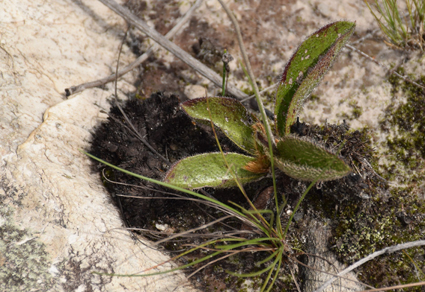
The project “Rede de Herbários preenchendo lacunas de conhecimento” (Network of Herbaria filling knowledge gaps) has the aim to create an herbarium network with the purpose to address the urgent compiling and systematizing plant diversity data from critical areas. In the course of this project, a new species of Richterago has been discovered, 25 years after the previous novelty. Richterago roqueae can be singled out within the genus by its hispid indumentum and tector trichomes on the corolla disc lobes. In addition, this is the first species to comprise populations with radiate and discoid individuals. The new species is described, illustrated and mapped, and its conservation status and taxonomic affinities are discussed.
References
- Alves, R.J.V. & Kolbek, J. (2010) Can campo rupestre vegetation be floristically delimited based on vascular plant genera? Plant Ecology 207: 67–79. https://doi.org/10.1007/s11258-009-9654-8
- Bachman, S., Moat, J., Hill, A.W., Torre, J. & Scott, B. (2011) Supporting Red List threat assessments with GeoCAT: Geospatial conservation assessment tool. ZooKeys 150: 117–126. https://doi.org/10.3897/zookeys.150.2109
- Baker, J.G. (1884) Compositae-Mutisieae. In: Martius, C.F.P. von & Eichler, A.W. (Eds.) Flora Brasiliensis. Vol. 6. Typografia Regia, München, pp. 339–396.
- Beentje, H. (2016) The Kew Plant Glossary an Illustrated Dictionary of Plant Terms. Kew Publishing, Richmond, 184 pp.
- Berchtold, F.W. & Presl, J.S. (1820) O Prirozenosti Rostlin. Krala Wiljma Endersa, Prague, 322 pp.
- Bueno, V.R. & Heiden, G. (2022) Novelties in Calea sect. Meyeria (Asteraceae, Neurolaeneae) from Brazil. Systematic Botany 47 (2): 575–585. https://doi.org/10.1600/036364422X16512564801632
- Cabrera, A.L. (1970) Actinoseris, nuevo género de Compuestas. Boletín de la Sociedad Argentina de Botánica 13 (1): 45–52.
- Cabrera, A.L. (1971) Revisión del género Gochnatia (Actinoseris, nuevo género de Compositae). Revista del Museo de La Plata 12: 1–160.
- Cabrera, A.L. (1974) Tres Compositae nuevas de Minas Gerais (Brasil). Boletim do Museu Botânico Prefeitura Municipal de Curitiba 15: 1–7.
- Cassini, H. (1819) Suit du Sixième mémoire sur la famille des Synanthérées, contenant les caractères des tribus. Journal de Physique, de Chimie, d´Historie Naturelle et des Arts 88: 150–163.
- C.V. Starr Virtual Herbarium (2026) New York Botanical Garden. Available from: http://sweetgum.nybg.org/science/vh/ (accessed 14 March 2026)
- Don, D. (1830) Descriptions of new genera and species of the Class Compositae belonging to the Floras of Peru, Mexico, and Chile. Transactions of the Linnean Society of London 16 (2): 169–303. https://doi.org/10.1111/j.1095-8339.1829.tb00136.x
- Ellis, B., Daly, D.C., Hickey, L.J., Johnson, K.R., Mitchell, J.D., Wilf, P. & Wing, S.L. (2009) Manual of Leaf Architecture. The New York Botanical Garden Press, New York, 190 pp. https://doi.org/10.1079/9781845935849.0000
- Endlicher, S.L. (1838) Genera Plantarum, pt. 6–7. Fr. Beck, Wien, pp. 401–560.
- Ferreyra, R. (1944) Revisión del genero Onoseris. Journal of the Arnold Arboretum 25: 349–395. https://doi.org/10.5962/p.185503
- Flora & Funga (2026) Flora e Funga do Brasil—Jardim Botânico do Rio de Janeiro. Available from: https://floradobrasil.jbrj.gov.br/consulta/#CondicaoTaxonCP (accessed 14 March 2026)
- Franco, I.M., Costa, F.N. & Nakajima, J.N. (2014) Richterago (Asteraceae, Gochnatieae) na porção central da Cadeia do Espinhaço em Minas Gerais, Brasil. Rodriguésia 65 (1): 159–173. https://doi.org/10.1590/S2175-78602014000100011
- Funk, V.A., Susanna, A., Stuessy, T.F. & Robinson, H. (2009) Systematics, Evolution and Biogeography of Compositae. International Association for Plant Taxonomy, Vienna, 965 pp.
- Gardner, G. (1847) Contributions towards a Flora of Brazil. London Journal of Botany 6: 456–457.
- Hickey, L.J. (1973) Classification of the architecture of dicotyledonous leaves. American Journal of Botany 60: 17–33. https://doi.org/10.1002/j.1537-2197.1973.tb10192.x
- IUCN (2024) Guidelines for using the IUCN Red List categories and criteria, version 16, Prepared by the Standards and Petitions Committee of the IUCN Species Survival Commission, Cambridge U.K. Available from: http://www.iucnredlist.org/resources/redlistguidelines (accessed 14 March 2026)
- Kuntze, C.E.O. (1891) Revisio Generum Plantarum, Vol. 1. A. Felix, Leipzig etc., 374 pp.
- Lessing, C.R. (1830) Mutisieae. Synanthereis Herbarii Regii Berolinensis, Dissertatio Tertia. Linnaea 5: 237–263.
- Miola, D.T.B., Ramos, V.D.V. & Silveira, F.A.O. (2021) A brief history of research in campo rupestre: identifying research priorities and revisiting the geographical distribution of an ancient, widespread Neotropical biome. Biological Journal of the Linnean Society 133: 464–480. https://doi.org/10.1093/biolinnean/blaa175
- Post, T. von & Kuntze, O. (1902) Lexicon Generum Phanerogamarum. Typis Wretmanianis, Uppsala, 714 pp.
- QGIS Development Team (2015) QGIS Geographic Information System, Open Source Geospatial Foundation Project. Available from: https://qgis.org/ (accessed 14 March 2026)
- Rapini, A., Bitencourt, C., Luebert, F. & Cardoso, D. (2021) An escape-to-radiate model for explaining the high plant diversity and endemism in campos rupestres. Biological Journal of the Linnean Society 133: 481–498. https://doi.org/10.1093/biolinnean/blaa179
- Rapini, A., Ribeiro, P.L., Lambert, S. & Pirani, J.R. (2008) A flora dos campos rupestres da Cadeia do Espinhaço. Megadiversidade 4 (1–2): 16–23.
- Reflora (2026) Reflora—Herbário Virtual. Available from: http://floradobrasil.jbrj.gov.br/reflora/herbarioVirtual/ (accessed 14 March 2026)
- Roque, N. (1997) A reassessment of Actinoseris polymorpha (Less.) Cabrera (Compositae: Mutisieae) with a new combination. Kew Bulletin 52: 197–204. https://doi.org/10.2307/4117853
- Roque, N. (2001) Five new species of Richterago (Compositae, Mutisieae): a genus endemic to Brazil. Novon 11 (3): 341–349. https://doi.org/10.2307/3393043
- Roque, N. (2026) Richterago in Flora e Funga do Brasil. Jardim Botânico do Rio de Janeiro. Available from: https://floradobrasil.jbrj.gov.br/FB16283 (accessed 14 March 2026)
- Roque, N. & Bautista, H. (2008) Asteraceae: caracterização e morfologia floral. EDUFBA, Salvador, 71 pp.
- Roque, N. & Nakajima, J.N. (2001) Two new species of Richterago Kuntze emend. Roque (Compositae, Mutisieae) from Minas Gerais and Goiás, Brazil. Kew Bulletin 56 (3): 697–703. https://doi.org/10.2307/4117697
- Roque, N. & Pirani, J.R. (1997) Flora da Serra do Cipó, Minas Gerais: Compositae—Barnadesieae e Mutisieae. Boletim de Botânica da Universidade de São Paulo 16: 151–185. https://doi.org/10.11606/issn.2316-9052.v16i0p151-185
- Roque, N. & Pirani, J.R. (2001) Reinstatement of the name Richterago Kuntze and recircumscription of the genus to include species formerly treated as Actinoseris (Endl.) Cabrera (Compositae, Mutisieae). Taxon 50 (4): 1155–1160. https://doi.org/10.2307/1224734
- Roque, N. & Pirani, J.R. (2014) Taxonomic Revision of Richterago (Asteraceae, Gochnatieae). Systematic Botany 39 (3): 997–1026. https://doi.org/10.1600/036364414X682210
- Silveira, F.A.O., Negreiros, D., Barbosa, N.P.U., Buisson, E., Carmo, F.F., Carstensen, D.W., Conceição, A.A., Cornelissen, T.G., Echternacht, L., Fernandes, G.W., Garcia, Q.S., Guerra, T.J., Jacobi, C.M., Lemos-Filho, J.P., Le Stradic, S., Morellato, L.P.C., Neves, F.S., Oliveira, R.S., Schaefer, C.E., Viana, P.L. & Lambers, H. (2016) Ecology and evolution of plant diversity in the endangered campo rupestre: a neglected conservation priority. Plant Soil 403: 129–152. https://doi.org/10.1007/s11104-015-2637-8
- Smithsonian National Museum of Natural History (2026) Collection NHMN. Available from: https://collections.nmnh.si.edu/search/botany/ (accessed 14 March 2026)
- Specieslink (2026) SpeciesLink network. Available from: https://specieslink.net/search/ (accessed 14 March 2026)
- Thiers, B. (2026 [continuously updated]) Index Herbariorum: A global directory of public herbaria and associated staff. New York Botanical Garden’s Virtual Herbarium, New York U.S.A. Available from: http://sweetgum.nybg.org/science/ih/ (accessed 14 March 2026)
- Tropicos.org (2026) Missouri Botanical Garden. Available from: https://tropicos.org (accessed 14 March 2026)
- Vellozo, J.M.C. (1829) Florae Fluminensis. Typographia Nationali, Rio de Janeiro, 352 pp.
- Zardini, E. (1975) A new species of Actinoseris (Compositae). Boletim do Museu de Botânica Municipal 23: 1–3.