
Abstract
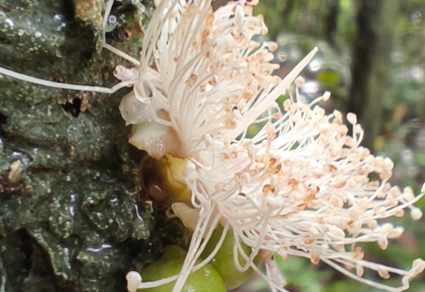
The Atlantic Forest domain, which runs along all the Brazilian cost, is one of the major world biodiversity hotspots. Despite historical anthropogenic pressures along the Brazilian coastal region, the Bahia Lower-South region, located in the context of the central corridor of Atlantic Forest, still holds a great sample of the biome plant diversity. Myrtaceae is one of the rich plant families in the Atlantic Forest and Plinia is one of its most notable genera considering its high number of endangered species in the Bahia Atlantic Forest. Here, we describe, discuss and illustrate one new species of Plinia for the Atlantic Forest remnants preserved by Michelin Ecological Reserve, Igrapiúna, Bahia. Finally, we provide an identification key for related species.
References
- Bachman, S., Moat, J., Hill, A.W., de la Torre, J. & Scott, B. (2011) Supporting Red List threat assessments with GeoCAT: Geospatial conservation assessment tool. ZooKeys 150: 117–126. https://doi.org/10.3897/zookeys.150.2109.figure1
- Beentje, H. (2016) Plant glossary, an illustrated dictionary of plant terms. Royal Botanic Gardens, Kew, 184 pp.
- Flora e Funga do Brasil (2026) Jardim Botânico do Rio de Janeiro. Available from: http://floradobrasil.jbrj.gov.br/ (accessed 11 March 2026)
- Hickey, L.J. (1973) Classification of the architecture of dicotyledonous leaves. American Journal of Botany 60: 17–33. https://doi.org/10.1002/j.1537-2197.1973.tb10192.x
- IBGE (Instituto Brasileiro de Geografia e Estatística) (2026) Domínios e regiões naturais terrestres dos biomas do Brasil. Available from: www.ibge.gov.br (accessed 11 March 2026)
- IUCN (International Union for Conservation of Nature) (2022) Prepared by the Standards and Petitions Committee. Version 2022–15.1. Available from: http://www.iucnredlist.org/documents/RedListGuidelines.pdf (accessed 9 April 2026)
- Linnaeus, C. (1753) Species plantarum. Laurenti Salvii, Stockholm, 560 pp.
- Marinho, L.C., Waga, I.A. & Cardoso, D. (2026) Niche-tracking as a collecting method: Habitat-targeted search strategies for taxon-focused botany. Plants People Planet. https://doi.org/10.1002/ppp3.70261
- Mori, S.A., Mattos Silva, L.A., Lisboa, G. & Coradin, L. (1989) Manual de manejo do herbário fanerogâmico. Centro de Pesquisas do Cacau, Ilhéus, BA, 2 ed., 44 pp.
- NASA (National Aeronautics and Space Administration) (2020) NASA SRTM-only Height and Height Precision Global 1 arc second V001 [Data set]. NASA Land Processes Distributed Active Archive Center (accessed 28 April 2026) https://doi.org/10.5067/MEASURES/NASADEM/NASADEM_SHHP.001
- POWO (2026) Plants of the World Online. Facilitated by the Royal Botanic Gardens, Kew. Published on Internet. Available from: https://powo.science.kew.org/ (accessed 18 May 2026)
- Radford, A.E., Dickson, W.C., Massey, J.R. & Bell, C.R. (1974) Vascular Plant Systematic. Harper & Row Publishers, New York, 891 pp.
- Saiter, F.Z., Guilherme, F.A.G., Thomaz, L.D. & Wendt, T. (2011) Tree changes in a mature rainforest with high diversity and endemism on the Brazilian coast. Biodiversity and Conservation 20: 1921–1949. https://doi.org/10.1007/s10531-011-0067-3
- Saiter, F.Z., Brown, J.L., Thomas, W.W., Oliveira-Filho, A.T. & Carnaval, A.C. (2016) Environmental correlates of floristic regions and plant turnover in the Atlantic Forest hotspot. Journal of Biogeography 43: 2322–2331.
- Sobral, M. (1988) Duas novas mirtáceas do litoral da Bahia, Brasil. Napaea 4: 11–15.
- SOS Mata Atlântica (2021) Atlas dos remanescentes florestais da Mata Atlântica: período 2019/2020, relatório técnico / Fundação SOS Mata Atlântica / Instituto Nacional de Pesquisas Espaciais—INPE. Fundação SOS Mata Atlântica, São Paulo, 73 pp.
- Stadnik, A.M.S. (2020) Estudos Sistemáticos na Subtribo Pliniinae E. Lucas & T. Vasc. (Myrtaceae). Tese (Doutorado em Botânica), Universidade Estadual de Feira de Santana, Feira de Santana, Bahia, Brasil, 119 pp. Available from: https://ppgbotanica.uefs.br/teses/ (accessed 23 September 2026) https://doi.org/10.24873/j.rpemd.2020.11.720
- Stadnik, A., Souza, M.C., Lucas, E. & Roque, N. (2020) A new species of Plinia (Myrtaceae) from the Bahia Atlantic forest. Phytotaxa 450: 102–108. https://doi.org/10.11646/phytotaxa.450.1.8
- Veloso, H.P. (1991) Classificação da vegetação brasileira, adaptada a um sistema universal. IBGE, Departamento de Recursos Naturais e Estudos Ambientais, Rio de Janeiro, 124 pp.