

Abstract
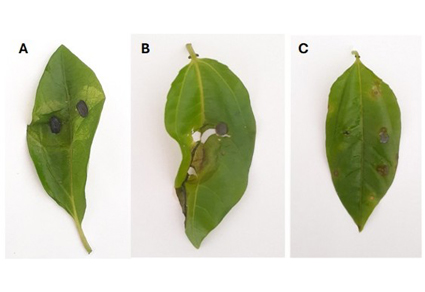
Passion fruit (Passiflora edulis) is an important fruit crop in Brazil. A new pathogenic species of Colletotrichum was isolated from anthracnose-symptomatic leaves collected from commercial orchards in Bahia and Alagoas, Brazil. Three isolates (COUFAL 0578, 0579, and 0580) obtained from symptomatic tissues were characterized based on morphological and molecular analyses, and their pathogenicity was confirmed. Phylogenetic analyses supported the recognition of Colletotrichum maracujensis as a new species, which is described and illustrated in this study. Multigene analyses using nrITS, CHS-1, ACT, GAPDH, and TUB2 sequences placed the isolates within the Colletotrichum magnum species complex. The isolates formed an independent lineage under the genealogical concordance phylogenetic species recognition (GCPSR) criteria and showed genetic diversity and differential reactions among passion fruit varieties.
References
- Araújo, H.F., Costa, R.N.T., Crisóstomo, J.R., Saunders, L.C.U. & Moreira, O.C. (2013) Technical and economic indicators of the yellow passion fruit tree irrigated with underground water supply. Engenharia Agrícola 33: 940–951. https://doi.org/10.1590/S0100-69162013000500006
- Butler, E.J. & Bisby, G.R. (1931) The fungi of India. Scientific Monograph 1. Imperial Council of Agricultural Research, Government of India Central Publication Branch, Calcutta, 237 pp.
- Campo-Arana, R.O., Escobar-Lopez, F.M. & Segura Cepeda, L.E. (2015) Patogenicidad de cepas de Colletotrichum gloeosporioides aisladas en distintos órganos de la planta de maracuyá amarillo (Passiflora edulis f. flavicarpa O. Deg.). Fitopatología Colombiana 39: 41–44.
- Campo-Arana, R.O., Urango-Esquivel, N. & Pérez-Polo, D. (2019) Integrated management of Colletotrichum gloeosporioides in yellow passion fruit (Passiflora edulis f. flavicarpa Degener). Revista de Ciencias Agrícolas 36 (2): 87–94. https://doi.org/10.22267/rcia.193602.120
- Carbone, I. & Kohn, L.M. (1999) A method for designing primer sets for speciation studies in filamentous ascomycetes. Mycologia 91: 553–556. https://doi.org/10.1080/00275514.1999.12061051
- Castellani, A. (1939) The viability of some pathogenic fungi in sterile distilled water. Journal of Tropical Medicine and Hygiene 42: 225–226.
- Colla, L. (1820) Memoria sul genere Musa e monografia del medesimo. Memorie della Reale Accademia delle Scienze di Torino 25: 333–402.
- Corda, A.C.J. (1831) Die Pilze Deutschlands. In: Deutschlands Flora in Abbildungen nach der Natur mit Beschreibungen. Abt. III, 3, pp. 33–64.
- Cruz, A.F., Barka, G.D. & Blum, L.E.B. (2021) Cross-pathogenicity of Colletotrichum isolates on tropical fruit species in Brazil. Archives of Phytopathology and Plant Protection 54: 295–307. https://doi.org/10.1080/03235408.2020.1829439
- Curtis, W. (1788) Passiflora alata. Botanical Magazine 2: t. 66.
- Damm, U., Cannon, P.F., Woudenberg, J.H.C., Johnston, P.R., Weir, B.S., Tan, Y.P., Shivas, R.G. & Crous, P.W. (2012) The Colletotrichum boninense species complex. Studies in Mycology 73: 1–36. https://doi.org/10.3114/sim0002
- Damm, U., Sato, T., Alizadeh, A., Groenewald, J.Z. & Crous, P.W. (2018) The Colletotrichum dracaenophilum, C. magnum and C. orchidearum species complexes. Studies in Mycology 92: 1–46. https://doi.org/10.1016/j.simyco.2018.04.001
- Delacroix, G. (1905) Travaux de la Station de Pathologie Végétale. II. Champignons parasites de plantes cultivées dans les régions chaudes. Bulletin Trimestriel de la Société Mycologique de France 21: 191–204.
- Diao, Y.-Z., Zhang, C., Liu, F., Wang, W.-Z., Liu, L., Cai, L. & Liu, X.-L. (2017) Colletotrichum species causing anthracnose disease of chili in China. Persoonia 38: 20–37. https://doi.org/10.3767/003158517X692788
- Doyle, J.J. & Doyle, J.L. (1987) A rapid DNA isolation procedure for small quantities of fresh leaf tissue. Phytochemical Bulletin 19: 11–15.
- Edgar, R.C. (2004) MUSCLE: multiple sequence alignment with high accuracy and high throughput. Nucleic Acids Research 32: 1792–1797. https://doi.org/10.1093/nar/gkh340
- Gardes, M. & Bruns, T.D. (1993) ITS primers with enhanced specificity for basidiomycetes—application to the identification of mycorrhizae and rusts. Molecular Ecology 2: 113–118. https://doi.org/10.1111/j.1365-294X.1993.tb00005.x
- Glass, N.L. & Donaldson, G.C. (1995) Development of primer sets designed for use with the PCR to amplify conserved genes from filamentous ascomycetes. Applied and Environmental Microbiology 61: 1323–1330. https://doi.org/10.1128/aem.61.4.1323-1330.1995
- IBGE (2019) Censo Agropecuário 2017: resultados definitivos. IBGE, Rio de Janeiro. [Disponível em: https://www.ibge.gov.br]
- IBGE (2023) Produção Agrícola Municipal 2022: culturas temporárias e permanentes. IBGE, Rio de Janeiro. [Disponível em: https://www.ibge.gov.br]
- James, R.S., Ray, J., Tan, Y.P. & Shivas, R.G. (2014) Colletotrichum siamense, C. theobromicola and C. queenslandicum from several plant species and the identification of C. asianum in the Northern Territory, Australia. Australasian Plant Disease Notes 9: 138. https://doi.org/10.1007/s13314-014-0138-x
- Junqueira, N.T.V., Braga, M.F., Faleiro, F.G., Peixoto, J.R. & Bernacci, L.C. (2005) Potencial de espécies silvestres de maracujazeiro como fonte de resistência a doenças. In: Faleiro, F.G., Junqueira, N.T.V. & Braga, M.F. (Eds.) Maracujá: germoplasma e melhoramento genético. Embrapa Cerrados, Planaltina, pp. 81–106.
- Li, W., Ran, F., Long, Y., Mo, F., Shu, R. & Yin, X. (2022) Evidences of Colletotrichum fructicola causing anthracnose on Passiflora edulis Sims in China. Pathogens 11: 6. https://doi.org/10.3390/pathogens11010006
- Linnaeus, C. (1753) Species Plantarum. Laurentii Salvii, Stockholm, 1: 560 pp.
- Linnaeus, C. (1753) Species Plantarum. Laurentii Salvii, Stockholm, 2: 561–1200 pp.
- Linnaeus, C. (1767) Mantissa plantarum. Laurentii Salvii, Holmiae, 129 pp.
- Mishra, A. & Siradhana, B.S. (1979) Studies on the survival of sorghum anthracnose (Colletotrichum graminicola) pathogen. Philippine Agriculturist 62: 149–152.
- Moriwaki, J., Sato, T. & Tsukiboshi, T. (2003) Morphological and molecular characterization of Colletotrichum boninense sp. nov. from Japan. Mycoscience 44: 47–53. https://doi.org/10.1007/S10267-002-0079-7
- Niu, X., Gao, H., Qi, J., Chen, M., Tao, A., Xu, J., Dai, Z. & Su, J. (2016) Colletotrichum species associated with jute (Corchorus capsularis L.) anthracnose in southeastern China. Scientific Reports 6: 25179. https://doi.org/10.1038/srep25179
- Noireung, P., Phoulivong, S., Liu, F., Cai, L., McKenzie, E.H.C., Chukeatirote, E., Jones, E.B.G., Bahkali, A.H. & Hyde, K.D. (2012) Novel species of Colletotrichum revealed by morphology and molecular analysis. Cryptogamie, Mycologie 33: 347–362. https://doi.org/10.7872/crym.v33.iss3.2012.347
- O’Donnell, K. & Cigelnik, E. (1997) Two divergent intragenomic rDNA ITS2 types within a monophyletic lineage of the fungus Fusarium are nonorthologous. Molecular Phylogenetics and Evolution 7: 103–116. https://doi.org/10.1006/mpev.1996.0376
- Penzig, A.J.O. (1884) Note micologiche. III. Seconda contribuzione allo studio dei funghi agrumicoli. Atti del Reale Istituto Veneto di Scienze, Lettere ed Arti, Serie 6, 2: 663–674.
- Peres, N.A.R., Kuramae, E.E., Dias, M.S.C. & de Souza, N.L. (2002) Identification and characterization of Colletotrichum spp. affecting fruit after harvest in Brazil. Journal of Phytopathology 150: 128–134. https://doi.org/10.1046/j.1439-0434.2002.00732.x
- Posada, D. & Buckley, T.R. (2004) Model selection and model averaging in phylogenetics: advantages of Akaike information criterion and Bayesian approaches over likelihood ratio tests. Systematic Biology 53: 793–808. https://doi.org/10.1080/10635150490522304
- Prihastuti, H., Cai, L., Chen, H., McKenzie, E.H.C. & Hyde, K.D. (2009) Characterization of Colletotrichum species associated with coffee berries in northern Thailand. Fungal Diversity 39: 89–109. https://doi.org/10.1016/j.riam.2009.11.001
- Qiu, F., Li, X., Xie, C., Li, J. & Zheng, F. (2021) Identification of Colletotrichum brevisporum causing fruit rot in yellow passion fruit (Passiflora edulis f. flavicarpa) in China. Australasian Plant Pathology 50: 229–232. https://doi.org/10.1007/s13313-020-00766-w
- Rodríguez, M. & Niño, N. (2009) Archivos de diagnóstico en laboratorio 2000–2009. Universidad Nacional de Colombia & Universidad Jorge Tadeo Lozano, Bogotá.
- Ronquist, F. & Huelsenbeck, J.P. (2003) MrBayes 3: Bayesian phylogenetic inference under mixed models. Bioinformatics 19: 1572–1574. https://doi.org/10.1093/bioinformatics/btg180
- Rossman, A.Y., Allen, W.C. & Castlebury, L.A. (2016) New combinations of plant-associated fungi resulting from the change to one name for fungi. IMA Fungus 7: 1–7. https://doi.org/10.5598/imafungus.2016.07.01.01
- Sanders, G.M. & Korsten, L. (2003) Comparison of cross inoculation potential of South African avocado and mango isolates of Colletotrichum gloeosporioides. Microbiological Research 158: 143–150. https://doi.org/10.1078/0944-5013-00186
- São José, A.R. (2015) Controle fitossanitário do maracujá. Revista Campo & Negócios. Available from: http://www.revistacampoenegocios.com.br/controle-fitossanitario-do-maracuja (accessed 26 September 2019)
- Schott, H.W. (1829) Für Liebhaber der Botanik. Wiener Zeitschrift für Kunst, Litteratur, Theater und Mode 3: 828.
- Serra, I.M.R.D.S., Braga, K.C.S., Tchaicka, L. & de Melo, T.A. (2018) Molecular differentiation of Colletotrichum spp. associated with tropical fruit anthracnose. AIP Conference Proceedings 2040: 020015. https://doi.org/10.1063/1.5079163
- Shi, M., Xue, S., Zhang, M., Li, S., Huang, B., Huang, Q., Liu, Q., Liao, X. & Li, Y. (2022) Colletotrichum truncatum—a new etiological anthracnose agent of sword bean (Canavalia gladiata) in southwestern China. Pathogens 11: 1463. https://doi.org/10.3390/pathogens11121463
- Silva, J.L., Lopes, L.E.M., Silva-Cabral, J.R.A., Costa, J.F.D.O., Lima, G.S.D.A. & Assunção, I.P. (2022) Espécies de Colletotrichum associadas à antracnose em maracujazeiro no Brasil. Diversitas Journal 7: 1205–1224. https://doi.org/10.48017/dj.v7i3.2162
- Sims, J. (1818) Passiflora edulis. Botanical Magazine 45: t. 1989.
- Simmonds, J.H. (1965) A study of the species of Colletotrichum causing ripe fruit rots in Queensland. Queensland Journal of Agricultural and Animal Sciences 22: 437–459.
- Sousa, M.A., Pires, M.C., Peixoto, J.R., Faleiro, F.G. & Blum, L.E. (2014) Reação de progênies de maracujazeiro azedo à antracnose. Bioscience Journal 30: 563–570.
- Sprengel, C.P.J. (1826) Systema vegetabilium, editio decima sexta. Vol. 3. Sumtibus Librariae Dieterichianae, Göttingae, 936 pp.
- Staden, R., Beal, K.F. & Bonfield, J.K. (1999) The Staden package, 1998. In: Misener, S. & Krawetz, S.A. (Eds.) Bioinformatics Methods and Protocols. Humana Press, Totowa, pp. 115–130. https://doi.org/10.1385/1-59259-192-2:115
- Sutton, B.C. (1980) The Coelomycetes: fungi imperfecti with pycnidia, acervuli and stromata. Commonwealth Mycological Institute, Kew, 696 pp.
- Sutton, B.C. (1992) The genus Glomerella and its anamorph Colletotrichum. In: Bailey, J.A. & Jeger, M.J. (Eds.) Colletotrichum: Biology, Pathology and Control. CAB International, Wallingford, UK, pp. 1–26.
- Talhinhas, P. & Baroncelli, R. (2021) Colletotrichum species and complexes: geographic distribution, host range and conservation status. Fungal Diversity 110: 109–198. https://doi.org/10.1007/s13225-021-00491-9
- Tarnowski, T. & Ploetz, R. (2010) First report of Colletotrichum boninense, C. capsici, and a Glomerella sp. as causes of postharvest anthracnose of passion fruit in Florida. Plant Disease 94: 786–787. https://doi.org/10.1094/PDIS-94-6-0786C
- Tamura, K., Peterson, D., Peterson, N., Stecher, G., Nei, M. & Kumar, S. (2011) MEGA5: molecular evolutionary genetics analysis using maximum likelihood, evolutionary distance, and maximum parsimony methods. Molecular Biology and Evolution 28: 2731–2739. https://doi.org/10.1093/molbev/msr121
- Templeton, M.D., Rikkerink, E.H., Solon, S.L. & Crowhurst, R.N. (1992) Cloning and molecular characterization of the glyceraldehyde-3-phosphate dehydrogenase-encoding gene and cDNA from the plant pathogenic fungus Glomerella cingulata. Gene 122: 225–230. https://doi.org/10.1016/0378-1119(92)90055-T
- Tozze Júnior, H.J., Fischer, I.H., Câmara, M.P.S. & Massola Júnior, N.S. (2010) First report of Colletotrichum boninense infecting yellow passion fruit (Passiflora edulis f. flavicarpa) in Brazil. Plant Disease 94: 70–72.
- Vieira, W.A.D.S., Bezerra, P.A., Silva, A.C.D., Veloso, J.S., Câmara, M.P.S. & Doyle, V.P. (2020) Optimal markers for the identification of Colletotrichum species. Molecular Phylogenetics and Evolution 143: 106694. https://doi.org/10.1016/j.ympev.2019.106694
- Wang, N., Chi, F., Ji, Z., Zhou, Z. & Zhang, J. (2021) First report of passion fruit anthracnose caused by Colletotrichum constrictum. Plant Disease 105: 4158. https://doi.org/10.1094/PDIS-04-21-0754-PDN
- Weir, B.S., Johnston, P.R. & Damm, U. (2012) The Colletotrichum gloeosporioides species complex. Studies in Mycology 73: 115–180. https://doi.org/10.3114/sim0011
- White, T.J., Bruns, T., Lee, S. & Taylor, J. (1990) Amplification and direct sequencing of fungal ribosomal RNA genes for phylogenetics. In: Innis, M.A., Gelfand, D.H., Sninsky, J.J. & White, T.J. (Eds.) PCR Protocols: A Guide to Methods and Applications. Academic Press, San Diego, pp. 315–322. https://doi.org/10.1016/B978-0-12-372180-8.50042-1
- Yang, Y.L., Liu, Z.Y., Hyde, K.D. & Cai, L. (2011) A new species of Colletotrichum associated with orchids. Cryptogamie, Mycologie 32: 229–241. https://doi.org/10.7872/crym.v32.iss3.2011.229
- Zauza, E.A.V., Alfenas, A.C. & Mafia, R.G. (2007) Esterilização, preparo de meios de cultura e fatores associados ao cultivo de fitopatógenos. In: Alfenas, A.C. & Mafia, R.G. (Eds.) Métodos em fitopatologia. Editora UFV, Viçosa, pp. 42–50.
- Zhao, S., Sun, W., Ouyang, D., Li, Q., Huang, S., Chen, X., Guo, T., Li, W. & Tang, L. (2024) First report of anthracnose caused by Colletotrichum plurivorum on passion fruit in Guangxi, China. Plant Disease 108. https://doi.org/10.1094/PDIS-04-24-0812-PDN