
Abstract
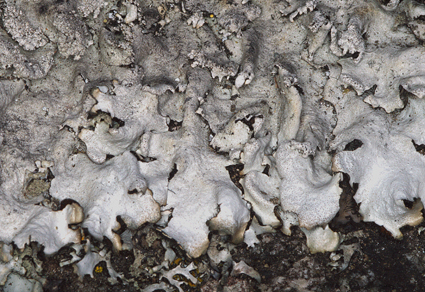
Parmotrema trippianum sp. nov. is described as new to science and named in honor of the lichenologist, botanist, and biodiversity scientist Dr. Erin Manzitto-Tripp. The new species grows on rocks in rich, mesic, montane canyons in the Colorado Front Range of the southern Rocky Mountains and the Chiricahua Mountains of Arizona. Phylogenetically, it is a member of the Parmotrema reticulatum species complex, and indeed, does share some morphological similarities with members of this species complex, including the production of medullary salazinic acid, reticulate maculae, and submarginal soredia. However, it differs from these and other species by its production of abundant lobules and cortical warts, from which pustular consoredia erupt, these forming large, subarbuscular agglomerations. Nuclear ribosomal Internal Transcribed Spacer phylogenies of closely related species and an identification key to Parmotrema with salazinic acid known from North America are presented to facilitate future identification of specimens derived from this diverse group.
References
- Ahn, C. & Moon, K.H. (2016) Parmotrema clavuliferum and P. reticulatum are independent species. Journal of Species Research 5: 254–260. https://doi.org/10.12651/JSR.2016.5.2.254
- Amo de Paz, G., Cubas, P., Divakar, P.K., Lumbsch, H.T. & Crespo, A. (2011) Origin and diversification of major clades in parmelioid lichens (Parmeliaceae, Ascomycota) during the Paleogene inferred by Bayesian analysis. PLoS One 6: e28161. https://doi.org/10.1371/journal.pone.0028161
- Anisimova, M., Gil, M., Dufayard, J.-F., Dessimoz, C. & Gascuel, O. (2011) Survey of branch support methods demonstrates accuracy, power, and robustness of fast likelihood-based approximation schemes. Systematic Biology 60: 685–699. https://doi.org/10.1093/sysbio/syr041
- Barbosa, S.B. & Marcelli, M.P. (2010) Cortical diversity in three species groups of Parmotrema sensu lato (Parmeliaceae, lichenized Ascomycota). Micron 41: 861–869. https://doi.org/10.1016/j.micron.2010.04.014
- Blanco, O., Crespo, A., Divakar, P.K., Elix, J.A. & Lumbsch, H.T. (2005) Molecular phylogeny of parmotremoid lichens (Ascomycota, Parmeliaceae). Mycologia 97: 150–159. https://doi.org/10.1080/15572536.2006.11832848
- Brodo, I.M. (2016) Keys to lichens of North America: Revised and expanded. Yale University Press.
- Bungartz, F. & Spielmann, A.A. (2019) The genus Parmotrema (Parmeliaceae, Lecanoromycetes) in the Galapagos Islands. Plant and Fungal Systematics 64: 1–xx. https://doi.org/10.2478/pfs-2019-0018
- Crespo, A. & Pérez-Ortega, S. (2009) Cryptic species and species pairs in lichens: a discussion on the relationship between molecular phylogenies and morphological characters. Anales del Jardín Botánico de Madrid 66: 71–81. https://doi.org/10.3989/ajbm.2225
- Culberson, C.F. (1972) Improved conditions and new data for identification of lichen products by standardized thin-layer chromatographic method. Journal of Chromatography A 72: 113–125. https://doi.org/10.1016/0021-9673(72)80013-x
- da Cruz Lima Gerlach, A. & Eliasaro, S. (2014) Parmotrema marcellii, a new species of Parmeliaceae (lichenized Ascomycota) from Brazil. Brazilian Journal of Botany 37: 597–600. https://doi.org/10.1007/s40415-014-0098-6
- Del-Prado, R., Divakar, P.K. & Crespo, A. (2011) Using genetic distances in addition to ITS molecular phylogeny to identify potential species in the Parmotrema reticulatum complex: a case study. The Lichenologist 43: 569–583. https://doi.org/10.1017/s0024282911000582
- Del-Prado, R., Divakar, P.K., Lumbsch, H.T. & Crespo, A.M. (2016) Hidden genetic diversity in an asexually reproducing lichen forming fungal group. PLoS One 11: e0161031. https://doi.org/10.1371/journal.pone.0161031
- Del-Prado, R., Buaruang, K., Lumbsch, H.T., Crespo, A. & Divakar, P.K. (2019) DNA sequence-based identification and barcoding of a morphologically highly plastic lichen forming fungal genus (Parmotrema, Parmeliaceae) from the tropics. The Bryologist 122: 281–291. https://doi.org/10.1639/0007-2745-122.2.281
- Divakar, P.K., Blanco, O., Hawksworth, D.L. & Crespo, A. (2005) Molecular phylogenetic studies on the Parmotrema reticulatum (syn. Rimelia reticulata) complex, including the confirmation of P. pseudoreticulatum as a distinct species. The Lichenologist 37: 55–65. https://doi.org/10.1017/s0024282904014586
- Divakar, P.K., Crespo, A., Kraichak, E., Leavitt, S.D., Singh, G., Schmitt, I. & Lumbsch, H.T. (2017) Using a temporal phylogenetic method to harmonize family- and genus-level classification in the largest clade of lichen-forming fungi. Fungal Diversity 84: 101–117. https://doi.org/10.1007/s13225-017-0379-z
- Doyle, J.J. & Doyle, J.L. (1987) A rapid DNA isolation procedure for small quantities of fresh leaf tissue. Phytochemical Bulletin 19: 11–15.
- Dyer, P.S. & O’Gorman, C.M. (2011) A fungal sexual revolution: Aspergillus and Penicillium show the way. Current Opinion in Microbiology 14: 649–654. https://doi.org/10.1016/j.mib.2011.10.001
- Egan, R.S., Pérez-Pérez, R.E. & Nash, T.H. III (2016) Parmotrema in Mexico. In: Herrera-Campos, M.A., Pérez-Pérez, R.E. & Nash, T.H. III (Eds.) Lichens of Mexico. The Parmeliaceae—Keys, Distribution and Specimen Descriptions. J. Cramer (Borntraeger Science Publishers), Stuttgart, pp. 323–426.
- Elix, J.A. (1993) Progress in the generic delimitation of Parmelia sensu lato lichens (Ascomycotina: Parmeliaceae) and a synoptic key to the Parmeliaceae. The Bryologist 96: 359–383. https://doi.org/10.2307/3243867
- Elix, J.A. (2022) A catalogue of standardized chromatographic data and biosynthetic relationships for lichen substances. Self-published, Canberra.
- Hale, M.E. (1973) Fine structure of the cortex in the lichen family Parmeliaceae viewed with the scanning-electron microscope. Smithsonian Contributions to Botany 10: 1–92. https://doi.org/10.5479/si.0081024X.10
- Hale, M.E. (1974) New combinations in the lichen genus Parmotrema Massalongo. Phytologia 28: 334–339.
- Hale, M.E. & Fletcher, A. (1990) Rimelia Hale & Fletcher, a new lichen genus (Ascomycotina: Parmeliaceae). The Bryologist 93: 23–29. https://doi.org/10.2307/3243542
- Hawksworth, D.L., Blanco, O., Divakar, P.K., Ahti, T. & Crespo, A. (2008) A first checklist of parmelioid and similar lichens in Europe and some adjacent territories, adopting revised generic circumscriptions and with indications of species distributions. The Lichenologist 40: 1–21. https://doi.org/10.1017/s0024282908007329
- Heitman, J. (2015) Evolution of sexual reproduction: a view from the fungal kingdom supports an evolutionary epoch with sex before sexes. Fungal Biology Reviews 29: 108–117. https://doi.org/10.1016/j.fbr.2015.08.002
- Huang, J.-P., Kraichak, E., Leavitt, S.D., Nelsen, M.P. & Lumbsch, H.T. (2019) Accelerated diversifications in three diverse families of morphologically complex lichen-forming fungi link to major historical events. Scientific Reports 9: 8518. https://doi.org/10.1038/s41598-019-44881-1
- IUCN Standards and Petitions Committee (2024) Guidelines for using the IUCN Red List Categories and Criteria. Version 16. [https://www.iucnredlist.org/documents/RedListGuidelines.pdf]
- Kalyaanamoorthy, S., Minh, B.Q., Wong, T.K.F., von Haeseler, A. & Jermiin, L.S. (2017) ModelFinder: fast model selection for accurate phylogenetic estimates. Nature Methods 14: 587–589. https://doi.org/10.1038/nmeth.4285
- Katoh, K. & Standley, D.M. (2013) MAFFT multiple sequence alignment software version 7: improvements in performance and usability. Molecular Biology and Evolution 30: 772–780. https://doi.org/10.1093/molbev/mst010
- Kauserud, H. (2023) ITS alchemy: On the use of ITS as a DNA marker in fungal ecology. Fungal Ecology 65: 101274. https://doi.org/10.1016/j.funeco.2023.101274
- Keuler, R., Garretson, A., Saunders, T., Erickson, R.J., St. Andre, N., Grewe, F., Smith, H., Lumbsch, H.T., Huang, J.-P., St. Clair, L.L. & Leavitt, S.D. (2020) Genome-scale data reveal the role of hybridization in lichen-forming fungi. Scientific Reports 10: 1497. https://doi.org/10.1038/s41598-020-58279-x
- Keuler, R., Jensen, J., Barcena-Peña, A., Grewe, F., Lumbsch, H.T., Huang, J.-P. & Leavitt, S.D. (2022) Interpreting phylogenetic conflict: hybridization in the most speciose genus of lichen-forming fungi. Molecular Phylogenetics and Evolution 174: 107543. https://doi.org/10.1016/j.ympev.2022.107543
- Kück, U. & Pöggeler, S. (2009) Cryptic sex in fungi. Fungal Biology Reviews 23: 86–90. https://doi.org/10.1016/j.fbr.2009.10.004
- Louwhoff, S.H.J. & Crisp, M.D. (2000) Phylogenetic analysis of Parmotrema (Parmeliaceae: lichenized Ascomycotina). The Bryologist 103: 541–554. https://doi.org/10.1639/0007-2745(2000)103[0541:PAOPPL]2.0.CO;2
- Louwhoff, S.H. & Elix, J.A. (2000) Five new species in the lichen family Parmeliaceae (Ascomycotina) from Grande Terre, New Caledonia. Mycotaxon 75: 195–203. https://doi.org/10.5962/p.414772
- Lücking, R., Dal-Forno, M., Sikaroodi, M., Gillevet, P.M., Bungartz, F., Moncada, B., Yánez-Ayabaca, A., Chaves, J.L., Coca, L.F. & Lawrey, J.D. (2014) A single macrolichen constitutes hundreds of unrecognized species. Proceedings of the National Academy of Sciences 111: 11091–11096. https://doi.org/10.1073/pnas.1403517111
- Lücking, R., Hodkinson, B.P. & Leavitt, S.D. (2017) The 2016 classification of lichenized fungi in the Ascomycota and Basidiomycota—approaching one thousand genera. The Bryologist 119: 361–416. https://doi.org/10.1639/0007-2745-119.4.361
- Lücking, R., Leavitt, S.D. & Hawksworth, D.L. (2021) Species in lichen-forming fungi: balancing between conceptual and practical considerations, and between phenotype and phylogenomics. Fungal Diversity 109: 99–154. https://doi.org/10.1007/s13225-021-00477-7
- Manzitto-Tripp, E.A. & Watts, J.L. (2025) The thin horizon of a plan is almost clear: towards a lichen biodiversity inventory of the southern Rocky Mountains, USA. Phytotaxa 712: 207–229. https://doi.org/10.11646/phytotaxa.712.3.1
- Masson, D., Magain, N. & Sérusiaux, E. (2024) Small island but great diversity: thirty-six species of Parmotrema (Parmeliaceae, lichenized Ascomycota), including sixteen new species, on Réunion (Mascarenes), with additional data from the Western Indian Ocean. Phytotaxa 657: 1–138. https://doi.org/10.11646/phytotaxa.657.1.1
- Minh, B.Q., Nguyen, M.A.T. & von Haeseler, A. (2013) Ultrafast approximation for phylogenetic bootstrap. Molecular Biology and Evolution 30: 1188–1195. https://doi.org/10.1093/molbev/mst024
- Nash, T.H. III & Elix, J.A. (2002) Parmotrema. In: Nash, T.H. III, Ryan, B.D., Diederich, P., Gries, C. & Bungartz, F. (Eds.) Lichen Flora of the Greater Sonoran Desert Region, Volume 1. Lichens Unlimited (Arizona State University), Tempe, AZ.
- Nelsen, M.P., Lücking, R., Boyce, C.K., Lumbsch, H.T. & Ree, R.H. (2020) The macroevolutionary dynamics of symbiotic and phenotypic diversification in lichens. Proceedings of the National Academy of Sciences 117: 21495–21503. https://doi.org/10.1073/pnas.2001913117
- Nguyen, L.-T., Schmidt, H.A., von Haeseler, A. & Minh, B.Q. (2015) IQ-TREE: a fast and effective stochastic algorithm for estimating maximum-likelihood phylogenies. Molecular Biology and Evolution 32: 268–274. https://doi.org/10.1093/molbev/msu300
- Otálora, M.A.G., Martínez, I., Aragón, G. & Molina, M.C. (2010) Phylogeography and divergence date estimates of a lichen species complex with a disjunct distribution pattern. American Journal of Botany 97: 216–223. https://doi.org/10.3732/ajb.0900064
- Roca Valiente, B., Divakar, P.K., Ohmura, Y., Hawksworth, D. & Crespo, A. (2013) Molecular phylogeny supports the recognition of the two morphospecies Parmotrema pseudotinctorum and P. tinctorum (Parmeliaceae, Ascomycota). Vieraea 41: 333–348. https://doi.org/10.31939/vieraea.2013.41.22
- Rundell, R.J. & Price, T.D. (2009) Adaptive radiation, nonadaptive radiation, ecological speciation and nonecological speciation. Trends in Ecology & Evolution 24: 394–399. https://doi.org/10.1016/j.tree.2009.02.007
- Spielmann, A.A. & Marcelli, M.P. (2009) Parmotrema sl (Parmeliaceae, lichenized Ascomycota) from Serra Geral slopes in central Rio Grande do Sul State, Brazil. Hoehnea 36: 551–595. https://doi.org/10.1590/s2236-89062009000400002
- Spielmann, A.A. & Marcelli, M.P. (2020) Type studies on Parmotrema (Parmeliaceae, Ascomycota) with salazinic acid. Plant and Fungal Systematics 65: 403–508. https://doi.org/10.35535/pfsyst-2020-0028
- Stelate, A., Del-Prado, R., Alors, D., Tahiri, H., Divakar, P.K. & Crespo, A. (2022) Resolving the phylogenetic relationship between Parmotrema crinitum and Parmotrema perlatum populations. The Lichenologist 54: 183–194. https://doi.org/10.1017/s0024282922000147
- Thiers, B. (accessed 2026) Index Herbariorum: a global directory of public herbaria and associated staff. New York Botanical Garden’s Virtual Herbarium.
- Trifinopoulos, J., Nguyen, L.-T., von Haeseler, A. & Minh, B.Q. (2016) W-IQ-TREE: a fast online phylogenetic tool for maximum likelihood analysis. Nucleic Acids Research 44: W232–W235. https://doi.org/10.1093/nar/gkw256
- Tripp, E.A. & Lendemer, J.C. (2018) Twenty-seven modes of reproduction in the obligate lichen symbiosis. Brittonia 70: 1–14. https://doi.org/10.1007/s12228-017-9500-6
- White, T.J., Bruns, T., Lee, S. & Taylor, J. (1990) Amplification and direct sequencing of fungal ribosomal RNA genes for phylogenetics. PCR Protocols: a Guide to Methods and Applications 18: 315–322. https://doi.org/10.1016/B978-0-12-372180-8.50042-1
- Widhelm, T.J., Egan, R.S., Bertoletti, F.R., Asztalos, M.J., Kraichak, E., Leavitt, S.D. & Lumbsch, H.T. (2016) Picking holes in traditional species delimitations: an integrative taxonomic reassessment of the Parmotrema perforatum group (Parmeliaceae, Ascomycota). Botanical Journal of the Linnean Society 182: 868–884. https://doi.org/10.1111/boj.12483
- Yahr, R., Allen, J.L., Atienza, V., Bungartz, F., Chrisman, N., Dal Forno, M., Degtjarenko, P., Ohmura, Y., Pérez-Ortega, S., Randlane, T., Næsborg, R.R., Simijaca-Salcedo, D., Hirschheydt, G., Anderson, F., Aptroot, A., Balderas, E., Borukhiyah, N., Chandler, A.M., Marro, M.C., Divakar, P.K., García, R.A., Herrera-Campos, M.A., Howe, N., Joseph, S., Larsen, E.M., Lendemer, J.C., McMullin, R.T., Michlig, A., Moncada, B., Paulsen, J., Roa-García, F., Rosentreter, R., Scheidegger, C., Sparrius, L.B. & Stone, D.F. (2024) Red listing lichenized fungi: best practices and future prospects. The Lichenologist 56: 345–362. https://doi.org/10.1017/s0024282924000355
- Zhang, Y., Clancy, J., Jensen, J., McMullin, R.T., Wang, L. & Leavitt, S.D. (2022) Providing scale to a known taxonomic unknown—at least a 70-fold increase in species diversity in a cosmopolitan nominal taxon of lichen-forming fungi. Journal of Fungi 8: 490. https://doi.org/10.3390/jof8050490