
Abstract
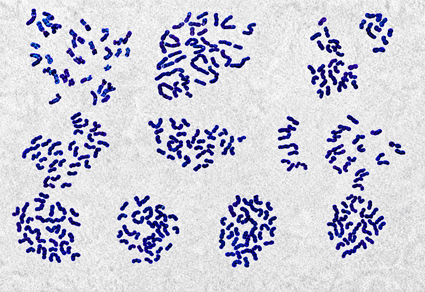
This work presents an extensive somatic karyotype analysis of ten accessions of Panicum sumatrense (Little Millet), a minor yet genetically valuable tetraploid crop (2n = 4x = 36) known for its high resilience to abiotic stress. Accessions were obtained from the National Bureau of Plant Genetic Resources (NBPGR), New Delhi, and analysed using standardised cytogenetic methodologies. Using the method described by Levan et al. (1964), chromosomes were grouped by length and arm ratio. Karyotype symmetry was assessed according to the classification system proposed by Stebbins (1958). Three-dimensional idiograms were created to show how the volume of different accessions changes. All accessions exhibited 1A symmetrical karyotypes, characterised by predominantly metacentric chromosomes. Even though the number of chromosomes was the same in all accessions, there was considerable variation among them in total chromatin length, centromeric index, gradient index, symmetry index, and volumetric metrics, including chromatid radius and chromosomal volume. These differences indicate structural chromosomal polymorphism among accessions, suggesting genomic diversity. This basic cytogenetic investigation reveals chromosomal variability within the species P. sumatrense, which can be further utilised in breeding programs and conservation strategies. The present dataset can be further used in advanced cytogenetic exploration, such as FISH and banding, to establish genomic relationships with other cultivars and facilitate genetic improvement in this underutilised millet species.
References
- Astuti, G., Roma-Marzio, F. & Peruzzi, L. (2017) Traditional cytotaxonomic studies: can they still provide a solid basis in plant systematics? Flora Mediterranea 27: 91–98. https://doi.org/10.7320/FlMedit27.091
- Barrier, M., Baldwin, B.G., Robichaux, R.H. & Purugganan, M.D. (1999) Interspecific hybrid ancestry of a plant adaptive radiation: allopolyploidy of the Hawaiian silversword alliance (Asteraceae) inferred from floral homeotic gene duplications. Molecular Biology and Evolution 16 (8): 1105–1113. https://doi.org/10.1093/oxfordjournals.molbev.a026200
- Bayer, R.J. (1999) New perspectives into the evolution of polyploid complexes. In: van Raamsdonk, L.W.D. & den Nijs, J.C.M. (Eds.) Plant Evolution in Man-made Habitats, Proceedings of the VIIth International Symposium of the International Organization of Plant Biosystematists. Rijksherbarium/Hortus Botanicus, Leiden.
- Burton, G.W. (1940) A cytological study of some species in the genus Paspalum. Journal of Agricultural Research 60: 193–197.
- Crawford, D.J. (1990) Plant Molecular Systematics: Macromolecular Approaches. Wiley, New York.
- FAO (1999) Women: users, preservers and managers of agrobiodiversity. Available from: [www.fao.org/FOCUS/E/Women/Biodiv-e.htm]
- Fedorov, A.A. (1974) Chromosome Numbers of Flowering Plants. Academy of Sciences, Leningrad.
- Geetha, K., Divya, S., Srividhya, Thilagam, P. & Allwin, L. (2023) Exploring the Genetic diversity studies in little millet (Panicum sumatrense) using multivariate tools - Principal component analysis and Cluster analysis. Agriculture Association of Textile Chemical and Critical Reviews Journal 11: 28–31. https://doi.org/10.58321/AATCCReview.2023.11.04.28
- Grant, V. (1981) Plant Speciation. Columbia University Press, New York. https://doi.org/10.7312/gran92318
- Hughes, A.L. (1994) The evolution of functionally novel proteins after gene duplication. Proceedings of the Royal Society of London B 256: 119–124. https://doi.org/10.1098/rspb.1994.0058
- Kadluczka, D. & Grzebelus, E. (2021) Using carrot centromeric repeats to study karyotype relationships in the genus Daucus (Apiaceae). BMC Genomics 22 (1): 508. https://doi.org/10.1186/s12864-021-07853-2
- Kimura, M. & Ohta, T. (1974) On some principles governing molecular evolution. Proceedings of the National Academy of Sciences USA 71: 2848–2852. https://doi.org/10.1073/pnas.71.7.2848
- Kishimoto, E. (1938) Chromosomenzahlen in den Gattungen Panicum and Setaria. I. Chromosomenzahlen einiger Setaria-Arten. Cytologia 9: 23–27. https://doi.org/10.1508/cytologia.9.23
- Krishnaswamy, N. (1951) Origin and distribution of cultivated plants of South Asia: Millets. Indian Journal of Genetics and Plant Breeding 11: 67–74.
- Krishnaswamy, N. & Ayyangar, G.N.R. (1941) Adventitious roots of ragi (Eleusine coracana, Gaertn.). Current Science 10: 79–80.
- Leitch, I.J. & Bennett, M.D. (1997) Polyploidy in angiosperms. Trends in Plant Science 2 (12): 470–476. https://doi.org/10.1016/S1360-1385(97)01154-0
- Levan, A., Fredga, K. & Sandberg, A.A. (1964) Nomenclature for centromeric position on chromosomes. Hereditas 52: 201–220. https://doi.org/10.1111/j.1601-5223.1964.tb01953.x
- Li, W.H. (1985) Accelerated evolution following gene duplication and its implications for the neutralist-selectionist controversy. In: Ohta, T. & Aoki, K. (Eds.) Population Genetics and Molecular Evolution. Springer-Verlag, Berlin, pp. 333–353.
- Malik, A. & Srivastava, A.K. (2012) Karyological studies in twelve accessions of Carthamus tinctorius. Caryologia 65 (1): 1–6. https://doi.org/10.1080/00087114.2012.678072
- Masterson, J. (1994) Stomatal size in fossil plants: evidence for polyploidy in majority of angiosperms. Science 264: 421–423. https://doi.org/10.1126/science.264.5157.421
- Ohno, S. (1970) Evolution by Gene Duplication. Springer-Verlag, New York. https://doi.org/10.1007/978-3-642-86659-3
- Ohta, T. (1994) Further examples of evolution by gene duplication revealed through DNA sequence comparisons. Genetics 138: 1331–1337. https://doi.org/10.1093/genetics/138.4.1331
- Pickett, F.B. & Meeks-Wagner, D.R. (1995) Seeing double: appreciating genetic redundancy. The Plant Cell 7 (9): 1347–1356. https://doi.org/10.1105/tpc.7.9.1347
- Pillai, R.S.N., Kumar, H. & Singh, R.B. (1981) Karyotypic Analysis of Safflower 1. Crop Science 21 (6): 809–811. https://doi.org/10.2135/cropsci1981.0011183x002100060003x
- Randall, R.S., Jourdain, C., Nowicka, A., Kaduchová, K., Kubová, M., Ayoub, M.A. & Baroux, C. (2022) Image analysis workflows to reveal the spatial organization of cell nuclei and chromosomes. Nucleus 13 (1): 279–301. https://doi.org/10.1080/19491034.2022.2144013
- Rani, M., Sujata & Srivastava, A.K. (2017) Pachytene Analyses in Some Genera of Minor Millets. Cytologia 82 (5): 521–526. https://doi.org/10.1508/cytologia.82.521
- She, C.W., Jiang, X.H., Ou, L.J., Liu, J., Long, K.L., Zhang, L.H., Duan, W.T., Zhao, W. & Hu, J.C. (2015) Molecular cytogenetic characterization and phylogenetic analysis of the seven cultivated Vigna species (Fabaceae). Plant Biology 17 (1): 268–280. https://doi.org/10.1111/plb.12174
- She, C.W., Wei, L. & Jiang, X.H. (2017) Molecular cytogenetic characterization and comparison of the two cultivated Canavalia species (Fabaceae). Comparative Cytogenetics 11 (4): 579–600. https://doi.org/10.3897/compcytogen.v11i4.13604
- She, C.W., Mao, Y., Jiang, X.H. & He, C.P. (2020) Comparative molecular cytogenetic characterization of five wild Vigna species (Fabaceae). Comparative Cytogenetics 14 (2): 243–264. https://doi.org/10.3897/CompCytogen.v14i2.51154
- Soltis, P.S., Doyle, J.J. & Soltis, D.E. (1992) Molecular data and polyploid evolution in plants. In: Soltis, P.S., Soltis, D.E. & Doyle, J.J. (Eds.) Molecular Systematics of Plants. Chapman and Hall, New York, pp. 177–201. https://doi.org/10.1007/978-1-4615-3276-7_8
- Soltis, D.E. & Soltis, P.S. (1993) Molecular data and the dynamic nature of polyploidy. Critical Reviews in Plant Sciences 12: 243–273. https://doi.org/10.1080/07352689309701903
- Srivastava, M.P. & Joshi, R.K. (1972) A smear technique for root tip chromosome preparation of Cajanus cajan (L.) Millsp.
- Stebbins, G.L. (1950) Variation and Evolution in Plants. Columbia University Press, New York. https://doi.org/10.7312/steb94536
- Stebbins, G.L. (1958) Longevity, habitat, and release of genetic variability in higher plants. Cold Spring Harbor Symposia on Quantitative Biology 23: 365–378. https://doi.org/10.1101/SQB.1958.023.01.035
- Stebbins, G.L. (1971) Chromosomal Evolution in Higher Plants. Edward Arnold, London.
- Stebbins, G.L. (1980) DNA, chromosomes, and evolution. Actas IV Congreso Latinoamericano de Genética 2: 325–338.
- Wang, T., van Dijk, A.D., Cai, X., Wu, J., Bonnema, G., Wang, X. & Baroux, C. (2025) Brassica diversity through the lens of polyploidy: genomic evolution, introgression, and homoeologous exchange. Horticultural Plant Journal. https://doi.org/10.1016/j.hpj.2025.08.002