
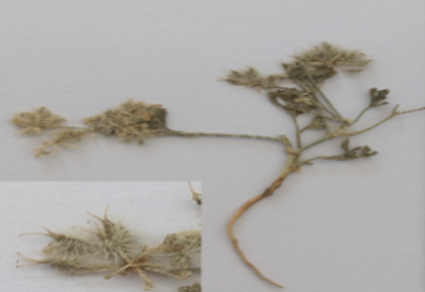

Abstract
A new species of Apiaceae, Psammogeton utterbehaniensis Bhellum & Magotra sp. nov. is described from the foot Hills Western Himalaya (Jammu & Kashmir, India). The species is morphologically similar to P. canescens and P. biternatus but differs for some morphological differences at flower and fruit level: stem striations, number of styles, number of stigmas, shape of cross section of schizocarp, unequal mericarps, mericarp ribs. Morphological description, photoplates, and a comparison table with allied species including key to Psammogeton species in India are provided. The taxon appears to be narrowly endemic and is tentatively assessed as Data Deficient.
References
- Ahmed, I. & Koul, A.K. (1980) In I. O. P. B. Chromosome number reports, LXVIII. Taxon 29: 543.
- Babu, C.R. (1977) Herbaceous Flora of Dehra Dun. Publication and Information Division (CSIR), New Delhi.
- Barrett, R.D.H. & Schluter, D. (2008) Adaptations from standing genetic variation. Trends in Ecology & Evolution 23 (1): 38–44. https://doi.org/10.1016/j.tree.2007.09.008
- Boissier, E. (1872) Umbelliferae. In: Boissier, E. (Ed.) Flora Orientalis, Vol 2. H Georg, Geneva & Basileae, pp. 819–1090.
- Calabrese, G., Perrino, E.V., Ladisa, G., Aly, A., Tesfmichael Solomon, M., Mazdaric, S., Benedettti, A. & Ceglie, F.G. (2015) Short-term effects of different soil management practices on biodiversity and soil quality of Mediterranean ancient olive orchards. Organic Agriculture 5: 209–223. https://doi.org/10.1007/s13165-015-0120-8
- Clarke, C.B. (1879) Umbelliferae. In: Hooker, J.D. (Ed.) The Flora of British India. Vol II. L Reeve & Co., London, pp. 665–720.
- Downie, S.R., Spalik, K., Katz-Downie, D.S. & Reduron, J. (2010) Major clades within Apiaceae subfamily Apioideae as inferred by phylogenetic analysis of nrDNA ITS sequences. Plant Diversity and Evolution 128: 111–136. https://doi.org/10.1127/1869-6155/2010/0128-0005
- GBIF Secretariat (2023) GBIF Backbone Taxonomy. Checklist dataset. Available from: https://doi.org/10.15468/39omei (accessed 27 May 2026)
- Hedge, I.C., Lamond, J.M. & Rechinger, K.H. (1987) Umbelliferae. In: Rechinger, K.H. (Ed.) Flora Iranica 162. Akademische Druck 4. Verlagsanstalt, Graz, pp. 1–555.
- Heywood, V.H. (1971) The Biology Chemistry of Umbelliferae. Academic Press, pp. 217–232.
- Hoffmann, A.A., Rymer, P.D., Byrne, M., Ruthrof, K.X., Whinam, J., McGeoch, M. & Williams, S.E. (2019) Impect of recent climate change on terrestrial flora and fauna: Some emerging Australian examples. Austral Ecology 44 (1): 3–27. https://doi.org/10.1111/aec.12674
- Hughes, A.R., Inouye, B.D., Johnson, M.T.J., Underwood, N. & Vellend, M. (2008) Eclolgical consequences of genetic diversity. Ecological Letters 11: 609–623. https://doi.org/10.1111/j.1461-0248.01179.x
- IUCN. (2024) Guidelines for Using the IUCN Red List Categories and Criteria. Version 16. Prepared by the Standard and Petitions Committee. Available from: https://www.iucnredlist.org/documents/RedListGuidelines.pdf (accessed 31 May 2026)
- Jain, S.K. & Rao, R.R. (1977) A Handbook of Field and Herbarium methods. Today & Tomorrow's Printers and Publishers, New Delhi.
- Jump, A.S. & Peñuelas, J. (2009) Environmental change and the option value of genetic diversity. Trends in Plant science 14 (1): 51–58. https://doi.org/10.1016/j.plants.2008.10.002
- Katz-Downie, D.S., Valiejo-Roman, C.M., Terentieva, E.I., Troitsky, A.V., Michail, T., Pimenov, M.G., Lee, B. & Downie, S.R. (1999) Towards a molecular phylogeny of Apiaceae subfamily Apioideae: additional information from nuclear ribosomal DNA ITS sequences. Plant Systematics and Evolution 216: 167–195. https://doi.org/10.1007/BF01084397
- Kitamura, S. (1960) Flora of Afghanistan. Kyoto University Nissha Printing Co Ltd, Japan.
- Mousavi, S.S., Mozaffarian, V., Mummenhoff, K. & Zarre, S. (2022) Systematics of Iranian Genera Aphanopleura, Demavendia, Haussknechtia, Psammogeton, Zeravschania (Apiaceae tribe Pimpinelleae). Plant Systematics and Evolution 308 (2): 89–109. https://doi.org/10.1007/s00606-021-01792-ⅹ
- Mukherjee, P.K. & Constance, L. (1993) Umbelliferae (Apiaceae) of India. Oxford and IBH Publ. Co., New Delhi.
- Nasir, E. (1972) Umbelliferae. In: Nasir, E. & Ali, S.I. (Eds.) Flora of West Pakistan. 20. Ferozsons Ltd., Rawalpindi, pp. 1–169.
- Ostroumova, T., A., Pimenov, M.G. & Ukrainskaya, U.A. (2010) Micromorphological diversity of hairs and emergences on fruits in the Umbelliferae and its taxonomic value. Botanicheskii Zhurnal 95: 1219–1231.
- Pimenov, M.G. & Leonov, E.V. (1993) The genera of Umbelliferae. R Bot Gard, Kew.
- Pimenov, M.G. & Leonov, E.V. (2004) The Asian Umbelliferae Biodiversity Database (ASIUM) with particular reference to south Asian taxa. Turkish Journal of Botany 28: 139–145.
- Pimenov, M.G., Degtjavera, G., Ostroumova, T., Samigullin, T. & Zakharova, E. (2019) What is Seseli diffusum? A comparative morphological and molecular appraisal of critical species of Umbelliferae. Plant Systematics and Evolution 305: 49–59. https://doi.org/10.1007/s00606-018-1550-z
- Rechinger, K.H. (1987) Flora Iranica 162. Akademische Druck–u. Verlagsanstalt, pp. 144.
- Sharma, B.M. & Kachroo, P. (1981) Flora of Jammu and Plants of neighbourhood. Vol. I. Bishen Singh Mahendra Pal Singh, Dehra Dun.
- Sharma, B.M. & Kachroo, P. (1983) Flora of Jammu and Plants of neighbourhood (illustrations). Vol. II. Bishen Singh Mahendra Pal Singh, Dehra Dun.
- Thuiller, W., Lavorel, S., Araújo, M.B., Sykes, M.T. & Prentice, I.C. (2005) Climate change threats to plant diversity in Europe. Proceedings of the National Academy of Sciences of the United States of America 102: 8245–8250. https://doi.org/10.1073/pnas.0409902102
- Turco, A., Wagensommer, R.P., Medagli, P., D’Emerico, S., Ippolito, F., Scordella, G. & Albano, A. (2025) Centaurea pumilio (Asteraceae): Conservation status, threats and population size of a critically endangered species in Italy. Plants 14 (7): 1074. https://doi.org/10.3390/plants 14071074
- Wagensommer, R.P., Perrino, E.V. & Silletti, G.N. (2014) Carex phyllostachys C. A. Mey. (Cyperaceae) New for Italy and phytogeographical Considerations. Phyton 54 (2): 215–222. https://doi.org/10.12905/0380.phyton54(2)2014-0215
- Wagensommer, R.P., Bartolucci, F., Fiorentino, M., Licht, W., Peccenini, S., Perrino, E.V. & Venanzoni, R. (2017) First record for the flora of Italy and lectotypification of the name Linum elegans (Linaceae). Phytotaxa 290 (2): 161–170. https://doi.org/10.11646/phytotaxa.296.2.5