

Abstract
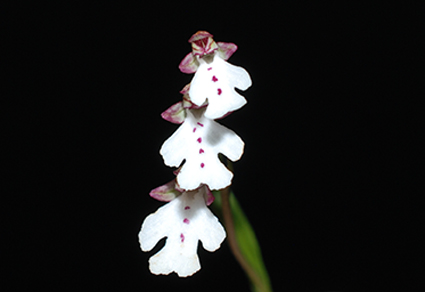
A new orchid species Amitostigma chamoense, from Motuo and Chayu County, Xizang, China, is described here based on morphological characters and molecular phylogenetic evidence. Amitostigma chamoense is morphologically close to A. basifoliatum and A. motuoense , but can be readily distinguished by its linear leaf, rachis bearing 2–5 flowers, sepals and petals yellowish green and frequently suffused with reddish maroon abaxially, petals dorsally carinate, apices of lobes slightly undulate, and spur apex emarginate. Molecular phylogenetic study using two nuclear markers (nrITS and Xdh) and three plastid markers (matK, psbA-trnH, and trnL-F) recovered A. chamoense as sister to A. nanum.
References
- Averyanov, L., Truong, V., Canh, N., Maisak, T., Diep, D., Nuraliev, M., Nguyen, K. & Chu, V. (2020) New Orchids in the Flora of Vietnam III (Collabieae, Malaxideae, Nervilieae and Orchideae). Taiwania 65 (4): 478–492. https://doi.org/10.6165/tai.2020.65.478
- Capella-Gutiérrez, S., Silla-Martínez, J.M. & Gabaldón, T. (2009) TrimAl: a tool for automated alignment trimming in large-scale phylogenetic analyses. Bioinformatics 25: 1972–1973. https://doi.org/10.1093/bioinformatics/btp348
- Chen, S.C., Cribb, P.J. & Gale, S.W. (2009) Amitostigma. In: Wu, Z.Y., Raven, P.H. & Hong, D.Y. (Eds.) Flora of China, vol. 25. Science Press, Beijing and Missouri Botanical Garden Press, St. Louis, pp. 124–131.
- Chowlu, K., Tsering, J., Rao, A.N., Kabeer, K.A. & Ray, A. (2025) Hemipilia basifoliata (Orchidaceae) – an addition to the orchid flora of India. Biodiversity Research and Conservation 78: 1–4. https://doi.org/10.14746/biorc.2025.78.1
- Doyle, J.J. & Doyle, J.L. (1987) A rapid DNA isolation procedure for small quantities of fresh leaf tissue. Phytochemical Bulletin 19: 11–15.
- Finet, M.E.A. (1901) Les Orchidées de L’Asie Orientale. Revue Generale de Botanique 13: 497–534.
- IUCN (2024) Guidelines for Using the IUCN Red List Categories and Criteria, Version 16. Prepared by the Standards and Petitions Committee. Available from: https://www.iucnredlist.org/documents/RedListGuidelines.pdf (accessed 20 November 2025)
- Jin, J.J., Yu, W.B., Yang, J.B., Song, Y. & Li, D.Z. (2019) GetOrganelle: A fast and versatile toolkit for accurate de novo assembly of organelle genomes. Genome Biology 21: e241. https://doi.org/10.1186/s13059-020-02154-5
- Jin, W.T., Jin, X.H., Schuiteman, A., Li, D.Z., Xiang, X.G., Huang, W.C., Li, J.W. & Huang, L.Q. (2014) Molecular systematics of subtribe Orchidinae and Asian taxa of Habenariinae (Orchideae, Orchidaceae) based on plastid matK, rbcL and nuclear ITS. Molecular Phylogenetics and Evolution 77: 41–53. https://doi.org/10.1016/j.ympev.2014.04.004
- Jin, W.T., Schuiteman, A., Chase, M.W., Li, J.W., Chung, S.W., Hsu, T.C. & Jin, X.H. (2017) Phylogenetics of subtribe Orchidinae s.l. (Orchidaceae; Orchidoideae) based on seven markers (plastid matK, psaB, rbcL, trnL-F, trnH-psba, and nuclear nrITS, Xdh): implications for generic delimitation. BMC Plant Biology 17: 222. https://doi.org/10.1186/s12870-017-1160-x
- Kalyaanamoorthy, S., Minh, B., Wong, T., von Haeseler, A. & Jermiin, L. (2017) ModelFinder: Fast Model Selection for Accurate Phylogenetic Estimates. Nature Methods 14: 587–589. https://doi.org/10.1038/nmeth.4285
- Katoh, K. & Standley, D.M. (2013) MAFFT Multiple Sequence Alignment Software Version 7: Improvements in Performance and Usability. Molecular Biology and Evolution 30: 772–780. https://doi.org/10.1093/molbev/mst010
- Kumar, P. (2024) Notes on Asian Orchidaceae–I: Cremastra appendiculata var. appendiculata and Hemipilia nana. Feddes Repertorium 135: 258–269. https://doi.org/10.1002/fedr.202300042
- Kumar, V. & Agrawala, D.K. (2025) Hemipilia himalayensis (Orchidaceae), a new species from Arunachal Pradesh, India. Annales Botanici Fennici 62: 89–93. https://doi.org/10.5735/085.062.0114
- Letunic, I. & Bork, P. (2021) Interactive Tree Of Life (iTOL) v5: an online tool for phylogenetic tree display and annotation. Nucleic Acids Research 49: W293–W296. https://doi.org/10.1093/nar/gkab301
- Lidén, M. & Adhikari, A. (2016) The real Ponerorchis nana (King & Pantling) Soó resurrected. Pleione 10 (2): 279–282.
- Lin, D.L., Ya, J.D., Schuiteman, A., Ma, C.B., Liu, C., Guo, X.L., Chen, S.S., Wang, X.L., Zhang, Z.R., Yu, W.B. & Jin, X.H. (2021) Four new species and a new record of Orchidinae (Orchidaceae: Orchideae) from China. Plant Diversity 43 (5): 390–400. https://doi.org/10.1016/j.pld.2021.05.003
- Lindley, J. (1835) The genera and species of orchidaceous plants: Part IV: Ophrydae. Ridgways, London, 554 pp.
- Luo, Y.B. & Chen, S.C. (2003) Hemipiliopsis, a new genus of Orchidaceae. Novon 13 (4): 450–453. https://doi.org/10.2307/3393378
- Nguyen, L.T., Schmidt, H.A., von Haeseler, A. & Minh, B.Q. (2014) IQ-TREE: A Fast and Effective Stochastic Algorithm for Estimating Maximum-Likelihood Phylogenies. Molecular Biology and Evolution 32: 268–274. https://doi.org/10.1093/molbev/msu300
- Pandey, T.R., Wang, Y.J., Ye, C., Wang, X.L. & Jin, X.H. (2026) A new species of Ponerorchis (Orchidaceae, Orchideae) from Xizang, China. Phytotaxa 741: 289–297. https://doi.org/10.11646/phytotaxa.741.3.4
- Pedersen, H.E., Suksathan, P. & Indhamusika, S. (2003) Sirindhornia, a new orchid genus from Southeast Asia. Nordic Journal of Botany 22: 391–403. https://doi.org/10.1111/j.1756-1051.2002.tb01390.x
- Peng, S., Cheng, Y.H., Mutie, F.M., Yang, J.X., Wang, J.J., Lin, H.Q., He, T.M., Hu, G.W. & Wang, Q.F. (2022) Ponerorchis wolongensis (Orchidaceae, Orchidinae), a new species with variable labellum from the Hengduan Mountains, western Sichuan, China. Nordic Journal of Botany 2022: e03295. https://doi.org/10.1111/njb.03295
- Reichenbach, H.G. (1852) Orchidiographische Beiträge. Linnaea: Ein Journal für die Botanik in ihrem ganzen Umfange 25: 225–232.
- Schlechter, R. (1912) Plantae Chinenses Forrestianae. Notes from the Royal Botanic Garden, Edinburgh 5: 93–112.
- Schlechter, R. (1919) Orchideologiae Sino–Japonicae Prodromus. Eine kritische Besprechung der Orchideen Ost-Asiens. Repertorium specierum novarum regni vegetabilis Beihefte 4: 1–319. https://doi.org/10.1002/fedr.4870163302
- Shen, C.Q., Lu, G.H., Chen, X.T., Yi, L.-S., Lan, D.Q., Qin, R. & Liu, H. (2024) Hemipilia zhuxiensis (Orchideae, Orchidaceae), a new species from Hubei Province, China. PhytoKeys 247: 203–217. https://doi.org/10.3897/phytokeys.247.131618
- Tang, Y., Yukawa, T., Bateman, R.M., Jiang, H. & Peng, H. (2015) Phylogeny and classification of the East Asian Amitostigma alliance (Orchidaceae: Orchideae) based on six DNA markers. BMC Evolutionary Biology 15: 96. https://doi.org/10.1186/s12862-015-0376-3
- Tang, Y., Zhu, X.X., Peng, H. & Ma, J.S. (2016) Hemipilia galeata (Orchideae, Orchidaceae), a new species from Fujian Province, southeastern China. Phytotaxa 245: 271–280. https://doi.org/10.11646/phytotaxa.245.4.4
- Tang, T. & Wang, W.F. (1936) Note on Orchidaceae of China II. Bulletin of the Fan Memorial Institute of Biology 7: 127–139.
- von Soó, B.K.R. (1966) Orchis Arten der Ostasiatisch-Nordamerikanischen Flora. Acta Botanica Academiae Scientiarum Hungaricae 12 (3–4): 351–354.
- Wang, X.M., Tang, Y., Peng, P.H. & Peng, H. (2022) Hemipilia avisoides (Orchidaceae), a new species from Sichuan Province, China. PhytoKeys 213: 1–18. https://doi.org/10.3897/phytokeys.213.90377
- Wen, H.X., Lin, D.L., Ye, C., Wang, H.C., Song, X.Q. & Jin, X.H. (2026) Two new species of Amitostigma (Orchidaceae: Orchideae) from Xizang, China, based on molecular and morphological evidence. Kew Bulletin 81: 405–415. https://doi.org/10.1007/s12225-025-10294-9
- Yang, J., Peng, S., Wang, J., Wang, Y., Ding, S., Tian, J., Hu, G. & Wang, Q. (2022) Hemipilia yajiangensis (Orchidoideae, Orchidaceae), a new species from western Sichuan, China, based on molecular and morphological evidence. Kew Bulletin 77: 973–982. https://doi.org/10.1007/s12225-022-10049-w
- Zhang, D., Gao, F., Jakovlić, I., Zou, H., Zhang, J., Li, W.X. & Wang, G.T. (2020) PhyloSuite: An integrated and scalable desktop platform for streamlined molecular sequence data management and evolutionary phylogenetics studies. Molecular Ecology Resources 20: 348–355. https://doi.org/10.1111/1755-0998.13096