
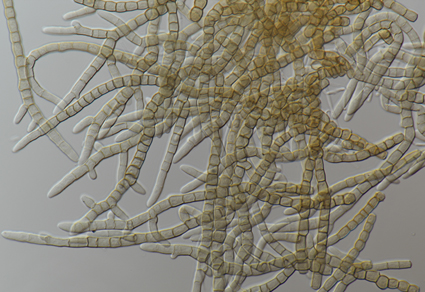

Abstract
Ants are a biologically significant group of insects, classified in the family Formicidae. Typically, ants are found in terrestrial ecosystems, including subterranean habitats and within trunks, branches, or subcortical cavities. Ant-fungus interaction is a complex form of symbiosis, encompassing both parasitic and mutualistic partnerships. In the current study, we isolated a novel microfungal species, Kosmimatomyces formicicola, from an ant-nest during a microfungal survey in Northern Thailand. We confirmed species novelty through a combination of phenotypic characters and multigene phylogeny using LSU, ITS, tef1-α, and rpb2 sequence data. Phylogenetically, K. formicicola was found to be a member of the family Capnodiaceae, forming a sister clade to K. alatophylus. Optimum growth occurred at 25 °C, while retarded growth was observed at 20 °C and 30 °C. A diffusible pigmentation was observed in cultures incubated at 20 °C and 25 °C, but not at 30 °C. This indicates that elevated temperatures may influence secondary metabolite production in K. formicicola.
References
- Abdollahzadeh, J., Groenewald, J.Z., Coetzee, M.P.A., Wingfield, M.J. & Crous, P.W. (2020) Evolution of lifestyles in Capnodiales. Studies in Mycology 95: 381–414. https://doi.org/10.1016/j.simyco.2020.02.004
- Aguilar-Colorado, Á.S. & Rivera-Chavez, J. (2023) Ants/nest-associated fungi and their specialized metabolites: taxonomy, chemistry, and bioactivity. Revista Brasileira de Farmacognosia 33 (5): 901–923. https://doi.org/10.1007/s43450-023-00417-3
- Almiman, B. (2024) Identifying the optimal temperature and water activity conditions of phytopathogenic fungi recovered from Al-Baha province. Journal of Umm Al-Qura University for Applied Sciences 10 (4): 640–651. https://doi.org/10.1007/s43994-024-00131-3
- Ametrano, C.G., Grewe, F., Crous, P.W., Goodwin, S.B., Liang, C., Selbmann, L., Lumbsch, H.T., Leavitt, S.D. & Muggia, L. (2019) Genome-scale data resolve ancestral rock-inhabiting lifestyle in Dothideomycetes (Ascomycota). IMA Fungus 10: 19. https://doi.org/10.1186/s43008-019-0018-2
- Andrews, J.H. (1992) Biological control in the phyllosphere. Annual Review of Phytopathology 30: 603–635. https://doi.org/10.1146/annurev.py.30.090192.003131
- Ariyawansa, H.A., Hyde, K.D., Jayasiri, S.C., Buyck, B., Chethana, K.T., Dai, D.Q., Dai, Y.C., Daranagama, D.A., Jayawardena, R.S., Lücking, R. & Ghobad-Nejhad, M. (2015) Fungal diversity notes 111–252—taxonomic and phylogenetic contributions to fungal taxa. Fungal Diversity 75: 27–274. https://doi.org/10.3897/mycokeys.100.109423
- Bailey, I.W. (1920) Some relations between ants and fungi. Ecology 1: 174–189. https://doi.org/10.2307/1929134
- Baker, C., Martins, D.J., Pelaez, J.N., Billen, J.P., Pringle, A., Frederickson, M.E. & Pierce, N.E. (2017) Distinctive fungal communities in an obligate African ant–plant mutualism. Proceedings of the Royal Society B: Biological Sciences 284: 1850. https://doi.org/10.1098/rspb.2016.2501
- Bhunjun, C.S., Niskanen, T., Suwannarach, N., Wannathes, N., Chen, Y.J., McKenzie, E.H.C., Maharachchikumbura, S.S.N., Buyck, B., Zhao, C.L., Fan, Y.G., Zhang, J.Y., Dissanayake, A.J., Marasinghe, D.S., Jayawardena, R.S., Kumla, J., Padamsee, M., Chen, Y.Y., Liimatainen, K., Ammirati, J.F., Phukhamsakda, C., Liu, J.K., Phonrob, W., Randrianjohany, É., Hongsanan, S., Cheewangkoon, R., Bundhun, D., Khuna, S., Yu, W.J., Deng, L.S., Lu, Y.Z., Hyde, K.D. & Lumyong, S. (2022) The numbers of fungi: are the most speciose genera truly diverse? Fungal Diversity 114 (1): 387–462. https://doi.org/10.1007/s13225-022-00501-4
- Biedermann, P.H.W. & Vega, F.E. (2020) Ecology and evolution of insect–fungus mutualisms. Annual Review of Entomology 65: 431–455. https://doi.org/10.1146/annurev-ento-011019-024910
- Biedermann, P.H.W. (2020) Cooperative breeding in the ambrosia beetle Xyleborus affinis and management of its fungal symbionts. Frontiers in Ecology and Evolution 8: 518954. https://doi.org/10.3389/fevo.2020.518954
- Blakeman, J.P. & Fokkema, N.J. (1982) Potential for biological control of plant diseases on the phylloplane. Annual Review of Phytopathology 20: 167–190. https://doi.org/10.1146/annurev.py.20.090182.001123
- Bose, T., Reynolds, D.R. & Berbee, M.L. (2014) Common, unsightly and until now undescribed: Fumiglobus pieridicola sp. nov., a sooty mold infesting Pieris japonica from western North America. Mycologia 106 (4): 746–756. https://doi.org/10.3852/13-288
- Caro, Y., Venkatachalam, M., Lebeau, J., Fouillaud, M. & Dufossé, L. (2017) Pigments and colorants from filamentous fungi. In: Fungal Metabolites 26: 499–568. https://doi.org/10.1007/978-3-319-19456-1_26-1
- Chaiwan, N., Gomdola, D., Wang, S., Monkai, J., Tibpromma, S., Doilom, M., Wanasinghe, D.N., Mortimer, P.E., Lumyong, S. & Hyde, K.D. (2021) An online database providing updated information of microfungi in the Greater Mekong Subregion. Mycosphere 12 (1): 1513–1526. https://doi.org/10.5943/mycosphere/12/1/19
- Chambergo, F.S. & Valencia, E.Y. (2016) Fungal biodiversity to biotechnology. Applied Microbiology and Biotechnology 100: 2567–2577. https://doi.org/10.1007/s00253-016-7305-2
- Cheewangkoon, R., Groenewald, J.Z., Hyde, K.D., To-anun, C. & Crous, P.W. (2012) Chocolate spot disease of Eucalyptus. Mycological Progress 11: 61–69. https://doi.org/10.1007/s11557-010-0728-8
- Cheewangkoon, R., Groenewald, J.Z., Summerell, B.A., Hyde, K.D., To-Anun, C. & Crous, P.W. (2009) Myrtaceae, a cache of fungal biodiversity. Persoonia – Molecular Phylogeny and Evolution of Fungi 23: 55–85. https://doi.org/10.3767/003158509X474752
- Chethana, K.W.T., Manawasinghe, I.S., Hurdeal, V.G., Bhunjun, C.S., Appadoo, M.A., Gentekaki, E., Raspé, O., Promputtha, I. & Hyde, K.D. (2021) What are fungal species and how to delineate them? Fungal Diversity 109: 1–25. https://doi.org/10.1007/s13225-021-00483-9
- Chhoker, K., Hausner, G. & Harris, S.D. (2025) Regulation of melanin production in fungi. Frontiers in Fungal Biology 6: 1621764. https://doi.org/10.3389/ffunb.2025.1621764
- Chomnunti, P., Schoch, C.L., Aguirre-Hudson, B., Ko-Ko, T.W., Hongsanan, S., Jones, E.B.G., Kodsueb, R., Phookamsak, R., Chukeatirote, E., Bahkali, A.H. & Hyde, K.D. (2011) Capnodiaceae. Fungal Diversity 51: 103–134. https://doi.org/10.1007/s13225-011-0145-6
- Cordero, R.J.B. & Casadevall, A. (2017) Functions of fungal melanin beyond virulence. Fungal Biology Reviews 31: 99–112. https://doi.org/10.1016/j.fbr.2016.12.003
- Crous, P.W., Groenewald, J.Z., Shivas, R.G., Edwards, J., Seifert, K.A., Alfenas, A.C., Alfenas, R.F., Burgess, T.I., Carnegie, A.J., Hardy, G.E.S.T.J., Hiscock, N., Hüberli, D., Jung, T., Louis-Seize, G., Okada, G., Pereira, O.L., Stukely, M.J.C., Wang, W., White, G.P., Young, A.J., McTaggart, A.R., Pascoe, I.G., Porter, I.J. & Quaedvlieg, W. (2011) Fungal Planet description sheets: 69–91. Persoonia 26: 108–156. https://doi.org/10.3767/003158511X581723
- Crous, P.W., Luangsa-ard, J.J., Wingfield, M.J., Carnegie, A.J., Hernández-Restrepo, M., Lombard, L., Roux, J., Barreto, R.W., Baseia, I.G., Cano-Lira, J.F. & Martín, M.P. (2018) Fungal Planet description sheets: 785–867. Persoonia 41: 238–417. https://doi.org/10.3767/persoonia.2018.41.12
- Crous, P.W., Schoch, C.L., Hyde, K.D., Wood, A.R., Gueidan, C., de Hoog, G.S. & Groenewald, J.Z. (2009) Phylogenetic lineages in the Capnodiales. Studies in Mycology 64: 17–47. https://doi.org/10.3114/sim.2009.64.02
- Crous, P.W., Summerell, B.A., Shivas, R.G., Romberg, M., Mel’nik, V.A., Verkley, G.J.M. & Groenewald, J.Z. (2011) Fungal Planet description sheets: 92–106. Persoonia 27: 130–162. https://doi.org/10.3767/003158511X617561
- Crous, P.W., Wingfield, M.J., Chooi, Y.H., Gilchrist, C.L.M., Lacey, E., Pitt, J.I., Roets, F., Swart, W.J., Cano-Lira, J.F., Valenzuela-Lopez, N. & Hubka, V. (2020) Fungal Planet description sheets: 1042–1111. Persoonia 44: 301–459. https://doi.org/10.3767/persoonia.2020.44.11
- Czachura, P., Janik, P. & Piątek, M. (2025) Chaetocapnodium magnum and Chaetocapnodium polonicum from conifer resins disclose an unknown lifestyle in the Capnodiales (Dothideomycetes). MycoKeys 119: 315. https://doi.org/10.3897/mycokeys.119.159094
- Deacon, J.W. (2006) Fungal Biology. 4th ed. Oxford: Blackwell Publishing Ltd.
- De Hoog, G.S., Zalar, P., Urzì, C., de Leo, F., Yurlova, N.A. & Sterflinger, K. (1999) Relationships of dothideaceous black yeasts and meristematic fungi based on 5.8S and ITS2 rDNA sequence comparison. Studies in Mycology: 31–37.
- Defossez, E., Selosse, M.A., Dubois, M.P., Mondolot, L., Faccio, A., Djieto-Lordon, C., McKey, D. & Blatrix, R. (2009) Ant-plants and fungi: a new three-way symbiosis. New Phytologist 182: 942–949. https://doi.org/10.1111/j.1469-8137.2009.02793.x
- Dejean, A., Azémar, F., Naskrecki, P., Tindo, M., Rossi, V., Faucher, C. & Gryta, H. (2023) Mutualistic interactions between ants and fungi: A review. Ecology and Evolution 13: e10386. https://doi.org/10.1002/ece3.10386
- Dufossé, L., Fouillaud, M., Caro, Y., Mapari, S.A.S. & Sutthiwong, N. (2014) Filamentous fungi are large-scale producers of pigments and colorants for the food industry. Current Opinion in Biotechnology 26: 56–61. https://doi.org/10.1016/j.copbio.2013.09.007
- Fresenius, G. (1852) Beiträge zur Mykologie. Heinrich Ludwig Brönner, Frankfurt am Main, pp. 39–80.
- Gegenbauer, C., Bellaire, A., Schintlmeister, A., Schmid, M.C., Kubicek, M., Voglmayr, H., Zotz, G., Richter, A. & Mayer, V.E. (2023) Exo- and endophytic fungi enable rapid transfer of nutrients from ant waste to orchid tissue. New Phytologist 238: 2210–2223. https://doi.org/10.1111/nph.18761
- Gmoser, R., Ferreira, J.A., Lennartsson, P.R. & Taherzadeh, M.J. (2017) Filamentous ascomycetes fungi as a source of natural pigments. Fungal Biology and Biotechnology 4: 4. https://doi.org/10.1186/s40694-017-0033-2
- Gómez, B.L. & Nosanchuk, J.D. (2003) Melanin and fungi. Current Opinion in Infectious Diseases 16: 91–96. https://doi.org/10.1097/00001432-200304000-00005
- Greenfield, M.J., Lach, L., Congdon, B.C., Anslan, S., Tedersoo, L., Field, M. & Abell, S.E. (2021) Consistent patterns of fungal communities within ant-plants across a large geographic range strongly suggest a multipartite mutualism. Mycological Progress 20: 681–699. https://doi.org/10.1007/s11557-021-01690-z
- Hajek, A.E. & St Leger, R.J. (1994) Interactions between fungal pathogens and insect hosts. Annual Review of Entomology 39: 293–322. https://doi.org/10.1146/annurev.en.39.010194.001453
- Hongsanan, S. (2015) Two new species of sooty moulds, Capnodium coffeicola and Conidiocarpus plumeriae in Capnodiaceae. Mycosphere 6: 814–824. https://doi.org/10.5943/mycosphere/6/6/14
- Hongsanan, S., Hyde, K.D., Phookamsak, R., Wanasinghe, D.N., McKenzie, E.H.C., Sarma, V.V., Lücking, R., Boonmee, S., Bhat, J.D., Liu, N.G., Tennakoon, D.S., Pem, D., Karunarathna, A., Jiang, S.H., Jones, G.E.B., Phillips, A.J.L., Manawasinghe, I.S., Tibpromma, S., Jayasiri, S.C., Sandamali, D., Jayawardena, R.S., Wijayawardene, N.N., Ekanayaka, A.H., Jeewon, R., Lu, Y.Z., Phukhamsakda, C., Dissanayake, A.J., Zeng, X.Y., Luo, Z.L., Tian, Q., Thambugala, K.M., Dai, D., Samarakoon, M.C., Chethana, K.W.T., Ertz, D., Doilom, M., Liu, J.K., Pérez-Ortega, S., Suija, A., Senwanna, C., Wijesinghe, S.N., Niranjan, M., Zhang, S.N., Ariyawansa, H.A., Jiang, H.B., Zhang, J.F., Norphanphoun, C., de Silva, N.I., Thiyagaraja, V., Zhang, H., Bezerra, J.D.P., Miranda-González, R., Aptroot, A., Kashiwadani, H., Harishchandra, D., Sérusiaux, E., Abeywickrama, P.D., Bao, D.F., Devadatha, B., Wu, H.X., Moon, K.H., Gueidan, C., Schumm, F., Bundhun, D., Mapook, A., Monkai, J., Bhunjun, C.S., Chomnunti, P., Suetrong, S., Chaiwan, N., Dayarathne, M.C., Yang, J., Rathnayaka, A.R., Xu, J.C., Zheng, J., Liu, G., Feng, Y. & Xie, N. (2020a) Refined families of Dothideomycetes: orders and families incertae sedis in Dothideomycetes. Fungal Diversity 105: 17–318. https://doi.org/10.1007/s13225-020-00462-6
- Hongsanan, S., Hyde, K.D., Phookamsak, R., Wanasinghe, D.N., McKenzie, E.H.C., Sarma, V.V., Boonmee, S., Lücking, R., Bhat, D.J., Liu, N.G., Tennakoon, D.S., Pem, D., Karunarathna, A., Jiang, S.H., Jones, E.B.G., Phillips, A.J.L., Manawasinghe, I.S., Tibpromma, S., Jayasiri, S.C., Sandamali, D.S., Jayawardena, R.S., Wijayawardene, N.N., Ekanayaka, A.H., Jeewon, R., Lu, Y.Z., Dissanayake, A.J., Zeng, X.Y., Luo, Z.L., Tian, Q., Phukhamsakda, C., Thambugala, K.M., Dai, D.Q., Chethana, K.W.T., Samarakoon, M.C., Ertz, D., Bao, D.F., Doilom, M., Liu, J.K., Pérez-Ortega, S., Suija, A., Senwanna, C., Wijesinghe, S.N., Konta, S., Niranjan, M., Zhang, S.N., Ariyawansa, H.A., Jiang, H.B., Zhang, J.F., Norphanphoun, C., de Silva, N.I., Thiyagaraja, V., Zhang, H., Bezerra, J.D.P., Miranda-González, R., Aptroot, A., Kashiwadani, H., Harishchandra, D., Sérusiaux, E., Aluthmuhandiram, J.V.S., Abeywickrama, P.D., Devadatha, B., Wu, H.X., Moon, K.H., Gueidan, C., Schumm, F., Bundhun, D., Mapook, A., Monkai, J., Chomnunti, P., Suetrong, S., Chaiwan, N., Dayarathne, M.C., Yang, J., Rathnayaka, A.R., Bhunjun, C.S., Xu, J.C., Zheng, J.S., Liu, G., Feng, Y. & Xie, N. (2020b) Refined families of Dothideomycetes: Dothideomycetidae and Pleosporomycetidae. Mycosphere 11 (1): 1553–2107. https://doi.org/10.5943/mycosphere/11/1/13
- Hughes, S.J. (1976) Sooty moulds. Mycologia 68: 693–820. https://doi.org/10.1080/00275514.1976.12019958
- Hyde, K.D., Jeewon, R., Chen, Y.J., Bhunjun, C.S., Calabon, M.S., Jiang, H.B., Lin, C.G., Norphanphoun, C., Sysouphanthong, P., Pem, D., Tibpromma, S., Zhang, Q., Doilom, M., Jayawardena, R.S., Liu, J.K., Maharachchikumbura, S.S.N., Phukhamsakda, C., Phookamsak, R., Al-Sadi, A.M., Thongklang, N., Wang, Y., Gafforov, Y., Jones, E.B.G. & Lumyong, S. (2020) The numbers of fungi: is the descriptive curve flattening? Fungal Diversity 103: 219–271. https://doi.org/10.1007/s13225-020-00458-2
- Hyde, K.D., Noorabadi, M.T., Thiyagaraja, V., He, M.Q., Johnston, P.R., Wijesinghe, S.N., Armand, A., Biketova, A.Y., Chethana, K.W.T., Erdoğdu, M., Ge, Z.W., Groenewald, J.Z., Hongsanan, S., Kušan, I., Leontyev, D.V., Li, D.W., Lin, C.G., Liu, N.G., Maharachchikumbura, S.S.N., Matočec, N., May, T.W., McKenzie, E.H.C., Mešić, A., Perera, R.H., Phukhamsakda, C., Piątek, M., Samarakoon, M.C., Selcuk, F., Senanayake, I.C., Tanney, J.B., Tian, Q., Vizzini, A., Wanasinghe, D.N., Wannasawang, N., Wijayawardene, N.N., Zhao, R.L., Abdel-Wahab, M.A., Abdollahzadeh, J., Abeywickrama, P.D., Abhinav, Absalan, S., Acharya, K., Afshari, N., Afshan, N.S., Afzalinia, S., Ahmadpour, S.A., Akulov, O., Alizadeh, A., Alizadeh, M., Al-Sadi, A.M., Alves, A., Alves, V.C.S., Alves-Silva, G., Antonín, V., Aouali, S., Aptroot, A., Apurillo, C.C.S., Arias, R.M., Asgari, B., Asghari, R., Assis, D.M.A., Assyov, B., Atienza, V., Aumentado, H.D.R., Avasthi, S., Azevedo, E., Bakhshi, M., Bao, D.F., Baral, H.O., Barata, M., Barbosa, K.D., Barbosa, R.N., Barbosa, F.R., Baroncelli, R., Barreto, G.G., Baschien, C., Bennett, R.M., Bera, I., Bezerra, J.D.P., Bhunjun, C.S., Bianchinotti, M.V., Błaszkowski, J., Boekhout, T., Bonito, G.M., Boonmee, S., Boonyuen, N., Bortnikov, F.M., Bregant, C., Bundhun, D., Burgaud, G., Buyck, B., Caeiro, M.F., Cabarroi-Hernández, M., Cai, M.F., Cai, L., Calabon, M.S., Calaça, F.J.S., Callalli, M., Câmara, M.P.S., Cano-Lira, J., Cao, B., Carlavilla, J.R., Carvalho, A., Carvalho, T.G., Castañeda-Ruiz, R.F., Catania, M.D.V., Cazabonne, J., Cedeño-Sanchez, M., Chaharmiri-Dokhaharani, S., Chaiwan, N., Chakraborty, N., Cheewankoon, R., Chen, C., Chen, J., Chen, Q., Chen, Y.P., Chinaglia, S., Coelho-Nascimento, C.C., Coleine, C., CostaRezende, D.H., Cortés-Pérez, A., Crouch, J.A., Crous, P.W., Cruz, R.H.S.F., Czachura, P., Damm, U., Darmostuk, V., Daroodi, Z., Das, K., Das, K., Davoodian, N., Davydov, E.A., da Silva, G.A., da Silva, I.R., da Silva, R.M.F., da Silva Santos, A.C., Dai, D.Q., Dai, Y.C., de Groot, D., De Kesel, A., De Lange, R., de Medeiros, E.V., de Souza, C.F.A., de Souza, F.A., dela Cruz, T.E.E., Decock, C., Delgado, G., Denchev, C.M., Denchev, T.T., Deng, Y.L., Dentinger, B.T.M., Devadatha, B., Dianese, J.C., Dima, B., Doilom, M., Dissanayake, A.J., Dissanayake, D.M.L.S., Dissanayake, L.S., Diniz, A.G., Dolatabadi, S., Dong, J.H., Dong, W., Dong, Z.Y., Drechsler-Santos, E.R., Druzhinina, I.S., Du, T.Y., Dubey, M.K., Dutta, A.K., Elliott, T.F., Elshahed, M.S., Egidi, E., Eisvand, P., Fan, L., Fan, X., Fan, X.L., Fedosova, A.G., Ferro, L.O., Fiuza, P.O., Flakus, A., Fonseca, E.O.W., Fryar, S.C., Gabaldón, T., Gajanayake, A.J., Gannibal, P.B., Gao, F., García-Sánchez, D., García-Sandoval, R., Garrido-Benavent, I., Garzoli, L., Gasca-Pineda, J., Gautam, A.K., Gené, J., Ghobad‑Nejhad, M., Ghosh, A., Giachini, A.J., Gibertoni, T.B., Gentekaki, E., Gmoshinskiy, V.I., Goes‑Neto, A., Gomdola, D., Gorjón, S.P., Goto, B.T., Granados‑Montero, M.M., Griffith, G.W., Groenewald, M., Grossart, H.P., Gu, Z.R., Gueidan, C., Gunarathne, A., Gunaseelan, S., Guo, S.L., Gusmão, L.F.P., Gutierrez, A.C., Guzman‑Davalos, L., Haelewaters, D., Haituk, H., Halling, R.E., He, S.C., Heredia, G., Hernandez‑Restrepo, M., Hosoya, T., Hoog, S.D., Horak, E., Hou, C.L., Houbraken, J., Htet, Z.H., Huang, S.K., Huang, W.J., Hurdeal, V.G., Hustad, V.P., Inácio, C.A., Janik, P., Jayalal, R.G.U., Jayasiri, S.C., Jayawardena, R.S., Jeewon, R., Jerónimo, G.H., Jin, J., Jones, E.B.G., Joshi, Y., Jurjević, Ž., Justo, A., Kakishima, M., Kaliyaperumal, M., Kang, G.P., Kang, J.C., Karimi, O., Karunarathna, S.C., Karpov, S.A., Kezo, K., Khalid, A.N., Khan, M.K., Khuna, S., Khyaju, S., Kirchmair, M., Klawonn, I., Kraisitudomsook, N., Kukwa, M., Kularathnage, N.D., Kumar, S., Lachance, M.A., Lado, C., Latha, K.P.D., Lee, H.B., Leonardi, M., Lestari, A.S., Li, C., Li, H., Li, J., Li, Q., Li, Y., Li, Y.C., Li, Y.X., Liao, C.F., Lima, J.L.R., Lima, J.M.S., Lima, N.B., Lin, L., Linaldeddu, B.T., Linn, M.M., Liu, F., Liu, J.K., Liu, J.W., Liu, S., Liu, S.L., Liu, X.F., Liu, X.Y., Longcore, J.E., Luangharn, T., Luangsa‑ard, J.J., Lu, L., Lu, Y.Z., Lumbsch, H.T., Luo, L., Luo, M., Luo, Z.L., Ma, J., Madagammana, A.D., Madhushan, A., Madrid, H., Magurno, F., Magyar, D., Mahadevakumar, S., Malosso, E., Malysh, J.M., Mamarabadi, M., Manawasinghe, I.S., Manfrino, R.G., Manimohan, P., Mao, N., Mapook, A., Marchese, P., Marasinghe, D.S., Mardones, M., Marin‑Felix, Y., Masigol, H., Mehrabi, M., Mehrabi‑Koushki, M., Meiras‑Ottoni, A., Melo, R.F.R., Mendes‑Alvarenga, R.L., Mendieta, S., Meng, Q.F., Menkis, A., Menolli Jr, N., Mikšík, M., Miller, S.L., Moncada, B., Moncalvo, J.M., Monteiro, J.S., Monteiro, M., Mora‑Montes, H.M., Moroz, E.L., Moura, J.C., Muhammad, U., Mukhopadhyay, S., Nagy, G.L., Najam ul Sehar, A., Najafiniya, M., Nanayakkara, C.M., Naseer, A., Nascimento, E.C.R., Nascimento, S.S., Neuhauser, S., Neves, M.A., Niazi, A.R., Yong, N., Nilsson, R.H., Nogueira, P.T.S., Novozhilov, Y.K., Noordeloos, M., Norphanphoun, C., Nunez‑Otano, N., O’Donnell, R.P., Oehl, F., Oliveira, J.A., Oliveira Junior, I., Oliveira, N.V.L., Oliveira, P.H.F., Orihara, T., Oset, M., Pang, K.L., Papp, V., Pathirana, L.S., Peintner, U., Pem, D., Pereira, O.L., Pérez‑Moreno, J., Pérez‑Ortega, S., Péter, G., Pires‑Zottarelli, C.L.A., Phonemany, M., Phongeun, S., Pošta, A., Prazeres, J.F.S.A., Quan, Y., Quandt, C.A., Queiroz, M.B., Radek, R., Rahnama, K., Raj, K.N.A., Rajeshkumar, K.C., Soumyadeep, R., Ralaiveloarisoa, A.B., Rämä, T., Ramirez‑Cruz, V., Rambold, G., Rathnayaka, A.R., Raza, M., Ren, G.C., Rinaldi, A.C., Rivas‑Ferreiro, M., Robledo, G.L., Ronikier, A., Rossi, W., Rusevska, K., Ryberg, M., Safi, A., Salimi, F., Salvador‑Montoya, C.A., Samant, B., Samaradiwakara, N.P., Sanchez‑Castro, I., Sandoval‑Denis, M., Santiago, A.L.C.M.A., Santos, A.C.D.S., Santos, L.A. dos, Sarma, V.V., Sarwar, S., Savchenko, A., Savchenko, K., Saxena, R.K., Schoutteten, N., Selbmann, L., Ševčíková, H., Sharma, A., Shen, H.W., Shen, Y.M., Shu, Y.X., Silva, H.F., Silva‑Filho, A.G.S., Silva, V.S.H., Simmons, D.R., Singh, R., Sir, E.B., Sohrabi, M., Souza, F.A., Souza‑Motta, C.M., Sriindrasutdhi, V., Sruthi, O.P., Stadler, M., Stemler, J., Stephenson, S.L., Stoyneva‑Gaertner, M.P., Strassert, J.F.H., Stryjak‑Bogacka, M., Su, H., Sun, Y.R., Svantesson, S., Sysouphanthong, P., Takamatsu, S., Tan, T.H., Tanaka, K., Tang, C., Tang, X., Taylor, J.E., Taylor, P.W.J., Tennakoon, D.S., Thakshila, S.A.D., Thambugala, K.M., Thamodini, G.K., Thilanga, Thines, M., Tiago, P.V., Tian, X.G., Tian, W.H., Tibpromma, S., Tkalčec, Z., Tokarev, Y.S., Tomšovský, M., Torruella, G., Tsurykau, A., Udayanga, D., Ulukapı, M., Untereiner, W.A., Usman, M., Uzunov, B.A., Vadthanarat, S., Valenzuela, R., Van den Wyngaert, S., Van Vooren, N., Velez, P., Verma, R.K., Vieira, L.C., Vieira, W.A.S., Vinzelj, J.M., Tang, A.M.C., Walker, A., Walker, A.K., Wang, Q.M., Wang, Y., Wang, X.Y., Wang, Z.Y., Wannathes, N., Wartchow, F., Weerakoon, G., Wei, D.P., Wei, X., White, J.F. & Wijesundara, D.S.A. (2024a) The 2024 outline of fungi and fungus‑like taxa. Mycosphere 15 (1): 5146–6239. https://doi.org/10.5943/mycosphere/15/1/25
- Hyde, K.D., Saleh, A., Aumentado, H.D.R., Boekhout, T., Bera, I., Khyaju, S., Bhunjun, C.S., Chethana, K.W.T., Phukhamsakda, C., Doilom, M., Thiyagaraja, V., Mortimer, P.E., Maharachchikumbura, S.S.N., Hongsanan, S., Jayawardena, R.S., Dong, W., Jeewon, R., Al-Otibi, F., Wijesinghe, S.N. & Wanasinghe, D.N. (2024b) Fungal numbers: global needs for a realistic assessment. Fungal Diversity 128: 191–225. https://doi.org/10.1007/s13225-024-00545-8
- Katoh, K., Rozewicki, J. & Yamada, K.D. (2019) MAFFT online service: multiple sequence alignment, interactive sequence choice and visualization. Briefings in Bioinformatics 20: 1160–1166. https://doi.org/10.1093/bib/bbx108
- Khodaparast, S.A., Pourmoghaddam, M.J., Amirmijani, A. & Byrami, F. (2020) Phylogenetic structure of the Iranian capnodiaceous sooty mould fungi inferred from sequences of rDNA regions and TEF1-α. Mycological Progress 19: 155–169. https://doi.org/10.1007/s11557-019-01551-w
- Kirti, K., Amita, S., Priti, S., Mukesh Kumar, A. & Jyoti, S. (2014) Colorful world of microbes: carotenoids and their applications. Advances in Biology 2014: 837891. https://doi.org/10.1155/2014/837891
- Kokolo, B., Atteke, C., Ibrahim, B. & Blatrix, R. (2016) Pattern of specificity in the tripartite symbiosis between Barteria plants, ants and Chaetothyriales fungi. Symbiosis 69: 169–174. https://doi.org/10.1007/s13199-016-0402-2
- Kularathnage, N.D., Senanayake, I.C., de Hoog, G.S., Quan, Y., Jayawardena, R.S., Hyde, K.D. & Qi, Z. (2025) Systematics and physiology of Cladophialophora matsushimae (Chaetothyriales) associated with ant carton and five new combinations in Cladophialophora and Epibryon. New Zealand Journal of Botany 63: 2138–2159. https://doi.org/10.1080/0028825X.2025.2479092
- Kumari, D., Sachivkina, N. & Pasrija, R. (2024) Investigation of the influence of pH and temperature on melanization and survival under oxidative stress in Cryptococcus neoformans. Archives of Microbiology 206: 355. https://doi.org/10.1007/s00203-024-04080-7
- Lagerheim, G. (1900) Über Lasius fuliginosus (Latr.) und seine Pilzzucht. Iduns Kungl. Hofboktryckeri.
- Li, W.J., McKenzie, E.H.C., Liu, J.K., Bhat, D.J., Dai, D.Q., Camporesi, E., Tian, Q., Maharachchikumbura, S.S.N., Luo, Z.L., Shang, Q.J. & Zhang, J.F. (2020) Taxonomy and phylogeny of hyaline-spored coelomycetes. Fungal Diversity 100: 279–801. https://doi.org/10.1007/s13225-020-00440-y
- Lindström, S., Rowe, O., Timonen, S., Sundström, L. & Johansson, H. (2018) Trends in bacterial and fungal communities in ant nests observed with terminal-restriction fragment length polymorphism (T-RFLP) and next generation sequencing (NGS) techniques—validity and compatibility in ecological studies. PeerJ 6: e5289. https://doi.org/10.7717/peerj.5289
- Lindström, S., Timonen, S. & Sundström, L. (2021) The bacterial and fungal community composition in time and space in the nest mounds of the ant Formica exsecta (Hymenoptera: Formicidae). MicrobiologyOpen 10: e1201. https://doi.org/10.1002/mbo3.1201
- Lin, L. & Xu, J. (2022) Production of fungal pigments: molecular processes and their applications. Journal of Fungi 9: 44. https://doi.org/10.3390/jof9010044
- Liu, Y.J., Whelen, S. & Hall, B.D. (1999) Phylogenetic relationships among ascomycetes: evidence from an RNA polymerase II subunit. Molecular Biology and Evolution 16: 1799–1808. https://doi.org/10.1093/oxfordjournals.molbev.a026092
- Lu, Z.H., Wanasinghe, D.N., Madrid, H. & Maharachchikumbura, S.S.N. (2022) Hyphocapnodia sichuanensis gen. et sp. nov. (Capnodiaceae), a novel hyphomycete from Sichuan Province, China. Phytotaxa 564: 84–94. https://doi.org/10.11646/phytotaxa.564.1.6
- Mapari, S.A.S., Thrane, U. & Meyer, A.S. (2010) Fungal polyketide azaphilone pigments as future natural food colorants? Trends in Biotechnology 28: 300–307. https://doi.org/10.1016/j.tibtech.2010.03.004
- Maschwitz, U. & Hölldobler, B. (1970) Carton nest building in Lasius fuliginosus Latr. (Hymenoptera: Formicidae). Zeitschrift für vergleichende Physiologie 66: 176–189. https://doi.org/10.1007/BF00297777
- Mayer, V.E., Voglmayr, H., Blatrix, R., Orivel, J. & Leroy, C. (2023) Fungi as mutualistic partners in ant–plant interactions. Frontiers in Fungal Biology 4: 1213997. https://doi.org/10.3389/ffunb.2023.1213997
- Mesquita, N.L.S., Santos, A., de Oliveira, R.J.V., Soares, P.P.D.S., de Novaes, Q.S. & Bezerra, J.L. (2022) Sooty mould caused by Capnodium alfenasii on Azadirachta indica. Journal of Phytopathology 170: 574–578. https://doi.org/10.1111/jph.13120
- Miller, M.A., Pfeiffer, W. & Schwartz, T. (2010) Creating the CIPRES Science Gateway for inference of large phylogenetic trees. In: Proceedings of the 2010 Gateway Computing Environments Workshop (GCE). pp. 1–8. https://doi.org/10.1109/GCE.2010.5676129
- Moreno, L.F., Mayer, V., Voglmayr, H., Blatrix, R., Stielow, J.B., Teixeira, M.M., Vicente, V.A. & de Hoog, G.S. (2019) Genomic analysis of ant domatia-associated melanized fungi (Chaetothyriales, Ascomycota). Mycological Progress 18: 541–552. https://doi.org/10.1007/s11557-018-01467-x
- Mortensen, A. (2006) Carotenoids and other pigments as natural colorants. Pure and Applied Chemistry 78: 1477–1491. https://doi.org/10.1351/pac200678081477
- Nagia, F.A. & El-Mohamedy, R.S.R. (2007) Dyeing of wool with natural anthraquinone dyes from Fusarium oxysporum. Dyes and Pigments 75: 550–555. https://doi.org/10.1016/j.dyepig.2006.07.002
- Nepel, M., Voglmayr, H., Schönenberger, J. & Mayer, V.E. (2014) High diversity and low specificity of chaetothyrialean fungi in carton galleries in a Neotropical ant–plant association. PLoS ONE 9: e112756. https://doi.org/10.1371/journal.pone.0112756
- Pandey, N., Jain, R., Dhakar, K., Sharma, A. & Pandey, A. (2023) A reduction in temperature induces bioactive red pigment production in a psychrotolerant Penicillium sp. GEU_37 isolated from Himalayan soil. Fungal Biology 127: 927–937. https://doi.org/10.1016/j.funbio.2023.01.008
- Phukhamsakda, C., McKenzie, E.H.C., Phillips, A.J.L., Jones, E.B.G., Bhat, D.J., Stadler, M., Bhunjun, C.S., Wanasinghe, D.N., Thongbai, B., Camporesi, E., Ertz, D., Jayawardena, R.S., Perera, R.H., Ekanayake, A.H., Tibpromma, S., Doilom, M., Xu, J. & Hyde, K.D. (2020) Microfungi associated with Clematis (Ranunculaceae) with an integrated approach to delimiting species boundaries. Fungal Diversity 102: 1–203. https://doi.org/10.1007/s13225-020-00448-4
- Phukhamsakda, C., Nilsson, R.H., Bhunjun, C.S., Farias, A.R.G. de, Sun, Y.R., Wijesinghe, S.N., Raza, M., Bao, D.F., Lu, L., Tibpromma, S., Dong, W., Tennakoon, D.S., Tian, X.G., Xiong, Y.-R., Karunarathna, S.C., Cai, L., Luo, Z.-L., Wang, Y., Manawasinghe, I.S., Camporesi, E., Kirk, P.M., Promputtha, I., Kuo, C.H., Su, H.Y., Doilom, M., Li, Y., Fu, Y.P. & Hyde, K.D. (2022) The numbers of fungi: contributions from traditional taxonomic studies and challenges of metabarcoding. Fungal Diversity 114: 327–386. https://doi.org/10.1007/s13225-022-00502-3
- Quaedvlieg, W.G.J.M., Binder, M., Groenewald, J.Z., Summerell, B.A., Carnegie, A.J., Burgess, T.I. & Crous, P.W. (2014) Introducing the consolidated species concept to resolve species in the Teratosphaeriaceae. Persoonia – Molecular Phylogeny and Evolution of Fungi 33: 1–40. https://doi.org/10.3767/003158514X681981
- Rambaut, A. (2012) FigTree v1.4.0. University of Oxford. Available from: http://tree.bio.ed.ac.uk/software/figtree (accessed 8 October 2026)
- Rehner, S.A. & Buckley, E. (2005) A Beauveria phylogeny inferred from nuclear ITS and EF1-α sequences: evidence for cryptic diversification and links to Cordyceps teleomorphs. Mycologia 97: 84–98. https://doi.org/10.3852/mycologia.97.1.84
- Ronquist, F., Teslenko, M., van der Mark, P., Ayres, D.L., Darling, A., Höhna, S., Larget, B., Liu, L., Suchard, M.A. & Huelsenbeck, J.P. (2012) MrBayes 3.2: efficient Bayesian phylogenetic inference and model choice across a large model space. Systematic Biology 61: 539–542. https://doi.org/10.1093/sysbio/sys029
- Ruiz-González, M.X., Malé, P.-J.G., Leroy, C., Dejean, A., Gryta, H., Jargeat, P., Quilichini, A. & Orivel, J. (2010) Specific, non-nutritional association between an ascomycete fungus and Allomerus plant-ants. Biology Letters 7: 475–479. https://doi.org/10.1098/rsbl.2010.0920
- Sayers, E.W., Cavanaugh, M., Clark, K., Ostell, J., Pruitt, K.D. & Karsch-Mizrachi, I. (2019) GenBank. Nucleic Acids Research 47 (D1): D94–D99. https://doi.org/10.1093/nar/gky989
- Schlick-Steiner, B.C., Steiner, F.M., Konrad, H., Seifert, B., Christian, E., Moder, K., Stauffer, C. & Crozier, R.H. (2008) Specificity and transmission mosaic of ant nest-wall fungi. Proceedings of the National Academy of Sciences of the United States of America 105: 940–943. https://doi.org/10.1073/pnas.0708320105
- Schoch, C.L. & Grube, M. (2015) Pezizomycotina: Dothideomycetes and Arthoniomycetes. In: Systematics and Evolution, Part B. pp. 143–176. https://doi.org/10.1007/978-3-662-46011-5_6
- Schoch, C.L., Crous, P.W., Groenewald, J.Z., Boehm, E.W.A., Burgess, T.I., de Gruyter, J., de Hoog, G.S., Dixon, L.J., Grube, M., Gueidan, C., Harada, Y., Hatakeyama, S., Hirayama, K., Hosoya, T., Huhndorf, S.M., Hyde, K.D., Jones, E.B.G., Kohlmeyer, J., Kruys, A., Li, Y.M., Lücking, R., Lumbsch, H.T., Marvanová, L., Mbatchou, A.S., McVay, A.H., Miller, A.N., Mugambi, G.K., Muggia, L., Nelsen, M.P., Nelson, P., Owensby, C.A., Phillips, A.J.L., Phongpaichit, S., Pointing, S.B., Pujade-Renaud, V., Raja, H.A., Rivas Plata, E., Robbertse, B., Ruibal, C., Sakayaroj, J., Sano, T., Selbmann, L., Shearer, C.A., Shirouzu, T., Slippers, B., Suetrong, S., Tanaka, K., Volkmann-Kohlmeyer, B., Wingfield, M.J., Wood, A.R., Woudenberg, J.H.C., Yonezawa, H., Zhang, Y. & Spatafora, J.W. (2009) A class-wide phylogenetic assessment of Dothideomycetes. Studies in Mycology 64: 1–15. https://doi.org/10.3114/sim.2009.64.01
- Senanayake, I.C., Rathnayaka, A.R., Marasinghe, D.S., Calabon, M.S., Gentekaki, E., Lee, H.B., Hurdeal, V.G., Pem, D., Dissanayake, L.S., Wijesinghe, S.N., Bundhun, D., Nguyen, T.T., Goonasekara, I.D., Abeywickrama, P.D., Bhunjun, C.S., Jayawardena, R.S., Wanasinghe, D.N., Jeewon, R., Bhat, D.J. & Xiang, M.M. (2020) Morphological approaches in studying fungi: collection, examination, isolation, sporulation and preservation. Mycosphere 11 (1): 2678–2754. https://doi.org/10.5943/mycosphere/11/1/20
- Siedlecki, I., Kochanowski, M., Pawłowska, J., Reszotnik, G., Okrasińska, A. & Wrzosek, M. (2024) Ant’s nest as a microenvironment: distinct Mucoromycota (Fungi) community of the red wood ant (Formica polyctena) mounds. Ecology and Evolution 14: e70333. https://doi.org/10.1002/ece3.70333
- Spatafora, J.W., Sung, G.-H., Johnson, D., Hesse, C., O’Rourke, B., Serdani, M., Spotts, R., Lutzoni, F., Hofstetter, V., Miadlikowska, J., Reeb, V., Gueidan, C., Fraker, E., Lumbsch, H.T., Lücking, R., Schmitt, I., Hosaka, K., Aptroot, A., Roux, C., Miller, A.N., Geiser, D.M., Hafellner, J., Hestmark, G., Arnold, A.E., Büdel, B., Rauhut, A., Hewitt, D., Untereiner, W.A., Cole, M.S., Scheidegger, C., Schultz, M., Sipman, H. & Schoch, C.L. (2006) A five-gene phylogeny of Pezizomycotina. Mycologia 98 (6): 1018–1028. https://doi.org/10.3852/mycologia.98.6.1018
- Su, W., Xu, R., Bhunjun, C.S., Tian, S., Dai, Y., Li, Y. & Phukhamsakda, C. (2022) Diversity of Ascomycota in Jilin: introducing novel woody litter taxa in Cucurbitariaceae. Journal of Fungi 8 (9): 905. https://doi.org/10.3390/jof8090905
- Sun, J., Tarafder, E., Chen, T., Hongsanan, S., Chen, S., Norphanphoun, C., Karunarathna, S.C. & Zeng, X. (2026) Two novel species of sooty mould fungi (Capnodiales, Dothideomycetes) from China. MycoKeys 129: 23–41. https://doi.org/10.3897/mycokeys.129.182290
- Tennakoon, D.S., Kuo, C.H., Maharachchikumbura, S.S.N., Thambugala, K.M., Gentekaki, E., Phillips, A.J.L., Bhat, D.J., Wanasinghe, D.N., de Silva, N.I., Promputtha, I. & Hyde, K.D. (2021) Taxonomic and phylogenetic contributions to Celtis formosana, Ficus ampelas, F. septica, Macaranga tanarius and Morus australis leaf litter inhabiting microfungi. Fungal Diversity 108: 1–215. https://doi.org/10.1007/s13225-021-00474-w
- Thungdee, S., Haituk, S., Withee, P., Cheewangkoon, R., Suwannarach, N., Marasinghe, D.S. & Hongsanan, S. (2023) Unraveling Capnodiaceae species in northern Thailand. Phytotaxa 620: 143–156. https://doi.org/10.11646/phytotaxa.620.2.2
- White, T.J. (1990) Amplification and direct sequencing of fungal ribosomal RNA genes for phylogenetics. In: PCR Protocols: A guide to methods and applications/Academic Press. https://doi.org/10.1016/B978-0-12-372180-8.50042-11
- Vasse, M., Voglmayr, H., Mayer, V., Gueidan, C., Nepel, M., Moreno, L., de Hoog, G.S., Selosse, M.A., McKey, D. & Blatrix, R. (2017) A phylogenetic perspective on the association between ants (Hymenoptera: Formicidae) and black yeasts (Ascomycota: Chaetothyriales). Proceedings of the Royal Society B: Biological Sciences 284: 1850. https://doi.org/10.1098/rspb.2016.2519
- Vilgalys, R. & Hester, M. (1990) Rapid genetic identification and mapping of enzymatically amplified ribosomal DNA from several Cryptococcus species. Journal of Bacteriology 172: 4238–4246. https://doi.org/10.1128/jb.172.8.4238-4246.1990
- Voglmayr, H., Mayer, V., Maschwitz, U., Moog, J., Djieto-Lordon, C. & Blatrix, R. (2011) The diversity of ant-associated black yeasts: insights into a newly discovered world of symbiotic interactions. Fungal Biology 115: 1077–1091. https://doi.org/10.1016/j.funbio.2010.11.006
- Vu, D., Groenewald, M., de Vries, M., Gehrmann, T., Stielow, B., Eberhardt, U., Al-Hatmi, A., Groenewald, J.Z., Cardinali, G., Houbraken, J., Boekhout, T., Crous, P.W., Robert, V. & Verkley, G.J.M. (2019) Large-scale generation and analysis of filamentous fungal DNA barcodes boosts coverage for kingdom fungi and reveals thresholds for fungal species and higher taxon delimitation. Studies in Mycology 92 (1): 135–154. https://doi.org/10.1016/j.simyco.2018.05.001
- Wang, M.Z., Belmonte-Lopes, R., Pan, T., Ahmed, S.A., Rodrigues Lustosa, B.P., Quan, Y., Al-Hatmi, A.M.S., Mayer, V.E., Voglmayr, H., Grisolia, M.E., de Souza Lima, B.B.J.F., Vicente, V.A., Zhou, S.Q., Cao, Y., Kang, Y.Q. & de Hoog, G.S. (2025) A new family of ant-associated fungi in Chaetothyriales. Studies in Mycology 110: 111–143. https://doi.org/10.3114/sim.2025.110.02
- Woronichin, N.N. (1925) Über die Capnodiales. Annales Mycologici 23: 174–178.
- Yang, C.L., Li, X.Y., Xiang, S.S., Xu, X.L., Zeng, Q., Sun, Q.R., Liu, J.K., Maharachchikumbura, S.S.N., Lv, Y.C., Wang, F.H., Ji-Zuo, J.L., A-Niu, X.Y. & Liu, Y.G. (2025) Microfungi associated with plant diseases on horticultural vegetation in southwestern China. Mycosphere 16 (1): 1861–2001. https://doi.org/10.5943/mycosphere/16/1/11
- Yang, H., Ariyawansa, H.A., Wu, H.X. & Hyde, K.D. (2014) The genus Leptoxyphium (Capnodiaceae) from China. Phytotaxa 176: 174–183. https://doi.org/10.11646/phytotaxa.176.1.17
- Yang, H.L., Sun, G.Y., Batzer, J.C., Crous, P.W., Groenewald, J.Z. & Gleason, M.L. (2010) Novel fungal genera and species associated with the sooty blotch and flyspeck complex on apple in China and the USA. Persoonia – Molecular Phylogeny and Evolution of Fungi 24: 29–37. https://doi.org/10.3767/003158510X492101