

Abstract
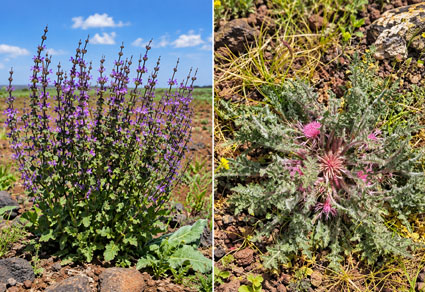
Field surveys in Jabal al Druze, southern Syria, rediscovered Salvia drusica and Centaurea trachonitica and provided the first modern population-level documentation of both species. We provide updated information on distribution, population size, morphology, habitat, associated flora and threats, together with preliminary assessments under the IUCN Red List Categories and Criteria. Salvia drusica was rediscovered at its historical locality at Sale on 1 May 2026, nearly 84 years after Mouterde’s collection, and was recorded at 15 georeferenced occurrence points around Sale, Tlaleen and Abu Zuraik. Approximately 500 flowering mature individuals and 150 non-flowering immature plants were observed. Its minimum convex polygon EOO was approximately 14.7 km²; for assessment purposes, this was adjusted to 20 km² to equal the AOO calculated with a 2 × 2 km grid. The species occurs predominantly in cultivated land, field margins and roadsides and is exposed to ploughing, livestock grazing and potential road widening. Mature nutlets, which were unknown in the original description, were collected on 30 May 2026 and are illustrated and described here for the first time. Centaurea trachonitica was rediscovered on the western slope of Tell Shihan, north of Shahba, on 11 May 2024, nearly 82 years after Mouterde’s collection. Eight separately rooted plants, comprising two mature and six immature individuals, were documented at two occurrence points approximately 150 m apart. The known plants of each species are provisionally treated as a single subpopulation. On present evidence, S. drusica is provisionally assessed as Vulnerable under criterion D1 (VU D1), and C. trachonitica as Critically Endangered under criterion D (CR D). Lectotypes are designated for both species names. These rediscoveries highlight the conservation importance of Jabal al Druze and the need for targeted surveys, population monitoring and habitat protection.
References
- Bentham, G. (1833) Labiatarum genera et species. Fascicle 3. James Ridgway and Sons, London.
- Berger, A. (1930) Crassulaceae. In: Engler, A. & Prantl, K. (Eds.) Die natürlichen Pflanzenfamilien. Edition 2, vol. 18a. Wilhelm Engelmann, Leipzig, pp. 352–483.
- Boissier, E. (1843) Diagnoses plantarum orientalium novarum. Series 1, fascicle 2. Ferdinand Ramboz, Geneva, 115 pp.
- Boissier, E. (1849a) Diagnoses plantarum orientalium novarum. Series 1, fascicle 8. Marc Ducloux et Cie, Paris, 128 pp.
- Boissier, E. (1849b) Diagnoses plantarum orientalium novarum. Series 1, fascicle 10. Marc Ducloux et Cie, Paris, 122 pp.
- Boissier, E. (1853) Diagnoses plantarum orientalium novarum. Series 1, fascicle 12. Henri Wolfrath, Neuchâtel, 120 pp.
- Boissier, E. (1872) Flora orientalis. Vol. 2. H. Georg, Geneva and Basel, 1159 pp.
- Chikhali, M. (2000) Ecology and vegetation of South-East Syria (Jabal El-Arab). Berichte des Institutes für Landschafts- und Pflanzenökologie der Universität Hohenheim, Beiheft 11. Verlag Günter Heimbach, Ostfildern, v + 153 pp.
- Chikhali, M., Shehadeh, A., Almasri, A. & Al-Zein, M.S. (2018) Syria. In: Valderrábano, M., Gil, T., Heywood, V. & de Montmollin, B. (Eds.) Conserving wild plants in the south and east Mediterranean region. IUCN, Gland, pp. 85–90. https://doi.org/10.2305/IUCN.CH.2018.21.en
- Conservatoire et Jardin botaniques de Genève (2026) Centaurea trachonitica Post, type material G00223067. Catalogue des herbiers de Genève (CHG). Available from: https://collections.geneve.ch/cjbg/chg/adetail.php?id=215950 (accessed 1 September 2026)
- de Candolle, A.P. (1829) Mémoire sur la famille des Ombellifères. Collection de mémoires pour servir à l’histoire du règne végétal 5: 1–84.
- de Candolle, A.P. (1838) Prodromus systematis naturalis regni vegetabilis. Vol. 6. Treuttel et Würtz, Paris, 687 pp.
- European Space Agency (2021) Copernicus DEM: Global and European Digital Elevation Model, GLO-90. https://doi.org/10.5270/ESA-c5d3d65
- GBIF.org (2026) Occurrence records 2618377374, 4906846749 and 437892665 for Centaurea trachonitica Post. Global Biodiversity Information Facility. Available from: https://www.gbif.org/occurrence/2618377374; https://www.gbif.org/occurrence/4906846749; https://www.gbif.org/occurrence/437892665 (accessed 31 July 2026)
- Herbette, F. (1926a) Observations sur le Djebel Druse. Résultats d’une mission scientifique en 1914. Bulletin de l’Association de Géographes Français 3 (7): 1–4. https://doi.org/10.3406/bagf.1926.6310
- Herbette, F. (1926b) Le Djebel Druse. Annales de géographie 35 (193): 51–57. https://doi.org/10.3406/geo.1926.8402
- Holmboe, J. (1907) Note sur une espèce nouvelle d’Onopordon de la flore syrienne. Bulletin de l’Herbier Boissier série 2 7: 827–829.
- IUCN (2012) IUCN Red List Categories and Criteria: Version 3.1. Second edition. IUCN, Gland and Cambridge.
- IUCN Standards and Petitions Committee (2024) Guidelines for Using the IUCN Red List Categories and Criteria. Version 16. Prepared by the Standards and Petitions Committee. Available from: https://www.iucnredlist.org/documents/RedListGuidelines.pdf (accessed 9 September 2026)
- Linnaeus, C. (1753a) Demonstrationes plantarum in horto Upsaliensi. Laurentius Magnus Höjer, Uppsala, 27 pp.
- Linnaeus, C. (1753b) Species plantarum. Vols. 1–2. Laurentius Salvius, Stockholm, 1200 pp.
- Linnaeus, C. (1759) Systema naturae. Edition 10, vol. 2. Laurentius Salvius, Stockholm, pp. 825–1384.
- Melderis, A., Bor, N.L. & Townsend, C.C. (1967) New names and combinations in the Iraqi flora. Taxon 16: 467. https://doi.org/10.2307/1216430
- Miller, P. (1768) The gardeners dictionary. Edition 8. Published by the author, London, unpaginated.
- Mouterde, P. (1953) La Flore du Djebel Druze. Université Saint-Joseph de Beyrouth, Beirut; P. Lechevalier, Paris, 224 pp.
- Mouterde, P. (1983) Nouvelle flore du Liban et de la Syrie. Tome troisième. Dar El-Machreq, Beirut.
- Natural Earth (2026) Admin 0 countries, 1:110m cultural vectors. Available from: https://www.naturalearthdata.com (accessed 5 September 2026)
- Pimenov, M.G. & Tikhomirov, V.N. (1983) The taxonomic problems in the genera Prangos Lindl., Cachrys L., Cryptodiscus Schrenk and Hippomarathrum Hoffmgg. et Link (Umbelliferae–Apioideae). Feddes Repertorium 94: 145–164. https://doi.org/10.1002/fedr.4910940302
- Plants of the World Online (2026) Salvia drusica Mouterde and Centaurea trachonitica Post. Royal Botanic Gardens, Kew. Available from: https://powo.science.kew.org (accessed 22 July 2026)
- Poiret, J.L.M. (1812) Encyclopédie méthodique. Botanique. Supplément 2 (2). H. Agasse, Paris, pp. 385–876.
- Post, G.E. (1888) Diagnoses Plantarum Novarum Orientalium. Journal of the Linnean Society, Botany 24: 419–441. https://doi.org/10.1111/j.1095-8339.1888.tb01335.x
- Radford, E.A., Catullo, G. & de Montmollin, B. (Eds.) (2011) Important Plant Areas of the South and East Mediterranean Region: Priority Sites for Conservation. IUCN, Gland and Malaga.
- Rafinesque, C.S. (1840) Autikon botanikon. Published by the author, Philadelphia, 200 pp. https://doi.org/10.5962/bhl.title.8121
- Rauschert, S. (1982) Nomina nova generica et combinationes novae Spermatophytorum et Pteridophytorum. Taxon 31: 554–563. https://doi.org/10.2307/1220694
- Recolnat (2026) Recolnat natural history collections portal. Available from: https://www.recolnat.org (accessed 7 September 2026)
- Royal Botanic Garden Edinburgh (2026) Salvia drusica Mouterde, specimen E01193879. Edinburgh (E) Herbarium Specimens, accessed through GBIF.org, occurrence 4420618655. Available from: https://www.gbif.org/occurrence/4420618655 (accessed 1 September 2026)
- Syrian Society for Conservation of Wildlife (2010) Syria Country Report on the Identification of Important Plant Areas (IPAs) in Syria: Rapid Assessment.
- Turland, N.J., Wiersema, J.H., Barrie, F.R., Gandhi, K.N., Gravendyck, J., Greuter, W., Hawksworth, D.L., Herendeen, P.S., Klopper, R.R., Knapp, S., Kusber, W.-H., Li, D.-Z., May, T.W., Monro, A.M., Prado, J., Price, M.J., Smith, G.F. & Zamora Señoret, J.C. (2025) International Code of Nomenclature for algae, fungi, and plants (Madrid Code). Regnum Vegetabile 162. University of Chicago Press, Chicago. https://doi.org/10.7208/chicago/9780226839479.001.0001