

Abstract
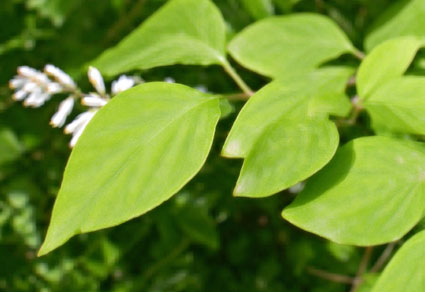
There are over 150 plant species in the genus Syringa L., which are known to have high practical values. In the DPR Korea grow 13 Syringa species, some of them are endemic, and Syringa palibiniana Nak. and Syringa micrantha Nak. are also ornamental and medicinal plant. But in some literature, their scientific names are noted to be synonyms of S. pubescens subsp. patula. In the presented study, we carried out morphological analysis and phylogentic analysis based on SRAP markers to clarify the taxonomic positions of these plants. Phylogenetic analysis was performed for 12 species of six genera of Oleaceae distributed in the DPR Korea. Firstly, was analized the morphological traits of these species including the traits of flowers, leaves and fruits. Secondly, was compared the result with the molecular phylogenetic tree built by UPGMA method using SRAP markers and the genetic structrure (K=12).Morphological analysis showed that S. palibiniana and S. micrantha have some differences in the traits of leaves and flowers. According to the SRAP analysis, they diverged at the species level, supporting the taxonomic status of these two plants as independent species respectively. The results of this study using morphological traits and SRAP markers support the independent taxonomic positions of S. micrantha and S. palibiniana. This research suggests that SRAP markers would be useful in the phylogenetic studies based on molecular information as well as DNA barcording.
References
- O, C.-S. & Sin, M.-H. (2020) eFlora Project in the D. P. R. Korea: Current Situation and Prospect. Taxon 69 (4): 842–846. https://doi.org/10.1002/tax.12286
- Hong-Wa, C. & Besnard, G. (2013) Intricate patterns of phylogenetic relationships in the olive family as inferred from multi-locus plastid and nuclear DNA sequence analyses: A close-up on Chionanthus and Noronhia (Oleaceae). Molecular Phylogenetics and Evolution 67: 367–378. https://doi.org/10.1016/j.ympev.2013.02.003
- Figueiredo, E., Canhoto, J. & Ribeiro, M.M. (2013) Fingerprinting and genetic diversity of Olea europaea L. ssp. europaea accessions from the cultivar Galega using RAPD markers. Scientia Horticulturae 156: 24–28. https://doi.org/10.1016/j.scienta.2013.03.011
- Evanno, G., Regnaut, S. & Goudet, J. (2005) Detecting the number of clusters of individuals using the software STRUCTURE: a simulation study. Molecular Ecology 14: 2611–2620. https://doi.org/10.1111/j.1365-294X.2005.02553.x
- Médail, F., Quézel, P., Besnard, G. & Khadari, B. (2001) Systematics, ecology and phylogeographic significance of Olea europaea L. ssp. maroccana (Greuter & Burdet) P. Vargas et al a relictual olive tree in south-west Morocco. Botanical Journal of the Linnean Society 137: 249–266. https://doi.org/10.1006/bojl.2001.0477
- Green, P.S. (2002) A revision of Olea L. (Oleaceae). Kew Bulletin 57: 91–140.
- Won, H.-M., Ju, I.-Y., Yo, C.-I., Ho, U.-H., Ri, S.-J., Pak, S.-H., Song, S.-R., Kim, K., Kim, C.-S. & Pak, M.-H. RAPD and SRAP analysis on species of Rosaceae family reveal taxonomic status of Pentactina rupicola endemic to the Democratic People’s Republic of Korea. Genetic Resources and Crop Evolution. https://doi.org/10.1007/s10722-024-01874-y
- Bhatt, J., Kumar, S., Patel, S. & Solanki, R. (2017) Sequence-related amplified polymorphism (SRAP) markers based genetic diversity analysis of cumin genotypes. Annals of Agrarian Science 15: 434–438. https://doi.org/10.1016/j.aasci.2017.06.003
- Médail, F., Quézel, P., Besnard, G. & Khadari, B. (2001) Systematics, ecology and phylogeographic significance of Olea europea L. subsp. maroccana (Greuter & Burdet) P. Vargas et al a relictual olive tree in south-west Morocco. Botanical Journal of the Linnean Society 137: 249–266. https://doi.org/10.1111/j.1095-8339.2001.tb01121.x
- Perrino, E.V., Calabrese, G., Ladisa, G., Viti, R. & Mimiola, G. (2011) First data of vascular flora and floristic biodiversity on secular olive groves in Apulia (Primi dati sulla biodiversità della flora vascolare di oliveti secolari in Puglia). Informatore Botanico Italiano 43 (1): 39–64.
- Rohlf, F.J. (2008) NTSYSpc: Numerical taxonomy system, ver. 2.20. Exerter Publishing Ltd., Setauket, New York.
- Im, R.-J., Kim, H.-S., Kwak, J.-S., Ri, Y.-J., Ra, U.-C., Ri, K.-P. & Han, K.-S. (1998) Flora Coreana 4. The Science and Technology Publishing House, Pyongyang, pp. 24–155.
- Jensen, S.R., Franzyk, H. & Wallander, E. (2002) Chemotaxonomy of the Oleaceae: iridoids as taxonomic markers. Phytochemistry 60: 213–231. https://doi.org/10.1016/S0031-9422(02)00102-4
- Ho, U.-H., Ri, J.-H. & Ri, C.-J. (2022b) Identification of new stock (Matthiola incana R. Br) cultivars with high fertility through morphological and molecular markers. Genetic Resources and Crop Evolution 69: 2719–2730. https://doi.org/10.1007/s10722-022-01392-9
- Ho, U.-H., Kye, J.S., Choe, S.I., Kim, J.H. & Kim, M.H. (2021) Molecular distinction among mulberry (Morus spp.) species and varieties cultivated in the Democratic People’s Republic of Korea. Genetic Resources and Crop Evolution 68: 3103–3114. https://doi.org/10.1007/s10722-021-01259-5
- Ho, U.-H., Ju, K.-S., Pak, S.-H., Ri, J.-G. & Ho, M.-S. (2023) Genetic relationship between Pinus species (P. densiflora, P. thunbergii, P. thunbergii ‘Kumyahuksong’) in the Democratic People’s Republic of Korea. Biologia. https://doi.org/10.1007/s11756-023-01426-2
- Ho, U.-H., Song, S.-R., Pak, H.-S., Kim, K., Ho, T.-S. & Ju, I.-Y. (2022a) Genetic evidence of stable northward extension of Pinus thunbergii Parl. forests in the Democratic People’s Republic of Korea. Genetic Resources and Crop Evolution 69: 2105–2114. https://doi.org/10.1007/s10722-022-01359-w
- Ho, U.-H., Pak, S.-H., Song, S.-R., Won, H.-M., Ju, I.-Y., Ri, S.-J., Ho, T.-S., Ri, J.-K. & Pak, M.-H. Phylogenetic study on some species of Fabaceae using morphological traits and sequence related amplified polymorphism (SRAP) markers. Genetic Resources and Crop Evolution. https://doi.org/10.1007/s10722-024-01936-1