

Abstract
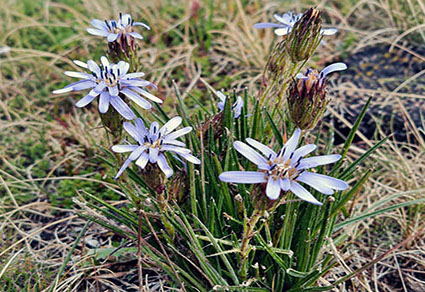
Perezia namorensis is described and illustrated as a new species restricted to subrupicolous habitats in southeastern Cajamarca, within the upper Marañón basin of northern Peru. Morphologically, it is related to P. pungens, a species apparently distributed along the Andean Cordillera from Colombia to Argentina, and P. linearis, from Chile and Argentina. It differs from P. pungens by its cespitose habit, linear leaves, glabrescent indumentum, and generally smaller vegetative organs, whereas P. pungens exhibits a rosulate habit, lanceolate, oblanceolate or elliptic leaves, a glandular‑pubescent indumentum, and vegetative organs generally of larger size. Perezia linearis is distinguished by its rosulate, tomentose plants and by organs consistently smaller than those of P. namorensis. We also provide a comparative assessment between the new species and the taxa of Perezia occurring in northern Peru, and comment on the phytosociological differences between P. namorensis and P. pungens. This new discovery is of great biogeographical significance, given its distribution in northern Peru, where the flora and vegetation of the Andes are more closely related to those of Ecuador and Colombia than to those of the rest of Peru.
References
- Barkworth, M.E. (1990) Nassella (Gramineae, Stipeae): Revised interpretation and nomenclatural changes. Taxon 39: 597–614. https://doi.org/10.2307/1223366
- Beltrán, H. & Galán de Mera, A. (2022) Patrones de distribución de las especies de Senecio L. (Asteraceae) en el Perú. Revista peruana de biología 29: e21463. https://doi.org/10.15381/rpb.v29i1.21463
- Bentham, G. (1846) Plantas Hartwegianas. W. Pamplin, London, pp. 249–256.
- Brako, L. & Zarucchi, J.L. (1993) Catalogue of the Flowering Plants and Gymnosperms of Peru. Missouri Botanical Garden, St. Louis, 1286 pp.
- Desvaux, N.A. (1808) Mémoire sur une monographie du genre Luzula. Journal de Botanique 1: 129–192.
- Ferreyra, R. (1995) Flora of Peru. J. Francis Macbride and Collaborators. Family Asteraceae: Part VI. Fieldiana, Botany, New Series 35: 1–101. https://doi.org/10.5962/bhl.title.2604
- Flüggé, J. (1810) Graminum Monographiae. part I. F. Perthes & J.H. Besser, Hamburg, 224 pp. https://doi.org/10.5962/bhl.title.15639
- Focke, W.O. (1906) Species andinae generis Geum. Botanische Jahrbücher für Systematik, Pflanzengeschichte und Planzengeographie 37: 539–541.
- Font Quer, P. (1979) Diccionario de Botánica. Labor, Barcelona, 1244 pp.
- Fries, E. (1848) Species Hieraciorum. Nova Acta Regiae Societatis Scientiarum Upsaliensis ser. 2 14: 1–220.
- Galán de Mera, A., Beltrán, H., Campos de la Cruz, J., Linares Perea, E., Montoya Quino, J., Trujillo Vera, C. & Vicente Orellana, J.A. (2024) Diversidad de comunidades vegetales del Perú. Una revisión a través de una clasificación fitosociológica. Arnaldoa 31: 211–239. https://doi.org/10.22497/arnaldoa.312.31201
- GBIF (2026) The Global Biodiversity Information Facility. Available from: https://www.gbif.org/species/2696178 (accessed 25 April 2026)
- Hensold, N. (1999) Las Angiospermas endémicas del Dpto. de Cajamarca, Perú. Arnaldoa 6: 141–184.
- Hieronymus, G. (1896) Plantae Stuebelianae novae. Botanische Jahrbücher für Systematik, Pflanzengeschichte und Planzengeographie 21: 306–378.
- Humboldt, F.W.H.A. & Bonpland, A.J.A. (1813) Plantes Équinoxiales, vol. 2. F. Schoell, Paris, 191 pp.
- Humboldt, A., Bonpland, A. & Kunth, C.S. (1820) Nova Genera et Species Plantarum, vol. 4. N. Maze, Paris, 246 pp.
- IUCN (2024) RedList. Guidelines for Using the IUCN Red List Categories and Criteria, Version 16. Available from: https://www.iucnredlist.org/resources/redlistguidelines (accessed 24 April 2026)
- JSTOR (2026) Global Plants. Available from: https://plants.jstor.org/ (accessed 15 April 2026)
- Katinas, L. (2012) Revisión del género Perezia (Compositae). Boletín de la Sociedad Argentina de Botánica 47 (1–2): 159–261.
- Kirschner, J., Štěpánek, J. & Moysiyenko, I.I. (2026) The diversity of Taraxacum (Asteraceae, Crepidinae) in Ukraine, with particular reference to the flora of Crimea. Phytotaxa 771 (1): 1–245. https://doi.org/10.11646/phytotaxa.771.1.1
- Lagasca, M. (1811) Amenidades Naturales de las Españas, vol. 1. Imprenta de la muy ilustre Junta, Orihuela, 44 pp.
- Lechler, W. (1857) Berberides Americae Australis. Kessinger, Whitefish, MT, 62 pp.
- Lessing, C.F. (1830) De Synanthereis Herbarii Regii Berolinensis, Dissertatio Secunda. Linnaea 5: 1–42.
- Lessing, C.F. (1832) Synopsis Generum Compositarum. Duncker & Humblot, Berlin, 473 pp.
- Linnaeus, C. (1760) Plantae Rariores Africanae. Laurentius Salvius, Stockholm, 28 pp.
- Lizarazu, M.A., Beck, S.G., Fuentes, A. & Freire, S.E. (2024) A revisión of Bidens (Asteraceae: Coreopsideae) from Bolivia. Annals of the Missouri Botanical Garden 109: 163–207. https://doi.org/10.3417/2024777
- Montoya Quino, J., Linares Perea, E. & Galán de Mera, A. (2023a) Confirmación de la presencia de Valeriana rumicoides Wedd. (Caprifoliaceae, Valerianoideae) para la flora peruana. Acta Botanica Malacitana 48: 160–165. https://doi.org/10.24310/abm.48.2023.17645
- Montoya Quino, J., Linares Perea, E. & Galán de Mera, A. (2023b) Una nueva especie de Noticastrum DC. (Compositae, Astereae) del norte del Perú. Arnaldoa 30: 103–116. https://doi.org/10.22497/arnaldoa.302.30201
- Peterson, P.M., Soreng, R.J., Romaschenko, K., Barberá, P., Quintanar, A. & Aedo, C. (2019) New combinations and new names in American Cinnagrostis, Peyritschia, and Deschampsia, and three new genera: Greeneochloa, Laegaardia, and Paramochloa (Poeae, Poaceae). Phytoneuron 2019 (39): 1–23.
- Pilger, R. (1909) Gramineae andinae. IV. Botanische Jahrbücher für Systematik, Pflanzengeschichte und Planzengeographie 42: 60–72.
- Pilger, R. (1921) Gramineae austro-americanae imprimis Werberbaueriana. V. Botanische Jahrbücher für Systematik, Pflanzengeschichte und Planzengeographie 56 (Beiblatt 123): 23–30.
- Reiche, K. (1905) Estudios críticos sobre la flora de Chile. Anales de la Universidad de Chile 116: 416–448. https://doi.org/10.5354/0717-8883.1905.24250
- Ruiz, H. & Pavón, J. (1798) Flora Peruviana, et Chilensis, vol. 1. Typis Gabrielis de Sancha, Madrid, 78 pp.
- Thiers, B. (2026) Index Herbariorum: A Global Directory of Public Herbaria and Associated Staff, New York Botanical Garden’s Virtual Herbarium. Available from: http://sweetgum.nybg.org/ih/ (accessed 18 April 2026)
- Tovar Serpa, O. (1955) Revisión de las especies peruanas del género Perezia (Compositae). Publicaciones del Museo de Historia Natural “Javier Prado” Serie B (Botánica) 8: 1–35.
- Vuilleumier, B.S. (1970) The systematics and evolution of Perezia sect. Perezia (Compositae). Contributions from the Gray Herbarium of Harvard University 199: 1–163. https://doi.org/10.5962/p.336463
- Weddell, H.A. (1855) Chloris Andina, vol. 1. P. Bertrand, Paris, 232 pp.