
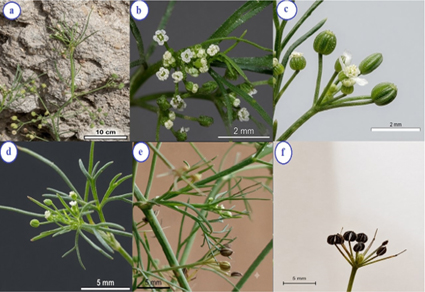

Abstract
Cyclospermum leptophyllum (Apiaceae) is reported for the first time from Saudi Arabia based on field collections from four populations in the Taif highlands. The identity of the species was confirmed through morphological comparison with relevant floras, herbarium material, and online taxonomic resources. The species was recorded in irrigated urban and peri-urban habitats at elevations of 1690–2100 m a.s.l., co-occurring with ruderal and moisture-associated vegetation. We provide a taxonomic description, voucher information, photographic documentation of diagnostic, a comparative analysis with similar regional Apiaceae, and a dichotomous key to facilitate identification. A comprehensive review of floristic literature and biodiversity databases confirms that this is the first record of both Cyclospermum and C. leptophyllum for the flora of Saudi Arabia. Based on the current study, C. leptophyllum is currently categorized as a casual alien species in Saudi Arabia. While four spatially separated reproductive populations were observed, data from a single growing season are insufficient to confirm multi-generational persistence required for naturalized status. We provide a taxonomic description, voucher information, field observations on habitat, phenology and associated vegetation, photographic documentation of diagnostic characters, a comparison with morphologically similar regional taxa, and a dichotomous key to facilitate identification.
References
- Acevedo-Rodríguez, P. (1996) Flora of St. John, US Virgin Islands, vol. 78. New York Botanical Garden, Bronx, NY.
- Alsherif, E.A., Ayesh, A.M. & Rawi, S.M. (2013) Floristic composition, life form and chorology of plant life at Khulais region, Western Saudi Arabia. Pakistan Journal of Botany 45 (1): 29–38.
- Bartolucci, F., Domina, G., Ardenghi, N.M.G., Bacaro, G., Bacchetta, G., Ballarin, F., Banfi, E., Barberis, G., Beccarisi, L., Bernardo, L., Bonari, G., Bonini, F., Brullo, S., Buono, S., Buono, V., Calbi, M., Caldararo, F., Calvia, G., Cancellieri, L., Cannavò, S., Dagnino, D., Esposito, A., Fascetti, S., Filibeck, G., Fiorini, G., Forte, L., Galasso, G., Gestri, G., Gigante, D., Gottschlich, G., Gubellini, L., Hofmann, N., Lastrucci, L., Lonati, M., Lorenz, R., Lunardi, L., Magrini, S., Mainetti, A., Maiorca, G., Mereu, G., Messa Ballarin, R.T., Minuto, L., Mossini, S., Musarella, C.M., Nimis, P.L., Passalacqua, N.G., Peccenini, S., Petriglia, B., Podda, L., Potenza, G., Ravetto Enri, S., Roma-Marzio, F., Rosati, L., Ruggero, A., Spampinato, G., Stinca, A., Tiburtini, M., Tietto, C., Tomaselli, V., Turcato, C., Viciani, D., Wagensommer, R.P. & Nepi, C. (2019) Notulae to the Italian native vascular flora: 8. Italian Botanist 8: 95–116. https://doi.org/10.3897/italianbotanist.8.48626
- Beentje, H. (2016) Tropical African floras: Progress, gaps, and future. Symbolae Botanicae Upsalienses 38: 101.
- Blackburn, T.M., Pyšek, P., Bacher, S., Carlton, J.T., Duncan, R.P., Jarošík, V., Wilson, J.R. & Richardson, D.M. (2011) A proposed unified framework for biological invasions. Trends in Ecology & Evolution 26 (7): 333–339. https://doi.org/10.1016/j.tree.2011.03.023
- Calviño, C.I. & Martínez, S.G. (2018) Typification of plant names belonging to subfamily Apioideae (Apiaceae) for the Flora of Argentina. Phytotaxa 379 (2): 153–161. https://doi.org/10.11646/phytotaxa.379.2.3
- Chaudhary, S.A. (1999–2001) Flora of the Kingdom of Saudi Arabia, vols 1–3. Ministry of Agriculture and Water, Riyadh.
- Collenette, S. (1999) Wildflowers of Saudi Arabia. National Commission for Wildlife Conservation and Development, Riyadh.
- De Mello, K., Garcia, E.A., Kopf, R.K. & Richards, A.E. (2025) Biodiversity indicators for wetland condition assessment and monitoring. In: Urban Watershed Microbiology, Vol. 2: Environmental Indicators, Regional Case Studies, and Bioremediation Strategies, pp. 795–840. https://doi.org/10.1007/978-3-032-05809-6_6
- Dev, K., Sharma, R., Sharma, S.K., Maitra Pati, A. & Agnihotri, V.K. (2025) Comparative chemical profiling, antimicrobial activity of Cyclospermum leptophyllum (Pers.) Sprague ex Britton and P. Wilson essential oil and evaluation of their integrative network pharmacology. Natural Product Research: 1–6. https://doi.org/10.1080/14786419.2025.2484270
- Haq, S.M., Waheed, M., Jameel, M.A., Walas, Ł., Khan, M.N., Siddiqui, M.H., Alamri, S., AbuYahya, A.E. & Bussmann, R.W. (2025) Alien flora of the Kingdom of Saudi Arabia: taxonomic composition, phylogenetic patterns, and invasion status. Biological Invasions 27 (11): 1–18. https://doi.org/10.1007/s10530-025-03692-4
- Kim, K.C. & Byrne, L.B. (2006) Biodiversity loss and the taxonomic bottleneck: emerging biodiversity science. Ecological Research 21 (6): 794–810. https://doi.org/10.1007/s11284-006-0035-7
- Kürschner, H. (1998) Biogeography and introduction to vegetation. In: Ghazanfar, S.A. & Fisher, M. (Eds.) Vegetation of the Arabian Peninsula. Springer, Dordrecht, pp. 63–98. https://doi.org/10.1007/978-94-017-3637-4_4
- Lu, M. (2025) The research progress on phytogeography: Global plant distribution patterns and environmental driving mechanisms. Geography Research Bulletin 4: 3–25.
- Miller, A.G. & Cope, T.A. (1996) Flora of the Arabian Peninsula and Socotra. Vol. 1. Edinburgh University Press, Edinburgh.
- Plunkett, G.M., Pimenov, M.G., Reduron, J.P., Kljuykov, E.V., Van Wyk, B.E., Ostroumova, T.A., Henwood, M.J., Tilney, P.M., Spalik, K., Watson, M.F. & Lee, B.Y. (2019) Apiaceae: Umbelliferae Juss., Gen. Pl.: 218 (1789), nom. cons. et nom. alt. In: Kubitzki, K. (Ed.) Flowering Plants. Eudicots: Apiales, Gentianales (except Rubiaceae). Springer, Cham, pp. 9–206.
- Musarella, C.M., Laface, V.L.A., Angiolini, C., Bacchetta, G., Bajona, E., Banfi, E., Barone, G., Biscotti, N., Bonsanto, D., Calvia, G., Cambria, S., Capuano, A., Caruso, G., Crisafulli, A., Del Guacchio, E., Di Gristina, E., Domina, G., Fanfarillo, E., Fascetti, S., Fiaschi, T., Galasso, G., Mascia, F., Mazzacuva, G., Mei, G., Minissale, P., Motti, R., Perrino, E.V., Picone, R.M., Pinzani, L., Podda, L., Potenza, G., Rosati, L., Stinca, A., Tavilla, G., Villano, C., Wagensommer, R.P. & Spampinato, G. (2024) New Alien Plant Taxa for Italy and Europe: An Update. Plants 13 (5): 620. https://doi.org/10.3390/plants13050620
- POWO—Plants of the World Online (2026) Royal Botanic Gardens Kew. Available from: https://powo.science.kew.org/ (accessed 12 July 2026)
- Perrino, E.V., Monteleone, M., Lorusso, L. & Liuzzi, C. (2026) Unsatisfactory Management of a Protected Wetland Area in Italy: Laghi di Conversano. Wetlands 46: 66. https://doi.org/10.1007/s13157-026-02076-1
- Perrino, E.V., Tomaselli, V., Wagensommer, R.P., Silletti, G.N., Esposito, A. & Stinca, A. (2022) Ophioglossum lusitanicum L.: New Records of Plant Community and 92/43/EEC Habitat in Italy. Agronomy 12: 3188. https://doi.org/10.3390/agronomy12123188
- Ramos, J.L., Cano, M.J., Jimenéz, J.A., Gallego, M.T. & Opisso, J.A. (2026) New or otherwise interesting records of Pottiaceae (Bryophyta) for Peru. Phytotaxa 744 (1): 1–19. https://doi.org/10.11646/phytotaxa.744.1.1
- Richardson, D.M., Pyšek, P., Rejmanek, M., Barbour, M.G., Panetta, F.D. & West, C.J. (2000) Naturalization and invasion of alien plants: concepts and definitions. Diversity and Distributions 6 (2): 93–107. https://doi.org/10.1046/j.1472-4642.2000.00083.x
- Verloove, F. & Sánchez Gullón, E. (2012) New records of interesting vascular plants (mainly xenophytes) in the Iberian Peninsula. II. Flora Mediterranea 22: 5–24. https://doi.org/10.7320/flmedit22.005
- Wagensommer, R.P. (2023) Floristic studies in the light of biodiversity knowledge and conservation. Plants 12 (16): 2973. https://doi.org/10.3390/plants12162973
- Wagensommer, R.P., Fröhlich, T. & Fröhlich, M. (2014) First record of the southeast European species Cerinthe retorta Sibth. & Sm. (Boraginaceae) in Italy and considerations on its distribution and conservation status. Acta Botanica Gallica: Botany Letters 161 (2): 111–115. https://doi.org/10.1080/12538078.2014.892438
- Walck, J.L., Baskin, C.C., Hidayati, S.N. & Baskin, J.M. (2008) Comparison of the seed germination of native and non‐native winter annual Apiaceae in North America, with particular focus on Cyclospermum leptophyllum naturalized from South America. Plant Species Biology 23 (1): 33–42. https://doi.org/10.1111/j.1442-1984.2008.00205.x
- White, F. & Léonard, J. (1991) Phytogeographical links between Africa and Southwest Asia. Flora Vegetatio Mundi 9: 229–246.
- Williams, Z., Daniels, A. & Gradstein, S. (2025) Cylindrocolea rhizantha (Cephaloziellaceae, Marchantiophyta)—a new record for Asia from the Western Ghats, India. Phytotaxa 721 (3): 295–300. https://doi.org/10.11646/phytotaxa.721.3.9
- Zohary, M. (1973) Geobotanical Foundations of the Middle East. Gustav Fischer Verlag, Stuttgart.