

Abstract
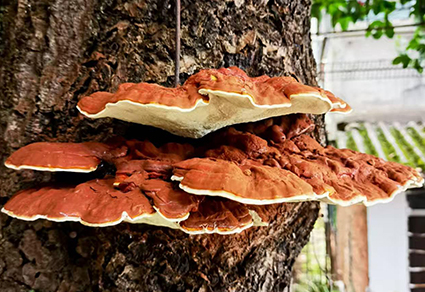
The genus Ganoderma is widely distributed in temperate and tropical regions. It is well known for causing white rot and for its medicinal properties. In this study, based on two specimens collected from Yunnan Province, China, a new species, Ganoderma camphorae, is proposed. Based on morphological evidence and multi-locus phylogenetic analyses using sequence data from the internal transcribed spacer region (ITS), the nuclear large subunit ribosomal RNA gene (nrLSU), translation elongation factor 1-alpha (TEF1-α), and the second largest subunit of RNA polymerase II (RPB2), the two specimens were confirmed to be conspecific and to represent a new species, described here as Ganoderma camphorae. Phylogenetically, the two specimens form a single, well-supported clade (99% ML / 0.99 PP). Morphologically, G. camphorae is characterized by its sessile, flabelliform basidiocarp; laccate, brown to reddish-brown pileus with concentric zones and radial rugae; corky context with black melanoid lines; crustohymeniderm pileipellis; its basidia are oval to subglobose, colorless, thin-walled, with 2–4 sterigmata, measuring 17–21 × 11–16 µm, while basidioles resemble basidia in shape, also colorless and thin-walled, ranging from 11–20 × 7–15 µm; and ovoid to obovoid, truncate basidiospores 9.1–12.4 × 6.5–8.8 μm. Detailed descriptions and illustrations of the new species are provided.
References
- Ahmad, M.F. (2020) Ganoderma lucidum: A rational pharmacological approach to surmount cancer. Journal of Ethnopharmacology 260: 113047. https://doi.org/10.1016/j.jep.2020.113047
- Bharath Kumar, S., Muthu Kumar, A. & Nagadesi, P.K. (2025) New Host Record, Phenotypic, and Genotypic Identification: One New Species of Ganoderma from Western Ghats of Karnataka, India. Journal of Sustainable Forestry 44 (8): 764–794. https://doi.org/10.1080/10549811.2025.2525204
- Bolaños-Rojas, A.C., Bononi, V.L.R., Gugliotta, A.M. & Muñoz, J.E. (2016) New records of Ganoderma multiplicatum (Mont.) Pat. (Polyporales, Basidiomycota) from Colombia and its geographic distribution in South America. Check List 12: 1–7. https://doi.org/10.15560/12.4.1948
- Cabarroi-Hernández, M., Decock, C., Welti, S., Amalfi, M., Villalobos-Arámbula, A.R., Aliaga-Ramos, D., Morera, G., Macedo-Pérez Sandi, E., Almarales Castro, A. & Guzmán-Dávalos, L. (2023) Ganoderma from Cuba: an approach to some species based on morphology and phylogenetic analyses. Biological Journal of the Linnean Society 140 (3): 323–357. https://doi.org/10.1093/biolinnean/blad055
- Cabarroi-Hernández, M., Villalobos-Arámbula, A.R., Torres-Torres, M.G., Decock, C. & Guzmán-Dávalos, L. (2019) The Ganoderma weberianum-resinaceum lineage: multilocus phylogenetic analysis and morphology confirm G. mexicanum and G. parvulum in the Neotropics. MycoKeys 59: 95–131. https://doi.org/10.3897/mycokeys.59.33182
- Cao, Y. & Yuan, H.S. (2013) Ganoderma mutabile sp. nov. from southwestern China based on morphological and molecular data. Mycological Progress 12: 121–126. https://doi.org/10.1007/s11557-012-0819-9
- Crous, P.W., Wingfield, M.J., Schumacher, R.K., Summerell, B.A., Giraldo, A., Gené, J., Guarro, J., Wanasinghe, D.N., Hyde, K.D., Camporesi, E., Jones, E.B.G., Thambugala, K.M., Malysheva, E.F., Malysheva, V.F., Acharya, K., Álvarez, J., Alvarado, P., Assefa, A., Barnes, C.W., Bartlett, J.S., Blanchette, R.A., Burgess, T.I., Carlavilla, J.R., Coetzee, M.P.A., Damm, U., Decock, C.A., den Breeÿen, A., de Vries, B., Dutta, A.K., Holdom, D.G., Rooney-Latham, S., Manjón, J.L., Marincowitz, S., Mirabolfathy, M., Moreno, G., Nakashima, C., Papizadeh, M., Shahzadeh Fazeli, S.A., Amoozegar, M.A., Romberg, M.K., Shivas, R.G., Stalpers, J.A., Stielow, B., Stukely, M.J.C., Swart, W.J., Tan, Y.P., van der Bank, M., Wood, A.R., Zhang, Y. & Groenewald, J.Z. (2014) Fungal Planet description sheets: 281–319. Persoonia 33: 212–289. https://doi.org/10.3767/003158514X685680
- Crous, P.W., Wingfield, M.J., Burgess, T.I., Hardy, G.E.St.J., Barber, P.A., Alvarado, P., Barnes, C.W., Buchanan, P.K., Heykoop, M., Moreno, G., Thangavel, R., van der Spuy, S., Barili, A., Barrett, S., Cacciola, S.O., Cano-Lira, J.F., Crane, C., Decock, C., Gibertoni, T.B., Guarro, J., Guevara-Suarez, M., Hubka, V., Kolařík, M., Lira, C.R.S., Ordoñez, M.E., Padamsee, M., Ryvarden, L., Soares, A.M., Stchigel, A.M., Sutton, D.A., Vizzini, A., Weir, B.S., Acharya, K., Aloi, F., Baseia, I.G., Blanchette, R.A., Bordallo, J.J., Bratek, Z., Butler, T., Cano-Canals, J., Carlavilla, J.R., Chander, J., Cheewangkoon, R., Cruz, R.H.S.F., da Silva, M., Dutta, A.K., Ercole, E., Escobio, V., Esteve-Raventós, F., Flores, J.A., Gené, J., Góis, J.S., Haines, L., Held, B.W., Horta Jung, M., Hosaka, K., Jung, T., Jurjević, Ž., Kautman, V., Kautmanova, I., Kiyashko, A.A., Kozanek, M., Kubátová, A., Lafourcade, M., La Spada, F., Latha, K.P.D., Madrid, H., Malysheva, E.F., Manimohan, P., Manjón, J.L., Martín, M.P., Mata, M., Merényi, Z., Morte, A., Nagy, I., Normand, A.-C., Paloi, S., Pattison, N., Pawłowska, J., Pereira, O.L., Petterson, M.E., Picillo, B., Raj, K.N.A., Roberts, A., Rodríguez, A., Rodríguez-Campo, F.J., Romański, M., Ruszkiewicz-Michalska, M., Scanu, B., Schena, L., Semelbauer, M., Sharma, R., Shouche, Y.S., Silva, V., Staniaszek-Kik, M., Stielow, J.B., Tapia, C., Taylor, P.W.J., Toome-Heller, M., Vabeikhokhei, J.M.C., van Diepeningen, A.D., Van Hoa, N., Van Tri, M., Wiederhold, N.P., Wrzosek, M., Zothanzama, J. & Groenewald, J.Z. (2017) Fungal Planet description sheets: 558–624. Persoonia 38: 240–384. https://doi.org/10.3767/003158517X698941
- Costa-Rezende, D.H., Robledo, G.L., Góes-Neto, A., Reck, M.A., Crespo, E. & Drechsler-Santos, E.R. (2017) Morphological reassessment and molecular phylogenetic analyses of Amauroderma s.lat. raised new perspectives in the generic classification of the Ganodermataceae family. Persoonia 39: 254–269. https://doi.org/10.3767/persoonia.2017.39.10
- Costa-Rezende, D.H., Robledo, G.L., Drechsler-Santos, E.R., Glen, M., Gates, G., Bonz, B.R., Popof, O.F., Crespo, E. & Góes-Neto, A. (2020) Taxonomy and phylogeny of polypores with ganodermatoid basidiospores (Ganodermataceae). Mycological Progress 19: 725–741. https://doi.org/10.1007/s11557-020-01589-1
- Donk, M.A. (1948) Notes on Malesian fungi I. Bulletin du Jardin Botanique de Buitenzorg, Série 3 17: 473–482.
- Gilbertson, R.L. & Ryvarden, L. (1986) North American Polypores, Vol. 1: Abortiporus to Lindtneria. Fungiflora, Oslo, 433 pp.
- Glez-Peña, D., Gómez-Blanco, D., Reboiro-Jato, M., Fdez-Riverola, F. & Posada, D. (2010) ALTER: program-oriented conversion of DNA and protein alignments. Nucleic Acids Research 38: W14–W18. https://doi.org/10.1093/nar/gkq321
- Hall, T.A. (1999) BioEdit: a user-friendly biological sequence alignment editor and analysis program for Windows 95/98/NT. Nucleic Acids Symposium Series 41: 95–98.
- He, J., Luo, Z.L., Tang, S.M., Li, Y.J., Li, S.H. & Su, H.Y. (2021) Phylogenetic analyses and morphological characters reveal two new species of Ganoderma from Yunnan province, China. MycoKeys 84: 141–162. https://doi.org/10.3897/mycokeys.84.69449
- He, J., Han, X., Luo, Z.L., Li, E.X., Tang, S.M., Luo, H.M., Niu, K.Y., Su, X.J. & Li, S.H. (2022) Species diversity of Ganoderma (Ganodermataceae, Polyporales) with three new species and a key to Ganoderma in Yunnan Province, China. Frontiers in Microbiology 13: 1035434. https://doi.org/10.3389/fmicb.2022.1035434
- He, J., Li, X.J., Tan, W.Z., Wu, X.Q., Wu, D., Luo, Z.L., Zhou, Q.W., Li, E.X. & Li, S.H. (2024) Two new species of Ganoderma (Ganodermataceae, Basidiomycota) from Southwest China. MycoKeys 106: 97–116. https://doi.org/10.3897/mycokeys.106.121526
- Karsten, P.A. (1881) Enumeratio boletinearum et polyproearum fennicarum, systemate novo dispositarum. Revue Mycologique 3: 16–19.
- Katoh, K. & Standley, D.M. (2013) MAFFT multiple sequence alignment software version 7: improvements in performance and usability. Molecular Biology and Evolution 30: 772–780. https://doi.org/10.1093/molbev/mst010
- Kaur, G. & Singh, A.P. (2017) Diversity of the genus Ganoderma in Punjab (India). Mycobiota 7: 25–49. https://doi.org/10.12664/mycobiota.2017.07.05
- Karunarathna, S.C., Patabendige, N.M., Luangharn, T., Dissanayake, A.S., Karunarathna, A., Dissanayake, C.W., Kohombange, H.L.G.N., Jones, E.B.G. & Hyde, K.D. (2025) Ganodermataceae-current status, research, and development in Lower Mekong Basin. Frontiers in Cellular and Infection Microbiology 15: 1545135. https://doi.org/10.3389/fcimb.2025.1545135
- Kornerup, A. & Wanscher, J.H. (1978) Methuen handbook of colour (3rd edn.). Methuen, London.
- Larsson, A. (2014) AliView: a fast and lightweight alignment viewer and editor for large datasets. Bioinformatics 30: 3276–3278. https://doi.org/10.1093/bioinformatics/btu531
- Leonardo-Silva, L., Cotrim, C.F.C. & Xavier-Santos, S. (2022) Furtadomyces nom. nov. (Ganodermataceae, Basidiomycota) with description of F. sumptuosus, a new species of ganodermatoid fungi from Brazil. Mycological Progress 21: 33. https://doi.org/10.1007/s11557-022-01794-0
- Lima Júnior, N.C., Gibertoni, T.B. & Malosso, E. (2014) Delimitation of some neotropical laccate Ganoderma (Ganodermataceae): molecular phylogeny and morphology. Revista de Biología Tropical 62: 1197–1208.
- Lin, Z. (2019) Ganoderma (Lingzhi) in Traditional Chinese Medicine and Chinese Culture. In: Lin, Z. & Yang, B. (Eds.) Ganoderma and Health. Springer, Singapore, pp. 1–17. https://doi.org/10.1007/978-981-13-9867-4_1
- Liu, Y.J., Whelen, S. & Hall, B.D. (1999) Phylogenetic relationships among ascomycetes: evidence from an RNA polymerase II subunit. Molecular Biology and Evolution 16: 1799–1808. https://doi.org/10.1093/oxfordjournals.molbev.a026092
- Loyd, A.C. (2018) Taxonomy, biology, decay potential, and pathogenicity of the laccate (varnished) Ganoderma species present in the U.S. Ph.D. dissertation, University of Florida, Gainesville, 294 pp.
- Luangharn, T., Karunarathna, S.C., Dutta, A.K., Paloi, S., Promputtha, I., Hyde, K.D., Xu, J. & Mortimer, P.E. (2021) Ganoderma (Ganodermataceae, Basidiomycota) species from the Greater Mekong Subregion. Journal of Fungi 7: 819. https://doi.org/10.3390/jof7100819
- Matheny, P.B., Wang, Z.W., Binder, M., Curtis, J.M., Lim, Y.W., Nilsson, R.H., Hughes, K.W., Hofstetter, V., Ammirati, J.F., Schoch, C.L., Langer, E., Langer, G., McLaughlin, D.J., Wilson, A.W., Frøslev, T., Ge, Z.W., Kerrigan, R.W., Slot, J.C., Yang, Z.L., Baroni, T.J., Aime, M.C., Crane, P.E., Halling, R.E., Desjardin, D.E., Henkel, T.W., Mueller, G.M., Lodge, D.J., Zoller, M.J., Spatafora, J.W., Ryvarden, L., Methven, A.S., Vellinga, E.C., Horak, E., Bougher, N.L., Jones, M.E., Hosaka, K., Læssøe, T., Looney, B.P., Vauras, J., Kytövuori, P.P., Minnis, A.M., Lindner, D.L., Langer, E.E., Ratkowsky, D.A., Hyde, K.D., Henkel, T.W., Bruns, T.D., Redhead, S.A., Nagasawa, E. & Hibbett, D.S. (2007) Contributions of rpb2 and tef1 to the phylogeny of mushrooms and allies (Basidiomycota, Fungi). Molecular Phylogenetics and Evolution 43: 430–451. https://doi.org/10.1016/j.ympev.2006.08.024
- Miller, M.A., Pfeiffer, W. & Schwartz, T. (2010) Creating the CIPRES Science Gateway for inference of large phylogenetic trees. In: Proceedings of the 2010 Gateway Computing Environments Workshop (GCE). New Orleans, 8 pp. https://doi.org/10.1109/GCE.2010.5676129
- Mohanty, P.S., Harsh, N.S.K. & Pandey, A. (2011) First report of Ganoderma resinaceum and G. weberianum from north India based on ITS sequence analysis and micromorphology. Mycosphere 2 (4): 469–474.
- Moncalvo, J.M. & Ryvarden, L. (1997) A nomenclatural study of the Ganodermataceae Donk. Synopsis Fungorum 11: 1–114.
- Murrill, W.A. (1902) The Polyporaceae of North America: I. The genus Ganoderma. Bulletin of the Torrey Botanical Club 29: 599–608. https://doi.org/10.2307/2478682
- Murrill, W.A. (1908) Ganoderma polychromum. In: Coulter, J.M. & Gentry, H.S. (Eds.) North American flora. New York Botanical Garden, New York, pp. 119.
- Núñez, M. & Ryvarden, L. (2000) East Asian polypores, Vol. 1: Ganodermataceae and Hymenochaetaceae. Fungiflora, Oslo, 168 pp.
- Nylander, J.A.A. (2004) MrModeltest v.2.3. Program distributed by the author. Evolutionary Biology Centre, Uppsala University, Uppsala.
- Pharmacopoeia Commission of the People’s Republic of China (2010) Pharmacopoeia of the People’s Republic of China, vol. 1. China Medical Science Press, Beijing, 174 pp.
- Quanten, E. (1997) The polypores (Polyporaceae s.l.) of Papua New Guinea. Opera Botanica Belgica 11: 1–352.
- Rambaut, A. (2012) FigTree version 1.4.0. Available from: http://tree.bio.ed.ac.uk/software/figtree/ (accessed 6 December 2025)
- Rannala, B. & Yang, Z. (1996) Probability distribution of molecular evolutionary trees: a new method of phylogenetic inference. Journal of Molecular Evolution 43: 304–311. https://doi.org/10.1007/BF02338839
- Ren, S., Liu, H., Sang, Q., Lu, M., Gao, Q. & Chen, W. (2025) A review of bioactive components and pharmacological effects of Ganoderma lucidum. Food Science & Nutrition 13: e70623. https://doi.org/10.1002/fsn3.70623
- Richter, C., Wittstein, K., Kirk, P.M. & Stadler, M. (2014) An assessment of the taxonomy and chemotaxonomy of Ganoderma. Fungal Diversity 71: 1–15. https://doi.org/10.1007/s13225-014-0313-6
- Ronquist, F., Teslenko, M., van der Mark, P., Ayres, D.L., Darling, A., Höhna, S., Larget, B., Liu, L., Suchard, M.A. & Huelsenbeck, J.P. (2012) MrBayes 3.2: efficient Bayesian phylogenetic inference and model choice across a large model space. Systematic Biology 61: 539–542. https://doi.org/10.1093/sysbio/sys029
- Ryvarden, L. & Johansen, I. (1980) A preliminary polypore flora of East Africa. Fungiflora, Oslo, 636 pp.
- Ryvarden, L. & Gilbertson, R.L. (1993) European polypores 1. Synopsis Fungorum 6: 1–387.
- Sanodiya, B.S., Thakur, G.S., Baghel, R.K., Prasad, G.B. & Bisen, P.S. (2009) Ganoderma lucidum: a potent pharmacological macrofungus. Current Pharmaceutical Biotechnology 10: 717–742. https://doi.org/10.2174/138920109789978757
- Stamatakis, A. (2014) RAxML version 8: a tool for phylogenetic analysis and post-analysis of large phylogenies. Bioinformatics 30: 1312–1313. https://doi.org/10.1093/bioinformatics/btu033
- Steyaert, R.L. (1972) Species of Ganoderma and related genera mainly of the Bogor and Leiden Herbaria. Persoonia 7: 55–118.
- Sun, Y.F., Costa-Rezende, D.H., Xing, J.H., Zhou, J.L., Zhang, B., Gibertoni, T.B., Gates, G., Glen, M., Dai, Y.C. & Cui, B.K. (2020) Multi gene phylogeny and taxonomy of Amauroderma s.lat. (Ganodermataceae). Persoonia 44: 206–239. https://doi.org/10.3767/persoonia.2020.44.08
- Sun, Y.F., Xing, J.H., He, X.L., Wu, D.M., Song, C.G., Liu, S., Vlasák, J., Gates, G., Gibertoni, T.B. & Cui, B.K. (2022) Species diversity, systematic revision and molecular phylogeny of Ganodermataceae (Polyporales, Basidiomycota) with an emphasis on Chinese collections. Studies in Mycology 101: 287–415. https://doi.org/10.3114/sim.2022.101.05
- Swofford, D.L. (2003) PAUP: phylogenetic analysis using parsimony (and other methods). Sinauer Associates, Sunderland, Massachusetts.
- Tian, R., Qin, H.-Z., Zhong, Q., Liang, Z.-Q., Zhang, X.-Y., Mu, X.-D., Xu, L., Wen, T.-C., Chen, X.-D. & Zeng, N.-K. (2025) What Are “Lingzhi Wang” or “Zhu Lingzhi”? Notes on Ganoderma (Ganodermataceae, Polyporales) Species Characterized by Diminutive Pilei and Gracile Stipes from Hainan Island, Tropical China. Journal of Fungi 11 (3): 237. https://doi.org/10.3390/jof11030237
- Umar, A., Ahmed, S., Guzmán-Dávalos, L. & Cabarroi-Hernández, M. (2022) Ganoderma multipileum and Tomophagus cattienensis—new records from Pakistan. Mycotaxon 137: 135–151. https://doi.org/10.5248/137.135
- Vaidya, G., Lohman, D.J. & Meier, R. (2011) SequenceMatrix: concatenation software for the fast assembly of multi-gene datasets with character set and codon information. Cladistics 27: 171–180. https://doi.org/10.1111/j.1096-0031.2010.00329.x
- Vilgalys, R. & Hester, M. (1990) Rapid genetic identification and mapping of enzymatically amplified ribosomal DNA from several Cryptococcus species. Journal of Bacteriology 172: 4238–4246. https://doi.org/10.1128/jb.172.8.4238-4246.1990
- Wei, Q.L., Zheng, H.F., Shao, Y.Y., Rasheed, U., Lin, J.T., Huang, F.C. & Liu, B. (2024) A New Species of Ganoderma (Ganodermataceae, Polyporales) from Southern China and Optimum Condition for Mycelia Production. Mycobiology 52 (1): 58–67. https://doi.org/10.1080/12298093.2024.2306012
- White, T.J., Bruns, T.D., Lee, S. & Taylor, J. (1990) Amplification and direct sequencing of fungal ribosomal RNA genes for phylogenetics. In: Innis, M.A., Gelfand, D.H., Sninsky, J.J. & White, T.J. (Eds.) PCR protocols, a guide to methods and applications. Academic Press, San Diego, pp. 315–322. https://doi.org/10.1016/B978-0-12-372180-8.50042-1
- Xing, J.H., Sun, Y.F., Han, Y.L., Cui, B.K. & Dai, Y.C. (2018) Morphological and molecular identification of two new Ganoderma species on Casuarina equisetifolia from China. MycoKeys 34: 93–108. https://doi.org/10.3897/mycokeys.34.22593
- Ye, L., Karunarathna, S.C., Mortimer, P.E., Li, H., Qiu, M.-H., Peng, X.-R., Luangharn, T., Li, Y.-J., Promputtha, I., Hyde, K.D. & Xu, J.-C. (2019) Ganoderma weixiensis (Polyporaceae, Basidiomycota), a new member of the G. lucidum complex from Yunnan Province, China. Phytotaxa 423: 75–86. https://doi.org/10.11646/phytotaxa.423.2.3
- Zheng, L., Jia, D., Fei, X., Luo, X. & Yang, Z. (2007) An assessment of the genetic diversity within Ganoderma strains with AFLP and ITS PCR-RFLP. Microbiological Research 164: 312–321. https://doi.org/10.1016/j.micres.2007.02.002
- Zhou, L.-W., Cao, Y., Wu, S.-H., Vlasák, J., Li, D.-W., Li, M.-J. & Dai, Y.-C. (2015) Global diversity of the Ganoderma lucidum complex (Ganodermataceae, Polyporales) inferred from morphology and multilocus phylogeny. Phytochemistry 114: 7–15. https://doi.org/10.1016/j.phytochem.2014.09.023