

Abstract
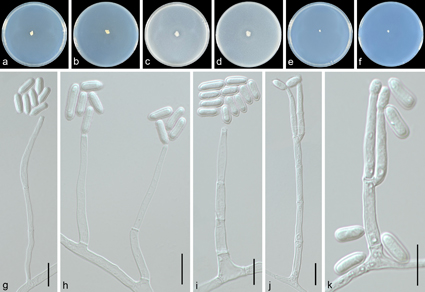
During an investigation of fungal diversity in urban soils in China, four plectosphaerellaceous fungal isolates were obtained. Based on integrated morphological characterization and multigene phylogenetic analyses of four loci (ITS, LSU, rpb2, and tef1), Sodiomyces sinensis sp. nov. is described and illustrated. Phylogenetic analyses indicate that this novel species forms a monophyletic clade with robust support values. Morphologically, S. sinensis can be distinguished from other species within the genus by lacking a known sexual morph, and by its subcylindrical to cylindrical, larger conidia (7.5–15 × 3–4 μm), and the presence of chlamydospores. This study contributes to fungal data from urban soils and enhances understanding of the species diversity, taxonomy, and distribution of Sodiomyces.
References
- Bilanenko, E., Sorokin, D., Ivanova, M. & Kozlova, M. (2005) Heleococcum alkalinum, a new alkali-tolerant ascomycete from saline soda soils. Mycotaxon 91: 497–507. https://doi.org/10.5962/p.431289
- Crous, P.W., Akulov, A., Balashov, S., Boers, J., Braun, U., Castillo, J., Delgado, M.A., Denman, S., Erhard, A., Gusella, G., Jurjević, Ž., Kruse, J., Malloch, D.W., Osieck, E.R., Polizzi, G., Schumacher, R.K., Slootweg, E., Starink-Willemse, M., van Iperen, A.L., Verkley, G.J.M. & Groenewald, J.Z. (2023) New and interesting Fungi. 6. Fungal Systematics and Evolution 11 (1): 109–156. https://doi.org/10.3114/fuse.2023.11.09
- Drummond, A.J. & Rambaut, A. (2007) BEAST: Bayesian evolutionary analysis by sampling trees. BMC Evolutionary Biology 7: 214. https://doi.org/10.1186/1471-2148-7-214
- Giraldo, A. & Crous, P.W. (2019) Inside Plectosphaerellaceae. Studies in Mycology 92 (1): 227–286. https://doi.org/10.1016/j.simyco.2018.10.005
- Giraldo, A., Hernández-Restrepo, M. & Crous, P.W. (2019) New plectosphaerellaceous species from Dutch garden soil. Mycological Progress 18 (9): 1135–1154. https://doi.org/10.1007/s11557-019-01511-4
- Grum-Grzhimaylo, A.A., Debets, A.J.M., van Diepeningen, A.D., Georgieva, M.L. & Bilanenko, E.N. (2013) Sodiomyces alkalinus, a new holomorphic alkaliphilic ascomycete within the Plectosphaerellaceae. Persoonia 31: 147–158. https://doi.org/10.3767/003158513X673080
- Grum-Grzhimaylo, A.A., Georgieva, M.L., Bondarenko, S.A., Debets, A.J.M. & Bilanenko, E.N. (2016) On the diversity of fungi from soda soils. Fungal Diversity 76: 27–74. https://doi.org/10.1007/s13225-015-0320-2
- Kalyaanamoorthy, S., Minh, B.Q., Wong, T.K., von Haeseler, A. & Jermiin, L.S. (2017) ModelFinder: fast model selection for accurate phylogenetic estimates. Nature Methods 14: 587–589. https://doi.org/10.1038/nmeth.4285
- Katoh, K. & Standley, D.M. (2013) MAFFT Multiple sequence alignment software version 7: improvements in performance and usability. Molecular Biology and Evolution 30: 772–780. https://doi.org/10.1093/molbev/mst010
- Liu, Y.J., Whelen, S. & Hall, B.D. (1999) Phylogenetic relationships among ascomycetes: evidence from an RNA polymerase II subunit. Molecular Biology and Evolution 16: 1799–1808. https://doi.org/10.1093/oxfordjournals.molbev.a026092
- Minh, B.Q., Nguyen, M.A.T. & von Haeseler, A. (2013) Ultrafast approximation for phylogenetic bootstrap. Molecular Biology and Evolution 30 (5): 1188–1195. https://doi.org/10.1093/molbev/mst024
- Nguyen, L.T., Schmidt, H.A., von Haeseler, A. & Minh, B.Q. (2015) IQ-TREE: a fast and effective stochastic algorithm for estimating maximum-likelihood phylogenies. Molecular Biology and Evolution 32: 268–274. https://doi.org/10.1093/molbev/msu300
- Okada, G., Niimura, Y., Sakata, T., Uchimura, T., Ohara, N., Suzuki, H. & Kozaki, M. (1993) Acremonium alcalophilum, a new alkalophilic cellulolytic hyphomycete. Transactions of the Mycological Society of Japan 34: 171–185.
- Pan, H., Tong, S.Q., Chen, Z., Wu, Y.J., Wang, Y., Tao, G. & Zhang, Z.Y. (2025) Two new acremonium-like species, Paragibellulopsis sinensis sp. nov. and Phialoparvum sinense sp. nov. (Sordariomycetes, Ascomycota) from China. MycoKeys 118: 207–224. https://doi.org/10.3897/mycokeys.118.155316
- Rambaut, A. (2012) FigTree, version 1.4.2. University of Edinburgh, Edinburgh.
- Rehner, S.A. & Buckley, E. (2005) A Beauveria phylogeny inferred from nuclear ITS and EF1-α sequences: evidence for cryptic diversification and links to Cordyceps teleomorphs. Mycologia 97 (1): 84–98. https://doi.org/10.1080/15572536.2006.11832842
- Ronquist, F., Teslenko, M., Van der Mark, P., Ayres, D.L., Darling, A., Höhna, S., Larget, B., Liu, L., Suchard, M.A. & Huelsenbeck, J.P. (2012) MrBayes 3.2: efficient Bayesian phylogenetic inference and model choice across a large model space. Systematic Biology 61: 539–542. https://doi.org/10.1093/sysbio/sys029
- Tamura, K., Stecher, G., Peterson, D., Filipski, A. & Kumar, S. (2013) MEGA6: molecular evolutionary genetics analysis version 6.0. Molecular Biology and Evolution 30: 2725–2729. https://doi.org/10.1093/molbev/mst197
- Vilgalys, R. & Hester, M. (1990) Rapid genetic identification and mapping of enzymatically amplified ribosomal DNA from several Cryptococcus species. Journal of Bacteriology 172 (8): 4238–4246. https://doi.org/10.1128/jb.172.8.4238-4246.1990
- White, T.J., Bruns, T.D., Lee, S.J.W.T. & Taylor, J.L. (1990) Amplification and direct sequencing of fungal ribosomal RNA genes for phylogenetics. PCR protocols: a guide to methods and applications 18 (1): 315–322. https://doi.org/10.1016/B978-0-12-372180-8.50042-1
- Xiang, C.Y., Gao, F., Jakovlic, I., Lei, H.P., Hu, Y., Zhang, H., Zou, H., Wang, G.T. & Zhang, D. (2023) Using PhyloSuite for molecular phylogeny and tree-based analyses. iMeta 2: e87. https://doi.org/10.1002/imt2.87
- Yeh, Y.H., Huang, Y.M. & Kirschner, R. (2024) Plectosphaerellaceous fungi (Ascomycota) on leaf litter of the subtropical giant fern Angiopteris lygodiifolia (Marattiaceae) in Taiwan. Nova Hedwigia 119 (3–4): 419–448. https://doi.org/10.1127/nova_hedwigia/2024/0960
- Zare, R., Gams, W., Starink-Willemse, M. & Summerbell, R.C. (2007) Gibellulopsis, a suitable genus for Verticillium nigrescens, and Musicillium, a new genus for V. theobromae. Nova Hedwigia 85 (3–4): 463–489. https://doi.org/10.1127/0029-5035/2007/0085-0463