
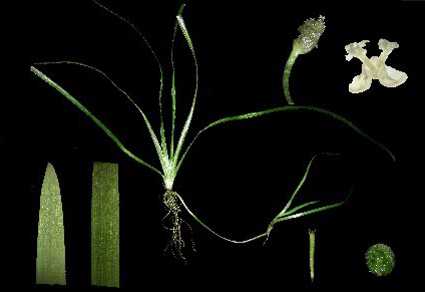

Abstract
The genus Vallisneria L. comprises submerged aquatic plants distributed worldwide, plays a fundamental role in the structure and functioning of freshwater ecosystems. Due to its high phenotypic plasticity in vegetative organs, difficulty in obtaining reproductive structure, and frequent interspecific hybridization, species classification and identification within the genus are challenging. The distribution history of V. spiralis, the type species of the genus, has long remained unclear in China. In this study, we conducted phylogenetic analyses on samples collected from multiple locations in China using nuclear ITS and chloroplast trnK intron sequences. Our results suggest that samples from different locations in China form a highly supported clade with European and African reference sequences of V. spiralis, thus providing the first molecular evidence for the occurrence of V. spiralis in China. In addition, V. spiralis and V. denseserrulata showed prominent differences in fruit morphology and phylogenetic tree position, which supported their distinction as independent species. We further detected six stable nucleotide sites in the ITS region, which can be used to distinguish V. spiralis and V. denseserrulata. Phylogenetic analyses also confirmed that the three recognized species of Vallisneria (V. natans, V. spinulosa and V. denseserrulata) in China were indeed three distinct branches. In summary, our study not only reported new distributional records of V. spiralis in China, but also provided molecular methods and data for species identification of similar taxa in Vallisneria.
References
- Baldwin, B.G. (1992) Phylogenetic Utility of the Internal Transcribed Spacers of Nuclear Ribosomal DNA in Plants: An Example from the Compositae. Molecular Phylogenetics and Evolution 1: 3–16. https://doi.org/10.1016/1055-7903(92)90030-k
- Castelnuovo, N., Villa, B., Boldrocchi, G., Lotti, P. & Bettinetti, R. (2024) Lake Shore Restoration with Vallisneria spiralis in Lake Como (Northern Italy) to Improve Sustainability. Sustainability 16: 10048. https://doi.org/10.3390/su162210048
- Chen, X., Meng, J.J., Sun, C., Wang, J., Deng, P., Dai, Y.T., Han, X.F. & Guo, B.H. (2025) The removal effects of combination of Bacillus and Vallisneria denseserrulata on nitrogen and phosphorus in water (in Chinese). Hubei Agricultural Sciences 64: 84–89.
- Edgar, R.C. (2004) MUSCLE: multiple sequence alignment with high accuracy and high throughput. Nucleic Acids Research 32: 1792–1797. https://doi.org/10.1093/nar/gkh340
- Field, D.L., Ayre, D.J., Whelan, R.J. & Young, A.G. (2011) The importance of pre-mating barriers and the local demographic context for contemporary mating patterns in hybrid zones of Eucalyptus aggregata and Eucalyptus rubida. Molecular Ecology 20: 2367–2379. https://doi.org/10.1111/j.1365-294x.2011.05054.x
- Fu, W.L., Li, Z.Z., Liu, Y., Cao, Y. & Li, W. (2019) Naming history, classification and characteristics of species from the genus Vallisneria in China (in Chinese). Plant Science Journal 37: 448–453.
- González-Pech, R.A., Stephens, T.G. & Chan, C.X. (2019) Commonly misunderstood parameters of NCBI BLAST and important considerations for users. Bioinformatics 35: 2697–2698. https://doi.org/10.1093/bioinformatics/bty1018
- Gorham, S.B., Seyoum, S., Furman, B.T., Darnell, K.M., Reynolds, L.K. & Tringali, M.D. (2021) Molecular detection of a non-native hybrid eelgrass, Vallisneria spiralis Linnaeus (1753) × V. denseserrulata Makino (1921), in the southeastern United States. Aquatic Botany 175: 103445. https://doi.org/10.1016/j.aquabot.2021.103445
- Hussner, A. (2012) Alien aquatic plant species in European countries. Weed Research 52: 297–306. https://doi.org/10.1111/j.1365-3180.2012.00926.x
- Les, D.H., Jacobs, S.W.L., Tippery, N.P., Chen, L., Moody, M.L. & Wilstermann-Hildebrand, M. (2008) Systematics of Vallisneria (Hydrocharitaceae). Systematic Botany 33: 49–65. https://doi.org/10.1600/036364408783887483
- Letunic, I. & Bork, P. (2007) Interactive Tree Of Life (iTOL): an online tool for phylogenetic tree display and annotation. Bioinformatics 23: 127–128. https://doi.org/10.1093/bioinformatics/btl529
- Lowden, R.M. (1982) An Approach To The Taxonomy Of Vallisneria L. (Hydrocharitaceae). Aquatic Botany 13: 269–298. https://doi.org/10.1016/0304-3770(82)90064-x
- Martin, A.P. & Mort, M.E. (2023) Vallisneria (Hydrocharitaceae): novel species, taxonomic revisions, and hybridization. Aquatic Botany 188: 103669. https://doi.org/10.1016/j.aquabot.2023.103669
- Martin, N.H. & Willis, J.H. (2007) Ecological divergence associated with mating system causes nearly complete reproductive isolation between sympatric Mimulus species. Evolution 61: 68–82. https://doi.org/10.1111/j.1558-5646.2007.00006.x
- Mesterházy, A., Somogyi, G., Efremov, A. & Verloove, F. (2021) Assessing the genuine identity of alien Vallisneria (Hydrocharitaceae) species in Europe. Aquatic Botany 174: 103431. https://doi.org/10.1016/j.aquabot.2021.103431
- Miki, S. (1934) On fresh water plants new to Japan. The Botanical Magazine 48: 326–337.
- Rimac, A., Alegro, A., Šegota, V., Koletićet, N., Stanković, I., Bogdanović, S. & Vuković, N. (2021) Distribution and habitat characteristics of Vallisneria spiralis L. in Croatia. Hacquetia 20: 7–18. https://doi.org/10.2478/hacq-2020-0014
- Tamura, K., Stecher, G. & Kumar, S. (2021) MEGA11: molecular evolutionary genetics analysis version 11. Molecular Biology and Evolution 38: 3022–3027. https://doi.org/10.1093/molbev/msab120
- Trifinopoulos, J., Nguyen, L.T., von Haeseler, A. & Minh, B.Q. (2016) W-IQ-TREE: a fast online phylogenetic tool for maximum likelihood analysis. Nucleic Acids Research 44: W232–W235. https://doi.org/10.1093/nar/gkw256
- Wasekura, H., Horie, S., Fujii, S. & Maki, M. (2016) Molecular identification of alien species of Vallisneria (Hydrocharitaceae) species in Japan with a special emphasis on the commercially traded accessions and the discovery of hybrid between nonindigenous V. spiralis and native V. denseserrulata. Aquatic Botany 128: 1–6. https://doi.org/10.1016/j.aquabot.2015.09.002
- Yan, S.Z. & Zhu, W.J. (1984) Comparative morphological studies on three species of Vallisneria from China (in Chinese). Guihaia 4: 309–315.
- Yin, J.F., Cao, Y., Lv, C.C., Cao, T., Zhang, Y., Zhang, Y.C., Qin, J. & Tang, X. (2025) Habitat requirements analysis of Vallisneria denseserrulata Makino in the lake restoration of typical subtropical city (Wuhan City) (in Chinese). Journal of Lake Sciences 37: 1357–1366.
- Yuan, L. & Zhang, L.Q. (2006) Identification of the spectral characteristics of a submerged plant Vallisneria spiralis (in Chinese). Acta Ecologica Sinica 26: 1005–1010. https://doi.org/10.1016/s1872-2032(06)60019-x
- Zhou, Y., Li, X.J., Zhao, Y., Zhou, W., Li, L., Wang, B., Cui, X.H., Chen, J.K. & Song, Z.F. (2016) Divergences in reproductive strategy explain the distribution ranges of Vallisneria species in China. Aquatic Botany 132: 41–48. https://doi.org/10.1016/j.aquabot.2016.04.005